
Creator commerce playbooks by industry: beauty, fashion, QSR, sports, events and retail
Influencer marketing by industry: the objective, compensation model, attribution surface, seasonal calendar and pitfalls for six verticals in Spain and Mexico.
Influencer marketing by industry comes down to three choices that change from vertical to vertical: the objective you measure, the way you pay creators, and the surface where you record the sale. A beauty brand seeds product to many creators and attributes refills with promo codes. A fast-food chain pays local creators a fixed fee and counts codes redeemed at the till. A fashion label pays fee plus commission, and judges creators on revenue after returns.
The calendar is the fourth choice. A creator campaign for Black Friday that starts in November is already late. Briefs, shortlists, contracts and drafts take weeks, and the best creators book up early.
This playbook is the hub for our industry guides. It has one section per vertical (beauty, fashion, QSR, sports and TV, events, retail), each with the objective that matters, the compensation model that fits, the attribution surface that works, the seasonal moments and the typical pitfalls. Then it gives a 2026 retail calendar for Spain and Mexico with planning start dates, and a worked example. It is written for brand and agency teams selling in Spain, the EU and Latin America.
How do creator campaigns differ by industry?
They differ in where the purchase happens and how long the buyer takes to decide. Those two facts decide the rest.
- Where the purchase happens decides the attribution surface. An online order on your own store can be tied to a creator by a tracking link and an on-page tag. An order at a restaurant counter needs a code the cashier can enter. A ticket sold on a third-party platform usually needs a promo code, because you cannot put your tag on someone else's checkout.
- How long the buyer takes decides the attribution window and the compensation model. An impulse purchase (a burger, a festival ticket in the last week) converts in hours, so a short window and a fixed fee work. A considered purchase (a serum, a winter coat, a streaming subscription) can take weeks, so you need a longer window and often a commission that rewards the creator for sales that arrive later.
The matrix below sums up the recommendation for each vertical. The sections after it explain each row.
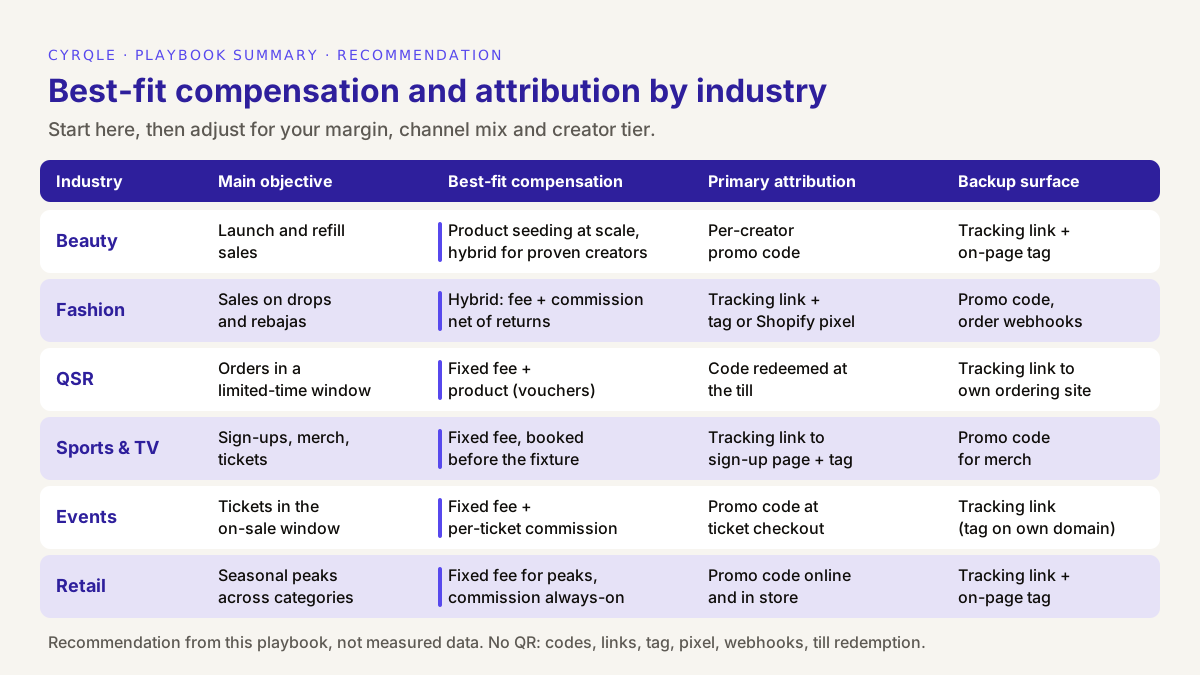
| Main objective | Best-fit compensation | Primary attribution | Typical window | |
|---|---|---|---|---|
| Beauty | Launch and refill sales | Product seeding at scale, hybrid for proven creators | Per-creator promo code, then tracking link and on-page tag | Up to 30 days |
| Fashion | Sales on drops and rebajas | Hybrid: fixed fee plus commission net of returns | Tracking link with on-page tag or Shopify pixel; order webhooks for refunds | 7 to 30 days |
| QSR and restaurants | Orders in a limited-time window | Fixed fee plus product (meal vouchers) | Promo code redeemed at the till; tracking link to your own ordering site | Same day to 7 days |
| Sports and TV | Sign-ups, merch and tickets around fixtures | Fixed fee, booked before the fixture | Tracking link to the sign-up page with on-page tag; promo code for merch | Same session to 7 days |
| Events and ticketing | Tickets in the on-sale window | Fixed fee plus per-ticket commission | Promo code at ticket checkout; tracking link | The on-sale window |
| Retail | Sales across categories on seasonal peaks | Fixed fee for peaks, commission for always-on creators | Promo code online and in store; tracking link with on-page tag | 7 to 30 days |
The windows are planning defaults, not rules. Set your own from your purchase data, and see the guide to measuring creator ROI beyond the discount code for how to read the results.
Beauty: seeding at scale, then pay the creators who sell
Objective. Sales of a launch, then repeat purchases. Beauty buyers try a product because someone they trust used it on camera, and they come back for the refill weeks later.
Compensation that fits. Start with product seeding to a wide group of micro and nano creators. It is cheap per creator and it finds out who can move product. Then move the creators who sell onto a hybrid deal: a fixed fee plus a commission on every sale. Mid-tier and macro creators usually want a fee from the start. The four creator compensation models explains the trade-offs.
Attribution surface. A per-creator promo code is the backbone, because beauty content lives in stories and reels where links are clumsy and viewers often buy days later. Add a tracking link with an on-page tag on your own store for the buyers who click. Use a long window: up to 30 days is reasonable for skincare.
Seasonal moments. Mother's Day (the first Sunday of May in Spain, 10 May in Mexico), summer suncare, Black Friday gift sets, Christmas and Reyes.
Pitfalls.
- Seeding without codes. If seeded creators have no code or link, you cannot tell which ones sold, so you cannot choose who to pay next time.
- Treating gifted product as free of rules. In most markets a gifted collaboration still needs a clear ad disclosure.
- Choosing creators by category tag. A "beauty" creator who posts makeup tutorials may not move a sensitive-skin serum. Check what the audience asks about in the comments.
Read more in creator commerce for beauty brands.
Fashion: hybrid deals, measured after returns
Objective. Sales on a drop or in the rebajas. Fashion lives on short windows: a collection launch, a capsule, the first week of the sales.
Compensation that fits. A hybrid deal: a fixed fee that pays for the content and the timing, plus a commission on sales. Define the commission on revenue net of returns. Fashion return rates are high, and a creator who drives many orders in the wrong size can look great on gross revenue and lose you money.
Attribution surface. A tracking link with an on-page tag on your store, or the Shopify pixel if you sell on Shopify. Fashion buyers click through to browse sizes and colours, so links matter more than in beauty. Back it up with a promo code for buyers who type the URL, and use order webhooks so refunds reduce the attributed revenue.
Seasonal moments. Summer rebajas (traditionally from 1 July in Spain), vuelta al cole, Hot Sale in Mexico, Black Friday, winter rebajas after Reyes. Spanish retailers can choose their own sale dates, because Article 25 of the Ley 7/1996 de Ordenación del Comercio Minorista leaves timing and duration to each retailer, so watch your competitors as well as the traditional dates.
Pitfalls.
- Gross ROAS. See the worked example below.
- Briefing too late for a drop. Creators need the product in hand, in the right size, at least two weeks before the post date.
- Code leakage. Fashion codes travel to coupon sites fast in the sales. Cap uses or time-limit each code.
Read more in creator commerce for fashion and apparel.
QSR and restaurants: local creators, codes at the till
Objective. Orders and visits during a limited-time offer (LTO). The window is days, the audience is local, and most sales happen in the restaurant or in a delivery app.
Compensation that fits. A fixed fee plus product, for example meal vouchers for the creator to share. Commission is hard here: delivery-app orders are not visible to you, and in-store sales are small tickets. Use local micro creators whose audience lives near your restaurants rather than one national name.
Attribution surface. A per-creator promo code that the cashier enters on a redemption page at the till. It needs no point-of-sale integration. For orders on your own website or app, add a tracking link. Codes typed inside third-party delivery apps are usually only visible in that app's own reports, so ask for the export.
Seasonal moments. LTO launches, big football nights, summer terraces, Christmas menus. The World Cup in June and July 2026 is a strong window for food and drink in both markets.
Pitfalls.
- A national creator for a local offer. Reach outside your catchment area is wasted.
- Codes that staff do not know. Brief the restaurant teams, or redemptions go unrecorded.
- No end date on the code. An LTO code that keeps working after the offer ends confuses the results.
Read more in creator marketing for QSR and fast food.
Sports and TV: book early, pay for the moment
Objective. Sign-ups to a streaming service or a membership, merchandise sales and tickets, all concentrated around fixtures and tentpole broadcasts.
Compensation that fits. A fixed fee, agreed well before the fixture. The value is the timing: a creator who posts on the night of the match is worth more than one who posts a week later. Commission-only deals rarely work here, because creators will not hold their best slot for an uncertain return.
Attribution surface. A tracking link to the sign-up or ticket page, with your on-page tag on that page so the visit and the sign-up connect. Add a promo code for merchandise. If your objective is a free trial, measure the trial start and, later, the conversion to paid.
Seasonal moments. The FIFA World Cup 2026 runs from 11 June (opening match at Estadio Azteca in Mexico City) to 19 July (final in New York New Jersey), according to FIFA's match schedule announcement. League starts in August, derbies, finals.
Pitfalls.
- Rights and marks. Tournament names, logos and footage are protected. Unless you are a licensed partner, brief creators not to use official marks or broadcast clips, and check with your lawyer.
- Briefing after the draw. Fixture dates are known months ahead. Contract creators before demand peaks.
- Measuring only clicks. Sign-ups often happen on a second device. Expect the tracking link to undercount.
Read more in creator commerce for sports and TV.
Events and ticketing: the on-sale window decides everything
Objective. Tickets sold during a short on-sale window: the announcement, the general sale, the last call.
Compensation that fits. A fixed fee for the announcement content, plus a commission per ticket sold with the creator's code. The commission keeps the creator posting through the last-call phase, which is when many tickets sell.
Attribution surface. A per-creator promo code at the ticket checkout. Many events sell through third-party ticketing platforms where you cannot install your own tag, so the code is often the only reliable surface. Where you sell on your own domain, add a tracking link and the on-page tag.
Seasonal moments. Spring announcements for the summer festival season, autumn tours, end-of-year shows.
Pitfalls.
- Relying on links when the checkout is not yours. Check before the campaign whether your ticketing partner reports promo codes per order.
- Paying for attendance you cannot measure. A code proves a purchase, not that the buyer walked in. Keep the two apart in your report.
- Starting at the general sale. The announcement is when creators shape demand.
Read more in creator marketing for events and ticketing.
Retail: the seasonal calendar is the brief
Objective. Sales across many categories, concentrated in seasonal peaks: back to school, Black Friday, Christmas, the sales.
Compensation that fits. A fixed fee for peak moments, when you need guaranteed posts on a date. For always-on creators who post about your range all year, a commission on every sale. Retailers with physical stores can mix both.
Attribution surface. Per-creator promo codes that work online and in store (with a cashier redemption page for the store), plus tracking links and an on-page tag for the online shop.
Seasonal moments. All of the calendar below. Retail is the vertical where it matters most.
Pitfalls.
- One brief for every category. A home-goods creator and a fashion creator need different briefs, even in the same Black Friday campaign.
- Codes that stack with sitewide discounts. In Black Friday and Buen Fin, decide in advance whether creator codes stack.
- Measuring only online sales. If you have stores, set up the till redemption before the peak.
Read more in creator commerce for retailers.
When should you start planning creator campaigns in 2026?
Start 8 to 12 weeks before the sales moment for most campaigns, and earlier for tournaments and for Christmas gifting, where products must ship to creators. The calendar below shows the 2026 moments for Spain and Mexico, with a recommended planning start for each.
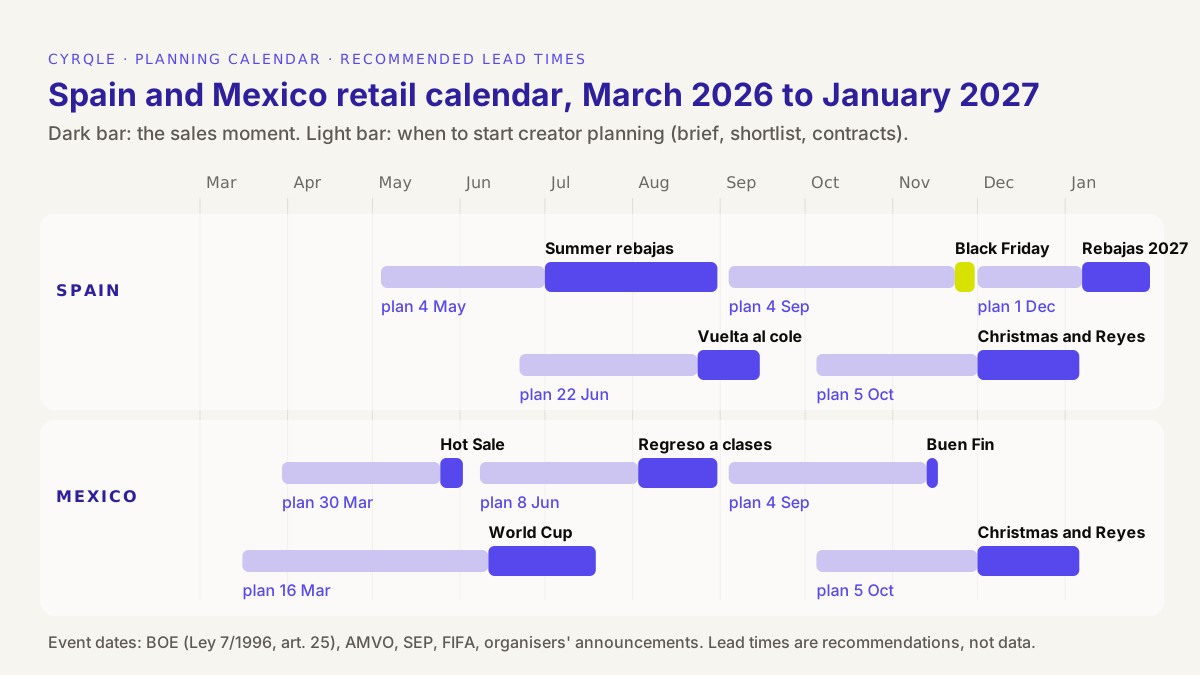
| Moment | Market | 2026 dates | Recommended planning start |
|---|---|---|---|
| Hot Sale | Mexico | 25 May to 2 June (AMVO, as reported by Xataka) | 30 March |
| World Cup | Mexico, Spain | 11 June to 19 July (FIFA) | Mid-March |
| Summer rebajas | Spain | Traditionally from 1 July; each retailer sets its own dates | Early May |
| Regreso a clases | Mexico | School year starts 31 August (SEP, as reported by UnoTV); shopping peaks in August | Early June |
| Vuelta al cole | Spain | Late August to mid-September; school start dates vary by region | Late June |
| Buen Fin | Mexico | 13 to 17 November (Expansión) | Early September |
| Black Friday | Spain, Mexico | 27 November, with Cyber Monday on 30 November | Early September |
| Christmas and Reyes | Spain, Mexico | December to 6 January 2027 | Early October |
| Winter rebajas | Spain | Traditionally from 7 January 2027 | Early December |
The winter rebajas lead time is shorter because the creators and product from your Christmas campaign can be reused. Dates change every year, and some are announced late. Confirm each one with the organiser before you brief creators.
Why these lead times? A creator campaign has fixed steps: write the brief, build the shortlist, send invites, negotiate, sign, ship product, review drafts, then publish. Even a fast team needs four to six weeks for that sequence, and the creators you want are booked by other brands for the same moment. Tentpoles like Black Friday and Buen Fin fall in the same fortnight in Mexico, so brands selling there should plan both together.
Worked example: a fashion rebajas campaign, gross versus net
All figures are illustrative.
A fashion brand in Spain runs a summer rebajas campaign with 10 mid-tier creators. Each creator gets a fixed fee of EUR 600 and a 10% commission. The campaign attributes EUR 24,000 in sales through tracking links, the on-page tag and promo codes. Within 30 days, 30% of that revenue comes back as returns.
| Gross view | Net-of-returns view | |
|---|---|---|
| Attributed revenue | EUR 24,000 | EUR 16,800 |
| Fixed fees (10 x EUR 600) | EUR 6,000 | EUR 6,000 |
| Commission at 10% | EUR 2,400 | EUR 1,680 |
| Total creator cost | EUR 8,400 | EUR 7,680 |
| ROAS | 2.86 | 2.19 |
On gross revenue the campaign looks like a 2.86x return. On revenue after returns it is 2.19x, and individual creators with high return rates can fall below break-even once you look at them one by one. Two lessons: define commission on net revenue in the contract, and judge creators for the next campaign on net results. For more detail on reading these numbers, see the influencer marketing ROI guide.
Pitfalls that cut across every industry
- One code for everyone. A shared campaign code tells you the campaign worked, not which creator did. Give each creator their own code and link.
- No disclosure plan. In Spain, Real Decreto 444/2024 sets obligations for some influencers, and self-regulation codes apply to brands too. Put the disclosure wording in the brief and check it at draft approval. This is not legal advice: for a specific campaign, ask your lawyer.
- Pricing on followers. Compare quotes by expected views and effective CPM. Our influencer rates in Spain for 2026 shows how.
- Paying across borders without a plan. A Mexican creator paid by a Spanish brand raises currency and tax questions. Decide how you will pay before you invite.
How cyrqle helps
cyrqle runs the same loop for every industry. Only the settings change.
- Objective and brief. In Campaigns, you write the brief and pick an objective: Sales, Lead gen, Traffic, Free trial, Booking, UGC, Awareness or Engagement. Find creators then ranks creators against that brief. You decide who to invite.
- Compensation. Set the deal per creator as Cash payment, Commission on every sale, Product gift, or a combination such as Cash & commission. Invites stay blocked until the compensation is complete. Commission owed is calculated and shown in reports; paying it is a separate step. Payouts go to creators in Europe and the US through Stripe Connect, settled in EUR. For creators elsewhere, including Mexico, the brand pays by bank transfer and records it. See compensation and contracts.
- Attribution. Mint a promo code and a tracking link for every creator in bulk. The tag on your store is under 2KB, the Shopify pixel covers hosted checkout, and signed order webhooks from Shopify, WooCommerce and Magento record orders and refunds, so revenue is net of refunds. For restaurants and stores, a cashier redemption page records codes at the till with no point-of-sale integration. Every sale gets a confidence tier (Tier 1 — promo code, Tier 2 — same-session, Tier 3 — cookied later, 30-day window). See creator attribution.
cyrqle does not do QR-code attribution, does not track attendance at events, and does not read codes redeemed inside third-party delivery or ticketing apps. Import those numbers from the partner's report. For a step-by-step setup, follow how to launch your first creator campaign, or book a demo to see it on your category.
More in this series
The industry and seasonal guides that build on this hub:
- Beauty creator playbook: from seeding to attributed sales
- Creator marketing for restaurants and multi-location QSR chains
- Hot Sale Mexico creator campaign playbook
- Planning creator campaigns around the World Cup
- Creator marketing for festivals and venues
- Summer rebajas playbook for fashion brands
- Vuelta al cole creator campaigns for retail
- A 12-week Black Friday creator timeline
- El Buen Fin creator campaigns
- Returns-adjusted ROAS for fashion
- Christmas and Reyes gifting campaigns
- Creator marketing for hotels and travel brands in peak summer
FAQ
Which compensation model works best for influencer marketing?
There is no single best model. It depends on how the sale happens. Use fixed fees when timing matters (sports, events, QSR offers), commission when sales arrive over weeks (fashion, beauty refills, always-on retail), product seeding to test many small creators, and hybrid deals for creators who have already proven they sell.
Can I attribute in-store sales to creators without QR codes?
Yes. Give each creator a promo code and let the cashier enter it on a redemption page at the till. It needs no point-of-sale integration. The limit is staff discipline: brief the store teams, and compare redemptions with the stores' own records.
How far in advance should I plan a Black Friday or Buen Fin creator campaign?
About 12 weeks. That leaves time for the brief, shortlist, negotiation, contracts, product shipping and draft review before creators book other brands. In Mexico, Buen Fin (13 to 17 November 2026) and Black Friday (27 November) fall close together, so plan them as one season.
Do creator codes work on delivery apps and ticketing platforms?
It depends on the platform. Only some delivery and ticketing platforms accept third-party promo codes, and where they do, the data stays with them. A code used in a delivery app or on a third-party ticket checkout shows up in that partner's report, not on your own store. Agree in advance that the partner will export redemptions per code.
Should B2B or high-consideration brands use the same playbook?
Use the same structure, with a longer window and an earlier objective. If the purchase takes months, measure leads, bookings or free trials instead of sales, and pay a fixed fee. Commission is unfair to the creator when the sale closes long after their post.
Sources
- Ley 7/1996, de Ordenación del Comercio Minorista, Article 25 (BOE consolidated text): https://www.boe.es/buscar/act.php?id=BOE-A-1996-1072
- Real Decreto 444/2024 (BOE): https://www.boe.es/buscar/act.php?id=BOE-A-2024-8716
- Hot Sale 2026 dates, organised by AMVO (Xataka México): https://www.xataka.com.mx/seleccion/hot-sale-2026-tiene-fecha-mexico-9-dias-promociones-internet-tiendas-fisicas
- El Buen Fin 2026 dates (Expansión): https://expansion.mx/empresas/2026/10/07/cuando-es-el-buen-fin-2026-fechas
- SEP school calendar 2026-2027 start date (UnoTV): https://www.unotv.com/nacional/cuando-regresan-a-clases-sep-fija-la-fecha-para-iniciar-el-ciclo-escolar-2026-2027/
- FIFA World Cup 26 opening match and final (FIFA): https://inside.fifa.com/media-releases/fifa-world-cup-26-tm-final-to-be-held-in-new-york-new-jersey-mexico-city-to
Related material.
Influencer marketing for restaurants and QSR chains: local creators per outlet, limited-time offers, per-creator codes redeemed at the till, footfall proxies.
Influencer marketing for beauty brands, step by step: seed 100 creators, move the ones who sell to hybrid deals, clear reuse rights, measure repeat purchase.
A practical checklist for your first campaign in cyrqle: drafting the brief, setting compensation and the destination link, choosing deliverables, finding and inviting creators, signing agreements, tracking posts and paying creators.