
Summer sales (rebajas): a creator playbook for fashion brands
Fashion influencer marketing for the summer sale: pick SKUs, brief try-on content, give each creator an expiring code and pay commission only after returns.
A fashion influencer marketing plan for the summer sale works when creators sell specific products, not the sale itself. Brief a short list of SKUs with stock in every size, ask for try-on content that shows fit, give each creator a personal code that expires, and pay commission on revenue after returns. This playbook is for fashion and apparel brands selling in Spain from their own online store.
Rebajas are crowded. In the last week of June, a shopper in Bilbao gets the same "hasta -50%" banner from every chain on her phone. A creator she trusts can tell her which linen shirt fits true to size and which trousers run small. That is a reason to buy from you that a price cut alone does not give. Rebajas also bring returns: shoppers order two sizes and send one back. If you measure creators on gross orders, you can reward the ones who cost you the most.
This guide is part of our creator commerce playbooks by industry. It covers dates and pricing rules, the four-week plan, SKU selection, try-on briefs, codes, get-the-look walls, measurement and when to pay.
When do the summer rebajas start in Spain?
Spanish summer rebajas start when each retailer decides. Article 25 of the Ley 7/1996 de Ordenación del Comercio Minorista says sales can run "in the seasonal periods of greatest commercial interest, at the discretion of each retailer", and each retailer chooses how long they last. The traditional 1 July start is now a habit, not a rule.
In practice the start has moved earlier. As reported by Infobae, in 2025 El Corte Inglés opened online sales on 19 June, H&M on 20 June, Mango in stores on 23 June after a private sale for members, and Zara on the evening of 25 June online, with stores on 26 June. Most sales then run through July and into August in several waves of markdowns.
Three rules from the same law shape what your creators can say:
- The "before" price. When you announce a price cut, Article 20 requires the previous price to appear, and that previous price is "the lowest applied to identical products in the preceding thirty days". A creator who says "it was 59.95, now 29.95" must quote that lowest price.
- Only products already on sale. Article 24 says products that were not previously offered at the ordinary price are not rebajas. A capsule made for the sale cannot be shown as "reduced".
- No damaged goods. Article 26 bans offering damaged items as rebajas.
This is not legal advice: for a specific campaign, ask your lawyer. Paid creator posts also need clear advertising labels; our explainer on Spain's influencer law, Real Decreto 444/2024 covers who it applies to.
The four-week rebajas creator plan
A rebajas creator campaign has four live phases: teaser, launch, second markdown and clearance. Each phase needs different content and a different code window. Preparation starts four to six weeks before your start date, so for a late-June start, book creators in May.
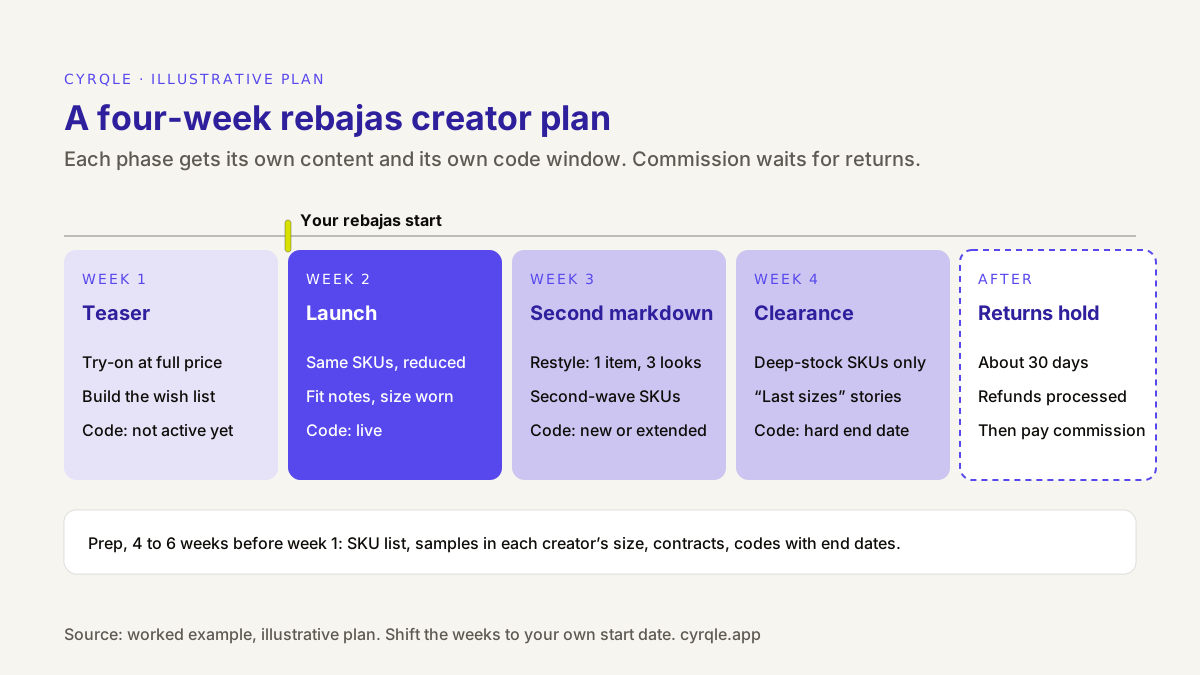
| Phase | When | Creator content | Code | Done when |
|---|---|---|---|---|
| Prep | 4 to 6 weeks before | Brief on the SKU list, ship samples in the creator's size, agree fees and dates | Codes created, end dates set | Every creator has signed and has samples |
| 1. Teaser | 3 to 5 days before your start | Try-on of the briefed SKUs at full price: "this is on my list" | Not active yet | Drafts approved, posts scheduled |
| 2. Launch | Days 1 to 7 | Same SKUs, now reduced. Fit notes, size worn, a link to the product | Active, ends day 7 or day 14 | Codes tested with a real checkout |
| 3. Second markdown | Days 8 to 14 | Restyle: one item, three outfits. Second-wave SKUs | New code or extended end date | Second-wave posts live |
| 4. Clearance | Days 15 to 21 | Only SKUs with stock in most sizes. "Last sizes" stories | Final code, hard end date | Codes expired |
| Returns hold | About 30 days after the last order | None | Expired | Commission calculated on net revenue |
Three notes on the calendar. First, the teaser is a try-on of full-price products, not a discount announcement. It builds a wish list without quoting a price that will change. Second, do not brief clearance content on items with only one or two sizes left: shoppers who cannot find their size return the size they could find. Third, the returns hold is part of the plan. You pay commission when the window closes, not when the order lands.
Which products should creators sell in the rebajas?
Brief creators on 5 to 15 SKUs that you need to move and that have stock across the size curve. A creator who promotes "the sale" sends traffic to the homepage, and you learn nothing about what sold. A creator who promotes three named products drives sell-through you can measure.
Sell-through is units sold divided by units received, over a period. It is the number your merchandising team already watches in rebajas, so it is the clearest way to show what creators did for stock.
How to choose the SKU list:
- Start from the markdown plan. Ask merchandising which lines are behind target before the sale. Those are the lines to brief.
- Check depth by size. A SKU with stock in only XS and XL will not sell through a creator with a size M audience. Brief SKUs with at least four sizes in stock.
- Match the creator's body and style. A creator who wears the product in their own size is more credible than a flat lay. Send samples in their size.
- Hold back the hero lines. Products that sell out at full price do not need creator spend in rebajas.
A worked example: one SKU
All figures are illustrative. A linen shirt arrived in March with 1,200 units. By 24 June it had sold 420, a sell-through of 35%. The target for the end of the sale is 80%, so 540 more units need to sell. In the launch week the shirt sells 260 units, and 70 of those orders carry a creator code or a creator link. Sell-through rises to 57%. Creators account for 27% of that week's units on this SKU, which is the share you report, alongside the sitewide markdown that did the rest.
Sell-through is a stock metric. It tells you the shirt moved. It does not prove that the creator caused the sale, so report it next to attributed revenue, never as a replacement for it.
Why try-on content sells rebajas stock and cuts returns
Try-on content works in rebajas because fit is the question a product page answers worst, and a discount does not settle it. A video where the creator says "I am 1.68 m, I wear an M and this is an M" answers the question the product page cannot.
Write the brief around fit:
- State height and size worn, on screen and in the caption.
- Show movement: sitting, walking, the back view. Static mirror shots hide how fabric falls.
- Compare two sizes when the product runs small or large. This is the most useful content for cutting returns.
- Name the product as it appears on your site, so shoppers find the right one.
- Keep the price claim simple: "now reduced" plus the code, rather than a "before" price that has to match Article 20.
Leave the rest to the creator. A script read aloud sounds like an ad. Fixed facts (product, code, dates, labels) plus the creator's own words sound like advice.
How should you set up creator codes for the rebajas?
Give every creator a personal code with an end date that matches their phase, and decide how the code combines with the markdown. Codes are the most certain way to tie an order to a creator, but they leak to deal sites in sale season, and a code without an end date keeps earning commission long after the post.
Four decisions before launch:
- What the code adds. If the product is already 40% off, a code that adds nothing gives the shopper no reason to type it, and you lose the attribution. Options: an extra 10% on the briefed SKUs only, free shipping, or a gift above a basket value. Check margin on the stacked price first.
- Naming. Creator name plus a sale tag, such as
LUCIA-REBAJAS. Easy to say in a video, easy to read in a report. - End dates. One code per creator, ending with their phase plus two or three days. If you re-brief the creator for clearance, issue a new code or extend the date on purpose.
- Scope. Restrict the code to the briefed SKUs if your store allows it. That protects margin and makes the sell-through link clearer.
Not every buyer types a code. Shoppers who tap the link, compare sizes and pay without a code are only visible through a tracking link and a tag on your store. Our comparison of discount codes, tracking links and pixels explains how to combine them so each order counts once.
Get-the-look walls on product pages
A get-the-look wall puts the creators' try-on posts on your own product pages, so the content keeps working after the post drops out of the feed. In rebajas that matters: a shopper who lands on a reduced product from a banner still sees a real person wearing it, with the size noted.
Practical rules for a rebajas wall:
- Show only posts you have rights to. Creator contracts should grant use on your site. Organic customer posts need a separate licence.
- Tag each post to the product and variant. A shopper who taps the shirt should land on the shirt, in the colour shown.
- Take sold-out items off. A wall full of products in no available size frustrates the shopper and sends returns up.
- Measure the wall on its own scoreboard. Wall views, product clicks and engagement show whether shoppers use the content. They are not sales attribution.
Our guides to shoppable walls on product pages and measuring on-site UGC cover formats and metrics in detail.
How do you measure a rebajas creator campaign?
Measure three things separately: sell-through of the briefed SKUs, attributed revenue net of returns, and wall engagement. Each answers a different question, and combining them into one number hides the trade-offs.
| Scoreboard | Question it answers | Source | Trap |
|---|---|---|---|
| Sell-through of briefed SKUs | Did the stock we needed to move, move? | Your inventory system | Sitewide markdown moves stock too; it does not prove creator effect |
| Attributed revenue, net of returns | Which creators drove orders that stayed sold? | Codes, tracking links, store tag, order and refund webhooks | Gross revenue rewards creators whose buyers order two sizes |
| Wall engagement | Do shoppers use creator content on product pages? | Wall analytics: views, product clicks | Engagement is not a sale |
Why gross orders mislead in fashion
In rebajas, a creator with a large audience and a vague size guide can top the order chart and the return chart at the same time. Look at returns per creator before you rank anyone.
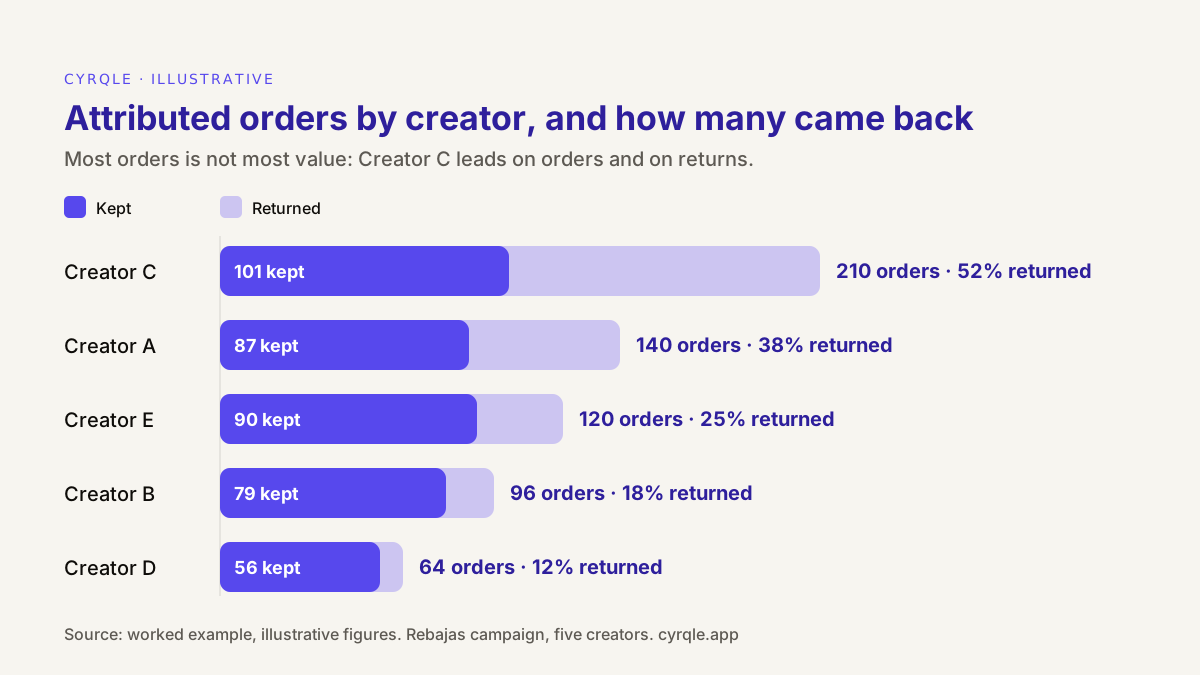
A worked example: five creators, commission after returns
All figures are illustrative. A Spanish fashion brand runs five creators through the rebajas. Average order value is EUR 55. Each creator has a fixed fee and a 10% commission. To keep the maths simple, a return here is a whole order.
| Creator | Orders | Returned | Kept orders | Gross revenue | Net revenue | Fixed fee | ROAS on gross | ROAS on net |
|---|---|---|---|---|---|---|---|---|
| A | 140 | 38% | 87 | EUR 7,700 | EUR 4,785 | EUR 800 | 4.90x | 3.74x |
| B | 96 | 18% | 79 | EUR 5,280 | EUR 4,345 | EUR 500 | 5.14x | 4.65x |
| C | 210 | 52% | 101 | EUR 11,550 | EUR 5,555 | EUR 1,500 | 4.35x | 2.70x |
| D | 64 | 12% | 56 | EUR 3,520 | EUR 3,080 | EUR 300 | 5.40x | 5.07x |
| E | 120 | 25% | 90 | EUR 6,600 | EUR 4,950 | EUR 600 | 5.24x | 4.52x |
ROAS = revenue divided by (fixed fee + 10% commission on that revenue).
Three lessons from the table:
- Creator C leads on orders and drops to last on net ROAS. More than half of their buyers sent the product back. Ask whether their content showed fit, and brief size comparisons next time before you cut them.
- Creator D is the smallest and the most efficient. A low return rate usually means the audience trusted the fit information. That is a creator to rebook for the winter sales.
- Commission on gross overpays. At 10%, commission on gross revenue is EUR 3,465. On net revenue it is EUR 2,271.50. Paying on gross would cost about EUR 1,190 for orders that came back.
For the full ROI method, including margin, see how to measure influencer marketing ROI beyond the discount code.
When should you pay commission on rebajas sales?
Pay commission after the return window has closed and refunds are processed, and calculate it on revenue net of returns. Write that rule into the contract before the campaign, so the creator knows when to expect it.
In Spain, an online shopper can withdraw from a purchase within 14 calendar days of receiving the goods, under Articles 102 and 104 of the consumer protection law (Real Decreto Legislativo 1/2007). The seller then has up to 14 days to refund (Article 107). Many fashion brands offer longer return periods than the legal minimum, especially in sale season. Add those together and a commission hold of about 30 days after the last order is a reasonable starting point; set it to your own returns policy plus delivery time.
A clean structure for the contract:
- Fixed fee on delivery of the agreed posts, because it pays for content and timing.
- Commission on net revenue from orders placed with the creator's code or link during the code's active dates.
- Settlement date: the end of the return window after the last eligible order.
- Leakage clause: orders from a code shared on a deal site still count, but you can agree that commission stops once a leak is reported and the code is replaced.
How cyrqle helps
cyrqle runs this playbook in one workspace, in Spanish or English. For the fashion view of the platform, see creator commerce for fashion brands.
- Brief and contract. In Campaigns, write the brief with the SKU list and fit instructions, invite creators and get the Creator Collaboration Agreement signed by both sides. Content-wall use is always granted under that agreement. The draft check flags missing required hashtags and handles before a post goes live.
- Codes and attribution. In Attribution, mint a promo code and a tracking link per creator in bulk. A tag under 2KB on your store, the Shopify pixel and signed order webhooks from Shopify, WooCommerce or Magento tie orders to creators. Each sale gets a tier: Tier 1 — promo code, Tier 2 — same-session or Tier 3 — cookied later. Attributed revenue is net of refunds, so returns lower the creator's number when the refund comes through. On Shopify, cyrqle can create the matching discount in your store if you paste an Admin API token; set the code's end date and product scope in your store.
- Get-the-look walls. In Content walls, build a content wall with a get-the-look rail or a product page wall, tag each post to a product and variant, and embed it on your store. A wall only shows a post while an active licence exists. Wall analytics report composition, engagement and product clicks, kept apart from attributed revenue.
- Commission and payouts. Commission owed is calculated and shown in reports. It is not paid automatically: a person triggers each payout, which is how you hold commission until returns are in. Creators in Europe and the US are paid through Stripe Connect in EUR; see compensation and payouts.
Sell-through comes from your own inventory system; cyrqle does not track stock. Put the two side by side in your report. To set up the wall on your store, follow how to embed a content wall on Shopify, or book a demo to see the flow on a fashion campaign.
FAQ
When do summer sales start in Spain in 2026?
Each retailer chooses. Article 25 of Ley 7/1996 leaves the dates and length of rebajas to the retailer. In 2025 the large chains started between 19 and 26 June, earlier than the traditional 1 July, so plan your creators for your own start date and watch your competitors.
Should creators announce the rebajas before they start?
Use the days before the sale for try-on content of the products at full price, so shoppers build a wish list. Do not quote a sale price before it is live, and when a creator quotes a "before" price, it must be the lowest of the previous 30 days.
How long should a creator discount code last?
Match the code to the creator's phase plus two or three days. An open-ended code keeps earning commission long after the post and leaks to deal sites. Issue a new code if you re-brief the creator for clearance.
Should I pay commission on gross or net revenue?
Net of returns. Fashion orders often come back, and commission on gross revenue pays creators for products that came back. Settle after the return window closes and write the rule into the contract.
Do get-the-look walls count as creator sales?
No. A wall shows whether shoppers use creator content on product pages: views, product clicks, engagement. A sale is attributed to a creator through their code, their link and the store tag. Report the two separately.
Sources
- Ley 7/1996, de 15 de enero, de Ordenación del Comercio Minorista, consolidated text, Articles 20, 24, 25 and 26: boe.es
- Real Decreto Legislativo 1/2007, consumer protection law, consolidated text, Articles 102, 104 and 107: boe.es
- Infobae, start times of the 2025 summer sales at Zara, Mango, H&M, Pull&Bear and El Corte Inglés (25 June 2025): infobae.com
Related field notes.
Buen Fin influencer marketing in six weeks: book Mexican creators, give each a promo code, label every post as advertising and record bank-transfer payouts.
Influencer marketing for hotels: local vs destination creators, free stays as ads, booking-engine codes, long attribution windows and shoulder-season reuse.
Hot Sale Mexico influencer marketing, step by step: pick Mexican creators, give each a promo code, land sales on your own store and measure by confidence tier.