
Creator marketing for hotels and travel brands in peak summer
Influencer marketing for hotels: local vs destination creators, free stays as ads, booking-engine codes, long attribution windows and shoulder-season reuse.
Influencer marketing for hotels works best as a booking campaign, not a visibility campaign. Choose creators by where their audience lives and travels from, track every creator with a promo code that your booking engine accepts, and measure over a long window, because guests book weeks after they see a post. Then reuse the rights-cleared content to sell the shoulder season.
Picture a 40-room boutique hotel in Menorca, a family resort on the Costa Blanca, a rural hotel in Asturias, or a tour operator selling Riviera Maya packages from Madrid. Each one has the same problem in summer: creators ask for free stays, posts look beautiful, and nobody can say how many rooms they sold. The fix is mostly operational. It needs the right creator mix, a code in the booking engine, a reporting window that matches how people plan trips, and a contract that lets you use the content after August.
This playbook is for hotels, resorts, rural accommodation, travel agencies and tour operators selling in Spain, the EU and Latin America. The tax and disclosure sections are not legal or tax advice: for a specific deal, ask your lawyer or gestor.
Why does summer need its own creator plan?
Spain had a record 96.8 million international tourists in 2025, according to INE, and domestic travellers fill the coast in July and August on top of that. Demand is high, but so is noise. Every property is posting the same pool, the same sunset and the same breakfast tray.
High demand changes the creator maths in two ways. First, a free room in August has a real cost: if you are full, a creator's room is a room you could have sold. Second, the bookings that creator content drives in summer are often for later dates, such as September, a long weekend in October or next Easter. Plan the season as a booking campaign with a long tail, not as a burst of posts. For how travel compares with beauty, fashion, QSR and events, see our creator commerce playbooks by industry.
Local creators or destination creators?
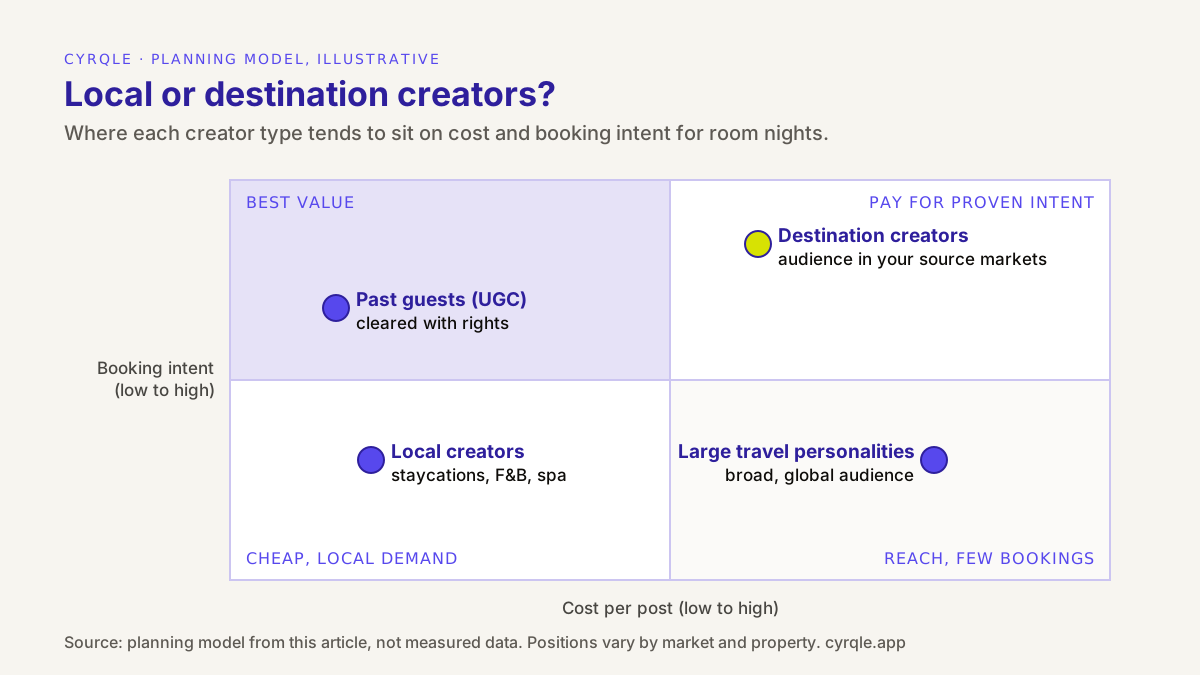
A local creator lives near your property and has a mostly local audience. A destination creator travels to places and has an audience in the cities your guests come from. For room nights, destination creators usually carry more booking intent; for food, spa, day passes and staycations, local creators are cheaper and often better.
| Local creators | Destination creators | |
|---|---|---|
| Where the audience lives | Mostly near the property | In the cities and countries guests travel from |
| Best for | Restaurant, spa, rooftop, day passes, staycations, events | Room nights, packages, multi-night stays |
| Typical deal | Small fee, meal or experience; often repeatable | Fee plus a stay, travel sometimes included |
| Booking lag | Short: same week for food and spa | Long: weeks to months for stays |
| Content reuse value | High for local channels and F&B pages | High for rooms, landing pages and shoulder-season campaigns |
| Main risk | Audience cannot book nights; they live there | Audience is broad and not in your source markets |
| How to check fit | Ask for audience city split from Instagram or TikTok insights | Ask for audience country split; compare with your guest origin data |
Two checks matter more than follower count. The first is audience location: ask each creator for a screenshot of the country and city split in their platform insights, and compare it with where your guests actually come from in your property management system. The second is past collaborations: a creator who has worked with three hotels in the same island in one summer is selling the same audience three times. Our post on choosing creators by views and effective CPM covers why median views are a better size signal than followers.
Past guests are the fourth group. A guest who posts a reel from your pool is not a creator under contract, but their content is often the most believable you will get. You can reuse it only with permission (see the reuse section below).
How long after a creator post do bookings arrive?
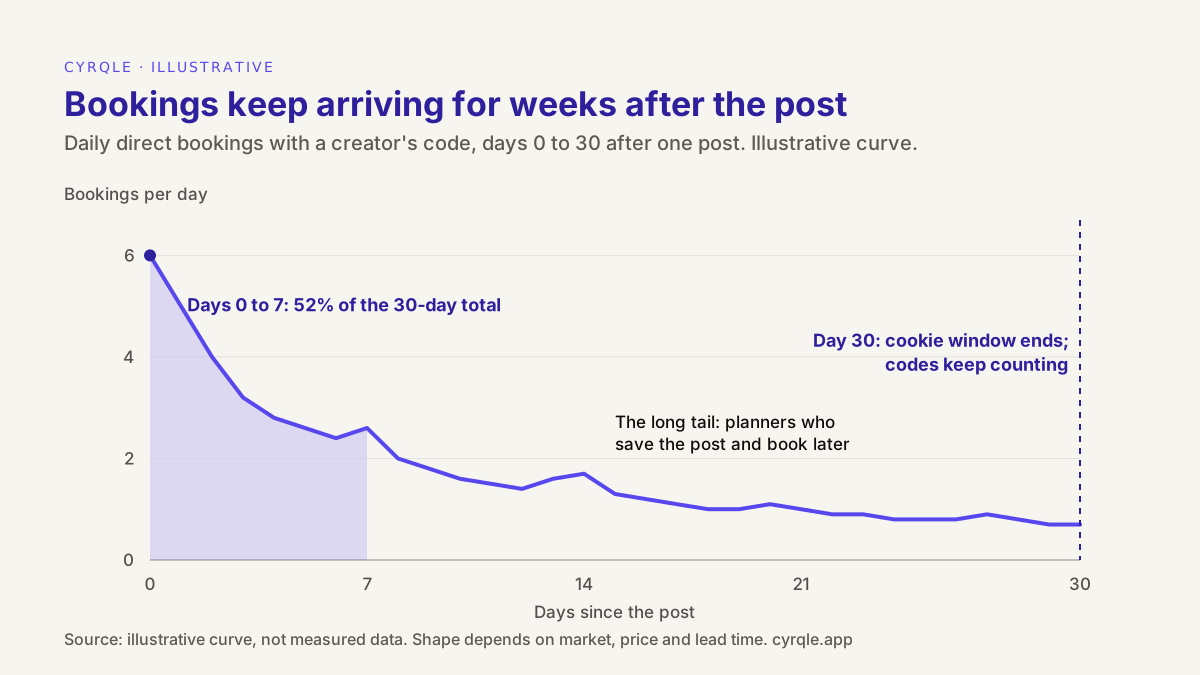
Travel bookings arrive later than almost any other purchase. People see a post, save it, talk to a partner, check dates and book days or weeks later. The time you allow between the post and the booking is your lookback window for crediting a creator, and for stays it should be long.
What that means for reporting:
- Report a creator at day 7, day 30 and day 90. A day-7 report under-credits stays. Agree with the creator up front that commission, if any, is settled at day 90.
- Codes do not expire with a cookie. A promo code is credited whenever it is used. A click tracked by a cookie is only credited inside the cookie window. For stays booked long after the post, the code is the signal that survives.
- Separate booking date from stay date. Revenue for an October stay booked in July belongs to the July campaign. Count it when the booking is made, then adjust for cancellations when the stay happens.
- Net out cancellations. Free-cancellation rates are common in hotels. Report gross bookings and net stays as two lines.
Our post on discount codes vs tracking links vs pixels explains what each method can and cannot prove.
How do you track bookings through a booking engine?
Most hotels take direct bookings through a third-party booking engine, often on a separate domain or subdomain from the main website. That decides what you can track. The most reliable per-creator signal is a promo code set up inside the booking engine, plus an export of reservations that shows which code each one used.
| Surface | How it works for a hotel | What it proves | Limit |
|---|---|---|---|
| Promo code in the booking engine | One code per creator, set up as a rate or discount code | A booking used that creator's code | Leaks to coupon sites; cap or time-limit it |
| Tracking link to your website | One link per creator, landing on a room or offer page | A click from that creator reached your site | If the booking engine is on another domain and does not allow your tag, the order is not tied to the click |
| Reservation export | CSV of bookings from the booking engine or PMS, with the code field | Revenue, nights and cancellations per code | Manual or scheduled; someone has to own it |
| Phone, email and front desk | Staff ask "do you have a code?" and log it | Offline bookings from a creator | Depends on staff discipline |
| On-property redemption | The guest shows the code at the restaurant, spa or bar | Local creators drove a visit | Not a room night |
Practical steps before the first post goes live:
- Create the codes in the booking engine first. Check that the code field appears in the reservation export. If it does not, fix that before you brief anyone.
- Give every code the same benefit. A different discount per creator makes the comparison meaningless. A fixed perk (late checkout, breakfast, a drink on arrival) leaks less than a percentage off.
- Point tracking links at the offer page, not the home page. Add UTM parameters so your website analytics see the source too.
- Steer guests to direct booking. Bookings made through online travel agencies do not carry your codes. A direct-only perk gives the guest a reason to book with you, and gives you the data.
Is a free stay payment?
Yes. A free stay given in exchange for content is consideration, so the post is advertising, and for a professional creator it is income. Three rules apply in Spain.
Disclosure. Norm 5 of the AUTOCONTROL influencer code lists the free supply of a service, "including complementary ones such as ... accommodation or meals", and trips among the forms of consideration, next to payment and free product. Content that promotes a product or service and is published in exchange for any of these is advertising (norm 4), so the post needs a clear label such as "publicidad" or the platform's paid-partnership tool at the start. Source: AUTOCONTROL, aea and IAB Spain, Código de Conducta de Publicidad a través de Influencers (2025). The legal duty behind it is article 26 of Ley 3/1991 de Competencia Desleal. Our guide to the AUTOCONTROL influencer code covers labels in detail.
Income tax. When a business pays a professional in kind, Article 104 of the IRPF regulation (Real Decreto 439/2007) requires a payment on account (ingreso a cuenta): the withholding percentage applied to the market value of what was given. A three-night stay with a market value of EUR 540, given to a creator taxed at 15%, means EUR 81 that the hotel pays to the Agencia Tributaria, even though no cash moved.
IVA. When a service is paid for in kind, the taxable base is the value in money (Article 79 of Ley 37/1992). The creator may owe IVA on their content service, and the hotel may owe IVA on the stay it supplied; hotel accommodation is on the reduced-rate list in Article 91 of the same law. Ask your gestor how to document it.
Our guide on paying influencers in Spain walks through withholding, IVA and invoices for each type of payee. Write the stay into the contract with its market value, dates and room type, the same way you would write a fee.
Worked example: a boutique hotel in Menorca
The figures below are illustrative. A 40-room hotel sells direct at an average of EUR 180 a night, with an average stay of four nights. Creator codes give 10% off direct bookings, so each code booking is worth EUR 648.
- 2 destination creators based in Madrid and Barcelona: EUR 1,500 fee each, plus a three-night stay each (market value EUR 540 each).
- 6 local creators on the island: EUR 250 fee each, plus dinner for two (market value EUR 120 each).
- All creators are Spanish professionals taxed at 15%.
| Line | Illustrative amount |
|---|---|
| Cash fees (2 x EUR 1,500 + 6 x EUR 250) | EUR 4,500 |
| Stays and dinners at market value | EUR 1,800 |
| Payment on account on in-kind value (15%) | EUR 270 |
| Total cost | EUR 6,570 |
| Code bookings by day 7 | 22 |
| Code bookings by day 30 | 40 |
| Code bookings by day 90 | 54 |
| ROAS at day 7 (22 x EUR 648) | 2.2 |
| ROAS at day 30 (40 x EUR 648) | 3.9 |
| ROAS at day 90 (54 x EUR 648) | 5.3 |
| Cost per booking at day 90 | EUR 122 |
The same campaign looks weak at day 7 and strong at day 90. That is the whole case for a long window in travel.
Three judgement calls change the result. First, the value of the free rooms: in a full August they displace paying guests, so count them at market value; in June or September their real cost is closer to cleaning and breakfast. Host creators on lower-occupancy dates when you can, since the light and the water still look like summer. Second, cancellations: report net stays as well as gross bookings. Third, incrementality: some code users would have booked anyway, and codes leak. Treat the ROAS as an upper bound. Our guide to measuring creator ROI covers how to discount for both.
How do you reuse summer content in the shoulder season?
Content shot in July is most valuable in September, October and the spring, when rooms are harder to fill and nobody is producing new content for you. Reuse needs rights you agreed before the shoot, not after.
Write these into every summer contract:
- Channels. Your website, room and offer pages, email, own social accounts, a wall on the booking landing page. List them.
- Paid ads, separately. Boosting a creator's reel as an ad is a bigger use. Ask for it as a separate right with its own fee.
- Term. Long enough to cover the shoulder season and next spring, for example 18 months.
- Markets. The source markets you will advertise in, not just Spain.
- Raw files. Ask for the unedited clips and photos as a deliverable if you want to cut your own versions.
For how much to pay for longer terms or exclusivity, use our usage rights pricing calculator. Guest posts follow the same logic with a different start: collect posts that tag your property, ask each guest for permission, and publish only what was cleared.
A peak-summer timeline for hotels
| When | What to do |
|---|---|
| April to May | Shortlist destination and local creators; check audience location; set up codes in the booking engine |
| Late May to June | Sign contracts with rights and in-kind values; host destination creators on lower-occupancy dates |
| June to August | Posts go live; weekly code report; local creators cover F&B and events |
| August to September | Request rights from guest posts; build shoulder-season pages with cleared content |
| September to October | Day-90 report per creator; settle any commission on net stays |
| October to March | Reuse content for autumn breaks and next Easter; rebook creators who sold |
For another tentpole calendar built the same way, see our festival season creator playbook.
How cyrqle helps
cyrqle runs the creator side of a hotel campaign in one workspace. It does not replace your booking engine or property management system, and it does not read bookings inside them; you import those.
- Find the right creators. In Find creators, search by meaning across captions and visuals, for example "family beach holiday Menorca" or "rural hotel Asturias hiking". Creator profiles show engagement, content mix and brand-collaboration history, so you can see which creators already worked with nearby hotels. cyrqle does not filter by where a creator's audience lives, so ask creators for their audience split.
- Brief with a Booking objective. In Campaigns, create the brief and choose Booking as the objective; cyrqle ranks creators against it and you decide who to invite. Set each deal as Cash payment, Product gift or a mix, and write the stay into the offer. Creators sign the Creator Collaboration Agreement in-platform; content-wall and campaign use are always granted, and paid-ads use only if you tick it.
- Codes, links and bookings. In creator attribution, mint a promo code and a tracking link per creator in bulk and export them to set up in your booking engine. The tag on your website (under 2KB) ties clicks to orders where it can run. For bookings made inside a third-party booking engine, import them with Record offline-attributed sale. Code sales are Tier 1 — promo code and are credited whenever they happen; Tier 3 — cookied later uses a 30-day window, so for long-lag stays, rely on codes.
- Reuse for the shoulder season. Collect guest posts with a UGC collector, request rights from the post card, and put cleared content on your offer pages with content walls. A wall shows a post only while its licence is active.
The creator marketing page for travel and hotels gives the vertical overview. To see it on your own property, book a 30-minute walkthrough.
FAQ
Should a hotel pay creators or only offer a free stay?
Offer a stay alone only to small creators where the content is the main goal. For creators you expect to sell rooms, pay a fee as well, because the stay alone rarely covers their time. Either way the stay is payment: the post needs an ad label and the stay goes into the contract with its value.
What attribution window should a hotel use for creators?
Use 60 to 90 days for room nights and 7 to 14 days for restaurant, spa and day-pass offers. Report at day 7, 30 and 90 so you can see the curve. Promo codes are the most reliable signal over long windows, because they do not depend on a cookie.
Do creator codes work with online travel agencies?
Generally no. Bookings made through an online travel agency do not carry your direct-booking code. Give creators a direct-only perk so their audience books with you, and treat any rise in OTA bookings during the campaign as a signal, not as attributed revenue.
Can I use a creator's summer reel in ads next spring?
Only if the contract grants paid-ads use for that period and those markets. Owned channels and paid ads are different permissions. Agree both, with a term that covers the next season, before the creator arrives.
Is a tour operator or travel agency different from a hotel?
The method is the same: destination creators, codes, long windows and reuse rights. The difference is the booking value and lag, which are both higher for packages, so use the longer end of the window and expect fewer, larger bookings per creator.
Sources
- INE, Frontur (international tourist arrivals), December 2025 release: ine.es
- AUTOCONTROL, aea and IAB Spain, Código de Conducta de Publicidad a través de Influencers (2025), norms 4 and 5: autocontrol.es
- Ley 3/1991 de Competencia Desleal, article 26: BOE-A-1991-628
- Real Decreto 439/2007, Reglamento del IRPF, article 104: BOE-A-2007-6820
- Ley 37/1992, del IVA, articles 79 and 91: BOE-A-1992-28740
Legal sources checked on 15 July 2026. Tax and advertising rules change; re-check before each season.
Related field notes.
Buen Fin influencer marketing in six weeks: book Mexican creators, give each a promo code, label every post as advertising and record bank-transfer payouts.
Fashion influencer marketing for the summer sale: pick SKUs, brief try-on content, give each creator an expiring code and pay commission only after returns.
Hot Sale Mexico influencer marketing, step by step: pick Mexican creators, give each a promo code, land sales on your own store and measure by confidence tier.