
Hot Sale Mexico: a creator campaign playbook for brands
Hot Sale Mexico influencer marketing, step by step: pick Mexican creators, give each a promo code, land sales on your own store and measure by confidence tier.
To run influencer marketing for Hot Sale Mexico, book Mexican creators about six weeks before the sale and give each one a personal promo code and tracking link. Send their traffic to your own online store, not a marketplace, and judge the result by how sure you are of each sale. This playbook is for ecommerce and D2C brands, many of them based in Spain or elsewhere in Europe, that sell into Mexico.
Hot Sale is crowded. Hundreds of brands cut prices on the same nine days, and every shopper in Monterrey or Guadalajara sees the same banners. A creator who already has their audience's trust can cut through that noise. If the sales land where you cannot see them, though, you will not know whether it worked. The plan below covers the calendar, creator selection, codes, where checkout happens, measurement, payouts and disclosure.
This is one of our seasonal guides. For the full set by vertical, see the creator commerce playbooks by industry.
When is Hot Sale 2026, and why plan creators around it?
Hot Sale 2026 runs from 25 May to 2 June 2026: nine days of online offers, with some retailers also running deals in physical stores. The Asociación Mexicana de Venta Online (AMVO) has organised it since 2014 and confirms the dates each spring on hotsale.com.mx. Check that site before you lock your calendar for a future edition.
The size of the event is why it is worth planning for. AMVO's results for the 2025 edition, as reported by Milenio, were as follows:
The same report says that 6 in 10 shoppers bought only through digital channels, and 3 in 10 used a mix of online and store. For a brand, that means two things. Demand is there. And so is the competition for attention: every participant is shouting "descuento" at the same time. Creator content works here because it gives the shopper a reason to choose your product, not only a lower price.
The six-week Hot Sale creator plan
Six weeks before the sale is the latest comfortable start for a first creator campaign in Mexico. Creators with real audiences book up before big sale events, contracts take a few days, and drafts need at least one round of changes. Plan backwards from 25 May.
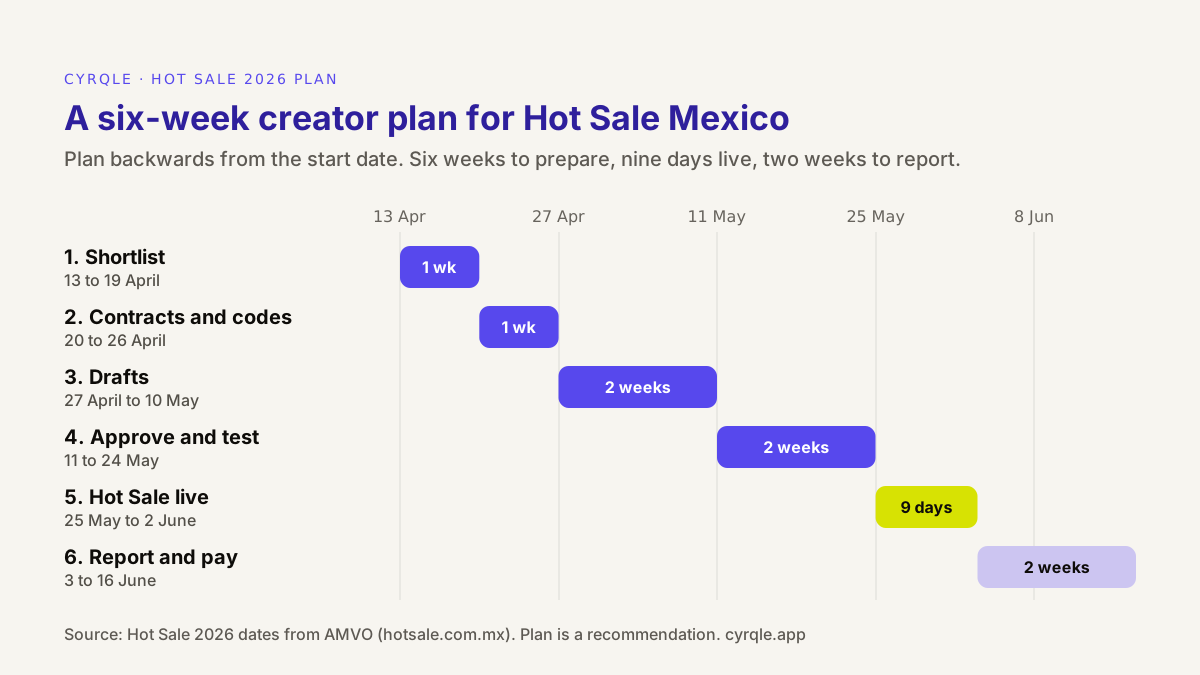
| Week | Dates (2026) | What happens | Done when |
|---|---|---|---|
| 1 | 13 to 19 April | Write the brief. Build a shortlist of 2 to 3 times the creators you need | Shortlist priced on expected views |
| 2 | 20 to 26 April | Send offers, agree fees, sign contracts, create a promo code and tracking link per creator | Every creator has signed and has their code |
| 3 to 4 | 27 April to 10 May | Products shipped, creators film, first drafts arrive | All drafts in |
| 5 to 6 | 11 to 24 May | Approve drafts, check disclosure, test every code and link on the live store, agree posting slots | Each code tested with a real checkout |
| Live | 25 May to 2 June | Posts go live. Watch sales by creator daily. Reshare the content that works | All posts published |
| Report | 3 to 16 June | Wait for returns and refunds, then report by confidence tier and pay creators | Report sent, payouts recorded |
Two tips for the calendar. First, spread posting across the nine days. Day one is the loudest, and a second wave on the final weekend often catches people who waited. Second, leave the report until returns have had time to arrive. A fashion order returned on 10 June is not a sale.
How do you choose creators for the Mexican market?
Choose creators who live in Mexico, post in Mexican Spanish and already talk about your category. Then price them on how many people see their recent posts. A Spanish creator with a big following in Madrid is not a Mexico creator, even though both speak Spanish.
Language and place matter more than follower count
Mexican Spanish differs from the Spanish spoken in Spain in vocabulary, humour and how people talk about prices and promotions. A brief written in Spain Spanish and read aloud by a creator in Mexico City sounds wrong to the audience. Write the brief in Mexican Spanish, or let the creator rewrite the script in their own words, and keep only the facts fixed: product, code, dates, disclosure.
Check where the creator lives and what they post about, not only what language they use. Look for recent posts that show local places, local stores and the Hot Sale itself in past years. If the audience's location matters for your deal, ask the creator for a screenshot of their audience insights, by country and city. Ask for it before you sign.
Our spring 2026 field notes on the LATAM creator market and the LATAM creator commerce 2026 report give more background on why a Spanish-first approach matters across Latin America.
Price on median views, not followers
Take the last 10 to 20 posts and use the median view count. Divide the fee by expected views and multiply by 1,000 to get an effective CPM. That makes a 30,000-follower creator in Puebla comparable with a 400,000-follower creator in Mexico City. Compare creators on effective CPM, not follower count, and keep the same view window for everyone.
Shortlist more than you need
During sale season, some creators will be booked, some will ask for more, and some will not reply. A shortlist of 2 to 3 times your target roster keeps week 2 on schedule.
How should you set up promo codes for Hot Sale?
Give every creator a unique promo code and a unique tracking link. Decide in advance how the code combines with your sitewide Hot Sale discount. A code is the most certain way to tie an order to a creator, which is why attributing sales by promo code sits at the top of most measurement plans. It needs three decisions before launch.
- Stacking. If your store already shows 30% off for Hot Sale, does the creator code add 10% more, unlock a gift, or give free shipping? An extra that does not stack with the sitewide price gives the shopper no reason to type the code, and you lose the attribution.
- Naming. Use the creator's name or handle plus a short sale tag, for example
ANA-HOTSALE. It is easy to say in a video and easy to read in a report. Avoid codes that clash across creators. - Leakage and limits. Codes get posted on deal-sharing sites during big sales. Set a start and end date, a usage limit if your margin needs one, and check the deal sites during the sale. A code that leaked still counts in reports, so note it, and judge the creator on the period before the leak.
The tracking link matters too. Some shoppers click the link in bio, buy in the same session and never type the code. Without a link and an on-site tag, those orders are invisible.
Where should Hot Sale creator sales land?
Send creator traffic to your own online store whenever you can. On your own store you can see the code, the click and the order, so each sale can carry a confidence tier. On a marketplace you usually see much less, and in a physical store you only see a sale if the cashier records the code.
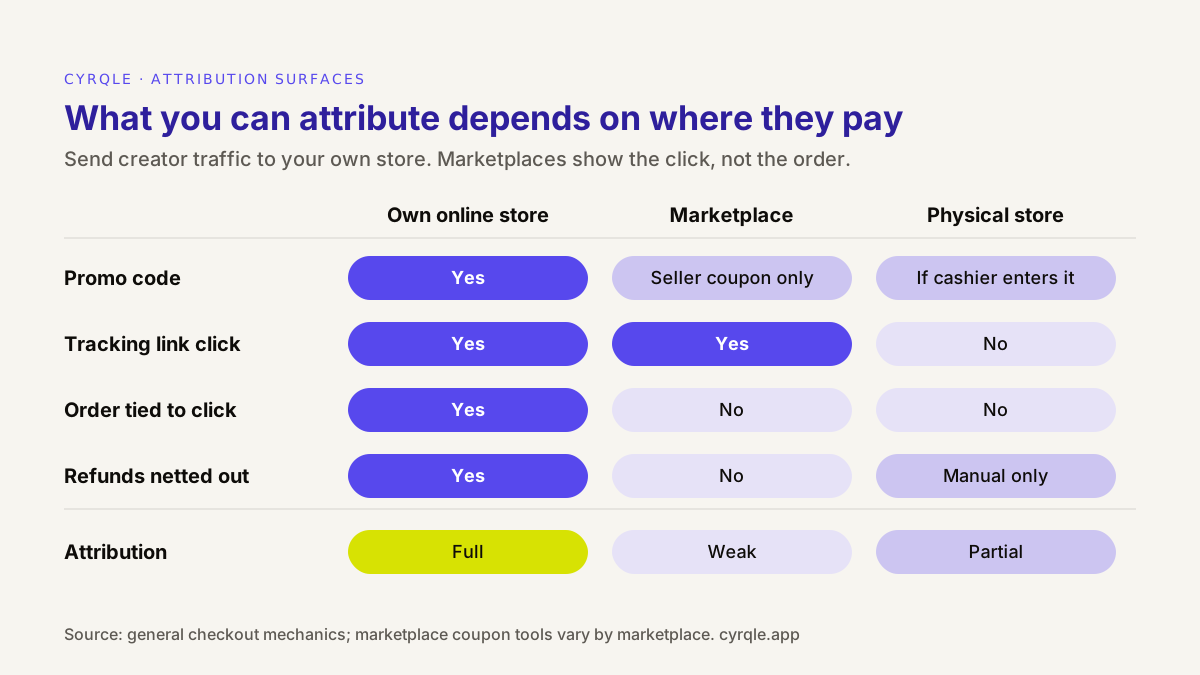
| Own online store | Marketplace | Physical store | |
|---|---|---|---|
| Promo code | Yes: read from the order | Only if the marketplace lets you issue a seller coupon, and you read results in the marketplace's own reports | Yes, if the cashier enters the code |
| Tracking link click | Yes | Yes, the click to the listing | No |
| Order tied to the click | Yes, with an on-site tag or store pixel | No: the checkout is the marketplace's | No |
| Refunds netted out | Yes, with order and refund webhooks | No | Only if recorded by hand |
| Customer data you keep | Yes | Little or none | Depends on your till |
| Best use in Hot Sale | Main destination for creator traffic | Reach and trust, not measurement | Omnichannel brands; train staff on the code |
Many brands sell on Mercado Libre or Amazon in Mexico as well as on their own site, and the marketplace may convert better during Hot Sale. That is a fair trade-off. If you send creators to a marketplace, accept that you will measure them on clicks and on the overall change in marketplace sales, not on attributed orders. A good compromise is to send the creator link to your own store and leave the marketplace as the default for everyone else. For D2C brands this is usually the right call; see creator commerce for D2C brands for the wider model.
How do you measure Hot Sale creator results?
Measure each creator on net revenue (after refunds) by confidence tier, then compare cost with the revenue you are sure of and with the revenue you think is likely. A single blended ROAS hides how much of the result rests on a cookie.
There are three tiers, from most to least certain:
- Tier 1, promo code: the shopper typed the creator's code. Very high confidence.
- Tier 2, same session: the shopper clicked the creator's link and bought in the same visit, without the code.
- Tier 3, cookied later: the shopper clicked the link and came back within 30 days to buy.
A worked example
A Spanish skincare brand sells into Mexico from its own Shopify store. It runs 8 Mexican creators for Hot Sale 2026. All figures are illustrative, converted to EUR for comparison.
| Item | Amount |
|---|---|
| 2 mid-size creators at EUR 1,200 each | EUR 2,400 |
| 6 micro creators at EUR 400 each | EUR 2,400 |
| Product sent to creators | EUR 600 |
| Total cost | EUR 5,400 |
| Tier 1, promo code (net of refunds) | EUR 9,800 |
| Tier 2, same session | EUR 3,900 |
| Tier 3, cookied later | EUR 2,700 |
| Total attributed revenue | EUR 16,400 |
| View | Revenue | ROAS |
|---|---|---|
| Tier 1 only | EUR 9,800 | 1.81x |
| Tiers 1 and 2 | EUR 13,700 | 2.54x |
| All tiers | EUR 16,400 | 3.04x |
With a 50% gross margin, the brand needs EUR 10,800 of revenue to break even on EUR 5,400 of cost. Code sales alone fall just short. Code plus same-session sales clear it with room to spare. So the campaign paid back on evidence the brand can defend, without relying on the cookied tier. The weaker the tier, the more cautious your claim should be. Our guide to measuring influencer marketing ROI beyond the discount code explains how to turn these tiers into ROI after margin.
Look at each creator separately too. Hot Sale traffic is spiky. A creator who drove most of their sales on day one may be worth booking again for El Buen Fin in November. A creator whose code leaked to a deal site needs a second look before you rebook.
How do you pay creators in Mexico?
Pay Mexican creators by bank transfer, and record each payment against the deal. Stripe Connect payouts, including those in cyrqle, cover creators in Europe and the US, not Mexico. Plan for this from the start and not after the campaign.
Practical points:
- Agree the currency in the contract. If you agree the fee in pesos and report in euros, write down which exchange rate applies and on which date.
- Keep proof. Save the transfer receipt and the creator's invoice or receipt for every payment.
- Ask about tax early. A cross-border fee can have tax consequences in both countries. Get advice for your case before you pay, not at year end.
- Pay on delivery. Tie each payment to a delivered and verified post, as you would in Europe.
For contract clauses on fees, usage rights and payment terms, our influencer contract template is a useful base. Adapt it to Mexican law with local counsel.
Disclosure rules for creators in Mexico
Every paid Hot Sale post must say clearly that it is advertising. Mexico's Federal Consumer Protection Law (Ley Federal de Protección al Consumidor) prohibits misleading advertising. As reported by ECIJA, Profeco, the consumer agency, published an advertising guide for influencers in the Diario Oficial in August 2023. The guide recommends labels such as #Publicidad or #PublicidadPagada that stay visible and legible, and a spoken mention in audio and video.
Two Hot Sale specifics. Price claims must be true: a "50% off" must be measured against a real previous price. And the creator's code terms (dates, minimum spend, exclusions) must be easy to find. This is not legal advice: for a specific campaign, ask a lawyer in Mexico.
How cyrqle helps
cyrqle runs this playbook in one workspace, in Spanish or English.
- Find and shortlist. In Find creators, search by meaning across captions and visuals, filter the index by country and sector in Explore, and compare creators on estimated reach and a cost estimate. Every figure is an estimate to compare creators with, not a quote.
- Brief, invite, contract. In Campaigns, build the brief, send bulk invites in Spanish by market, and get the Creator Collaboration Agreement signed by both sides. The draft check flags missing required hashtags such as #Publicidad.
- Codes and attribution. In Attribution, mint a promo code and tracking link per creator in bulk. A tag under 2KB on your own store, the Shopify pixel and signed order webhooks from Shopify, WooCommerce or Magento tie orders to creators. Each sale gets a tier: Tier 1 — promo code, Tier 2 — same-session or Tier 3 — cookied later, net of refunds. In-store sales can be redeemed on a cashier page. Marketplace orders are not visible to cyrqle; you can log a sale you verified elsewhere with Record offline-attributed sale.
- Payouts. In Compensation, cyrqle schedules a payout when a creator delivers. Creators in Europe and the US are paid through Stripe Connect. For creators in Mexico, you pay by bank transfer and record it, so the campaign ledger stays complete. Settlement is in EUR.
If you sell on Shopify, the Shopify connection covers the pixel and order webhooks. To see the sequence from brief to report on your category, book a demo.
FAQ
When should I start planning creators for Hot Sale?
About six weeks before the start date, so mid-April for a sale that starts on 25 May. That leaves one week for the shortlist, one for contracts and codes, two for drafts and two for approvals and testing. Start earlier if you want well-known creators, who book up first.
Can I use creators from Spain for Hot Sale in Mexico?
You can, but it rarely works well. Most of their audience lives in Spain, and their Spanish sounds foreign to Mexican shoppers. Use creators who live in Mexico, and ask for audience screenshots by country before you sign.
Should creator codes give a bigger discount than the Hot Sale price?
The code needs to give something extra, or shoppers will skip it and you lose the attribution. That can be a few extra points of discount, free shipping or a gift. Check the margin on the stacked price before you agree it.
Can I track creator sales on Mercado Libre or Amazon?
Only partly. You can count clicks on the creator's link to the listing, and some marketplaces let sellers issue coupons that show up in their own reports. The order itself happens on the marketplace's checkout, so you cannot attribute it the way you can on your own store.
Can cyrqle pay creators in Mexico through Stripe?
No. Stripe Connect payouts in cyrqle cover creators in Europe and the US. For creators in Mexico, you pay by bank transfer and record the payment in cyrqle, and settlement is in EUR.
Sources
- AMVO, Hot Sale official site: hotsale.com.mx
- Milenio, "Ventas de Hot Sale crecieron 23.7% en 2025", reporting AMVO results (8 July 2025): milenio.com
- Xataka México, Hot Sale 2026 dates (25 May to 2 June): xataka.com.mx
- ECIJA, "Influencers: Mexican Consumer Protection Agency establishes advertising guidelines" (August 2023): ecija.com
Related field notes.
Buen Fin influencer marketing in six weeks: book Mexican creators, give each a promo code, label every post as advertising and record bank-transfer payouts.
Influencer marketing for hotels: local vs destination creators, free stays as ads, booking-engine codes, long attribution windows and shoulder-season reuse.
Fashion influencer marketing for the summer sale: pick SKUs, brief try-on content, give each creator an expiring code and pay commission only after returns.