
Back-to-school (vuelta al cole) creator campaigns for retail and fashion
Back to school influencer marketing in Spain: when to book creators, parent vs teen audiences, the rules on ads to minors, basket offers and sales by category.
Back to school influencer marketing works when you treat it as a basket, not a single product. Book creators in late July, brief parents and teen-audience creators separately, give each one a personal code with an end date, and push offers that add the second and third item to the order. Then measure what each creator group sold, category by category, after returns.
The scene is familiar. In the last week of August, a mother in Murcia has the school list on the fridge: trainers, a backpack, two polos for the uniform, a pencil case, a lunchbox. Her 15-year-old has his own list, and it is mostly about which trainers. Two different buyers, two different reasons to buy, one checkout. A creator campaign that talks to only one of them, or talks to both with the same post, leaves money on the table.
This post is part of our creator commerce playbooks by industry. It covers the dates, the two creator groups, the rules on advertising to minors, basket-building offers, codes and how to measure by category. It is written for retailers and fashion brands selling in Spain from their own online store, with or without physical shops.
When does the vuelta al cole start, and when should you book creators?
Classes in Spain start in early to mid-September, and each autonomous community sets its own dates. In the Región de Murcia, for example, the official 2026-2027 school calendar starts infant and primary classes on 8 September 2026 and ESO and Bachillerato on 10 September. Other regions start a few days earlier or later, and secondary often starts after primary.
Shopping follows a predictable pattern. Families buy the big items in the last two weeks of August and the first days of September, then make top-up purchases in the first week of school, once teachers hand out their own lists. That gives you a peak window of about three weeks.
Our industry pillar recommends starting the plan in late June. If you are starting at the end of July, the plan below still works, but you have no slack: creators are on holiday, warehouses run on summer staffing and samples take longer to arrive.
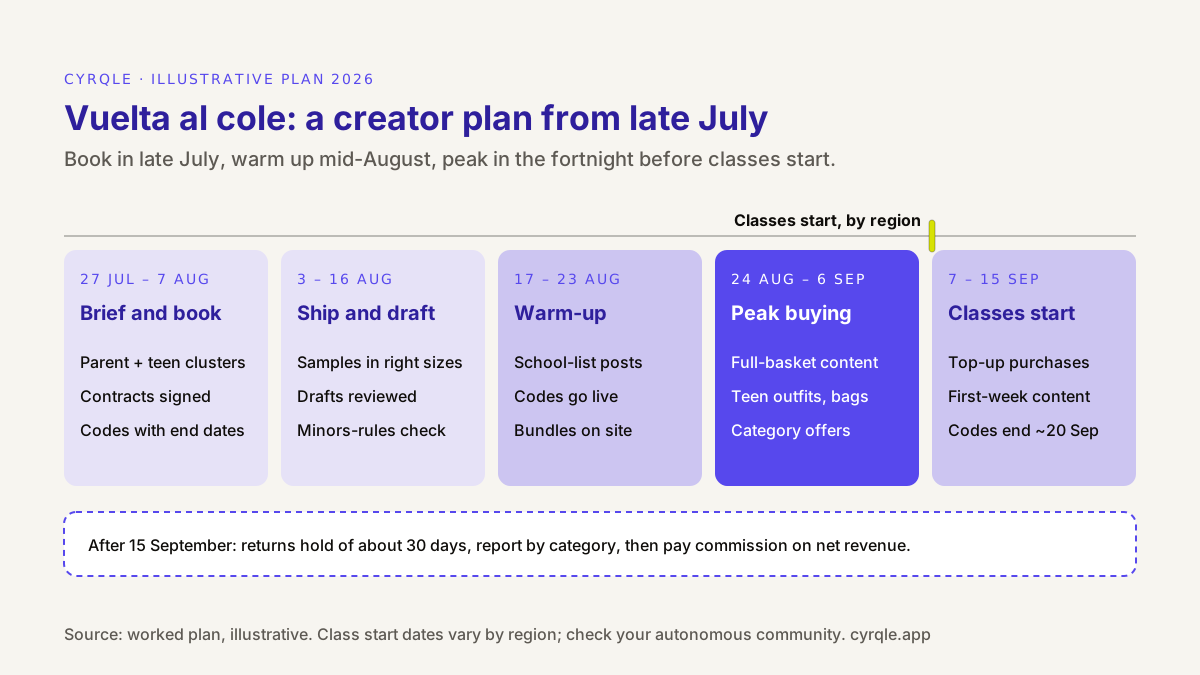
| Phase | 2026 dates | What creators do | Code status |
|---|---|---|---|
| Brief and book | 27 July to 7 August | Sign contracts, agree dates and the product list | Codes created, end dates set |
| Ship and draft | 3 to 16 August | Receive samples in the right sizes, submit drafts | Not active |
| Warm-up | 17 to 23 August | "What is on our school list" posts, first try-ons | Live from the first post |
| Peak buying | 24 August to 6 September | Full-basket content (parents), outfits and backpacks (teen audiences) | Live |
| Classes start | 7 to 15 September | Top-up purchases, "first week" content | Ends around 20 September |
| Returns hold | About 30 days after the last order | None | Expired; commission calculated on net revenue |
Parent creators or teen-audience creators?
Use both, with separate briefs, because they sell different parts of the basket to different buyers. Parent creators reach the person who holds the list and the card. Teen-audience creators reach the person who decides which trainers and which backpack are acceptable.
| Parent creators | Teen-audience creators | |
|---|---|---|
| Who they reach | Parents of school-age children, often in one city or region | Teenagers and young adults who follow style, sport or gaming content |
| What they sell best | The whole list: uniform basics, stationery, lunchboxes, shoes in several sizes | The visible items: trainers, backpacks, first-week outfits, tech accessories |
| Content that works | "Our school list, ticked off", organising the house for September, price per item | Try-ons, "first day" outfits, backpack "what's inside" |
| Basket shape | More items per order, higher order value | Fewer items, often one hero product |
| Main risk | Children in the content: consent and privacy | Advertising that targets minors directly |
| Best offer | Threshold gift or bundle | Category-scoped code on footwear or bags |
A practical way to split the budget is by category. If stationery, uniform basics and lunchboxes are your margin, weight the budget towards parents. If footwear and bags are your growth line, weight it towards teen-audience creators. In fashion, a creator commerce plan for fashion brands usually leans on the second group; for a general retailer with school supplies, see creator commerce for retailers.
How to find each group
Search on what creators post, not on labels. Parent creators show school runs, family organisation and home routines in their captions and images. Teen-audience creators are usually creators aged 18 or over, often in their twenties, who post about trainers, outfits or study routines, and whose comments come from younger followers. Ask each creator for a recent screenshot of their audience insights before you sign; the platforms show age bands to the account owner.
What are the rules on advertising to minors in Spain?
Advertising aimed at minors must not push them to buy by exploiting their inexperience or credulity, and must not show them persuading their parents or guardians to buy. That is article 3.b of the Ley 34/1988, General de Publicidad, which applies to all advertising, including creator posts. The same letter bans showing children in dangerous situations without a justified reason and misleading them about a product's characteristics or safety.
Creators who count as "users of special relevance" under the audiovisual law also fall under article 124 of Ley 13/2022. It bans commercial communications that directly encourage minors to buy, directly encourage them to persuade parents or others to buy, or exploit the special trust minors place in parents, teachers or other people. Our legal checklist for influencer marketing in Spain explains who counts as a user of special relevance, and the explainer on Real Decreto 444/2024 covers the registry and labelling duties.
What this means in a back-to-school brief:
- No pester power. Ban lines such as "ask your parents for it" or "tell your mum it is on the list". This is the clearest breach, and it is the line a teen-audience creator is most likely to improvise.
- No false urgency aimed at teens. "Everyone in your class will have these" exploits exactly the inexperience the law protects.
- Safe scenes. A child on a scooter without a helmet, or crossing a road on a phone, is a dangerous situation on screen.
- Truthful product claims. A backpack sold as "ergonomic" needs a basis. Do not let creators invent features.
- A clear advertising label on every paid post, as for any campaign.
When children appear or the creator is under 18
Parent creators often show their children. Norm 8 of the AUTOCONTROL influencer code says a creator under 18 needs a contract with the explicit consent of the parents or guardians, and that content with minors must suit their age. Ley Orgánica 1/1982 protects the minor's honour, privacy and image. In the brief, say whether children may appear at all. Many brands ask for no faces, no school name and no uniform crest, which also protects the family's privacy. If you run a giveaway, note that article 7 of the LOPDGDD sets 14 as the age of consent for processing personal data.
This is not legal advice: for a specific campaign, ask your lawyer.
Which offers build a bigger basket?
The best back-to-school offers reward the second and third item, not the first. A percentage off everything gives away margin on the item the family was going to buy anyway. An offer tied to basket value or to a set of items moves the order value.
Context helps here. In a survey of 687 parents with 976 children aged 3 to 18, the consumer organisation OCU estimated an average estimated school cost of 2,390 euros for the 2025/2026 year, with uniforms at about 181 euros a year and school supplies at about 92 euros. Families feel that bill, so offers that make the list cheaper as a whole land better than a discount on a single item.
| Threshold gift | Bundle or school pack | Multi-buy on basics | Category-scoped code | |
|---|---|---|---|---|
| Example | Free pencil case above EUR 60 | Backpack + pencil case + bottle at a pack price | Three uniform polos for the price of two | Extra 10% on footwear with the creator's code |
| What it does to the basket | Pulls orders up to the threshold | Sells three items in one decision | Raises units on a repeat item | Protects margin outside the category |
| Best creator group | Parents | Parents | Parents | Teen audiences |
| Attribution | Code or link still needed | Code or link still needed | Code or link still needed | The code is the attribution |
| Watch out | Set the threshold just above your current order value | Pack must be cheaper than the items bought separately | Check stock in every size | Check whether it stacks with sitewide offers |
Two legal points shape the offers:
- Books have fixed prices. Under article 9 of the Ley 10/2007 del libro, the retail price of a book can only be between 95% and 100% of the publisher's fixed price. Article 10.1.g excludes textbooks and teaching materials for primary and ESO, but not dictionaries, atlases or reading books. A creator code that takes 10% off "all books" breaks the rule on those titles, so exclude them from the code scope.
- "Before" prices. When a creator quotes a price cut, the previous price must be the lowest price of the previous 30 days, under article 20 of the Ley 7/1996 de Ordenación del Comercio Minorista. The simplest brief: "now in a pack" or "with my code", not "it was X".
How should you set up creator codes for the vuelta al cole?
Give every creator a personal code with an end date and a scope, and pair it with a tracking link. Codes are the most certain way to tie an order to a creator, and parents in particular type them because the list is long and every euro counts. Teen-audience buyers often tap a link and pay without a code, so the link and a tag on your store catch those orders.
- Name the code for speech. Creator name plus a short tag, such as
MARTA-COLE. A parent should be able to say it aloud in the car. - Set an end date. Around 20 September covers the top-up purchases after classes start. An open code keeps earning commission and leaks to deal sites.
- Scope it. Restrict category codes to the category. Exclude fixed-price books.
- Decide stacking in advance. If you run a sitewide school promotion, decide whether the creator code adds to it. If it adds nothing, nobody types it and you lose the attribution.
- Test a real checkout with each code before the first post goes live.
Shops matter in this season. Many families buy uniforms and shoes in store, where the child can try them on. If you have shops, set up code redemption at the till before the peak, or you will undercount the parent creators. Our comparison of discount codes, tracking links and pixels explains how to combine the methods so each order counts once.
How do you measure a back-to-school campaign by category?
Report attributed revenue per creator group, split by product category, net of returns. Total revenue tells you the campaign worked. The category split tells you which creator group sold what, and that is the decision you make for next year.
The method is simple. Take the orders attributed to each creator through their code or link. In your store's order export, each order lists its line items, so you can group revenue by product category. Then subtract refunded items.
A worked example: two creator groups, gross and net
All figures are illustrative. A Spanish retailer selling clothing, footwear and school supplies runs eight parent creators and six teen-audience creators on fixed fees. Parents get a threshold gift above EUR 60; teen-audience creators get an extra 10% on footwear and bags.
| Parent creators | Teen-audience creators | |
|---|---|---|
| Creators | 8 | 6 |
| Fixed fees | EUR 6,400 | EUR 5,000 |
| Attributed orders | 520 | 410 |
| Average order value | EUR 68 | EUR 54 |
| Items per order | 3.1 | 1.7 |
| Gross attributed revenue | EUR 35,360 | EUR 22,140 |
| Returned share of revenue | 9% | 17% |
| Net attributed revenue | EUR 32,178 | EUR 18,376 |
| ROAS on gross | 5.53x | 4.43x |
| ROAS on net | 5.03x | 3.68x |
ROAS = attributed revenue divided by fixed fees.
What the table says:
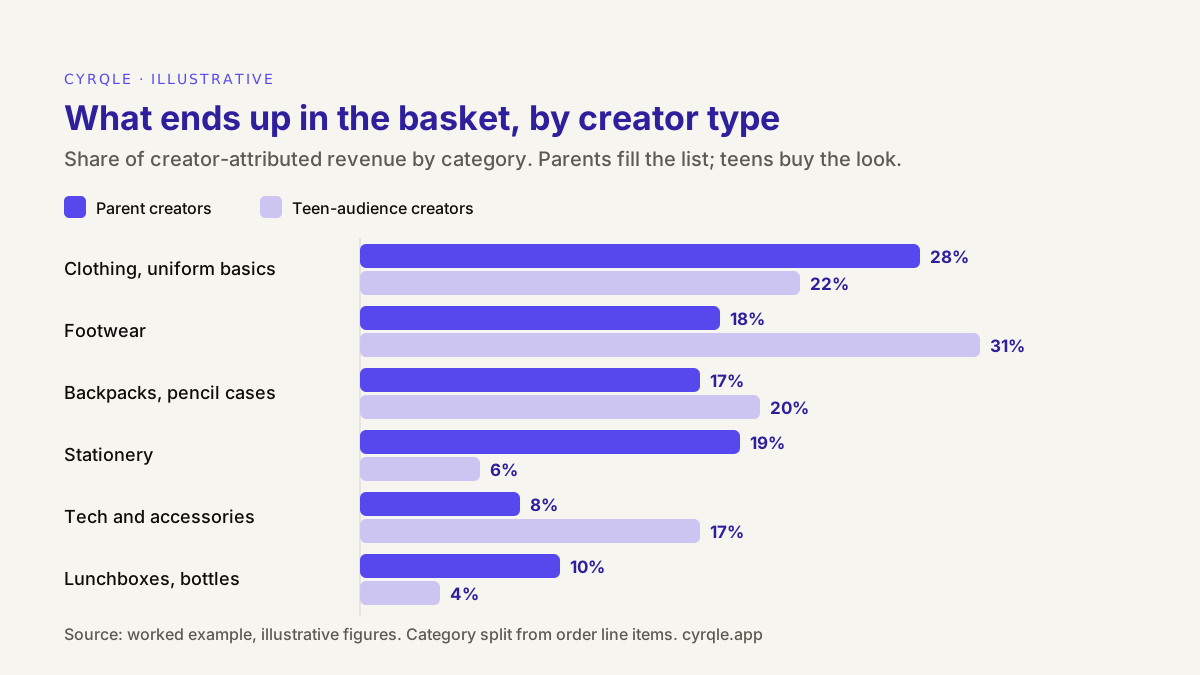
- Parents built the basket. Their average order of EUR 68 sits above the EUR 60 threshold, and stationery alone, 19% of their revenue, comes to about EUR 6,718. A threshold gift worked for this group.
- Teen-audience creators sold the hero items. Footwear was 31% of their revenue, about EUR 6,863. Their average order of EUR 54 sits just under the threshold, so next year test a bundle (trainers plus backpack) instead of a percentage code.
- Returns change the ranking. Footwear and outfits come back more often than pencil cases. Rank on net revenue, and pay any commission after the return window closes. Our rebajas playbook for fashion brands shows the same effect creator by creator.
- ROAS is not the whole story. Teen-audience creators may bring buyers who were not your customers before. Check the share of first-time buyers in your store data before you cut the group.
How cyrqle helps
cyrqle runs this playbook in one workspace, in Spanish or English.
- Two clusters, one comparison. In Clusters and planning, build a parent cluster and a teen-audience cluster, each with a live reach and cost estimate, and compare them side by side (up to four clusters) before you commit budget. Then add the cluster you choose to a campaign. The forecast is an estimate, not measured performance. To fill each cluster, Find creators searches by meaning across captions and visuals, so a query like "school run and family organisation" finds parent creators who never use the word "influencer". Vet each one on engagement, content mix and past brand collaborations; audience age comes from the creator's own insights.
- Brief, contract and drafts. In Campaigns, write one brief per cluster with the objective set to Sales, the product list and the rules: no pester power, whether children may appear. The Creator Collaboration Agreement is signed by both sides. Draft sign-off flags missing required hashtags and handles; a person still checks the content against the minors rules.
- Codes and attribution. In Attribution, mint a promo code and a tracking link per creator in bulk. A tag under 2KB on your store, the Shopify pixel and signed order webhooks from Shopify, WooCommerce or Magento tie orders to creators, and a cashier redemption page records codes used in your shops without a store integration. Each sale gets a tier (Tier 1 — promo code, Tier 2 — same-session, Tier 3 — cookied later), and revenue is net of refunds.
- Payouts. Creators in Europe and the US are paid through Stripe Connect in EUR. A person triggers each payout, so you can hold commission until returns are in.
cyrqle does not split revenue by product category. Take the attributed orders and join them with the line items in your store's order export, as in the worked example. To see the flow on a retail campaign, book a demo.
FAQ
When should a back-to-school creator campaign start in Spain?
Ideally in late June, and no later than the end of July. Classes start between about 7 and 15 September depending on the region, and families do most of their buying in the two weeks before. Book creators by early August, so content is ready for a warm-up from mid-August.
Can I work with creators under 18 for a back-to-school campaign?
Yes, with care. Under norm 8 of the AUTOCONTROL code, the contract needs the explicit consent of the parents or guardians, and the content must suit the creator's age. The bans on pushing minors to buy and on pester power still apply to what they say.
Should I hire parent creators or teen creators?
Both, for different categories. Parent creators sell the full school list with more items per order. Teen-audience creators sell trainers, backpacks and outfits. Brief them separately and compare the two groups on net attributed revenue by category.
How do I measure a vuelta al cole campaign by category?
Take the orders attributed to each creator through codes and links, group their line items by product category in your store's order export, and subtract returns. Report the result per creator group, not only as one total.
Can a creator code discount school books?
Only some. Primary and ESO textbooks are excluded from Spain's fixed book price, but dictionaries, atlases and reading books are not, and their retail price cannot go below 95% of the fixed price. Exclude fixed-price titles from the code scope.
Sources
- Región de Murcia, Resolución del calendario escolar 2026-2027 (BORM, June 2026): borm.es
- Ley 34/1988, de 11 de noviembre, General de Publicidad, article 3.b: boe.es
- Ley 13/2022, de 7 de julio, General de Comunicación Audiovisual, article 124: boe.es
- AUTOCONTROL, aea and IAB Spain, Código de Conducta de Publicidad a través de Influencers (2025), norm 8: autocontrol.es
- Ley Orgánica 3/2018 de Protección de Datos Personales (LOPDGDD), article 7: boe.es
- Ley 10/2007, de 22 de junio, de la lectura, del libro y de las bibliotecas, articles 9 and 10: boe.es
- Ley 7/1996, de 15 de enero, de Ordenación del Comercio Minorista, article 20: boe.es
- OCU, press release on school costs for 2025/2026 (August 2025): ocu.org
Related field notes.
A Christmas influencer marketing campaign for Spain must cover two gift peaks: Christmas and Reyes on 6 January. Gift guides, cut-offs, cleared content, codes.
Buen Fin influencer marketing in six weeks: book Mexican creators, give each a promo code, label every post as advertising and record bank-transfer payouts.
Black Friday influencer marketing for 2026, week by week: shortlist creators in September, sign in October, mint codes before your freeze, peak on 27 November.