
World Cup 2026: how to plan creator campaigns around the tournament
World Cup 2026 influencer marketing for brands in Spain and Mexico: match-day content windows, FIFA trademark limits, hashtag fan activations and creator codes.
World Cup 2026 influencer marketing works best as a set of short, pre-booked content windows, not one long campaign. The tournament runs from 11 June to 19 July 2026 across 16 host cities in Canada, Mexico and the US. For a brand in Spain or Mexico, the windows that sell are the days before kick-off, the hours around each national-team match, and the knockout rounds if your team gets there.
Three rules decide whether that plan works. Keep FIFA's official marks out of anything commercial unless you hold a licence. Give every creator a personal code and link so you can see which window and which creator drove sales. And decide before the first match what success looks like in each window, because a build-up reel and a match-night delivery code do different jobs.
This playbook is for sports, QSR, beer and retail brands, and for the agencies that run them. It covers the dates, the windows, the trademark limits, a hashtag fan activation, per-creator codes and a worked measurement example. For other seasonal and vertical plans, see our creator commerce playbooks by industry.
When is the World Cup 2026, and which dates matter for creators?
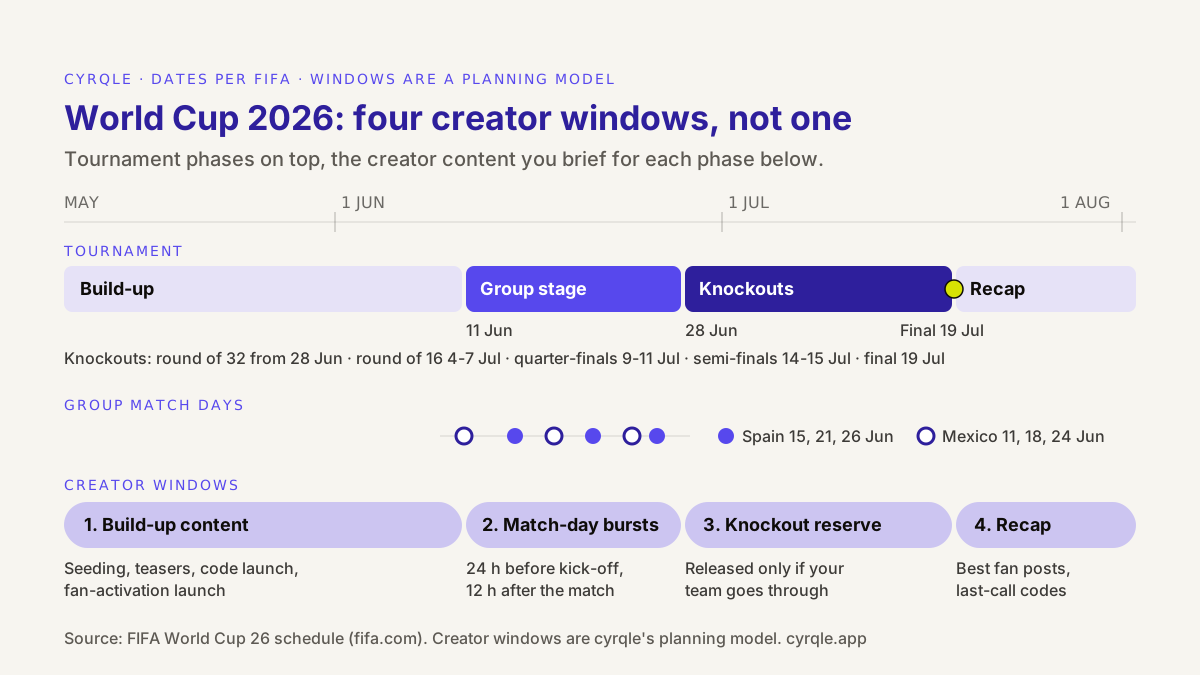
The 2026 World Cup starts on 11 June with Mexico against South Africa at Estadio Azteca in Mexico City, and the final is on 19 July. It is the first edition with 48 teams and 104 matches. The group stage ends on 27 June, and a new round of 32 starts on 28 June.
| Phase | Dates (2026) | What it means for creator content |
|---|---|---|
| Build-up | Mid-May to 10 June | Teasers, product seeding, code launch, fan-activation launch |
| Group stage | 11 to 27 June | Three fixed match days per team; the busiest window for QSR and bars |
| Round of 32 | 28 June to 3 July | First knockout round; only qualified teams' fans stay engaged |
| Round of 16 | 4 to 7 July | Shorter notice, higher stakes |
| Quarter-finals | 9 to 11 July | |
| Semi-finals | 14 and 15 July | |
| Third place and final | 18 and 19 July | The largest single audience of the tournament |
| Recap | 20 July to early August | Best fan content, last-call codes, wall refresh |
For the two markets in this guide, the fixed group-stage dates are:
- Spain (Group H): 15 June against Cabo Verde, 21 June against Saudi Arabia, 26 June against Uruguay.
- Mexico (Group A): 11 June against South Africa (the opening match), 18 June against South Korea, 24 June against Czechia.
Check kick-off times on FIFA's official schedule before you brief, because third-party listings use different time zones. One practical point does not change: every match is played in North America. In summer, Spain is 6 hours ahead of the US East Coast, 8 hours ahead of Mexico City and 9 hours ahead of the West Coast. For Spanish audiences, kick-offs fall in the afternoon, the evening or the middle of the night. For Mexican audiences, they fall in local daytime and evening hours. That changes when people order food, buy beer and scroll.
Which content windows should you plan?
A tentpole window is a fixed period around a high-attention event in which creator activity is scheduled to peak. The World Cup is not one window. It is four, and each one needs its own brief, deliverables and success measure.
1. Build-up (about three weeks before 11 June)
The goal is reach and memory, not sales. Creators introduce the product in a football context: the kit they wear to watch, the snack for the group chat, the boots they train in. Launch each creator's promo code here, so their audience has it before the first match. If you run a hashtag fan activation, open it in this window too.
2. Match-day bursts (group stage)
Each national-team match creates a short, predictable spike. Split it into two sub-windows:
- Pre-match (the 24 hours before kick-off): "where I am watching", "what we are ordering", a reminder of the code. This is the sales window for QSR, delivery and beer.
- Post-match (the 12 hours after): reaction, a recap, the fan entries you liked. Energy is high after a win and the content travels.
Do not brief creators to film the TV screen or share match clips. Broadcast footage belongs to the rights-holding broadcasters, and a reaction video works better anyway.
3. Knockout reserve
Nobody knows in May whether Spain or Mexico will play in July. Hold 20 to 30% of the creator budget as a reserve and write an option into the creator agreements: "one additional reel and three stories within 24 hours of each knockout match the team plays, at the agreed fee". If the team goes out, you do not trigger the option and you keep the budget.
4. Recap
After the final, the attention fades fast but does not vanish. Use the week after to publish the best fan content on your site, run a last-call code with a hard expiry, and close out reporting while the data is fresh.
What can you say about the World Cup without a FIFA licence?
FIFA's guidelines allow generic football and country-related images and terms, but they do not allow a brand to create a commercial association with the tournament unless it is a sponsor or licensee. In FIFA's words, an undue association arises "when a company makes it appear as if it is associated with FIFA or the Tournament". Paid creator posts are commercial, so this applies to your creators as well as to your own accounts.
The FIFA World Cup 26 Intellectual Property Guidelines (June 2024, version 2.0) list the protected word marks. They include "FIFA World Cup 26", "World Cup 26", "World Cup", "Copa Mundial de la FIFA 26", "Copa Mundial de la FIFA", "COPA MUNDIAL" and "MUNDIAL", plus the official emblem, trophy, mascot, posters and typeface. The same document covers the situations that matter most for creator campaigns:
| Situation | What the FIFA guidelines say | What to brief your creators |
|---|---|---|
| Hashtags | Using official marks in hashtags for commercial benefit is restricted to FIFA and its rights holders | Use a brand hashtag with no official marks, for example #NocheDeFutbolBrand |
| Advertisements | Using official marks in commercial ads is likely to create an unauthorised association | No "Mundial", "World Cup" or emblem in captions, overlays or codes |
| Contests and games | Contests that use official marks or create an association with the tournament are not permitted without authorisation | Run the fan activation on your brand and on football in general |
| Ticket prizes | Tickets may not be used for prize draws or consumer promotions without FIFA authorisation; tickets from unauthorised promotions are cancelled | Use your own product, vouchers or merchandise as prizes |
| Match schedule | Commercial use of the official schedule next to a company logo is not permitted | Say "Spain plays on Monday", not a branded fixture graphic |
| Countdowns | A commercially branded countdown to the tournament creates an unauthorised association | No branded countdown stickers or clocks |
| Generic football | Generic football or country-related images and terms are encouraged | Balls, pitches, national colours, flags, "match night", "the national team" |
Two more cautions. National-team crests, kits with crests and player images belong to federations, clubs and players, not to FIFA, so they need their own permission. And a promo code such as MUNDIAL10 is a commercial use of a word mark. Use the creator's name instead.
This section is a summary, not legal advice. FIFA itself suggests independent legal advice for promotional activity, and the rules differ by country. For the Spanish rules on creator advertising in general, read our legal checklist for influencer marketing in Spain.
How should sports, QSR, beer and retail brands use the tournament?
Each vertical buys a different moment. Sports brands sell the build-up, QSR and beer sell the match day, and retail sells both the build-up and the recap.
| Sports and sportswear | QSR and delivery | Beer | Retail and electronics | |
|---|---|---|---|---|
| Main goal | Product desire before kick-off | Orders around match times | Brand presence at viewing moments | Footfall and online orders before the first match |
| Strongest window | Build-up | Pre-match 24 hours | Pre-match and post-match | Build-up and recap |
| Creator type | Grassroots players, coaches, fitness creators | Food, humour and local city creators | Adult lifestyle and food creators with an adult audience | Tech, home and family creators |
| Mechanic | Seeding plus per-creator code | Match-day code with a short expiry | Hashtag fan activation with non-alcohol prizes | Per-creator code plus a store-visit offer |
| Main watch-out | Implying official kit or sponsorship | Code leakage to coupon sites | Alcohol advertising rules and minors | Ticket prizes and branded fixture lists |
Sports and sportswear. Creators who play, coach or train are more credible than celebrity fans. Seed product three to four weeks before 11 June and make the content about playing, not about the tournament. Our page on creator commerce for sports and media covers the wider vertical.
QSR and delivery. The order spike sits in the hours before kick-off. In Spain, late kick-offs push orders into dinner and late-night slots. Give each creator a code that works only for delivery or only in restaurants, so you can tell the channels apart. See creator marketing for QSR and fast food for multi-location patterns.
Beer. Alcohol advertising has its own rules on top of the FIFA limits. In Spain, article 5.5 of the Ley 34/1988 General de Publicidad limits the form and content of alcohol advertising, with explicit reference to the people it targets and to sports settings. In Mexico, article 308 of the Ley General de Salud sets requirements for alcohol advertising. In practice: work only with adult creators whose audience is mostly adult, never show drinking linked to playing sport, and do not offer beer as a fan-activation prize.
Retail and electronics. The classic sale is the screen and the sofa before the first match. Brief creators on the viewing set-up, use per-creator codes online and a cashier-redeemable code in stores, and keep any fixture list unbranded.
How do you run a fan activation by hashtag?
A fan activation asks fans to post their own content with your hashtag under published terms. You review the entries, pick winners and reuse the best posts on your own channels. It turns the creator campaign into a wave of fan content you can show on your site.
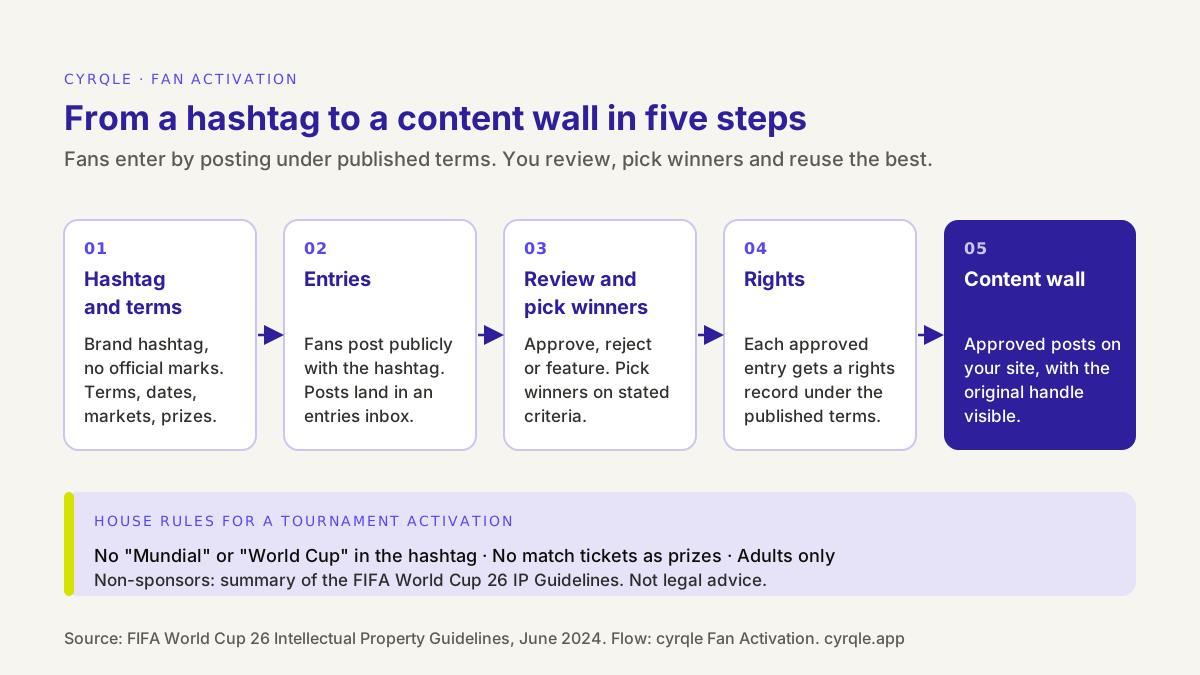
- Choose a brand hashtag with no official marks. "#NocheDeFutbolBrand" works; anything containing "Mundial" or "WorldCup" does not.
- Publish the terms before launch. State who can enter (adults only is the safe default), the dates, the markets, how winners are chosen, the prizes, and what rights the brand gets to reuse entries. Our post on UGC rights in the EU explains why clear, published terms matter.
- Let creators kick it off. Each paid creator posts an entry of their own and asks their audience to join. This is where the creator campaign and the fan campaign connect.
- Collect and review entries. Remove anything with official marks, broadcast footage, minors or other people's content.
- Pick winners on stated criteria. A judged selection on published criteria is a different mechanic from a random draw. In Mexico, a draw (sorteo) needs a permit from the Secretaría de Gobernación under the Reglamento de la Ley Federal de Juegos y Sorteos. In Spain, promotional draws have their own rules too. Ask your lawyer which mechanic fits.
- Reuse the approved posts. Put them on a content wall on your site, with the original handle visible.
How do per-creator promo codes work during the tournament?
Give each creator one personal code and one tracking link for the whole tournament, and change the offer, not the code, between windows. Creators' audiences learn one code, and you still get per-creator, per-window data because you can read sales by date.
- Name codes after the creator, not the event. LAURA15, not MUNDIAL15.
- Set an expiry and a per-customer limit. Tournament codes leak to coupon sites quickly. A hard expiry on 26 July limits the damage.
- Use a separate code only when the offer changes. A match-day-only offer can run as a second code per creator, valid on match days only.
- Cover offline sales. For bars, restaurants and stores, make the code redeemable at the till so in-person sales count too.
How do you measure each window? A worked example
Measure each window on its own goal and its own cost, then add them up. A single tournament ROAS hides the fact that the build-up mostly buys reach and the match days mostly buy orders.
The example below is illustrative. A QSR chain in Spain books 12 food and humour creators for EUR 18,000 in fees, splits the fees across three windows, gives every creator a code, and runs a hashtag fan activation with EUR 2,000 in vouchers as prizes. Average order value is EUR 22, before IVA.
| Window | Fees allocated | Views | Effective CPM | Code and link orders | Attributed revenue | ROAS on fees |
|---|---|---|---|---|---|---|
| Build-up (25 May to 10 June) | EUR 6,000 | 900,000 | EUR 6.67 | 450 | EUR 9,900 | 1.65x |
| Group stage (11 to 27 June) | EUR 8,000 | 1,600,000 | EUR 5.00 | 1,400 | EUR 30,800 | 3.85x |
| Knockout reserve (released) | EUR 4,000 | 1,100,000 | EUR 3.64 | 900 | EUR 19,800 | 4.95x |
| Total | EUR 18,000 | 3,600,000 | EUR 5.00 | 2,750 | EUR 60,500 | 3.36x |
Effective CPM is the fee divided by views, times 1,000. Including the EUR 2,000 in fan-activation prizes, total cost is EUR 20,000 and blended ROAS is 3.03x. The fan activation is measured separately: entries, approved posts and posts placed on the wall, not sales.
What the table teaches:
- Do not cut the build-up on ROAS alone. It has the weakest code return, but it put the codes in front of the audience before the match days that sold.
- The reserve was the most efficient money, because it was spent only when attention was highest. Had the team gone out, the EUR 4,000 would have stayed in the budget.
- ROAS is not profit. At a 30% gross margin, after the code discount, the result looks very different. Our guide to measuring influencer marketing ROI beyond the discount code shows how to turn this table into an honest range, net of refunds and margin.
If you are starting in late May
Three weeks is enough for a focused plan if you cut scope:
- Week 1: pick one market and one objective. Shortlist 8 to 15 creators on recent median views, not followers. Write the brief with the trademark rules in it.
- Week 2: send offers with the knockout option, sign agreements, mint codes and links, and publish the fan-activation terms.
- Week 3: approve drafts, check every caption and overlay for official marks, and go live with the build-up content before 11 June.
How cyrqle helps
cyrqle runs the creator side and the fan side of a tentpole campaign in one workspace. In Campaigns, you write the brief with an objective such as Sales or Awareness, rank creators against it, send invites in Spanish or English by market, and sign the Creator Collaboration Agreement with two-sided e-signature. Optional draft sign-off includes an automated check for your required hashtags and handles. It does not scan for FIFA marks, so keep that rule in your brief and review drafts against it.
- Fan Activation. Set the hashtag, the brand handle to tag, start and end dates and markets. Use cyrqle's standard terms template or paste your own, and an EU GDPR clause is added automatically for EU markets. cyrqle publishes a public landing page, and a hashtag listener collects public Instagram posts into the entries inbox. You approve, reject or feature entries by hand, or set auto-approve, then use Pick winners. Approved entries get a rights record under the published terms. Winners with a cyrqle account are notified in the app. You contact the others yourself through the account they entered from.
- Per-creator codes and links. In Attribution, you mint a promo code and a tracking link per creator in bulk and export them. A cashier redemption page records codes in bars, restaurants and stores without a till integration. Every sale gets a confidence tier, and the Attribution tab shows sales and revenue by creator, content and market, so you can read each window by date.
- The wall. Approved fan posts and cleared creator posts can go straight onto a content wall on your site.
What cyrqle does not do: it does not check FIFA's trademark rules for you, track Instagram Stories automatically, or measure incrementality. Creator payouts settle in EUR. To plan the tournament with your own creators and category, book a 30-minute demo.
FAQ
Can I use the words "World Cup" or "Mundial" in a sponsored creator post?
Not as a non-sponsor. FIFA lists "World Cup", "World Cup 26", "Copa Mundial de la FIFA" and "Mundial" among its word marks, and its guidelines say commercial ads that use them are likely to create an unauthorised association. Talk about football, the national team and match night instead.
Can creators wear their national-team shirt?
Fans wearing a shirt is normal, but a paid post built around the crest, or a product shot that implies official kit, is a different matter. Crests and kits are protected by federations and kit makers. If the shirt is not your product, keep it incidental.
Can I give away match tickets in a creator contest?
No, unless FIFA authorises it or you run it with a FIFA rights holder. The guidelines say tickets obtained through unauthorised promotions will be cancelled. Use your own product, vouchers or a viewing-party experience as prizes.
How early should I book creators for the World Cup?
Book three to five weeks before 11 June for the build-up and group stage, and agree the knockout option at the same time. Popular sports and food creators fill their tournament calendars early, and late briefs leave no time for draft approval.
What if my national team is knocked out early?
That is why the knockout reserve exists. If the team goes out, you do not trigger the option and the reserve stays in your budget. Use part of it for the recap window, which works regardless of results.
Sources
- FIFA, FIFA World Cup 26 schedule and fixtures: https://www.fifa.com/en/tournaments/mens/worldcup/canadamexicousa2026/scores-fixtures
- Sports Illustrated, 2026 World Cup full list of matches, schedule and locations (group dates for Spain and Mexico, knockout dates): https://www.si.com/soccer/2026-world-cup-full-list-matches-schedule-locations
- FIFA, FIFA World Cup 26 Intellectual Property Guidelines, June 2024, version 2.0: https://digitalhub.fifa.com/m/3567360896991b48/original/FIFA-World-Cup-26-IP-Guidelines.pdf
- FIFA, Brand protection: https://inside.fifa.com/tournament-organisation/brand-protection
- Ley 34/1988, de 11 de noviembre, General de Publicidad, article 5.5: https://www.boe.es/buscar/act.php?id=BOE-A-1988-26156
- Ley General de Salud (Mexico), article 308: https://www.diputados.gob.mx/LeyesBiblio/pdf/LGS.pdf
- Reglamento de la Ley Federal de Juegos y Sorteos (Mexico): https://www.ordenjuridico.gob.mx/Documentos/Federal/html/wo88470.html
Related field notes.
Black Friday influencer marketing for 2026, week by week: shortlist creators in September, sign in October, mint codes before your freeze, peak on 27 November.
A Christmas influencer marketing campaign for Spain must cover two gift peaks: Christmas and Reyes on 6 January. Gift guides, cut-offs, cleared content, codes.
Buen Fin influencer marketing in six weeks: book Mexican creators, give each a promo code, label every post as advertising and record bank-transfer payouts.