
Black Friday 2026: a 12-week creator campaign timeline
Black Friday influencer marketing for 2026, week by week: shortlist creators in September, sign in October, mint codes before your freeze, peak on 27 November.
Black Friday influencer marketing works when the creators are booked in September and the codes are tested before November. Black Friday 2026 falls on 27 November, so a 12-week plan starts in the week of 7 September: shortlist and brief in September, negotiate and sign by mid-October, approve drafts and mint codes before your store freezes changes, tease from mid-November, peak in Black Friday week, close on Cyber Monday and report after returns.
Picture a skincare brand in Valencia that decides on 2 November to "do something with creators for Black Friday". The creators it wants have already signed with three other brands. The ones who are free quote more than they did in September. Product samples arrive on 18 November, drafts come back on the 24th, and the promo codes go live on Thursday night without a test order. On Monday, nobody can say which creator sold what.
This post is the week-by-week fix. It is part of our creator commerce playbooks by industry, written for ecommerce and D2C brands selling in Spain, the EU and Latin America from their own online store.
When is Black Friday 2026, and when should you start?
Black Friday 2026 is Friday 27 November, the day after US Thanksgiving (Thursday 26 November). Cyber Monday is Monday 30 November. Start the creator work in the week of 7 September, 12 weeks before the peak, and treat Black Friday as a week-long event, not a single day.
In Spain, many retailers run offers for the whole week or longer, so the shopper's buying window is wider than the date. In Mexico, El Buen Fin runs from 13 to 17 November 2026, two weeks before Black Friday. If you sell in both markets, plan the two moments as one season with one creator pool; the industry pillar has the full Spain and Mexico retail calendar.
Twelve weeks is not padding. A creator campaign has fixed steps: brief, shortlist, invites, negotiation, contract, product shipping, drafts, revisions, then publishing. Each step waits on the one before it, and each one involves a person who also has other clients in Q4.
Why book creators early for Black Friday?
Book early because creator demand peaks in Q4 and prices follow demand. Creators and their managers fill their calendars for the holiday season in late summer, and the free slots that remain in November cost more.
Two data points from the market, both from US-led sources, so treat them as direction rather than a Spanish price list:
- Traackr's holiday guidance cites Lumanu payments data showing that total creator spend rose about 60% from spring to its December peak, and that the median payout reached USD 1,750 in December, up from roughly USD 1,100 to 1,200 in a typical month (Traackr, 4 tips for working with creators during the holidays).
- The same article says a brand booking late going into Q4 may be quoted 50% or more above normal for a single post.
There is a second reason, and it shapes the whole plan. Traackr reports that creator content volume rose 73% year on year in Q4 2025 while attention per holiday post fell 28%, and that attention per Black Friday and Cyber Monday post fell 63%. Black Friday week is crowded. Posts that land in the two weeks before it, when feeds are quieter, do more of the warming-up work. This is why the plan below spreads content over four weeks instead of putting everything on the 27th.
The 12-week Black Friday creator timeline, week by week
The plan runs from the week of 7 September to Cyber Monday on 30 November, with reporting after. Weeks start on Monday. Move the whole plan earlier if you also run Buen Fin in Mexico.
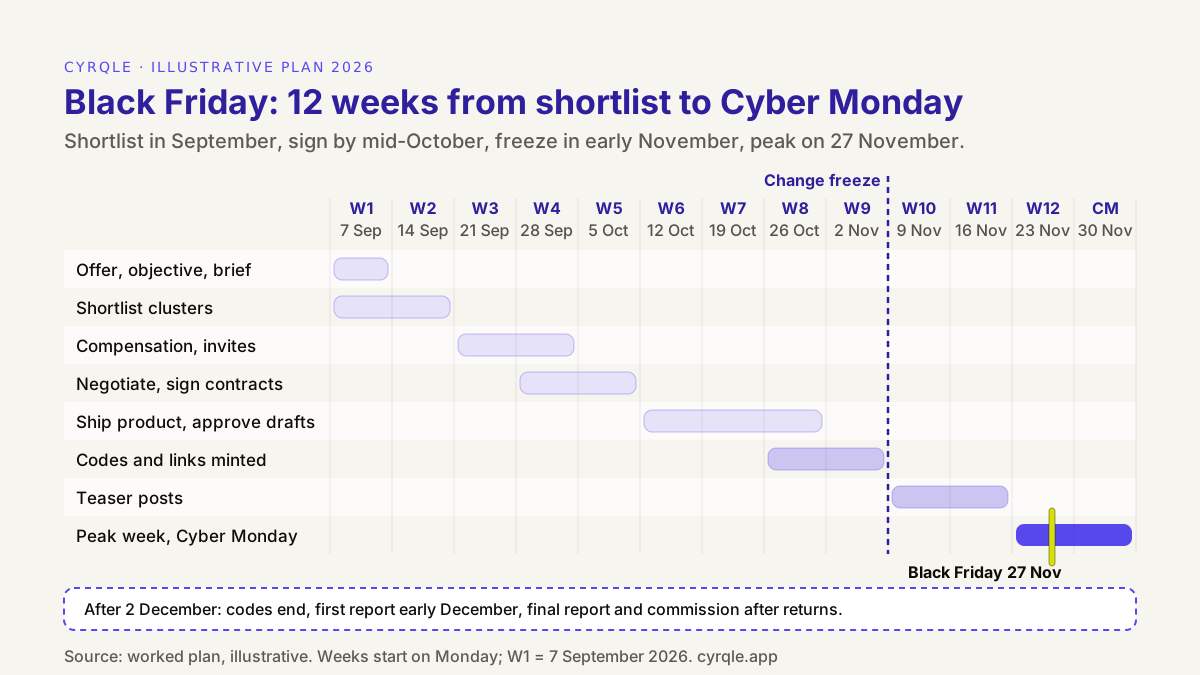
| Week | Dates (2026) | Milestone | Done when |
|---|---|---|---|
| 1 | 7 to 13 Sep | Objective, offer and budget | The Black Friday offer is decided and written into the brief |
| 2 | 14 to 20 Sep | Shortlist one or two creator clusters | Each cluster has a reach and cost estimate inside budget |
| 3 | 21 to 27 Sep | Set compensation and send invites | Fee, commission and product terms are fixed per tier |
| 4 | 28 Sep to 4 Oct | Negotiate | Dates, deliverables and rates are agreed |
| 5 | 5 to 11 Oct | Sign contracts | Every creator has a signed agreement with posting dates |
| 6 | 12 to 18 Oct | Ship product | Samples delivered; creators confirm receipt |
| 7 | 19 to 25 Oct | First drafts | Drafts in, feedback sent within 48 hours |
| 8 | 26 Oct to 1 Nov | Approve drafts, finish store setup | All drafts approved; tag, pixel and webhooks verified |
| 9 | 2 to 8 Nov | Mint codes and links, then freeze | Every code tested with a real checkout; change freeze starts |
| 10 | 9 to 15 Nov | Teasers start | First posts live: wishlists, "save this for Friday" |
| 11 | 16 to 22 Nov | Teasers and early access | Second wave live; read early clicks and code use |
| 12 | 23 to 29 Nov | Peak week | Most posts live; Black Friday on 27 Nov |
| CM | 30 Nov to 2 Dec | Cyber Monday and close | Last posts live; codes end on 2 Dec |
| After | December | Reporting | Final numbers after the returns window |
Weeks 1 and 2: decide the offer before you choose creators
Write the offer first, because it decides which creators make sense. A 20% sitewide discount, a gift with purchase above a threshold and a bundle need different stories and different creators. Put the offer, the objective (sales), the hero products and the posting window into the brief. Our guide to KPIs by objective helps you pick the one number you will judge the campaign on.
Then shortlist. Build one or two groups of creators, for example one with mid-tier creators for reach and one with many micro creators for conversion, and compare their estimated reach and cost before you send a single message. Choose creators on recent views and effective cost per thousand views, not followers: Black Friday is a bad week to find out that a large account no longer reaches its audience.
Weeks 3 to 5: compensation, invites and contracts
Set the compensation model before you invite anyone. For a sales campaign, a fixed fee plus a commission on attributed sales is common: the fee pays for the content and the slot, the commission aligns the creator with the result. Product-only deals rarely survive Q4, when creators with an audience have paid offers to choose from. If you work with micro creators, our micro-influencer pay guide covers the negotiation.
The contract must fix four things for Black Friday: the posting dates (a post on 30 November is worth less than one on 26 November for most offers), the deliverables per date, the usage rights for your own channels, and the code's end date. Add the commercial disclosure rule in writing. In Spain, the influencer rules under Real Decreto 444/2024 and the AUTOCONTROL code expect paid and gifted content to be identifiable as advertising; check whether the creator falls under the decree's thresholds.
Weeks 6 to 8: product, drafts and approvals before the freeze
Ship product in week 6 and expect drafts in week 7. Give feedback within 48 hours; every day you hold a draft is a day the creator cannot schedule it. Approve all drafts by the end of week 8.
Many ecommerce teams stop deploying changes to the store in the weeks before peak traffic. Whatever your freeze date is, everything that touches checkout must be finished before it: the on-page tag, the pixel, the order webhooks, the discount rules and any landing page creators will link to.
Check prices in the drafts too. In Spain, when you show a reduced price, the previous price must be the lowest price applied to the same product in the 30 days before, under article 20 of the Ley 7/1996 de Ordenación del Comercio Minorista. A creator who says "it was 60 euros" must quote that 30-day lowest price, so brief creators to say "with my code" instead of quoting a "before" price.
Week 9: mint codes and links, then test
Create one personal promo code and one tracking link per creator, with a start date, an end date and a scope. Place a real test order with every code before the freeze. Decide now whether creator codes stack with your sitewide Black Friday offer. If the sitewide price already beats the code, nobody types the code and you lose your clearest attribution signal.
Codes alone undercount: many Black Friday buyers tap a link and pay with the sitewide price. Our comparison of discount codes, tracking links and pixels explains how to combine the three so each order is counted once. On Shopify, the Shopify creator tracking guide covers the setup.
Weeks 10 and 11: teaser posts
Teasers do the work that peak-week posts cannot: they reach people before their feeds fill up with offers. Good formats are wishlists, "what I am buying on Friday", early-access sign-ups and honest reviews of the hero product. Keep the code live from the first post if you run an early-access price; otherwise the teaser carries the link and the code goes live with the offer.
Read the first numbers in week 11: clicks per creator, code use, and which product the clicks land on. If one creator's audience clicks on the bundle and not on the hero product, change the peak-week brief for that creator while there is still time.
Week 12, Cyber Monday and after: peak, close and report
Black Friday week carries about half of the posts in this plan. Stagger them: some on Monday and Tuesday for early buyers, most on Thursday and Friday, a few on the weekend. Cyber Monday is the last push, and it suits creators whose audience shops online after the weekend.
End codes on 2 December. Then wait for returns. In Spain, consumers have 14 calendar days to withdraw from an online purchase, counted from the day they receive the goods, under articles 102 and 104 of the consumer protection law (Real Decreto Legislativo 1/2007). Many retailers extend Christmas returns into January. Publish a first report in early December, and the final report, with commission, once the returns window has closed.
How should you spread creator posts across November?
Spread posts over the four weeks from 9 November to Cyber Monday: roughly half in Black Friday week, about a third in the two teaser weeks, 15% around Cyber Monday and a small early slice in week 9. A single-day plan competes with every other brand on the busiest day of the year; a spread plan warms the audience first and converts it on the day.
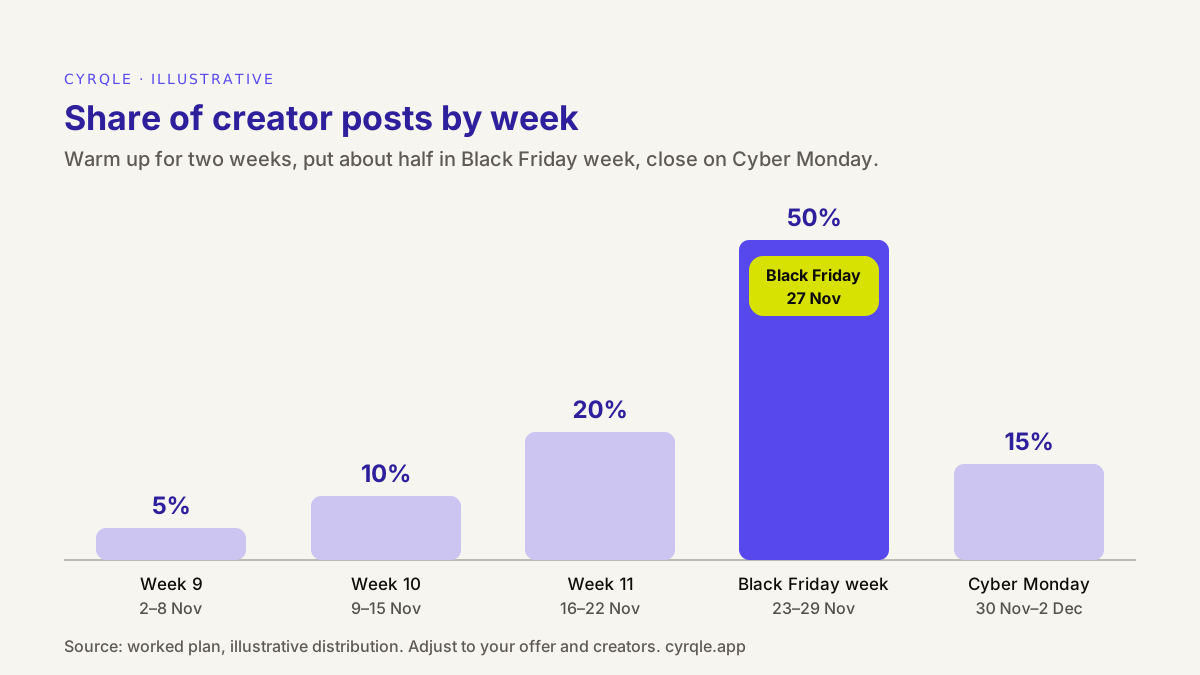
Each phase has a different job, so brief each one separately.
| Teaser (weeks 10 to 11) | Peak (week 12) | Cyber Monday | |
|---|---|---|---|
| Job of the post | Create intent before feeds fill up | Convert intent on the day | Catch late and online-first buyers |
| Good formats | Wishlist, review, early access | Unboxing, try-on, offer explained | Last-chance reminder, bundle |
| Call to action | Save the post, join the list | Buy with my code or link | Last day for my code |
| Code status | Link live; code live only with early access | Live | Live until 2 December |
| Share of posts (illustrative) | About 30% | About 50% | About 15% |
| Main risk | Offer leaks before launch | Lost in a crowded feed | Code used after the end date |
The remaining 5% in the chart is week 9: early posts from creators who need a lead time, for example gift-guide content.
A worked example: one D2C budget, booked early
All numbers in this example are illustrative. A D2C skincare brand in Spain plans one Black Friday creator campaign with two mid-tier creators and ten micro creators.
| Line | Booked in September | Booked in November |
|---|---|---|
| 2 mid-tier creators | 2 x EUR 2,500 = EUR 5,000 | 2 x EUR 3,750 = EUR 7,500 |
| 10 micro creators | 10 x EUR 800 = EUR 8,000 | 10 x EUR 1,200 = EUR 12,000 |
| Product samples | EUR 1,500 | EUR 1,500 |
| Fixed cost | EUR 14,500 | EUR 21,000 |
The November column applies a 50% last-minute premium, the level the Traackr article quotes for late Q4 bookings. For the same twelve creators, booking late costs EUR 6,500 more before a single sale.
Now the result, using the September plan. Creator codes and links bring EUR 30,000 in attributed revenue. Returns take 15% of it, so net revenue is EUR 25,500. The commission is 10% of net revenue, EUR 2,550.
- Total cost: EUR 14,500 + EUR 2,550 = EUR 17,050.
- Net ROAS: EUR 25,500 / EUR 17,050 = 1.50.
- At the November prices, total cost is EUR 23,550 and net ROAS falls to 1.08, for the same posts and the same sales.
Two lessons. Booking date alone moves this campaign from clearly profitable to barely break-even. And if you had paid commission on gross revenue (EUR 3,000 instead of EUR 2,550), you would have paid creators for orders that came back. Attributed ROAS is not incremental lift; if you need to know what the creators added on top of your sitewide offer, run a simple holdout, as our holdout test guide explains.
How cyrqle helps
cyrqle runs the 12 weeks in one workspace, from the shortlist to the commission statement.
- Shortlist (weeks 1 and 2). In the Planner, build a creator cluster and see a live reach and cost estimate as you add creators, run budget what-ifs and compare up to four clusters side by side. Then choose Add this cluster to a campaign. The figures are estimates for comparing options, not quotes.
- Brief, invites and contracts (weeks 1 to 5). In Campaigns, write the brief with the Sales objective. Invites stay blocked until compensation is complete, so no creator receives an offer without terms. Send invites one by one or in bulk, in Spanish or English by market, with two automatic follow-ups. Each creator signs the Creator Collaboration Agreement with two-sided e-signature and a frozen snapshot of the terms.
- Drafts (weeks 7 and 8). Turn on draft sign-off, approve or request changes, and let the automated check flag drafts that miss the required hashtags or handles.
- Codes and links (week 9). Bulk mint per-creator promo codes and tracking links and export them. A tag under 2KB on your store, the Shopify pixel and signed order webhooks from Shopify, WooCommerce or Magento tie orders to creators. On Shopify you can let cyrqle create the matching discount if you paste an Admin API token.
- Peak and reporting (weeks 10 to 12 and after). The Posts tab tracks Instagram and TikTok posts with views, engagement and effective CPM. The campaign Attribution tab shows sales by confidence tier (promo code, same-session, cookied later), net of refunds. Commission owed is calculated and shown; paying it is a separate step, and payouts to creators in Europe and the US go through Stripe Connect when a person triggers them.
For the D2C view of the same workflow, see creator commerce for D2C brands. If you want to see the timeline set up on your own category, book a 30-minute demo.
FAQ
When should I start planning Black Friday influencer marketing?
Start in early September, about 12 weeks before Black Friday on 27 November 2026. That leaves time to shortlist, negotiate, sign, ship product and approve drafts before your store freezes changes in early November. If you also sell in Mexico for El Buen Fin (13 to 17 November 2026), start in late August.
How many posts should a creator make for Black Friday?
Two or three posts per creator work well: one teaser in the two weeks before, one post in Black Friday week and, for online-first audiences, one Cyber Monday reminder. A single post on the day competes with every other brand in the feed.
Should creator codes stack with my Black Friday discount?
Decide before you mint the codes, and tell creators. If the code adds nothing to the sitewide price, buyers skip it and you lose attribution. A small extra (free shipping, a gift or a few extra points of discount) keeps the code worth typing; tracking links cover buyers who do not use it.
Do Black Friday creator posts need an ad label in Spain?
Yes, if the creator is paid or received product. The post must be identifiable as advertising, in line with Spain's influencer rules and the AUTOCONTROL code. This is not legal advice; for a specific campaign, ask your lawyer.
When should I pay creator commission after Black Friday?
After the returns window closes, on net revenue. In Spain, online buyers have 14 calendar days from delivery to withdraw, and many stores extend returns into January. Paying on gross revenue rewards orders that come back.
Sources
- Traackr, "4 tips for working with creators during the holidays" (cites Lumanu payments data and Traackr's 2026 holiday report): https://www.traackr.com/influencer-marketing-blog/holiday-season-influencer-marketing-tips
- Ley 7/1996, de 15 de enero, de Ordenación del Comercio Minorista, article 20 (BOE): https://www.boe.es/buscar/act.php?id=BOE-A-1996-1072
- Real Decreto Legislativo 1/2007 (consumer protection law), articles 102 and 104 (BOE): https://www.boe.es/buscar/act.php?id=BOE-A-2007-20555
Related field notes.
World Cup 2026 influencer marketing for brands in Spain and Mexico: match-day content windows, FIFA trademark limits, hashtag fan activations and creator codes.
A Christmas influencer marketing campaign for Spain must cover two gift peaks: Christmas and Reyes on 6 January. Gift guides, cut-offs, cleared content, codes.
Buen Fin influencer marketing in six weeks: book Mexican creators, give each a promo code, label every post as advertising and record bank-transfer payouts.