
Beauty creator playbook: from seeding to attributed sales
Influencer marketing for beauty brands, step by step: seed 100 creators, move the ones who sell to hybrid deals, clear reuse rights, measure repeat purchase.
Influencer marketing for beauty brands works best as a two-step programme: send product to many small creators to find out who can sell, then pay the few who did. Give every seeded creator their own promo code, so the first wave tells you who converts. Then offer the winners a hybrid deal, clear the rights to reuse their content, and judge them on whether their buyers come back for the refill.
A serum that launches in September is bought on trust. A shopper in Valencia sees a creator she follows use it for three weeks, reads the comments about texture and breakouts, and orders days later with a code. She comes back for a second bottle about two months on, if the product works. That buying pattern decides the whole plan: codes over links, a 30-day window, and a measurement that runs past the first order.
This playbook walks through an autumn launch for a skincare or beauty brand in Spain, step by step, with illustrative numbers. It extends the beauty section of our creator commerce playbooks by industry and is written for brand and agency teams in Spain, the EU and Latin America.
What does the autumn launch plan look like?
Work backwards from the launch date and from Black Friday, which falls on 27 November in 2026. The seeding wave runs around the launch. The paid wave runs into Black Friday gift sets. The cohort read comes in December and January, when the first refills have had time to happen.
| When (launch on 15 September) | Step | Output |
|---|---|---|
| Early to mid August | Brief, claims sheet, shortlist of 100 to 130 creators | Approved wording, a gifting agreement, one promo code and link per creator |
| Late August to early September | Ship kits; ask creators to use the product for two weeks before posting | 100 kits delivered, posts free to land from launch day |
| 15 September to mid October | Seeding posts go live; codes and links collect orders | Attributed orders per creator, net of refunds |
| Second half of October | Read the wave; offer hybrid deals and reuse rights to the winners | 6 to 10 signed hybrid contracts |
| November | Paid wave for Black Friday and gift sets | Attributed revenue per hybrid creator |
| December to January | Read repeat purchase at 60 and 90 days by creator cohort | A rebooking list for spring |
The timings assume a product with a refill cycle of about two months. Shorten or stretch the last row to match how long your product lasts.
Step 1: How do you run a seeding wave that shows who converts?
Product seeding is the cheapest way to test many creators at once. You pay for product and postage, not for posts. The aim of the first wave is not reach. It is information: which creators can make their audience buy.
Four rules make a seeding wave readable:
- Seed enough creators to see a pattern. Seventy to 130 is a practical range for one launch. Fewer, and a single creator dominates the result. More, and the operations work grows faster than what you learn.
- Pick on fit, not on the "beauty" label. A creator who films full-face makeup may not move a fragrance-free barrier cream. Read the comments: if her audience asks about sensitive skin, routines and ingredients, she fits. Check median views rather than followers, as our guide to paying micro-influencers on views explains.
- Give every creator a promo code and a tracking link before the kit ships. Without a code you cannot tell who sold, and the wave teaches you nothing. Beauty content lives in Stories and Reels, where links are clumsy, so the code does most of the work.
- Put the terms on one page. State the product and its market value, whether a post is expected, how a post must be labelled and what you may do with the content. Our one-page gifting agreement template covers each clause in Spanish and English.
Do not require a post in exchange for a gift unless you mean it. If you ask for content, the product is payment, and the post is advertising that must be labelled as such. Either way, the creator should be free to say she did not like the product.
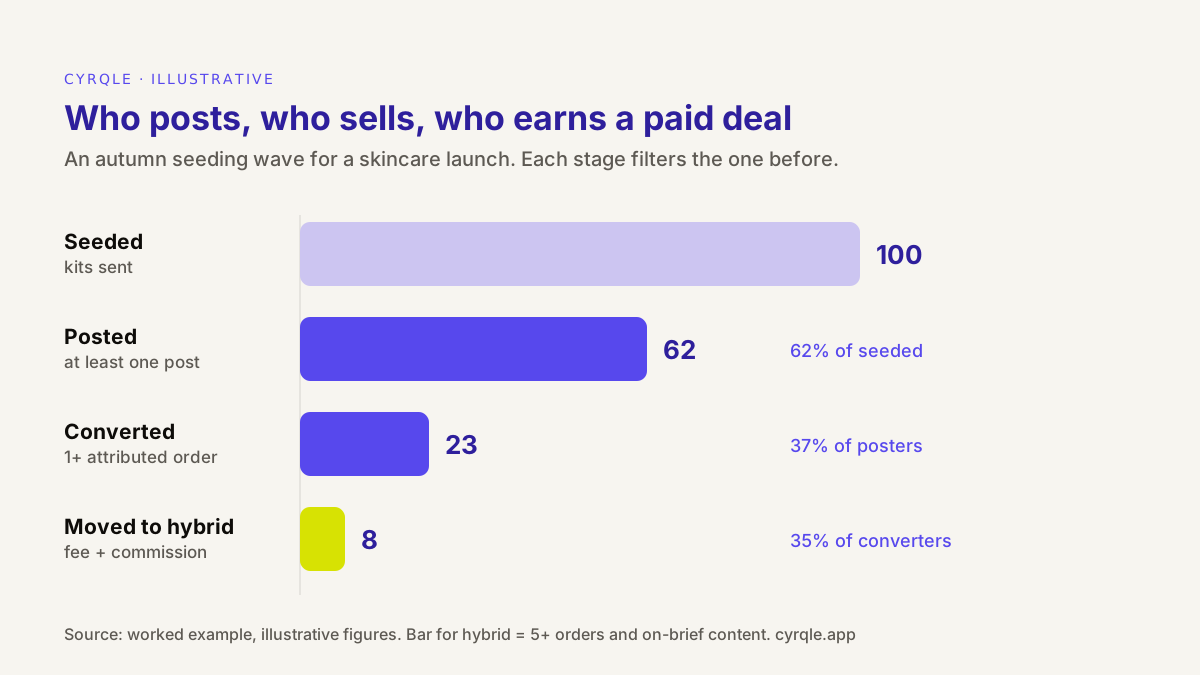
In the illustrative wave above, 62 of 100 creators post, 23 drive at least one attributed order and 8 clear the bar for a paid deal. The kits cost EUR 14 each in product and EUR 7 in packaging and postage, so the wave costs EUR 2,100. It brings 190 attributed orders at EUR 40 average net revenue: EUR 7,600, or about EUR 11 of kit cost per order. The 8 winners bring 141 of those orders, close to three in four.
Step 2: How do you read the wave and pick the winners?
Write the bar for a paid deal before the kits ship, so nobody argues about it afterwards. A useful bar has three parts:
- Volume. At least five attributed orders in the 30 days after the post. One or two orders can be the creator's friends.
- Quality. Revenue net of refunds, not gross. A creator whose buyers return the product is not a winner.
- Fit. The content matched the brief and the claims sheet, and the comments show real interest in the product.
Rank the creators who cleared the bar on revenue per 1,000 views as well as on total revenue. A creator with 12,000 median views and 15 orders may be a better hybrid partner than one with 80,000 views and 20 orders, because her fee will be lower. If you want to understand why the code carries most beauty attribution, our comparison of discount codes, tracking links and pixels covers the trade-offs.
Do not drop the creators who posted but did not sell. Some made excellent content you may want to license. Some reach an audience that buys later through search. Keep them on a list for the next wave, without a fee.
Step 3: How do you convert winners to hybrid deals?
A hybrid deal pays a modest fixed fee for the content and the timing, a commission on the sales the creator brings, and product. It suits beauty because the seeding wave has already shown how much a creator sells, so both sides can price the deal on evidence. Our post on seeding versus hybrid budgets covers the budget logic.
| Product seeding | Fixed fee | Hybrid: fee + commission + product | |
|---|---|---|---|
| Cost per creator | Product and postage only | Highest fixed cost | Lower fee, plus commission only on sales |
| What it guarantees | Nothing: the creator may not post | The agreed posts on agreed dates | The agreed posts, with an incentive to sell |
| Best use in the autumn plan | Wave 1, to find who converts | Mid-tier and macro creators who will not work for product | Wave 2, for creators who cleared the bar |
| Attribution needed | Promo code per creator | Code or link, for reporting | Code and link per creator, net of refunds, because commission depends on it |
| Main risk | Low post rate, unlabelled posts | Paying for reach that does not sell | Commission disputes if the revenue rule is vague |
Worked example: pricing one hybrid deal
One winner from the wave drove 26 orders and EUR 1,040 of net revenue from a single Reel. All figures are illustrative; the 70% gross margin is an assumption.
- Offer: EUR 400 for one Reel and three Story frames in November, 10% commission on net revenue (excluding VAT, after refunds), and a new kit worth EUR 21 to you.
- If she repeats her seeding result (26 orders, EUR 1,040): contribution is EUR 1,040 × 70% = EUR 728, minus EUR 104 commission, EUR 400 fee and EUR 21 kit. You keep EUR 203.
- Break-even: each euro of revenue leaves 60 cents after margin and commission, so you need EUR 421 ÷ 0.60 = about EUR 702 of revenue, or 18 orders at EUR 40.
- If she sells only 10 orders (EUR 400): you lose about EUR 181 on the first orders. The repeat purchases in Step 5 decide whether that creator is still worth rebooking.
Write the commission rule in the contract: which revenue counts (net of VAT and refunds), which window (30 days after the post is a common choice), and when it is paid. For the fee itself, price on expected on-topic views, not followers.
Step 4: How do you clear reuse rights before you need them?
The best seeding content often becomes your best ad or product-page asset. A gift does not give you the right to use it. In Spain, Article 45 of the Ley de Propiedad Intelectual requires any transfer of rights to be in writing. Article 43 limits a transfer to the uses it names, and to five years and the country where it was signed if the contract says nothing about time or territory.
Agree rights when you sign the hybrid deal, while you have leverage and goodwill. Name each use separately:
- Organic reuse on your own channels and product pages.
- Paid ads using the creator's content, priced as a separate line, because it is worth more to you and costs the creator more.
- Term and territory, for example 6 or 12 months in Spain and Portugal.
- Exclusivity, only if you really need it, and priced separately.
For a seeded creator you did not move to a paid deal, request rights post by post when you want a specific piece of content. Our usage rights and exclusivity calculator shows how to price each line.
Can a creator show before-and-after results for a beauty product?
Before-and-after content sells beauty, and it is where most beauty creator campaigns take legal risk. Once a post is advertising for your product, treat what the creator says and shows as your own product claim.
Two EU rules apply. Article 20 of Regulation (EC) No 1223/2009 says that in labelling, marketing and advertising, text, names, pictures and other signs must not imply that a cosmetic has characteristics or functions it does not have. Commission Regulation (EU) No 655/2013 sets six common criteria for cosmetic claims: legal compliance, truthfulness, evidential support, honesty, fairness and informed decision-making. Two of its points matter most for creators: a claim must not go beyond the evidence you hold, and an opinion must not be presented as a verified claim unless verifiable evidence supports it.
| Content | Risk | What to brief |
|---|---|---|
| "My skin feels softer after two weeks" | Lower | Fine as an honest personal opinion. Do not turn it into a percentage or a promise |
| "Reduces wrinkles by 40% in 4 weeks" | High | Only wording from your claims sheet, word for word, backed by your study |
| Before-and-after photos or video | High | Same light, angle and distance; no skin filters or retouching; state the time between shots; the visible result must match your evidence |
| "Approved by the health authority" | Not allowed | Cosmetics are not authorised by an EU authority; claiming so is banned |
| "Cures acne", "heals eczema" | Out of bounds | Treating a disease is a medicine claim, not a cosmetic one. Take it out of the brief |
| "Unlike X, ours has no nasty chemicals" | High | Do not denigrate competitors or ingredients that are used legally |
Give every creator a one-page claims sheet with the wording they may use, the wording they must not use, and the before-and-after rules. Review drafts against it before they go live. Label every post clearly as advertising: our guide to the AUTOCONTROL influencer code covers which labels pass in Spain. This section is not legal advice: for a specific campaign, ask your lawyer or your regulatory team.
Step 5: How do you measure repeat purchase by creator cohort?
First-order revenue undervalues the creators who bring loyal customers. In beauty, the second order is where the margin is. Measure it by cohort:
- Define the cohort. New customers whose first order carried a given creator's code or link during the campaign. Exclude existing customers, who would have come back anyway.
- Start each customer's clock at their first order. Day 0 is the first order date, not the campaign start.
- Count repeat purchase at 30, 60 and 90 days. The share of the cohort that placed a second order through any channel. Refill orders rarely carry the code again, so match on the customer in your store data, not on the code.
- Compare against a baseline. New customers from paid social in the same weeks is a fair comparison.
- Group small cohorts. A cohort of 20 buyers moves 10 points on two orders. Below about 30 new customers, judge creators as a group (for example educators versus lifestyle creators), not one by one.
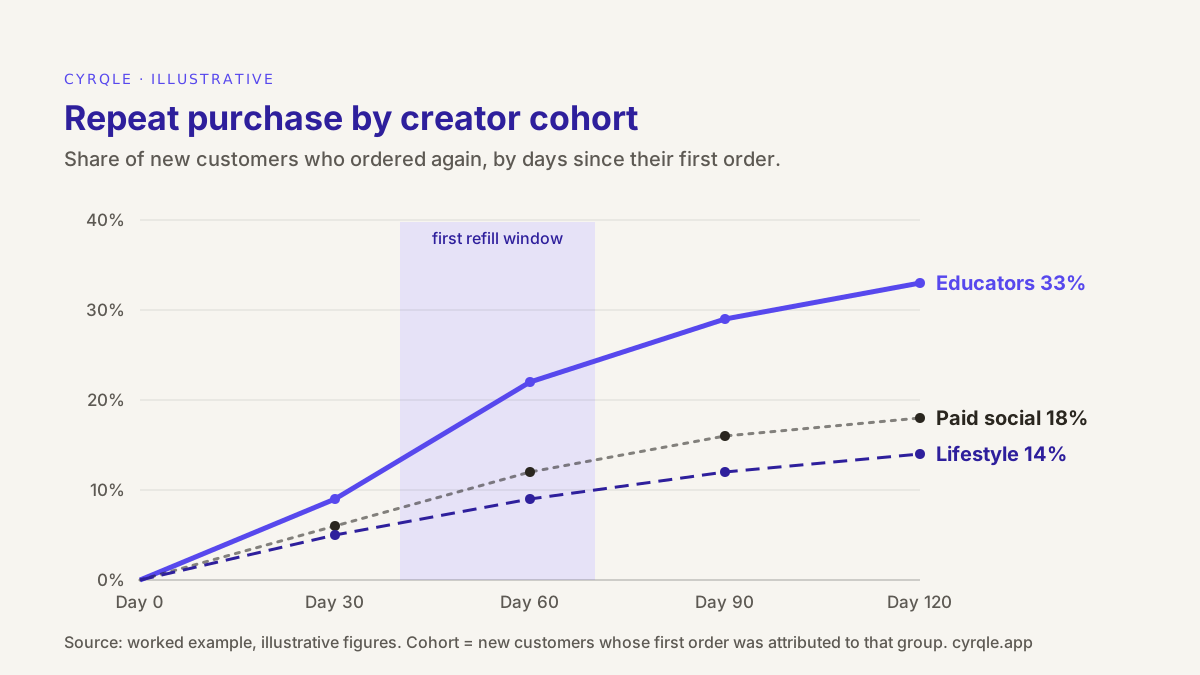
In the illustrative chart, 29% of the new customers brought by skincare educators order again by day 90, against 16% from paid social and 12% from lifestyle creators. Go back to the creator from Step 3 who sold only 10 orders. If she is an educator, her cohort adds repeat revenue that a first-order report never shows. That is the case for judging creators on the cohort they bring, not the click.
A cohort comparison is not proof that the creator caused the sale. To estimate how many sales would have happened anyway, run a holdout test on your creator campaign alongside it.
What mistakes break a beauty creator programme?
- Seeding without codes. You learn nothing about who sold, so the second wave is a guess.
- Paying everyone the same fee in wave 2. Price each hybrid deal on that creator's seeding result and median views.
- Judging on gross revenue. Refunds happen in beauty too, for example after a reaction or a wrong shade. Use net revenue for both ranking and commission.
- Letting creators improvise claims. One "cured my acne" caption can turn a launch into a complaint.
- Assuming a gift includes reuse rights. It does not. Get them in writing before the content goes into an ad.
How does cyrqle help run this playbook?
cyrqle runs this playbook in one workspace, from the shortlist to the commission statement. For the vertical overview, see creator commerce for beauty brands.
- Shortlist. In Find creators, search by meaning across captions and visuals ("barrier repair routine for sensitive skin"), then check each creator's engagement, content mix and past brand collaborations. Save the shortlist to Lists.
- Seeding wave. In Campaigns, set the deal type to Product gift and invite in bulk, in Spanish or English by market. Optional draft sign-off lets you approve content before it goes live. The automated check covers required hashtags and handles; it does not judge product claims, so the claims sheet review stays with your team.
- Attribution. In Attribution, mint a promo code and a tracking link for every creator in bulk. A tag under 2KB on your own store, the Shopify pixel and signed order webhooks record each order, and revenue is shown net of refunds. Every sale gets a confidence tier (Tier 1 — promo code, Tier 2 — same-session, Tier 3 — cookied later). The Attribution tab ranks top creators, which is your wave read-out.
- Hybrid deals. Use invite again to start a new cycle with a winner and switch the deal to Cash, commission & product. The Creator Collaboration Agreement is signed by both sides in the app, with the terms frozen. Content-wall and campaign use are always granted; paid-ads use is granted only if you tick it on the offer. Commission owed is calculated and shown; paying it is a separate step. Creators in Europe and the US are paid in EUR through Stripe Connect.
What cyrqle does not do: it does not build repeat-purchase cohorts or measure incrementality. Each sale carries an audit chain to the creator and code, so you can take the first orders it attributes and match those customers in your own store data. To see the flow on a beauty brief, book a 30-minute demo.
FAQ
How many creators should a beauty brand seed for one launch?
Seventy to 130 is a practical range for a single launch. It is enough for a pattern to show, and small enough to brief, ship and follow up properly. Fewer than 40 and one creator can dominate the result.
How long should I wait before judging a seeding wave?
Thirty days after each creator's post. Skincare buyers often order days after they see the content, and some creators post two or three weeks after the kit arrives. Judge first orders at 30 days and repeat purchase at 60 and 90 days.
Do gifted creators have to label their posts as advertising?
If the gift was given in exchange for content, yes, in Spain the post is advertising and must be labelled. Even a no-strings gift is safer labelled. Brief the label in the gifting agreement and check it in drafts.
Can a creator post before-and-after photos of my product?
Yes, if the result shown matches what your evidence supports, and the photos are honest: the same light and angle, no skin filters, and the time between shots stated. Treat the photos as your own product claim and review them before they go live.
What commission should I offer a beauty creator on a hybrid deal?
There is no standard rate. Work back from your gross margin and your break-even. In our illustrative example, a 10% commission on net revenue and a EUR 400 fee break even at about 18 orders. Always define the revenue as net of VAT and refunds.
Sources
- Regulation (EC) No 1223/2009 on cosmetic products, Article 20 (EUR-Lex): https://eur-lex.europa.eu/eli/reg/2009/1223/oj
- Commission Regulation (EU) No 655/2013, common criteria for claims made for cosmetic products (Official Journal, L 190, via BOE): https://www.boe.es/doue/2013/190/L00031-00034.pdf
- Real Decreto Legislativo 1/1996, Ley de Propiedad Intelectual, Articles 43 and 45 (BOE): https://www.boe.es/buscar/act.php?id=BOE-A-1996-8930
- AUTOCONTROL, Código de Conducta de Publicidad a través de Influencers (2025): https://www.autocontrol.es/app/uploads/codigo-de-conducta-de-publicidad-a-traves-de-influencers-2025.pdf
Related material.
Influencer marketing for restaurants and QSR chains: local creators per outlet, limited-time offers, per-creator codes redeemed at the till, footfall proxies.
Influencer marketing by industry: the objective, compensation model, attribution surface, seasonal calendar and pitfalls for six verticals in Spain and Mexico.
Influencer gifting agreement template on one page: product and value, content expected or not, disclosure, usage rights, returns and the no-post outcome.