
Christmas and Reyes: creator gifting campaigns that still land in time
A Christmas influencer marketing campaign for Spain must cover two gift peaks: Christmas and Reyes on 6 January. Gift guides, cut-offs, cleared content, codes.
A Christmas influencer marketing campaign in Spain should run from early November to 6 January, not to 24 December. Book creators in the first two weeks of November, get product to them before Black Friday, publish gift guides from 30 November, switch to last-minute and Reyes content after the Christmas shipping cut-off, and keep every creator's code live until Reyes. Then put the best cleared posts on your gift pages and measure them separately.
Picture a jewellery brand in Seville. Its creators post gift guides in the second week of December, the codes expire on 24 December, and the team closes the report on the 28th. Then the brand watches orders climb again on 2 and 3 January, from shoppers buying for the Three Kings, with no creator content in their feed and no code to track.
This post is the season plan for brands selling gifts in Spain from their own store: jewellery, beauty, fashion, toys, home and small electronics. It is part of our industry playbooks for creator commerce, and it picks up where our 12-week Black Friday timeline ends.
Why does Spain need two gift peaks in one plan?
Spain gives gifts twice: on Christmas Eve or Christmas Day, and on the night of 5 to 6 January for Reyes, the Three Kings. Both are real buying moments, and in household budgets they are about the same size. A plan that treats Reyes as an afterthought leaves revenue and creator content on the table.
The numbers from Spain's main consumer organisation show the split. In its December 2025 survey of 2,000 people aged 18 to 74, OCU put the planned Christmas-season spend at EUR 796 per person, with gifts the largest item at EUR 370. Of that, EUR 192 was for Reyes gifts and EUR 178 for Christmas Eve gifts. The same survey found that 37% of people named the internet as their main channel, and that 29% planned to push part of their gift buying into January.
Three dates frame the season for 2026 and 2027:
- Friday 25 December 2026: Christmas Day.
- Wednesday 6 January 2027: Epiphany (Reyes), a public holiday throughout Spain in the 2027 work calendar (BOE-A-2026-21254). The parades and gift night are the evening of Tuesday 5 January.
- Thursday 7 January 2027: the traditional start of the winter sales. Retailers can choose their own sale dates, because article 25 of the Ley 7/1996 de Ordenación del Comercio Minorista leaves timing to each retailer, so check what your competitors announce.
That gives you two content windows, separated by a week in which deliveries slow down and people travel. Plan both from the start, with the same creators.
The Christmas and Reyes creator timeline, November to 6 January
Start on 2 November and you can still land both peaks, if each step is short. The plan below assumes a team that already has a creator shortlist or can build one in a week.
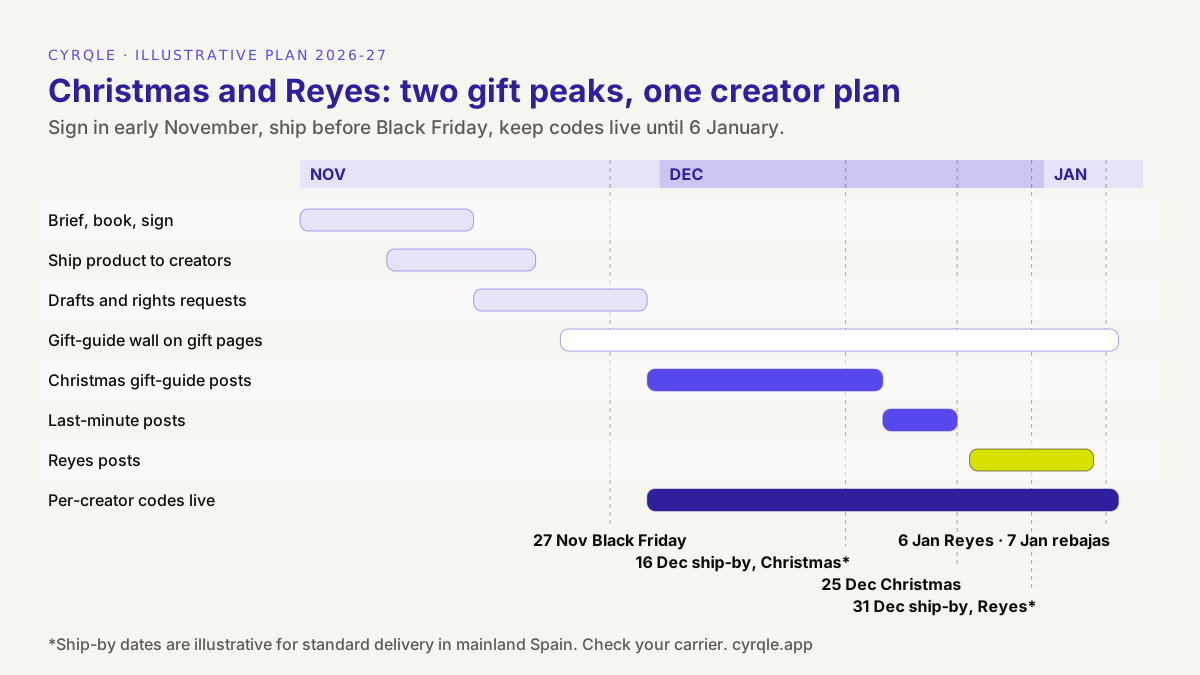
| Dates (2026-27) | Step | Done when |
|---|---|---|
| 2 to 15 Nov | Brief, shortlist, book and sign | Every creator has signed terms with two posting dates |
| 9 to 20 Nov | Ship product to creators | Samples received before Black Friday week |
| 16 to 29 Nov | Drafts, approvals and rights requests | Gift-guide drafts approved; licences cover your gift pages |
| 23 Nov | Gift-guide wall live | Cleared posts on gift and product pages |
| 30 Nov to 18 Dec | Christmas gift guides | First post per creator live, codes active |
| Mid-December | Your Christmas ship-by date | Stories with "order by" go out in the days before |
| 19 to 24 Dec | Last-minute content | Gift cards, click and collect, in-store pickup |
| 26 Dec to 4 Jan | Reyes posts | Second post per creator live |
| Late December | Your Reyes ship-by date | Last "order by" reminders |
| 6 Jan | Reyes | Codes end at midnight |
| Late January | Report | Final numbers after Christmas returns close |
Why ship to creators before Black Friday?
Ship by 20 November because Black Friday week fills the parcel networks and your own warehouse. A sample that leaves on 25 November competes with every Black Friday order, yours included. If a creator films a gift guide without the product, the content is weak; if they film it on 10 December, it misses the first half of the window.
Two ship-by dates, not one
Carriers publish their own Christmas and Reyes cut-offs each year, and they vary by service and destination (mainland, Balearics, Canaries). Take your dates from your carrier, add your own picking time, and treat them as fixed inputs to the plan. The dates in the figure (16 and 31 December for standard delivery) are illustrative.
Is November too late to start a Christmas creator campaign?
No, if you shrink the plan to fit. November is too late for a large cast found from scratch, but it is enough for a smaller group of creators who already know your brand or your category, on clear terms, with product sent at once.
Four ways to make a late start work:
- Start from creators who already post about you. Customers and past collaborators answer faster and need less briefing.
- Offer a fee plus product, not product alone. December is a paid season for creators. A gift-only offer is fine for small creators who love the product, but expect fewer yeses.
- Book two posts per creator in one contract. One gift guide for Christmas and one Reyes post. Negotiating twice in December costs you a week you do not have.
- Cut the approval loop. Approve or reject drafts within 48 hours. Every day a draft waits is a day it is not live.
How to brief a creator gift guide that sells
A gift guide works when it solves the shopper's real problem: who is this for, what does it cost, and will it arrive in time. Brief creators on those three questions, not on your brand story.
| Brief element | What to ask for | Why |
|---|---|---|
| Angle | By budget ("under EUR 50"), by recipient ("for your mum"), or "what I am giving this year" | Matches how people search for gifts |
| Products | Three to five products, each one taggable and in stock | A guide with one product is an ad; with fifteen, nobody chooses |
| Price | Today's price with the creator's code, no "was" price | In Spain, a "before" price must be the lowest price in the previous 30 days (article 20, Ley 7/1996) |
| Deadline | "Order by" date in a story frame or caption | Converts the post into a reason to buy now |
| Code and link | One personal code and one tracking link per creator | Codes survive screenshots; links catch people who skip the code |
| Disclosure | Clear ad label when the creator is paid or got product | Paid or gifted content must be identifiable as advertising |
| Reyes post | A second post after 26 December, Reyes angle | Keeps the same creator and code in the second peak |
On disclosure: paid and gifted content must be identifiable as advertising. Our explainer on Real Decreto 444/2024 for brands covers who the rules apply to, and the decree itself is on the BOE. This is not legal advice: for a specific campaign, ask your lawyer.
After the ship-by date, change the call to action
Once your Christmas ship-by date passes, a post that says "buy now" sends people to an order that will arrive late. Brief creators in advance for the last-minute days: gift cards, click and collect, and in-store pickup. If you have shops, a creator's code can still work at the till, as long as your staff can redeem it.
Should creator codes run through Reyes?
Yes. Keep each creator's personal code live from the first post until 6 January. Ending codes on 24 December cuts attribution in the middle of the season and leaves the Reyes posts with nothing to track. Ending them on 6 January also stops them colliding with your winter sale prices on the 7th.
| End on 24 December | End on 6 January | Run into the winter sales | |
|---|---|---|---|
| Reyes sales tracked | No | Yes | Yes |
| Reyes posts have a code | No | Yes | Yes |
| Clash with sale prices | No | No | Yes: the code stacks on reduced prices or gets ignored |
| Commission on sale orders | Not an issue | Not an issue | You pay commission on discounted orders |
| Best for | Brands that do not sell for Reyes | Most gift brands in Spain | Only with a planned sale offer per creator |
Two details make the codes hold up. Decide whether creator codes stack with your own Christmas offers before you mint them; our post on naming, limits and leakage for creator promo codes covers the rules. And keep the commission calculation open until Christmas returns close. Online buyers in Spain have 14 calendar days from delivery to withdraw, under articles 102 and 104 of the consumer protection law (Real Decreto Legislativo 1/2007), and many stores extend gift returns into January.
Put rights-cleared creator content on your gift pages
The creator posts you paid for do most of their work in the first days on Instagram or TikTok. Your gift pages get traffic for six weeks. Putting the best posts on those pages, as a gift-guide wall under the product, gives shoppers proof from real people at the moment they decide.
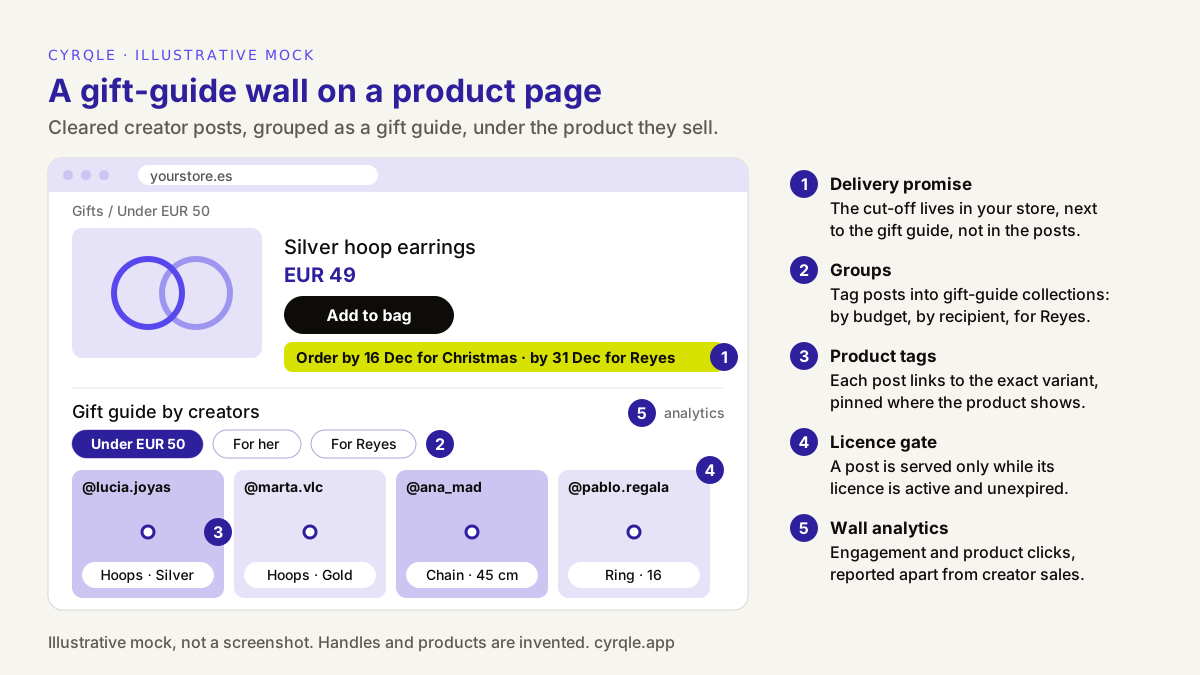
What makes a gift-guide wall work:
- Clear the rights first. A creator's post is not yours to put on your site because you paid for it, unless the contract says so. Get a licence that covers your website, for at least as long as the season. Our guide to requesting content rights from a creator walks through it.
- Group the posts the way people shop. Tabs by budget, by recipient and "for Reyes" turn a grid of posts into a guide.
- Tag the exact product and variant. "Silver, 16 mm" beats "earrings". A tap should land on something the shopper can add to the bag.
- Keep the delivery promise in your store, not in the posts. Put your ship-by dates in a store banner next to the wall. Posts stay up after the date; the banner changes.
- Rotate after Christmas. On 26 December, pin the Reyes posts first.
Jewellery and accessories suit this well, because the product is small, giftable and easy to show on a person. Our page on creator marketing for jewellery brands covers the category in more detail.
Report wall engagement separately from creator sales
A gift-guide wall and a creator campaign feed the same sales, so they must not be added together. Keep two ledgers and read them side by side.
| Ledger | What it measures | Main metrics | Source of truth |
|---|---|---|---|
| Creator sales | Orders that used a creator's code or came through their link | Attributed orders, revenue net of refunds, net ROAS per creator | Promo codes, tracking links, store tag, order webhooks |
| Wall engagement | Whether the content on your pages gets seen and sends people to products | Sessions with the wall, card clicks, product clicks, product click-through rate | Wall analytics |
Wall engagement is a leading indicator, not a sale. If a shopper sees a creator's post on your product page and then types that creator's code, the order belongs to the creator ledger once, not to both. To find out whether the wall itself lifts conversion, compare gift pages with and without it, as our guide to measuring on-site UGC impact explains.
Worked example: a jewellery brand across both peaks
All figures are illustrative.
A jewellery brand in Spain with an average order of about EUR 85 books eight creators in the first week of November: six micro creators at EUR 600 each and two mid-tier creators at EUR 2,000 each, plus one product per creator (EUR 400 in product cost across all eight) and a 10% commission on net revenue. Each creator makes two posts: a Christmas gift guide and a Reyes post. Codes run from 30 November to 6 January.
| Line | Christmas window (30 Nov to 24 Dec) | Reyes window (26 Dec to 6 Jan) | Total |
|---|---|---|---|
| Attributed revenue (gross) | EUR 14,000 | EUR 7,500 | EUR 21,500 |
| Returns (12%) | EUR 1,680 | EUR 900 | EUR 2,580 |
| Net revenue | EUR 12,320 | EUR 6,600 | EUR 18,920 |
| Commission (10% of net) | EUR 1,232 | EUR 660 | EUR 1,892 |
- Fixed cost: 6 x EUR 600 + 2 x EUR 2,000 + EUR 400 = EUR 8,000.
- Total cost: EUR 8,000 + EUR 1,892 = EUR 9,892.
- Net ROAS across both peaks: EUR 18,920 / EUR 9,892 = 1.91.
Now end the codes on 24 December instead. The fixed cost stays the same, because the creators are booked either way, but the Reyes revenue is no longer tracked. Net revenue falls to EUR 12,320, commission to EUR 1,232, total cost to EUR 9,232, and net ROAS to EUR 12,320 / EUR 9,232 = 1.33. The posts and the creators are the same; only the reporting window changed.
In the same period, the gift-guide wall on 40 product pages shows, say, 6% product click-through. That number goes in the wall report. It does not get added to the EUR 18,920, because many of those clicks end in orders that a code or link already counts. And attributed revenue is not incremental revenue: if you need to know what the creators added on top of your normal Christmas demand, run a holdout test, in which a comparable group of shoppers or regions sees no creator content, and compare the two.
How cyrqle helps
cyrqle runs both peaks in one workspace, from the booking to the gift page.
- Book and sign fast. In Campaigns, write the brief with the Sales objective and set the deal as Cash & product or Cash, commission & product. Invites stay blocked until compensation is complete, and each creator signs the Creator Collaboration Agreement with two-sided e-signature. Turn on draft sign-off to approve gift guides and let the automated check flag missing hashtags or handles.
- Codes through Reyes. In Attribution, bulk mint a personal promo code and a tracking link for each creator, with dates that run to 6 January. A tag under 2KB on your store, the Shopify pixel and signed order webhooks tie orders to creators, net of refunds, by confidence tier. In shops, a cashier redemption page records code use at the till. Commission owed is calculated and shown; paying it is a separate step that a person triggers.
- Gift-guide walls. In Content walls, build a product page wall, use "suggest groups" to sort posts into gift-guide collections, and tag each post with the product, variant and pin position. Products come from a Shopify CSV export or are added by hand. A wall serves a post only while an active, unexpired licence exists, so a campaign creator's signed agreement or a rights request covers what shoppers see.
- Two separate reports. Wall analytics (Composition, Engagement, Products) show how the wall performs. Creator sales stay on the campaign Attribution tab. The two do not mix.
To set up the wall on your theme, follow how to embed a content wall on Shopify. To see the plan on your own catalogue, book a 30-minute demo.
FAQ
When should I start a Christmas influencer marketing campaign in Spain?
Ideally in early October, so creators are booked before the Black Friday rush. If you start in November, keep the group small, book two posts per creator in one contract and ship product before 20 November. That is still enough to land gift guides in December and Reyes posts in early January.
Do I need separate creators for Christmas and Reyes?
No. Use the same creators with two posts each. Their audience already knows the product from the Christmas guide, the Reyes post works as a reminder, and one contract and one code cover both peaks.
What should a creator say after the shipping cut-off?
Switch the call to action from "order now" to options that still arrive: gift cards, click and collect, in-store pickup with the creator's code. Brief this in advance, because creators post fast in the last days and a wrong delivery promise costs you trust.
Can I put a creator's Instagram post on my product page?
Only with a licence that covers your website. Paying for a post does not give you that right unless the contract says so. Ask for website use for at least the whole season, and ask separately if you also want to use the post in paid ads.
Should wall engagement count towards creator ROAS?
No. Wall engagement shows whether content on your pages gets attention and product clicks. Creator ROAS comes from orders that used the creator's code or link. Report them side by side, and test the wall's effect by comparing pages with and without it.
Sources
- OCU, "Encuesta Navidad 2025" press release, 9 December 2025 (2,000 people aged 18 to 74): https://www.ocu.org/organizacion/prensa/notas-de-prensa/2025/encuestanavidad091225
- Resolución de 8 de octubre de 2026, de la Dirección General de Trabajo, fiestas laborales 2027 (BOE-A-2026-21254): https://www.boe.es/diario_boe/txt.php?id=BOE-A-2026-21254
- Ley 7/1996, de 15 de enero, de Ordenación del Comercio Minorista, articles 20 and 25 (BOE): https://www.boe.es/buscar/act.php?id=BOE-A-1996-1072
- Real Decreto 444/2024 on influencers (BOE): https://www.boe.es/buscar/act.php?id=BOE-A-2024-8716
- Real Decreto Legislativo 1/2007 (consumer protection law), articles 102 and 104 (BOE): https://www.boe.es/buscar/act.php?id=BOE-A-2007-20555
Related field notes.
Buen Fin influencer marketing in six weeks: book Mexican creators, give each a promo code, label every post as advertising and record bank-transfer payouts.
Black Friday influencer marketing for 2026, week by week: shortlist creators in September, sign in October, mint codes before your freeze, peak on 27 November.
Back to school influencer marketing in Spain: when to book creators, parent vs teen audiences, the rules on ads to minors, basket offers and sales by category.