
Festival season: creator marketing for events, festivals and venues
Influencer marketing for events, festivals and venues: ticket codes and tracking links, on-site content, usage rights, hashtag UGC, an event wall, disclosure.
Influencer marketing for events works best when you treat a festival, concert or venue season as three separate campaigns: one that sells tickets before the doors open, one that captures content while the event runs, and one that reuses that content afterwards. Each window has a different job, a different deal with creators and a different way to measure it. Promoters, venues and sponsor brands that run all three get attributable ticket sales, a library of cleared content and a head start on next year.
Picture a three-day music festival on the coast near Valencia, a club venue in Madrid with a summer programme, or a drinks brand sponsoring a stage at a festival in Mexico City. The creators are the same kind of people in each case: local music, nightlife, lifestyle and food creators whose followers live within travel distance. What changes is who pays, what they want back and where the ticket is sold.
This playbook covers the three windows, how to pay and track creators in each, what to write into the contract so you can reuse the content, how to collect attendee posts by hashtag and put them on a wall, and the disclosure rules for free tickets. It is written for teams selling in Spain, the EU and Latin America. The disclosure section is not legal advice: for a specific campaign, ask your lawyer.
Why is festival season worth planning for?
Live music in Spain is a large and growing market. Ticket revenue passed EUR 800 million for the first time in 2025, according to the yearbook of the Asociación de Promotores Musicales (APM) as reported by Euronews.
The money sits in a short, fixed calendar. A summer festival announces its line-up months ahead, sells in phases, and then lives or dies on a few weekends. Creators help most where demand is still being formed: the announcement, the price-rise deadlines and the last call. For the wider picture of how events compare with other industries, read our creator commerce playbooks by industry.
The three content windows, and how to measure each
A festival campaign has three windows. Each one has a goal, a type of content and a surface that tells you whether it worked. Mixing them up is the most common reporting mistake: a sponsor asks "how many tickets did the on-site creators sell?", when on-site creators were never there to sell tickets.
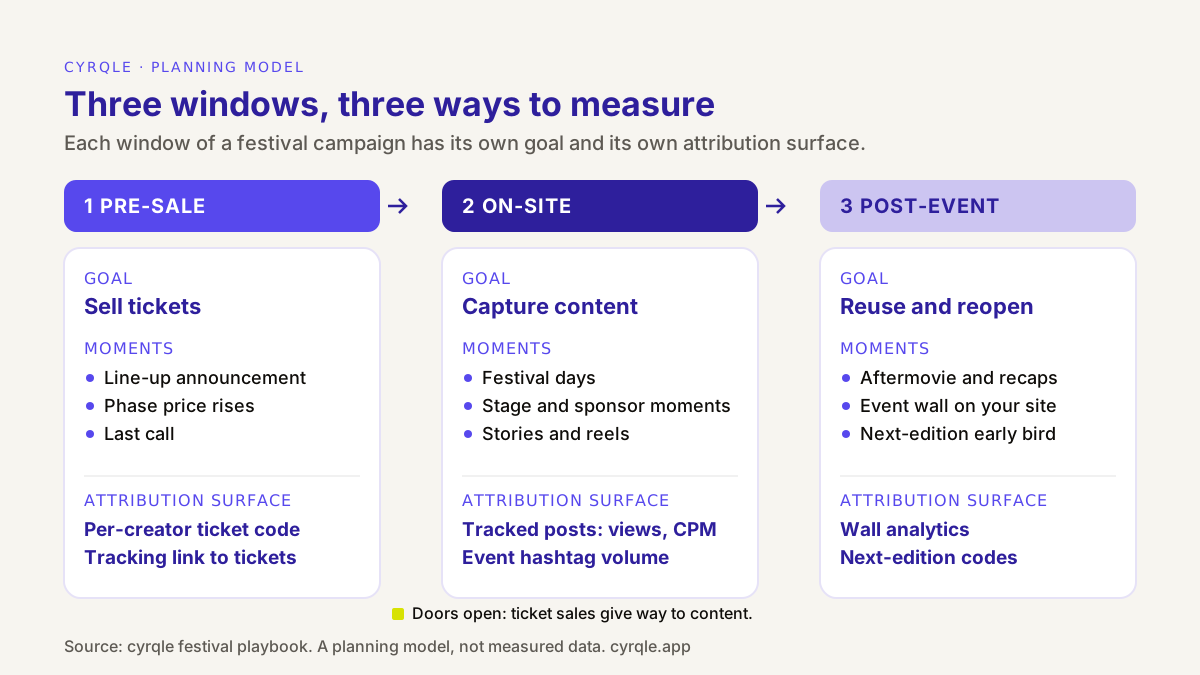
| Window | Goal | Typical content | Attribution surface | What it cannot prove |
|---|---|---|---|---|
| Pre-sale | Sell tickets in each sale phase | Line-up reaction, "who is coming with me", price-rise reminders | Per-creator ticket code; tracking link to the ticket page | That the buyer would not have bought anyway |
| On-site | Capture content and social proof | Stage moments, sponsor activations, outfit and food content | Tracked posts (views, engagement, effective CPM); hashtag volume | Ticket sales (the tickets are already sold) |
| Post-event | Reuse content, open the next edition | Aftermovie clips, recap posts, wall on the event site | Wall engagement; codes for the next edition's early-bird sale | That wall viewers bought (engagement is not a sale) |
Pre-sale: sell the ticket
The pre-sale window runs from the announcement to the last call. This is where creators earn a commission, so this is where attribution must be watertight.
- One code and one link per creator. A personal ticket code (for example
ANA10) works at any checkout that accepts discount codes. A tracking link adds click data and, if the ticket page is on your own domain, ties clicks to orders. - Check the ticketing platform first. Many promoters sell through a third-party ticketing platform. You usually cannot add your own tag to its checkout, so links alone will undercount. Confirm before launch that the platform can export orders with the code used, and agree who sends you that export and how often.
- Time the posts to the phase deadlines. A post that says "prices go up on Friday" has a reason to act. A post on a random Tuesday does not.
On-site: capture, do not sell
On-site creators are there to make content, not to sell tickets that are already sold. Measure them on what they produce: the number of posts delivered, the views those posts got, the effective CPM against the fee, and how many attendee posts use the event hashtag during the event. For the method behind effective CPM, see choosing creators by views and CPM.
Plan the logistics before the gates open: an accreditation list at the creator entrance, a quiet place with power and Wi-Fi, a shot list per sponsor activation, and one person on your team who approves drafts on the day. Stories are where most festival content lives, and they disappear after 24 hours, so ask creators to save them and send you the files or screenshots as proof of delivery.
Post-event: reuse and reopen
The post-event window is short. Interest drops within days, and many festivals open the next edition's early-bird sale soon after the last day. Use it for two things: put the best creator and attendee content on your site, and give returning creators a fresh code for the next edition so their recap posts can sell.
How should you pay event creators?
Pay for the job each window does. A fixed fee suits content you need on a date. A commission suits ticket sales, because it keeps the creator posting through the last call. A free ticket is a form of payment too, and it should be written down as one.
| Deal | Best for | Watch out for |
|---|---|---|
| Fixed fee | Announcement content, on-site coverage, sponsor activations | No link to sales; set deliverables and dates in the contract |
| Commission per ticket | Pre-sale phases, last call | Only works if the ticketing platform reports codes per order |
| Fixed fee plus commission | Larger creators who announce and keep selling | Agree what counts as a sale: net of refunds and cancellations |
| Free ticket (guest list, plus-one) | Micro creators, local scenes, venue nights | It is consideration: disclosure applies, and in Spain it can carry a tax obligation |
In Spain, a free ticket given to a professional creator in return for content can be income in kind, which can trigger a payment on account (ingreso a cuenta) for the payer, in the same way as gifted product. Our guide on paying influencers in Spain walks through that case; confirm the treatment with your tax adviser.
Worked example: a summer festival pre-sale
The figures below are illustrative. A festival sells a three-day pass at EUR 89. Creator codes give EUR 10 off, so each code sale brings in EUR 79.
- 4 mid-size creators: EUR 1,200 fixed fee each, plus 2 passes each. Cash: EUR 4,800.
- 10 micro creators: EUR 250 each, plus 2 passes each. Cash: EUR 2,500.
- Commission: EUR 5 per pass sold with the creator's code.
- Result from the ticketing platform's export: 640 passes sold with creator codes.
| Line | Illustrative amount |
|---|---|
| Ticket revenue from codes (640 x EUR 79) | EUR 50,560 |
| Fixed fees | EUR 7,300 |
| Commission (640 x EUR 5) | EUR 3,200 |
| Total cash cost | EUR 10,500 |
| Cost per pass sold | EUR 16.41 |
| ROAS on cash cost | 4.8 |
| Free passes given (28 x EUR 89 face value) | EUR 2,492 |
Two judgement calls change this picture. First, the 28 free passes: if the festival will not sell out, their real cost is close to zero; if it will, each one is a pass you could have sold. Report both views. Second, incrementality: some code buyers would have bought anyway, and codes leak to coupon sites. Treat the ROAS as an upper bound, and check the code report for sudden spikes from one code. Our guide to influencer marketing ROI covers how to discount for both.
What rights do you need to reuse event content?
You need a licence that names the uses you plan after the event. A creator who agreed to post on their own account has not agreed to appear in your aftermovie, on your website or in next year's ads. Write the reuse into the contract before the event, because asking afterwards gives the creator all the bargaining power.
A usable licence for event content states:
- Which content. The posts and stories delivered under the contract, plus any raw files you ask for.
- Which channels. Your website and event wall, your own social accounts, the aftermovie, email, venue screens. List them.
- Paid ads, separately. Boosting a creator's clip as an ad is a bigger use. Ask for it as a separate, paid right.
- Which markets and for how long. For example: Spain and Mexico, until the end of next year's edition.
- What happens on withdrawal or expiry. The content comes down from live surfaces.
The usage rights entry in our glossary defines the term, and our guide to UGC rights in the EU covers copyright, image rights and GDPR in detail.
One event-specific trap: crowds. A creator can license their own clip, but not the faces of strangers standing next to them. For content you plan to put in ads or large formats, prefer shots where bystanders are not identifiable, and be stricter still where minors could appear.
How do you collect attendee posts by hashtag?
Attendee posts are the largest content source at any event, and the cheapest. The process has four steps: collect posts that use your event hashtag, review them, request rights from each creator, and publish only the cleared posts.
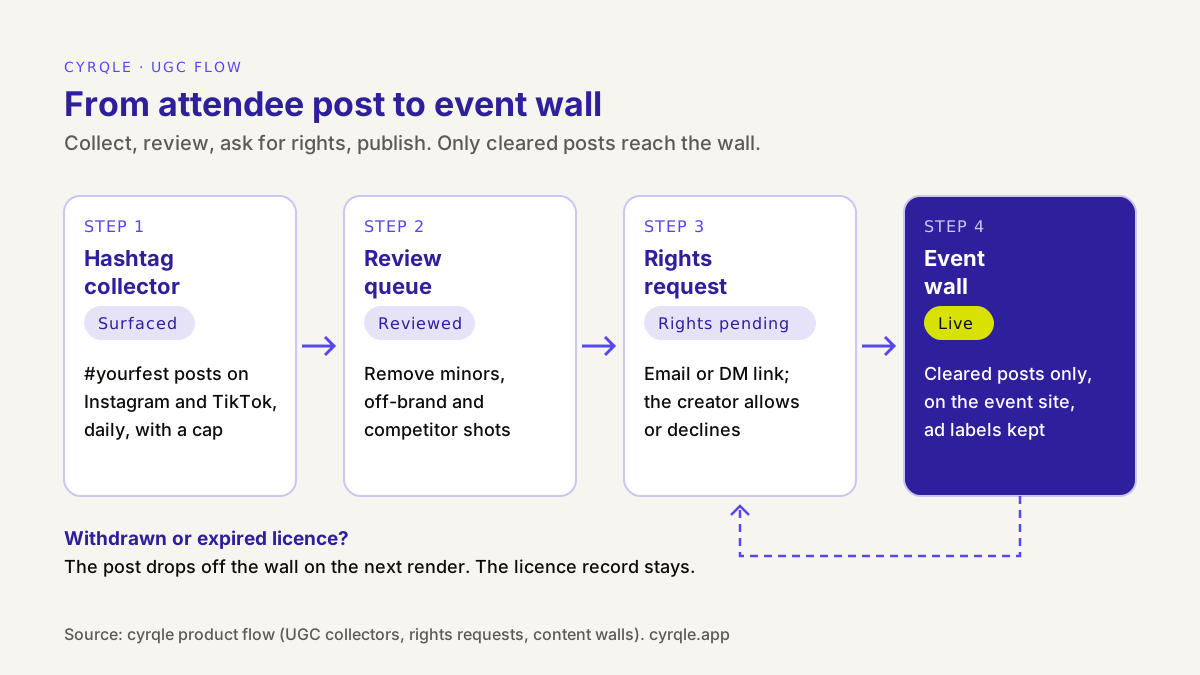
- Pick one short hashtag and print it everywhere. On wristbands, screens, the app and the stage visuals. One hashtag per event (or per edition) keeps the queue clean. Add your venue or festival handle as a second source to catch people who tag you without the hashtag.
- Collect during the event, not a week later. Run the collection daily over the event weekend and keep a spending cap on it.
- Review in a queue. Remove off-brand content, posts showing minors, and posts with visible competitor branding near a sponsor's stage.
- Ask each creator for rights. A hashtag alone is weak evidence of consent. If you run a hashtag contest, publish the terms (in Spain, the bases legales) and still ask post by post before reuse outside the platform.
Then put the cleared posts on the event site. A social wall on the festival page shows the atmosphere to people deciding whether to buy next year, and a wall on a sponsor's page shows its activation in real use. Keep wall engagement and ticket sales in separate columns of your report: a view of the wall is not a sale. Our post on shoppable UGC walls covers formats and curation.
Do free tickets need an ad label?
Yes. In Spain, a free ticket given in exchange for content is consideration, and the post is advertising. Norm 5 of the AUTOCONTROL influencer code lists "la entrada gratuita a eventos" (free entry to events) among the forms of consideration, next to payment, free product, hotel, meals and trips. Content counts as advertising when it promotes a product or service and is published as part of a collaboration in exchange for a payment or other consideration (norm 4).
What that means on the day:
- The label goes at the start of the post, in the language of the post: "publicidad", "publi", "colaboración pagada", "en colaboración con", or the platform's paid-partnership tool. Norm 6 says "Ad" in a Spanish post, "Colab", "sp" and "Regalo de [marca]" are not enough, and that the brand hashtag alone does not identify the content as advertising.
- Hosted extras count too. A courtesy car, a hotel night or dinner in the VIP area are consideration under the same norm.
- The label travels with the content. Norm 6.e says that when sponsored content is shared on other networks or web pages, the label must stay or be added. If you put a paid creator's post on your event wall, keep the disclosure visible.
- Attendees who paid for their own ticket and post without any deal are not advertising. That changes once you give them something in return, such as a prize in a hashtag contest.
The duty itself comes from Spanish law: article 26 of Ley 3/1991 de Competencia Desleal treats paid content presented as information on social networks as misleading unless it is identified as advertising. Our legal checklist for influencer marketing in Spain covers the rest, including the Real Decreto 444/2024 thresholds for large creators. Source for the code: AUTOCONTROL, aea and IAB Spain, Código de Conducta de Publicidad a través de Influencers (2025), checked on 3 June 2026.
A planning checklist for promoters, venues and sponsors
| When | Promoter or venue | Sponsor brand |
|---|---|---|
| 12 to 8 weeks before the announcement | Shortlist local creators; confirm the ticketing platform reports codes per order | Agree with the promoter who owns creator content and the hashtag |
| 4 weeks before | Contracts signed, codes and links issued, disclosure in the brief | Shot list for the activation; paid-ads right agreed if you will boost |
| Sale phases | Posts timed to each price rise; weekly code report | Optional pre-event teaser with your product |
| Event days | Accreditation, draft sign-off, daily hashtag collection | Activation content approved on the day |
| First week after | Rights requests, wall live, recap posts, next-edition codes | Sponsor wall or recap with cleared content |
| End of season | Report: tickets by code, posts and views, cleared assets | Report: content delivered, views, assets cleared for reuse |
For a full calendar of other tentpole moments, see how to plan creator campaigns around the World Cup. The event logic is the same: fixed dates, short windows, content that loses value fast.
How cyrqle helps
cyrqle runs all three windows in one workspace. It does not sell tickets and does not track attendance; it handles the creators, the codes, the contracts, the content and the rights.
- Campaigns and deals. In Campaigns, write the brief and pick an objective such as Sales for the pre-sale or UGC for on-site content. Find creators ranks creators against the brief; you decide who to invite. Set each deal as Cash payment, Commission on every sale, Product gift or a combination; invites stay blocked until compensation is complete. Creators sign the Creator Collaboration Agreement in-platform, and content-wall and campaign use are always granted. Paid-ads use applies only if you tick it on the offer.
- Codes and links. Mint a promo code and a tracking link for every creator in bulk and export them for your ticketing platform. If tickets sell on your own domain, the tag on your site (under 2KB) ties clicks to orders. cyrqle cannot read codes redeemed inside a third-party ticketing platform, so import those sales from the platform's export with Record offline-attributed sale. See creator attribution.
- Drafts and posts. Optional draft sign-off checks the required hashtags and handles before a post goes live. Published Instagram and TikTok posts are tracked with views, engagement and effective CPM. Instagram Stories are not tracked automatically, so collect story proof from creators.
- Hashtag collection and rights. A UGC collector gathers Instagram and TikTok posts by hashtag, keyword or (on Instagram) mention, with a monthly budget cap and a review queue. Request rights from the post card; the creator allows or declines without an account, and every licence lands on the Agreements page.
- The event wall. Content walls put cleared posts on your event site as a social wall grid or another layout, embedded with a small script. A wall serves a post only while its licence is active, so a withdrawal takes the post down.
For the hands-on setup, follow how to set up a UGC collector and then how to request content rights from a creator. The creator marketing page for events and ticketing shows the vertical overview, and you can book a demo to see it on your own event.
FAQ
How far ahead should a festival book creators?
Start shortlisting 8 to 12 weeks before the line-up announcement, and sign contracts at least four weeks before it. The announcement is when demand forms, so creators need their codes, links and brief before that date, not at the general sale.
Can I pay event creators only in tickets?
You can, and it is common with micro creators and venue nights. The ticket is still payment: the post needs an ad label, the deal should be written down, and in Spain a ticket given to a professional creator can carry a tax obligation for the payer. Expect larger creators to ask for a fee as well.
Does a creator's discount code prove they brought someone to the event?
No. A code proves that a ticket was bought with it. It does not prove the buyer attended, and it does not prove the creator caused the purchase. Report ticket sales by code, and keep attendance figures from the ticketing platform in a separate line.
Can I put attendee posts that use my hashtag on the festival website?
Not without permission. Using a hashtag lets you see and share the post inside the platform. Putting it on your own site is a new use that needs a licence from the creator. Collect, review, ask for rights, and publish only what was cleared.
Who owns content a sponsor's creators make at the festival?
The creator owns the copyright unless the contract says otherwise. The sponsor and the promoter should agree before the event which of them gets a licence, for which channels and for how long, and the creator's contract should name both if both will reuse it.
Related field notes.
A Christmas influencer marketing campaign for Spain must cover two gift peaks: Christmas and Reyes on 6 January. Gift guides, cut-offs, cleared content, codes.
Buen Fin influencer marketing in six weeks: book Mexican creators, give each a promo code, label every post as advertising and record bank-transfer payouts.
Black Friday influencer marketing for 2026, week by week: shortlist creators in September, sign in October, mint codes before your freeze, peak on 27 November.