
How much do influencers charge in Spain in 2026?
How much do influencers charge in Spain? Illustrative 2026 fee bands by tier and format, the levers that move price, and how to compare quotes by effective CPM.
Influencers in Spain charge anything from a free product to five figures per post. As an illustrative guide for 2026, one Instagram post or reel costs roughly EUR 50 to 250 from a nano creator (1k to 10k followers), EUR 150 to 800 from a micro creator, EUR 600 to 4,000 from a mid-tier creator and EUR 3,000 to 10,000 from a macro creator. Those bands overlap, and the published sources do not agree with each other.
So the useful answer is a range plus the things that move a quote inside it. A beauty creator in Madrid with 40,000 followers and steady reel views can price above a lifestyle account with 150,000 followers and a tired audience. A brand in Valencia that wants to run the content as ads for three months, and wants the creator to avoid competitors for 60 days, will pay more than one that only wants an organic post next month.
This guide gives illustrative fee bands by tier and format, shows what the public sources say and where they disagree, explains the six levers that move price, and shows how to turn any quote into an effective CPM so you can compare offers on the same scale. It is written for brand and agency teams buying creators in Spain.
How much does an influencer charge per post in Spain?
An influencer in Spain typically charges a flat fee per deliverable, quoted before IVA. The fee scales with audience size, but not in a straight line: a creator's fee rises more slowly than their follower count, and two creators with the same following can quote very different prices.
The chart and table below are illustrative bands for one Instagram reel or feed post with organic use only. They are a planning aid built from the public sources in the next section and from how creator rate cards are usually structured. They are not survey data.
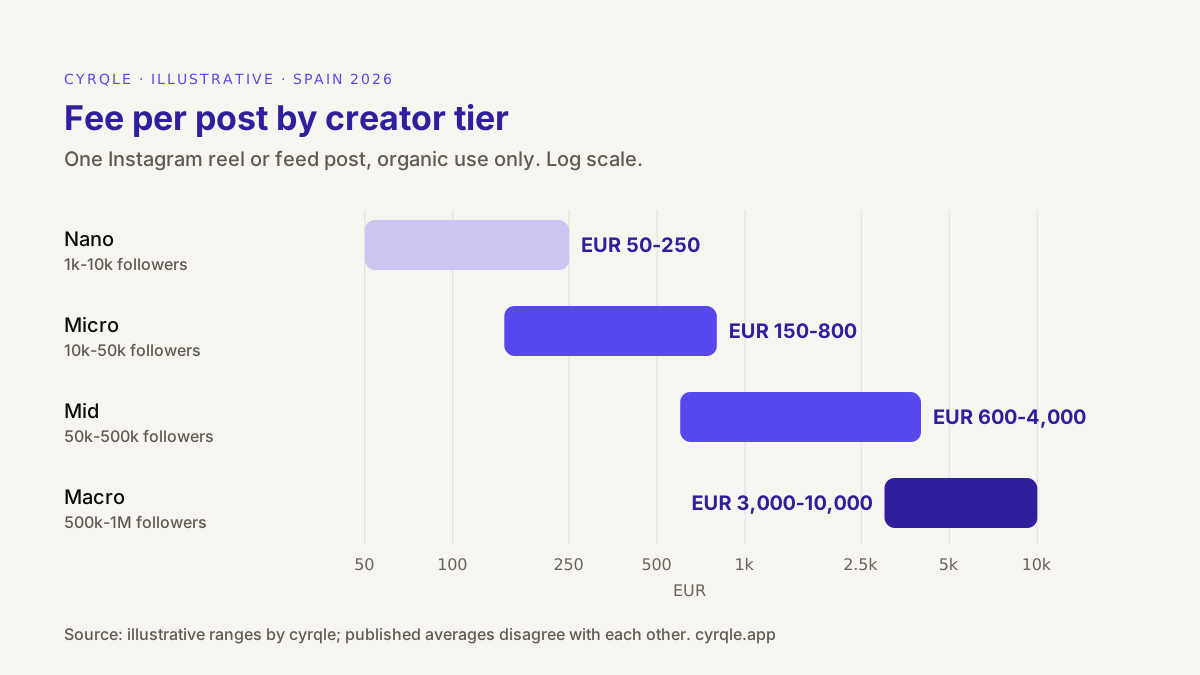
| Tier | Followers | Illustrative fee per post or reel | Illustrative fee per story |
|---|---|---|---|
| Nano | 1k-10k | EUR 50-250, or product only | EUR 20-120 |
| Micro | 10k-50k | EUR 150-800 | EUR 60-400 |
| Mid | 50k-500k | EUR 600-4,000 | EUR 250-2,000 |
| Macro | 500k-1M | EUR 3,000-10,000 | EUR 1,200-5,000 |
| Mega and celebrity | 1M+ | Negotiated case by case, often through an agent | Usually bundled |
All figures illustrative, before IVA and before any usage rights or exclusivity. Many nano and some micro creators accept product gifting or a commission instead of a fee. At the top end, celebrity deals are bespoke and are rarely priced per post at all.
TikTok fees in Spain sit in a similar range for the same audience size, but TikTok views swing more from post to post, so the spread between a creator's quote and the reach you actually get is wider. YouTube integrations usually cost more per creator because the video is longer and lives for years.
What do published sources say, and why do they disagree?
Published Spanish price guides give ranges that overlap but do not match. Two of the most visible are a cost guide from the services marketplace Cronoshare and a Spanish-language article on the Shopify blog. Both are useful as a sanity check. Neither describes its method or sample, and they disagree on several bands.
| Cronoshare (Spain, Jan 2026) | Shopify blog in Spanish (Oct 2024) | |
|---|---|---|
| 1k-10k followers | EUR 85-150 | EUR 10-100 |
| 10k-50k followers | EUR 100-500 | EUR 100-500 |
| 50k-500k followers | EUR 500-5,000 (band runs 50k-1M) | EUR 500-5,000 |
| 500k-1M followers | EUR 500-5,000 (same 50k-1M band) | EUR 5,000-10,000 |
| 1M+ followers | EUR 7,000-18,000 | EUR 10,000 to seven figures |
| Headline figure | EUR 150-700 per post, national reference | Up to EUR 500 per post on average above 100k followers |
| Method stated | No; prices called indicative | No; written for creators, not Spain-specific |
Sources: Cronoshare, "¿Cuánto cuesta contratar a un influencer?" (guide dated 7 January 2026) and Shopify, "Cómo ganar dinero en Instagram" (24 October 2024). Checked on 27 March 2026.
Three things explain the gaps:
- Different tier boundaries. Cronoshare puts everything from 50k to 1M followers in one "macro" band. Shopify splits it into mid (50k to 500k) and macro (500k to 1M). The same creator lands in different rows.
- Different readers. Shopify's article is written for creators deciding what to ask for, and its own text says a 100k account charges "up to EUR 500" on average, which sits at the bottom of its own mid band. Cronoshare's page is written for buyers requesting quotes.
- No method. Neither source says how many creators, which platforms or which years the numbers come from. That is normal for price guides, and it is why you should not anchor a negotiation on one.
Cronoshare also publishes a few useful ratios: on Instagram, roughly EUR 8.50 per 1,000 followers; stories at 40 to 60% of a feed post; reels and video 20 to 50% above a static post; and specialised niches up to 50% higher. Treat those as rules of thumb from one source, not market law.
What moves an influencer's price?
Six levers move a quote more than follower count does. When two creators of similar size quote very different fees, one of these is usually the reason.
| Lever | What it changes | Illustrative effect on the fee |
|---|---|---|
| Median views | Real reach per post, not potential reach | The strongest argument a creator has for pricing above their tier |
| Format | Reel, carousel, static post, story, live, YouTube integration | Stories below a post; reels and video above |
| Usage rights | Reuse on your site, in email, or as paid ads; for how long; in which markets | Often +20 to 50% of the base fee for a few months of paid use |
| Exclusivity | Creator avoids competing brands for a period | Often +10 to 30%, higher for long or broad categories |
| Deadline | Turnaround time, fixed publish date, number of revision rounds | Rush work often +10 to 25% |
| Category | Beauty, finance, tech, parenting, gaming, luxury | Specialist and high-trust niches cost more per view |
Effects are illustrative ranges, not benchmarks. Each is negotiated, and many creators fold some of them into a package price.
Median views: the lever that matters most
Median views of recent posts tell you how many people will probably see your post. Follower count tells you how many people pressed "follow" at some point. A creator with 35k followers and a 60k view median delivers more than a creator with 180k followers and a 40k median. We cover the method in detail in choosing creators by real views and CPM.
Usage rights and exclusivity: the hidden half of the price
The base fee usually covers one organic post on the creator's own account. Anything beyond that is extra. Using the video on your product page, in a newsletter or as a paid ad is a separate permission, and so is asking the creator to turn down your competitors. If you want either, put it in the brief and the contract from the start. Our guide to UGC rights and licences in the EU explains why a public post is not a licence, and the usage rights entry defines the term.
Deadlines and category
A creator who has to shoot, edit and publish in 48 hours is giving up other work. Expect a surcharge, or a no. Category works the other way round: a finance or skincare creator whose audience trusts their advice can charge more per view than a general lifestyle creator, because that trust converts.
Worked example: from base fee to final price
The final price of a creator deal is the base fee plus every extra you ask for. Here is one illustrative deal with a mid-tier creator (50k to 500k followers) at the lower end of the band, for a skincare launch in Spain.
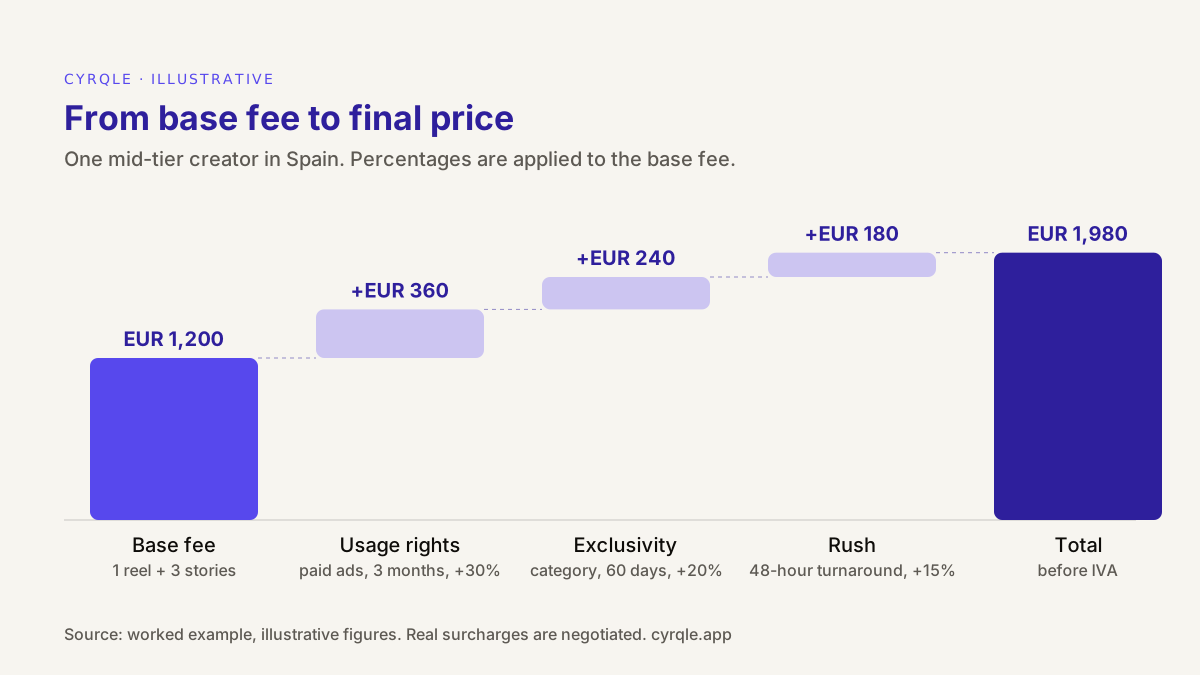
| Line | Basis | Amount |
|---|---|---|
| Base fee | 1 reel + 3 stories, organic use | EUR 1,200 |
| Usage rights | Paid ads in Spain, 3 months, +30% of base | EUR 360 |
| Exclusivity | No competing skincare brands for 60 days, +20% of base | EUR 240 |
| Rush | Publish within 48 hours of approval, +15% of base | EUR 180 |
| Total before IVA | EUR 1,980 |
Illustrative figures. The extras add 65% to the base fee. If you only need organic use and can give the creator two weeks, the same deal costs EUR 1,200. Ask yourself which of the extras you will actually use before you agree to pay for them.
The figure above is the fee. It is not yet the cash you pay out. In Spain the invoice adds IVA and, when the creator is a self-employed individual, you usually withhold IRPF. Our guide on how to pay influencers in Spain covers invoices, withholding and IVA step by step.
How do you compare quotes? Convert them to effective CPM
Effective CPM is the fee divided by the views you expect, times 1,000. It turns quotes from creators of different sizes into one number: what you pay for each thousand people who see the post. It is the same unit paid social uses, so you can also compare creators with your ad benchmark. The CPM glossary entry has the general definition.
Effective CPM = fee ÷ (median views per post × number of posts) × 1,000
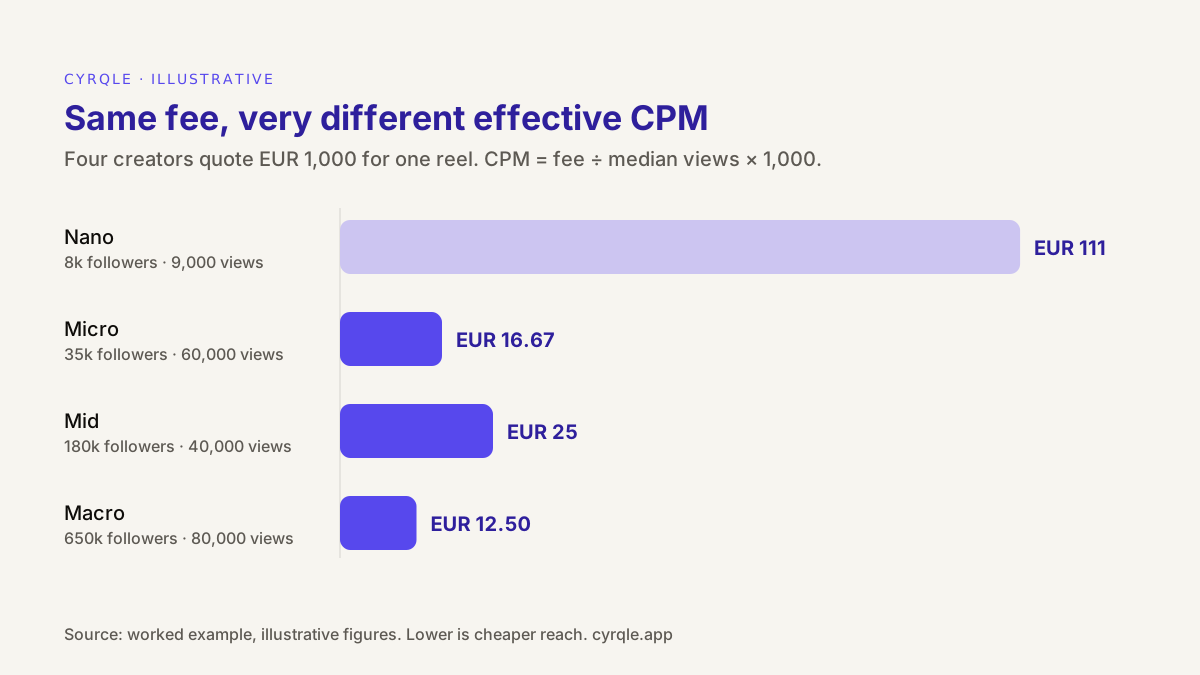
In the chart, four creators all ask for EUR 1,000. The nano creator is a poor buy at that price unless the niche is very specific. The micro creator beats the mid-tier creator because her median views are higher, even with a fifth of the followers.
Converting a follower-based quote
Many creators and agencies still quote per thousand followers. Convert that quote before you compare it. Two illustrative creators, both quoting EUR 10 per 1,000 followers for one reel:
| Creator A | Creator B | |
|---|---|---|
| Followers | 120,000 | 60,000 |
| Quote (EUR 10 per 1,000 followers) | EUR 1,200 | EUR 600 |
| Median views, last 15 reels | 30,000 | 55,000 |
| Effective CPM | EUR 40 | EUR 10.91 |
Illustrative figures. The same per-follower rate gives a CPM almost four times higher for Creator A.
Use effective CPM to set a counter-offer
Work backwards from the CPM you are willing to pay. If you decide EUR 20 per thousand views is fair for this audience, Creator A's post is worth about EUR 600 on reach alone (EUR 20 × 30,000 ÷ 1,000). You can counter at that figure, or keep the EUR 1,200 and ask for more in return: a second reel, three months of usage rights, or story frames with a link. Set the target CPM from your own paid social results for the same audience, not from someone else's average.
Where CPM is not enough
Effective CPM prices reach. It does not price fit, trust or sales. A creator with a higher CPM can still be the better buy if her audience matches your customer exactly, or if you have measured revenue from her past campaigns. Use CPM to find quotes that are out of line, then decide on fit and results.
How to budget and negotiate with creators in Spain
A sensible process for a first campaign in Spain takes five steps:
- Shortlist on views and fit, not followers. Look at median views, the topics the creator actually posts about and recent brand work.
- Write the brief before you ask for prices. State the deliverables, formats, publish window, usage rights and any exclusivity. Vague briefs get padded quotes.
- Ask for a rate card or a quote per deliverable. Then convert every quote to effective CPM.
- Negotiate the package, not just the fee. Trade a lower fee for a longer deadline, fewer revisions or no exclusivity. Or keep the fee and ask for more rights.
- Choose the right pay model. A flat fee suits awareness. Commission or a fee plus commission suits sales objectives. The four creator compensation models covers when to use each.
How cyrqle helps
In Find creators, each creator card carries estimates you can sort on: estimated reach, on-topic reach, a cost estimate, estimated media value and an estimated return. Where cyrqle holds enough observed views for a creator, the reach estimate uses those views rather than a follower-based assumption. The cost estimate is an estimate built from public post data so you can compare creators against each other. It is not the creator's quote, and the real price comes from your negotiation.
When you build a shortlist in clusters, the Planner shows a live reach and cost estimate for the whole group, so you can test budget what-ifs before you contact anyone.
Once you agree terms, compensation and contracts records the deal type (cash payment, commission on every sale, product gift or a combination) and the signed Creator Collaboration Agreement. Paid-ads use is only included if you tick it on the offer, which keeps usage rights explicit rather than assumed. When the campaign is live, the Posts tab shows each published post's views, engagement and effective CPM against a paid-ads benchmark, so you can see whether the price you agreed delivered the reach you priced in.
For pricing of cyrqle itself, see pricing or book a demo.
More in this series
- How to pay influencers in Spain: invoices, IRPF withholding and IVA
- How much should you pay a micro-influencer?
- How much to pay for usage rights and exclusivity: a worked calculator
- Influencer rate card template (EUR)
- How much does a UGC creator charge in Spain?
- CPM, CPE, CPA or flat fee: which pricing model fits your goal
- The true cost of a creator collaboration
- How much do influencers charge in Mexico in 2026?
- Planning your 2027 creator budget: a worked model
FAQ
How much does a micro-influencer charge in Spain?
As an illustrative range, a micro creator with 10k to 50k followers charges about EUR 150 to 800 for one Instagram post or reel, before IVA. Both Cronoshare and Shopify's Spanish blog put the band at EUR 100 to 500. Creators with strong views or a specialist niche price above that.
Do influencer prices in Spain include IVA?
Usually not. Creators quote the fee before IVA, and a self-employed creator in Spain adds IVA on the invoice and may be subject to IRPF withholding. Agree in writing whether a quote is gross or net. This is general information, not tax advice.
Is EUR 10 per 1,000 followers a fair price?
It is a common rule of thumb, not a fair price. A per-follower rate ignores how many people actually see the post. Convert the quote to effective CPM using the creator's median views, and compare it with what you pay for the same audience in paid social.
Do I have to pay extra to use a creator's video in ads?
Yes, in almost every case. The base fee covers an organic post on the creator's account. Reuse on your site, in email or as paid ads is a separate licence, priced by channel, market and duration. Agree it in the contract before the creator publishes.
Will creators work for free product in Spain?
Some nano and micro creators accept product gifting, especially for products they already use. Larger creators rarely do. If you gift, you still need clear terms on what, if anything, the creator is expected to post and how it is disclosed as advertising.
Related field notes.
Influencer CPM vs CPA, CPE and flat fee: one campaign priced four ways, who carries the risk under each, and a decision tree matching the model to your goal.
Influencer rates in Mexico for 2026: illustrative peso fee bands by tier, euro equivalents for Spanish brands, effective CPM, and how to pay Mexican creators.
How much to pay micro influencers: price on median views and on-topic reach, set an opening offer and a walk-away point, and compare gifting, fee and hybrid.