
Returns-adjusted ROAS for fashion creator campaigns
Returns-adjusted ROAS for fashion creator campaigns: gross vs net ROAS per creator with worked numbers, why commission waits for returns, and who changes rank.
Returns-adjusted ROAS is the revenue a creator campaign produced after cancellations and refunds, divided by what the campaign cost. You calculate it once the return window has closed, from revenue net of refunds, and you compare creators on it instead of on gross orders. In fashion, where shoppers often order two sizes and send one back, the gap between gross and returns-adjusted ROAS is usually the biggest correction in the whole report.
Take a denim launch in Spain. A creator in Sevilla posts a haul, her code tops the order chart in week one, and her ROAS looks like 5x. Four weeks later, half of those parcels are on their way back to your warehouse. The creator who ranked third, a stylist in Bilbao who said "I'm wearing a 38, it runs small", kept almost every sale. If you only looked at the first week, you would rebook the wrong person.
This post is a calculator in article form. It gives you the formula, a five-line worksheet you can copy, a worked campaign in euros, a per-creator comparison, and the rule for when to pay commission. It builds on our broader guide to measuring influencer marketing ROI beyond the discount code, which covers VAT, attribution windows and margin.
What is returns-adjusted ROAS?
Returns-adjusted ROAS is ROAS calculated on revenue you kept. The standard return on ad spend divides attributed revenue by cost. The returns-adjusted version removes three things from the revenue first:
- Orders cancelled before shipping. They never became revenue.
- Full returns that were refunded. The whole order came back.
- Partial refunds. One item of a multi-item order came back, or you refunded part of the price.
Returns-adjusted ROAS = (gross attributed revenue − cancellations − refunds) ÷ campaign cost
Do all of it without VAT. Spanish IVA at 21% inflates every euro of revenue by about a fifth, and it is not yours to keep.
Two things are not refunds, and you should not subtract them here:
- Exchanges. A shopper who swaps a 38 for a 40 kept the sale. The exchange costs you shipping and handling, but the revenue stays.
- Store credit. If you refund to a voucher instead of to the card, the money has not left. Decide one rule and write it down. Most brands count store credit as kept revenue and count the later redemption as a new, unattributed order.
Why fashion needs a returns-adjusted number
Fashion return rates are high because fit is hard to judge on a screen. Zalando, one of Europe's largest fashion retailers, says that across all its markets an average of 50 percent of the items ordered are returned (Zalando, "Returns at Zalando"). That is a share of items at a marketplace with free returns, not a share of revenue at your store, so do not copy it into your model. Use your own refund rate by value. The point is the order of magnitude: in fashion, a large share of first-week revenue can come back.
Creator campaigns can push that rate up or down. A haul video invites the viewer to order several sizes and see what fits. A promo code shared on deal forums brings in impulse buyers. A try-on that states the size worn, and compares two sizes, sends buyers to the right size first time. Gross ROAS cannot see any of this. Returns-adjusted ROAS can.
How to calculate it: the five-line worksheet
Copy this worksheet into your report. Every line is ex-VAT. The example column is the campaign used in the rest of this post. All figures are illustrative.
| Line | What goes in it | Example |
|---|---|---|
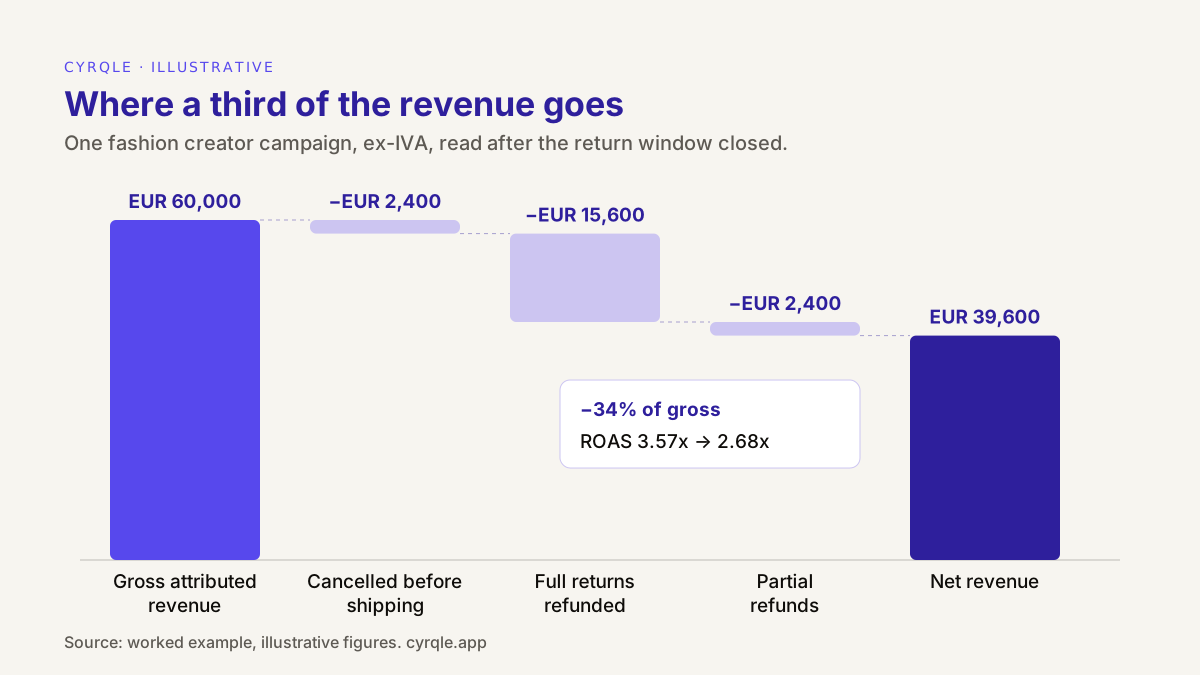
| 1. Gross attributed revenue | All orders tied to the campaign's creators inside your attribution window | EUR 60,000 |
| 2. Cancellations | Orders cancelled before they shipped | −EUR 2,400 |
| 3. Refunds | Full returns plus partial refunds on the remaining orders | −EUR 18,000 |
| 4. Net revenue | Line 1 − line 2 − line 3 | EUR 39,600 |
| 5. Campaign cost | Creator fees, gifted product at cost, commission on net revenue | EUR 14,760 |
| Returns-adjusted ROAS | Line 4 ÷ line 5 | 2.68x |
Two refund rates matter, and they are easy to confuse:
- Refund rate on shipped revenue = refunds ÷ (gross − cancellations). Here 18,000 ÷ 57,600 = 31%. Use this one to compare creators and campaigns.
- Revenue lost to cancellations and refunds = (cancellations + refunds) ÷ gross. Here 20,400 ÷ 60,000 = 34%. Use this one to explain the gap between the dashboard and the final report.
Item return rates (pieces returned ÷ pieces sold) are a third number your warehouse will quote you. They run higher than the refund rate by value when exchanges are common, because an exchanged piece counts as returned but not refunded. They run lower when expensive pieces come back more often than cheap ones. For ROAS, use value.
A worked example: one campaign, gross to net
All figures are illustrative. A Spanish fashion brand runs a six-creator campaign for an autumn denim drop on Instagram and TikTok. Each creator has a fixed fee, a personal promo code, a tracking link and a 10% commission. The store's average order value is EUR 75 ex-VAT. The attribution window is 30 days after the click, and the brand reads the campaign again once every attributed order has passed its return window.
Costs: creator fees EUR 10,000, gifted product at cost EUR 800, commission 10%.
Revenue: the waterfall above. EUR 60,000 gross becomes EUR 39,600 net.
Now the same campaign, measured three ways:
| View | Revenue | Commission | Total cost | ROAS |
|---|---|---|---|---|
| Gross, commission paid on gross | EUR 60,000 | EUR 6,000 | EUR 16,800 | 3.57x |
| Net revenue, but commission already paid on gross | EUR 39,600 | EUR 6,000 | EUR 16,800 | 2.36x |
| Net revenue, commission on net (returns-adjusted) | EUR 39,600 | EUR 3,960 | EUR 14,760 | 2.68x |
The first row is the number that tends to reach the slide in week two. The third row is the honest one. The middle row is what happens when you pay commission before returns settle: you overpay creators EUR 2,040 on sales that came back, and your ROAS takes the hit twice, once in revenue and once in cost.
Is 2.68x still profitable?
ROAS is not profit. To decide, apply your gross margin to net revenue and subtract the cost of handling returns, which ROAS ignores.
- Gross margin after cost of goods, fulfilment and payment fees: 60%. Contribution = EUR 39,600 × 60% = EUR 23,760.
- Return handling: 260 return parcels at EUR 7 each for postage, inspection and repacking = EUR 1,820.
- Profit after campaign cost = EUR 23,760 − EUR 1,820 − EUR 14,760 = EUR 7,180. ROI = 7,180 ÷ 14,760 = 49%.
Break-even ROAS at a 60% margin is 1 ÷ 0.60 = 1.67x, before return handling. Anything below that loses money on the first order, however good the gross figure looked.
Items that come back damaged or out of season and cannot be resold at full price are a further cost. If your returns team writes off a measurable share, add it to the return handling line.
Quick estimate: what refunds do to any ROAS
When you do not have per-order refund data yet, estimate it. With a fixed cost (fees only), returns-adjusted ROAS is simply:
Net ROAS ≈ gross ROAS × (1 − refund rate by value)
| Gross ROAS | 10% refunded | 20% refunded | 30% refunded | 40% refunded | 50% refunded |
|---|---|---|---|---|---|
| 2x | 1.8x | 1.6x | 1.4x | 1.2x | 1.0x |
| 3x | 2.7x | 2.4x | 2.1x | 1.8x | 1.5x |
| 4x | 3.6x | 3.2x | 2.8x | 2.4x | 2.0x |
| 5x | 4.5x | 4.0x | 3.5x | 3.0x | 2.5x |
Calculated from the formula; not benchmarks. At a 60% margin, every cell below 1.67x loses money on the first order. Commission on net revenue shrinks slightly as refunds grow, so the true figure is a little better than the table when part of the cost is commission.
You can also turn the formula around to find how much can come back before a campaign stops paying:
Maximum refund rate before break-even = 1 − 1 ÷ (gross ROAS × margin)
At a gross ROAS of 4x and a 60% margin, that is 1 − 1 ÷ 2.4 = 58%. At 2.5x it is 1 − 1 ÷ 1.5 = 33%. A campaign that looks comfortable on gross can sit only a few points of return rate away from a loss.
A provisional read before the window closes
You will be asked for a number before every return is in. Give a provisional one, labelled as such:
- Take each creator's gross revenue so far.
- Apply your historical refund rate by value for the same categories, from the last two or three campaigns or seasons. Use the category mix: denim and footwear usually come back more than accessories.
- Report "provisional net ROAS" and the date it will be confirmed.
- True it up when the window closes, and keep the provisional figure next to the final one. Over a few campaigns you learn how far off your estimates run.
Do not book commission on the provisional figure. That is the next section.
Which creators look different after returns?
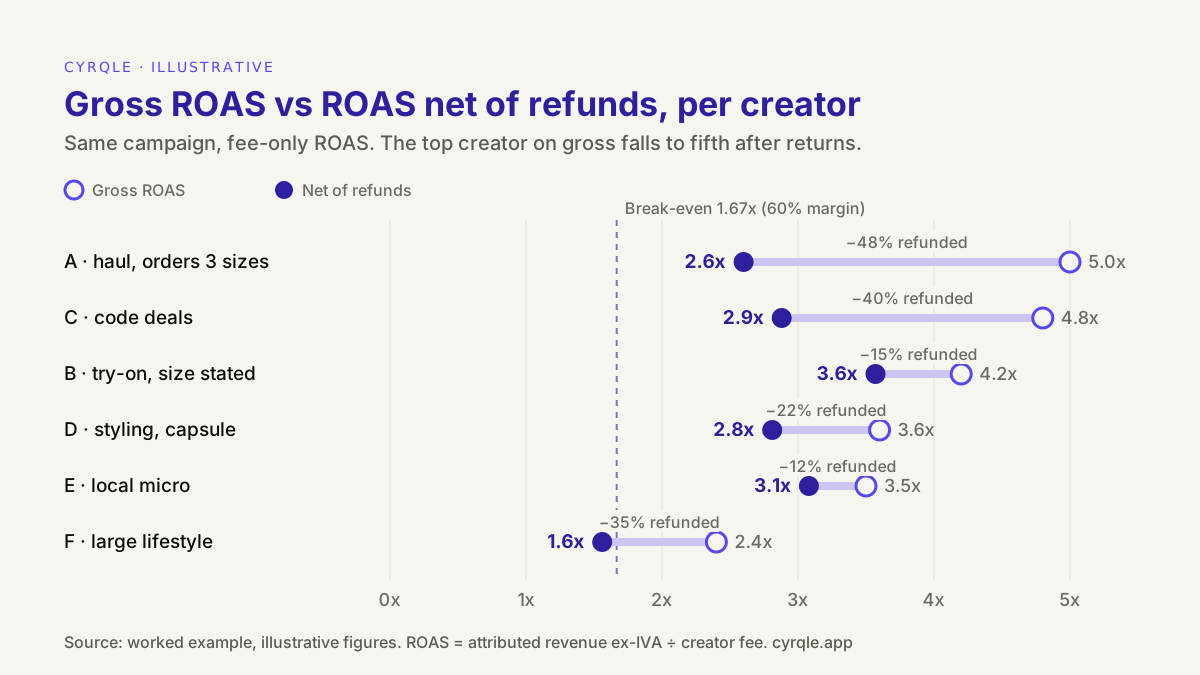
Returns rarely fall evenly across creators. The pattern depends on what the content promised and who it reached. Here are six creators from one illustrative campaign, judged on fee-only ROAS, before and after refunds.
| Creator | Content | Fee | Gross revenue | Refunded | Net revenue | Gross ROAS | Net ROAS | Rank, gross → net |
|---|---|---|---|---|---|---|---|---|
| A | Haul, "I ordered three sizes" | EUR 3,000 | EUR 15,000 | 48% | EUR 7,800 | 5.0x | 2.6x | 1 → 5 |
| C | Shared code on deal pages | EUR 1,500 | EUR 7,200 | 40% | EUR 4,320 | 4.8x | 2.9x | 2 → 3 |
| B | Try-on, states the size worn | EUR 2,000 | EUR 8,400 | 15% | EUR 7,140 | 4.2x | 3.6x | 3 → 1 |
| D | Styling a capsule wardrobe | EUR 2,500 | EUR 9,000 | 22% | EUR 7,020 | 3.6x | 2.8x | 4 → 4 |
| E | Local micro creator | EUR 800 | EUR 2,800 | 12% | EUR 2,464 | 3.5x | 3.1x | 5 → 2 |
| F | Large lifestyle account | EUR 4,000 | EUR 9,600 | 35% | EUR 6,240 | 2.4x | 1.6x | 6 → 6 |
All figures are illustrative. Across the six, gross revenue is EUR 52,000 and net revenue EUR 34,984, so campaign ROAS on fees falls from 3.77x to 2.54x.
What the comparison shows:
- Haul content inflates gross. Creator A sells the most, because the content invites bracketing: order several sizes, keep one. Her net ROAS is still positive, but she is no longer the obvious rebook. A brief that asks for one size and a fit note can fix this; dropping her may not be necessary.
- Codes that leak bring returners. Creator C's code spread to deal pages. Buyers who come for the discount return more and often were not her audience at all. Our post on promo code naming, limits and leakage covers how to keep codes personal.
- Fit information is the strongest lever. Creator B says what size she wears and how it fits. Her buyers choose right the first time, and her net ROAS is the best in the group.
- Small creators often hold up. Creator E's buyers are close to her and trust her fit advice. A 12% refund rate on a small base moves her from fifth to second.
- Some creators fail on both counts. Creator F was the weakest on gross and drops below break-even on net. Returns did not cause the problem, but they confirm it.
The summer-sale version of this pattern, with orders and returns per creator, is in our rebajas playbook for fashion brands.
Check returns by reason, not only by rate
A high refund rate is a signal, not a verdict. Before you judge a creator, look at the return reasons your store records:
| Return reason | What it usually points to | What to change |
|---|---|---|
| Too small or too large | Fit was unclear in the content | Brief try-on with the size worn and a two-size comparison |
| Not as pictured | Colour or fabric looked different on camera | Ask for natural light and a close-up of the fabric |
| Changed mind | Impulse purchase, often discount-led | Shorter code expiry, no stacking with sitewide sales |
| Damaged or wrong item | Your warehouse, not the creator | Exclude from the creator comparison |
Exclude returns caused by your own operations from any creator ranking. The creator did not pack the parcel.
When should you pay commission on fashion sales?
Pay commission on revenue net of refunds, after the return window for those orders has closed. Paying on gross at the moment of the order means paying on sales that will come back, then asking the creator for money or deducting it later.
Spanish consumer law sets the minimum window for online sales (Real Decreto Legislativo 1/2007):
- The buyer can withdraw within 14 calendar days without giving a reason (article 102), counted from the day they receive the goods (article 104).
- After telling you, the buyer has up to 14 more days to send the goods back (article 108.1).
- You must refund within 14 days of being told, but you may hold the refund until the goods arrive or the buyer proves they sent them (article 107).
- If you did not inform the buyer of the right to withdraw, the period is extended by up to twelve months (article 105).
So under the legal minimum a refund can arrive around a month after delivery. Many stores offer 30 days or more as a commercial policy, and then the wait is longer. The same 14-day withdrawal right applies across the EU under the Consumer Rights Directive 2011/83/EU.
A rule that works for most fashion brands: orders placed in one month are confirmed at the close of the following month, and commission is paid on that confirmed net revenue. If your returns policy is longer than 30 days, push the close out by another month. Refunds that arrive after confirmation come off the next statement as a clawback.
Write three things into the creator contract before the first post: the commission base (net of IVA, excluding shipping, after refunds and cancellations), the hold period, and the clawback rule. Our guide to running monthly commission payments without spreadsheets has a full statement with returns, clawback and the IRPF and IVA lines. Fixed fees are different: they pay for content delivered, so pay them on delivery, not after the hold.
This is not legal or tax advice. For a specific contract, check with your lawyer or gestor.
Returns-adjusted ROAS is still not incrementality
Netting out refunds makes ROAS honest about what you kept. It does not tell you what you would have sold anyway. A loyal customer who used a creator's code for a purchase she had already planned is attributed, kept and not incremental. To estimate that share, run a simple holdout; our guide to incrementality testing for creator campaigns shows how without a data team. Report returns-adjusted ROAS as your attributed figure, and incrementality as a separate, later line.
How cyrqle helps
In Attribution, every creator gets a promo code and a tracking link, and each sale gets a confidence tier: Tier 1 — promo code, Tier 2 — same-session or Tier 3 — cookied later, with a 30-day window for Tier 3. Order webhooks from Shopify, WooCommerce and Magento are the server-side source of truth, and refund events from the store are recorded against the original order. Attributed revenue in the campaign Attribution tab is shown net of refunds, the funnel shows how much the campaign has had refunded, and the top-creators list ranks creators on net revenue. The re-ranking in the table above shows up there without an export.
The ROAS at the top of the Attribution tab divides that net revenue by the creator fees committed to the campaign. Revenue is the order total your store sends, so if your finance team reports ex-VAT, remove IVA when you compare it with your own figures. For commission deals, cyrqle calculates the commission owed from net attributed revenue and shows it in reports. It does not pay commission automatically: you decide when the hold period has passed and trigger the payment, which keeps the rule in this post in your hands. See compensation and payouts for how fees, commission and product deals are set up.
If you sell fashion and want to see this on your own categories, the creator commerce setup for fashion and apparel brands shows the full flow, or you can book a 30-minute demo.
FAQ
What is a good returns-adjusted ROAS for a fashion creator campaign?
It depends on your margin. Break-even ROAS is 1 divided by your gross margin: 1.67x at 60%, 2.5x at 40%. Compare returns-adjusted ROAS against that line and against your paid social on the same net, ex-VAT basis, rather than against a published benchmark.
How long should I wait before I calculate returns-adjusted ROAS?
Wait until the return window has passed for the last attributed order. In Spain that is at least about a month after delivery under the legal minimum, longer if your policy allows 30 days or more. Give a provisional figure earlier using your historical refund rate, and label it.
Should exchanges count as returns?
No, not for ROAS. An exchange keeps the sale, so the revenue stays. It still costs you shipping and handling, so include exchanges in the return handling cost when you work out profit.
Should I stop working with creators who have high return rates?
Not automatically. Check the return reasons first. If most returns are about size, a brief that asks for the size worn and a two-size comparison often brings the rate down. Drop a creator when net ROAS stays below break-even after a better brief.
Is commission paid on gross or net sales?
Whatever your contract says, so write it down. Most fashion brands pay commission on revenue net of IVA, shipping, cancellations and refunds, after a hold period that covers the return window. Without a written base, creators and finance will read "10% of sales" differently.
Sources
- Real Decreto Legislativo 1/2007, texto refundido de la Ley General para la Defensa de los Consumidores y Usuarios, articles 102, 104, 105, 107 and 108: https://www.boe.es/buscar/act.php?id=BOE-A-2007-20555
- Directive 2011/83/EU on consumer rights: https://eur-lex.europa.eu/eli/dir/2011/83/oj
- Zalando, "Returns at Zalando" (undated corporate page, checked 3 November 2026): https://corporate.zalando.com/en/node/10413
Related field notes.
Run an influencer marketing incrementality test with a geo holdout: pick regions, size the test, then compute lift and a rough range in a spreadsheet.
How to measure influencer marketing ROI past the discount code: the formula, windows, refunds, repeat purchase, confidence tiers and a worked euro example.
How to tell whether the creator content on your site is earning its place. The metrics that matter at each step, from wall impressions to product clicks to attributed orders, and the traps that make the numbers look better or worse than they are.