
The creator's guide to brand deals: pricing, contracts and getting paid
How to get brand deals as a creator in Spain and Latin America: how brands find you, how to price on views, what to check in a contract, and how you get paid.
To get brand deals as a creator, you need three things: a profile that brands can find and judge in a minute, a price you can explain, and terms you check before you say yes. Brands look for creators by topic and by recent views, not by follower count alone. The deals that go well are the ones where the fee, the usage rights and the payment date are written down before anyone films.
Picture a food creator in Seville with 42,000 followers. A restaurant group sends a DM: "We love your content, can we collaborate?" There is no fee in the message, no dates and no mention of ads. This guide is for that moment. It covers how brands find you, how to price, what to check in a brief and a contract, how and when you get paid in Spain and Latin America, and the red flags that mean you should walk away. It is written for creators in Spain and Latin America, with euros as the currency.
What is a brand deal, and which kinds are there?
A brand deal is a paid agreement in which a creator makes content that promotes a brand's product or service. "Paid" can mean cash, commission on sales, free product, or a mix. The deal is defined by two things: what you deliver, and how you are paid.
There are four common payment structures. We explain each from the brand's side in the four creator compensation models; here is the creator's view.
| How you are paid | Risk on you | Good when | Watch out for | |
|---|---|---|---|---|
| Fixed fee | An agreed amount per deliverable or package | Low: the fee does not depend on sales | You know your views and the brand wants reach or content | Late payment and unpaid extra revisions |
| Commission (revenue share) | A percentage of attributed sales, via your code or link | High: no sales, no income | Your audience buys in that category and you trust the product | How sales are counted, the attribution window, and refunds |
| Product (gifting) | The product itself, with no cash | Medium: you spend time and get no money | You would buy the product anyway and posting is optional | Gifts that come with posting obligations |
| Hybrid | A smaller fixed fee plus commission | Medium: the fee covers your time | You want a floor and upside on sales | A fee so low that the deal is really commission only |
A fifth case is UGC work. Here you make content for the brand to post on its own channels and ads, not on yours. That is spec work: content made to the brand's specification. It is priced on the content and the rights, not on your audience. If that is your main work, see cyrqle for UGC creators.
How do brands find creators?
Brands find creators in four main ways: by searching social platforms and creator databases for a topic, by looking at who already posts about them or their competitors, through agencies, and through creators who apply to open briefs. In every case, the person deciding spends very little time on your profile, so make the important facts visible.
What a brand checks, in roughly this order:
- Topic and audience fit. Do you post about this subject, for people in this market? A Madrid running creator is a natural fit for a sports retailer in Spain, and a weak fit for one in Mexico.
- Recent views. Brands that buy well look at the views on your last 10 to 20 posts, and use the median, not your best post. We explain why in choosing creators by views and CPM.
- Engagement quality. Real comments and saves matter more than a high like count.
- Past brand collaborations. Paid partnerships with similar brands show you can deliver. Too many ads in a row show the opposite.
- How easy you are to reach. An email in your bio and a one-page media kit save a brand a step.
What to put in a media kit
Keep it to one page: who you are, your topic, your markets, median views per format (reels, stories, carousels, TikTok videos) from recent posts, audience basics from your platform insights, two or three past collaborations with results you can share, and your rates or "rates on request". Update it every month or two. Brands notice old numbers.
How much should you charge for a brand deal?
Price on expected views, not on followers. A simple, defensible base rate is: median views per post ÷ 1,000 × the CPM you choose. CPM is cost per thousand views. Then add separate prices for the extras that cost you something: usage rights, paid ads, exclusivity, raw files and extra revisions.
There is no official rate table, and rates depend on market, platform, format and category. For ranges seen in the Spanish market, read how much influencers charge in Spain in 2026. Use those ranges to sanity-check your number, not to set it.
A worked example
All figures in this example are illustrative, not market rates.
The food creator in Seville has 42,000 followers. Her last 15 reels have a median of 18,000 views. Her stories get a median of 4,000 views. She decides on a CPM of EUR 25. The restaurant group asks for two reels and three stories, plus three months of paid ads with the reels, and no other restaurant groups in Seville for 60 days.
| Line | How it is calculated | Amount |
|---|---|---|
| 2 reels | 18,000 ÷ 1,000 × EUR 25 = EUR 450 each | EUR 900 |
| 3 stories | 4,000 ÷ 1,000 × EUR 25 = EUR 100 each | EUR 300 |
| Content subtotal | EUR 1,200 | |
| Paid ads, 3 months | 30% of the content subtotal | EUR 360 |
| Exclusivity, 60 days, local category | 15% of the content subtotal | EUR 180 |
| Quote before tax | EUR 1,740 |
Three points make this quote stronger than "my rate is EUR 1,500":
- Each line has a reason. If the brand pushes back, you can remove a line (drop the ads, shorten the exclusivity) instead of cutting your base rate.
- Rights and exclusivity are separate. They limit what you can earn elsewhere, so they have a price. The 30% and 15% here are examples. Set your own and keep them consistent.
- The tax is extra. In Spain, if you invoice, IVA is added on top of the fee, so say "before tax" in the quote.
If the brand only offers product, compare the product's retail value with your base rate for the same work. If the gap is large, ask for a hybrid deal instead.
What should you check in a brief before you accept?
A brief is the brand's written request: what it wants, by when, and on what terms. Accept it only when eight things are clear. If any of them is missing, ask in writing before you sign or film. Our post on what a working brief includes shows the same document from the brand's side.
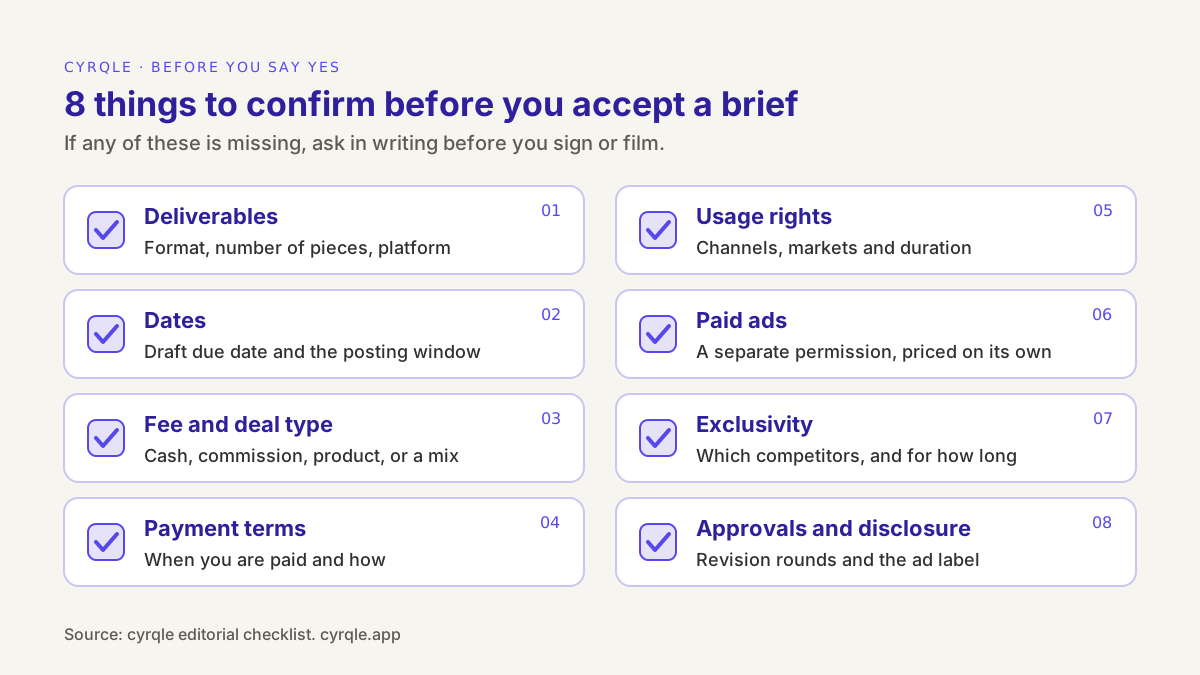
- Deliverables. Format (reel, story, carousel, TikTok video), number of pieces, platform, and how long the post stays up.
- Dates. When the draft is due, and the window in which you post.
- Fee and deal type. Cash, commission, product, or a mix, and the exact amount or rate.
- Payment terms. When you are paid (for example, within 30 days of posting) and how (bank transfer, a payment platform).
- Usage rights. Where the brand may reuse your content (its website, its social accounts, email), in which markets, and for how long.
- Paid ads. Whether the brand may run your content as an ad, or from your account. This is a separate permission with its own price.
- Exclusivity. Which competitors you cannot work with, and for how long. "No food brands for six months" is very different from "no other pizza chains in Seville for 60 days".
- Approvals and disclosure. How many revision rounds are included, and how the post will be labelled as an ad.
Usage rights are where most money is lost
The most common mistake is to treat "the brand can use my post" as one small favour. Showing your reel on the brand's website is a modest use. Running it as an ad that reaches hundreds of thousands of people is a much larger one, and it can run for months. Always agree channels, markets and duration in writing, and price paid ads separately. Our article on UGC rights in the EU explains why a public post is not a licence.
What should a brand deal contract include?
A brand deal contract should repeat everything in the brief as binding terms, and add what happens when something goes wrong. Sign it before you film. A message thread that says "ok, deal" is better than nothing, but it is weak proof and it says nothing about rights or late payment.
| Clause | What to look for |
|---|---|
| Parties | The real company name and tax ID of the brand or agency that pays you |
| Deliverables and dates | The same list as the brief, with the posting window |
| Fee and payment | Amount, currency, whether tax is included, the payment date and method |
| Usage licence | Channels, markets, duration, and whether paid ads are included |
| Exclusivity | Named categories or competitors, and the period |
| Approvals | Number of revision rounds included; the price of extra rounds |
| Disclosure | How the ad label will appear, and who is responsible |
| Cancellation | What you are paid if the brand cancels after you have started |
| Withdrawal | What happens if a post must be removed early, and who decides |
For a clause-by-clause model, see the influencer contract template for Spain and the EU. It is written for brands, which makes it useful for you too: you can see what a careful brand will ask for.
When and how do you get paid?
In Spain, a business that buys your services has to pay within 30 calendar days of delivery when the contract sets no date. The parties can agree a longer term, but never more than 60 calendar days. This is article 4 of Ley 3/2004 on late payment in commercial transactions (BOE). It applies to self-employed professionals as well as companies.
Getting paid in Spain usually also means sending an invoice:
- IVA. The general rate in Spain is 21% (Agencia Tributaria). It is added on top of your fee.
- IRPF withholding. If the brand must withhold income tax on your invoice, the general rate for professional income is 15%, and 7% in the year you start and the two years after, provided you tell the payer (Agencia Tributaria). Whether withholding applies depends on how your activity is classified, so ask your gestor.
- Registration. Regular paid collaborations usually mean you have to register your activity with Hacienda and, in most cases, as self-employed (autónomo) with Social Security. Thresholds and exceptions are a question for a gestor, not for a blog post.
This is general information, not legal or tax advice. For your own situation, ask a gestor or a tax adviser. Our post on how brands pay influencers in Spain shows the same invoice from the brand's side.
If you are in Latin America and the brand is in Spain or elsewhere in Europe, agree the currency, who pays the transfer fees and the payment method in the contract. Local tax rules apply to you, and they differ by country.
Commission deals need a statement
With commission, ask how sales are counted (your code, your link, or both), how long the attribution window is, whether refunds are deducted, and how often you are paid. Ask for a statement with every payment. Without one, you cannot check the number.
Do Spain's influencer rules apply to you?
Some do, whatever your size. The rule that applies to everyone is disclosure: Spain's unfair competition law treats paid promotion on social networks as misleading when it is not clearly identified as advertising (article 26 of Ley 3/1991, BOE). Label every paid or gifted collaboration clearly, at the start of the post or video.
Spain's influencer decree, Real Decreto 444/2024, is narrower. It defines "users of special relevance" (BOE), and a creator is in scope only if all of these are true at the same time:
| Requirement in RD 444/2024 | Threshold |
|---|---|
| Gross income from the activity in the previous calendar year | EUR 300,000 or more |
| Followers | 1,000,000 or more on one platform, or 2,000,000 or more across all platforms |
| Videos published in the previous calendar year | 24 or more |
Creators in scope must register in the state register and follow extra rules under the General Audiovisual Communication Law. Most creators are far below these thresholds. Being below them does not exempt you from the disclosure rule above.
The industry also has a self-regulatory code. The code of conduct on advertising through influencers by AUTOCONTROL, the AEA and IAB Spain was updated with effect from 1 October 2025. It binds the companies and creators that sign up to it, and many brands that work in Spain expect their creators to follow it. Our legal checklist for influencer marketing in Spain covers the brand side.
It is not legal advice: for a specific deal, ask your lawyer.
What are the red flags in a brand deal?
Walk away, or slow down and ask questions, when you see any of these:
- You are asked to pay. A legitimate brand deal does not ask you to pay a joining fee, buy the product first, or pay for "verification".
- No fee, but obligations. "Exposure" with fixed deliverables and dates is unpaid work.
- Free test content. Producing a full video "to see if you are a fit" is unpaid spec work. A paid test is fine. A free one is a red flag.
- Unlimited rights. "All rights, all channels, forever" for the price of one post.
- No written terms. Everything agreed by voice note, nothing in writing.
- Payment only "after results". Unless the deal is openly a commission deal with a clear statement, a fixed fee should not depend on sales.
- Account access. Nobody needs your password. Links to "log in to confirm the collaboration" are a common way to steal accounts.
- A sender you cannot verify. Check that the email domain matches the brand and that the brand's official account knows about the campaign.
How cyrqle helps
cyrqle runs the creator side of a deal in one place. cyrqle for creators is open as a waitlist, and the Creator plan is free. Here is what you get when you join:
- A profile brands can judge. You connect Instagram and TikTok, and brands see your recent performance instead of a follower count alone.
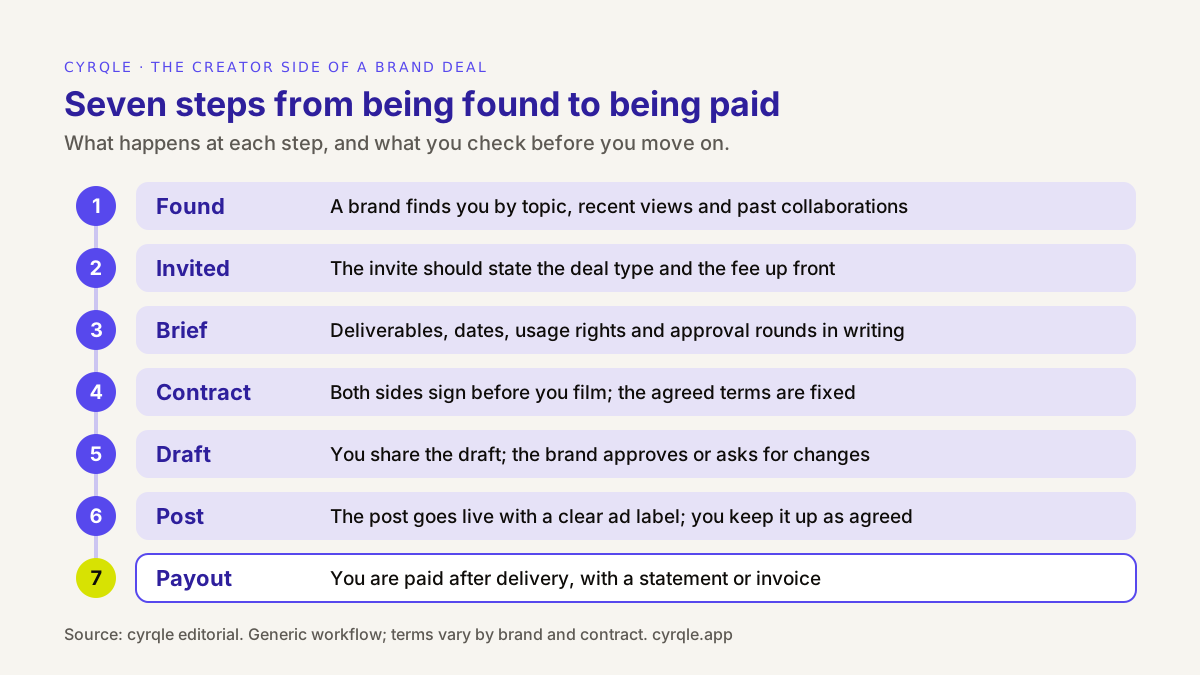
- A briefs inbox. Brands can invite you directly, or you can apply to open briefs. In cyrqle, a brand cannot send invites until the campaign's compensation is complete, so every invite states the deal type and the fee.
- In-app contracts. You sign a Creator Collaboration Agreement by e-signature, and the brand signs too. The agreed terms are saved as a fixed snapshot. Campaign use and content-wall use are part of every agreement, and paid-ads use is included only when the brand ticks it on the offer, so you can see it before you sign. See compensation and contracts.
- Drafts and approvals. You submit drafts, and the brand approves them or asks for changes. An automatic check flags missing required hashtags and handles before you post. See campaigns in cyrqle.
- Payouts. The brand funds the campaign, and a payout is scheduled when you deliver. A person on the brand side releases it, so it is not instant. Creators in Europe and the US are paid in euros to their bank through Stripe Connect, with a statement for each payout. Elsewhere, the brand pays by bank transfer and records the payment in cyrqle.
Commission deals are tracked with your own code and link, and the commission you are owed is shown in the campaign. It is paid as a separate step, not automatically. For the full campaign from the brand's side, read a creator campaign end to end.
More in this series
- How much to charge for a sponsored post: the base-rate calculation for each format.
- Media kit template for creators: a free template in Spanish and English.
- How to negotiate your rate with a brand: scripts for counter-offers.
- Gifted product or paid collaboration: when to accept product only.
- UGC creator rates in Spain: pricing content made for brand channels.
- How to invoice a brand collaboration in Spain: an invoice template.
- Getting paid through Stripe Connect: a walkthrough for creators.
- Tax on gifted products in Spain: what to ask your gestor.
- How brands find creators: the signals they check on your profile.
- How to spot a fake brand deal: scam signals to check before you reply.
FAQ
How many followers do you need to get brand deals?
There is no minimum. Brands that buy well look at recent views, topic and audience fit, so a creator with 5,000 engaged followers in a clear niche can get paid deals. Smaller creators often start with product or hybrid deals and move to fixed fees as their views become steady.
Should you put your rates in your media kit?
You can do either. Published rates save time and filter out brands that cannot pay. "Rates on request" gives you room to price each brief, which helps when usage rights and exclusivity change the deal a lot. If you publish rates, publish the base rate per format and say that rights and exclusivity are priced separately.
Is it OK to accept only free product?
Yes, if the product is worth the work to you and the obligations are light. If the brand expects fixed deliverables, dates and usage rights in exchange for product only, ask for a fee or a hybrid deal. Gifts can also have tax consequences in Spain, so ask your gestor.
What happens if the brand pays late?
First, send a polite reminder with the invoice and the agreed date. In Spain, payment terms between businesses cannot go beyond 60 days, and late payment interest can apply under Ley 3/2004. Keep the contract, the invoice and proof of delivery. If the brand still does not pay, a lawyer or your local consumer and business associations can explain the options.
Do you need a contract for a small deal?
Yes. Even a one-page agreement or a confirmation email that lists deliverables, fee, payment date and usage rights protects you. Small deals are where the terms are most often left vague, and where unpaid extra revisions add up fastest.
Sources
- Real Decreto 444/2024, users of special relevance: BOE-A-2024-8716
- Ley 3/1991 de Competencia Desleal, article 26: BOE-A-1991-628
- Ley 3/2004 on late payment in commercial transactions, article 4: BOE-A-2004-21830
- IVA rates: Agencia Tributaria, tipos impositivos de IVA
- IRPF withholding rates for professional income: Agencia Tributaria, retenciones
- AUTOCONTROL, AEA and IAB Spain influencer code (October 2025 version), effective date as reported by trade press and law firms: Puro Marketing
Related field notes.
How to negotiate with brands as an influencer: anchor on views, counter with scripts in English and Spanish, trade rights, not your fee, and know when to walk.
Should you accept gifted collaborations? A decision guide for creators: product value vs your time, usage rights, disclosure, tax in Spain and how to counter.
Influencer marketing budget planning for 2027, built bottom-up: objectives, tier mix, pricing model, seasonal peaks in Spain and Mexico and a worked euro model.