
Do creators pay tax on gifted products in Spain?
Do influencers pay tax on gifted products in Spain? Payment in kind in plain language, where sources disagree, which records to keep and when to ask a gestor.
Do influencers pay tax on gifted products in Spain? Usually yes. When a brand sends you a product in exchange for a post, Spanish tax law treats it as income in kind, valued at what the product is normally worth on the market. A product with no posting obligation is a grey zone, but we found no official ruling that treats a brand gift to a creator as tax-free.
Picture Lucía, a lifestyle creator in Seville. In one month, three parcels arrive: a EUR 250 skincare set "for a Reel", a EUR 600 bike plus EUR 400 in cash for three posts, and a EUR 90 PR box with a note that says "no obligation, enjoy". None of them feels like income. All three can end up in her tax return.
This guide explains payment in kind in plain language, walks through the common scenarios, shows where official sources and advisers do not agree, lists the records to keep, and tells you when to call a gestor. It covers Spain's common tax territory; the Basque Country and Navarre have their own income tax rules, and the Canary Islands use IGIC instead of IVA. It is not tax advice: for your case, ask a gestor or tax adviser.
What is payment in kind (renta en especie)?
Payment in kind is income you receive as goods, rights or services instead of money. Spain's income tax law (Ley 35/2006, article 42.1) defines it as using, consuming or obtaining goods, rights or services for private purposes free of charge or below the normal market price, even when it costs the payer nothing. Article 43.1 says income in kind is generally valued at its normal market value.
For a creator, that means a product sent in exchange for content is not "free". It is your fee, paid in another form. If a brand would have paid you EUR 250 in cash for the same Reel, a EUR 250 product is the same income for tax purposes.
Two more rules matter in practice:
- The payment on account (ingreso a cuenta). When a Spanish payer would have to withhold tax on a cash payment, it makes a payment on account to Hacienda when it pays in kind instead. For professional activity income, the regulation sets it at the withholding rate applied to the market value (Real Decreto 439/2007, article 104). The general professional rate is 15%, or 7% in your first years (article 95.1).
- The payment on account is part of your income. Under article 43.2 of the income tax law, you add the payment on account to the value of the product, unless the brand charged it back to you. Article 99.6 goes further: when a payment on account was due, it is presumed to have been made, and you include it in your income even if the brand never paid it. You then deduct it as tax already paid.
So a gift is not a loophole. It is a payment that is harder to see, and the paperwork still exists.
Which scenario are you in?
Three questions place most parcels: did you agree to post or deliver something, are you registered with Hacienda as a creator, and was cash paid as well?
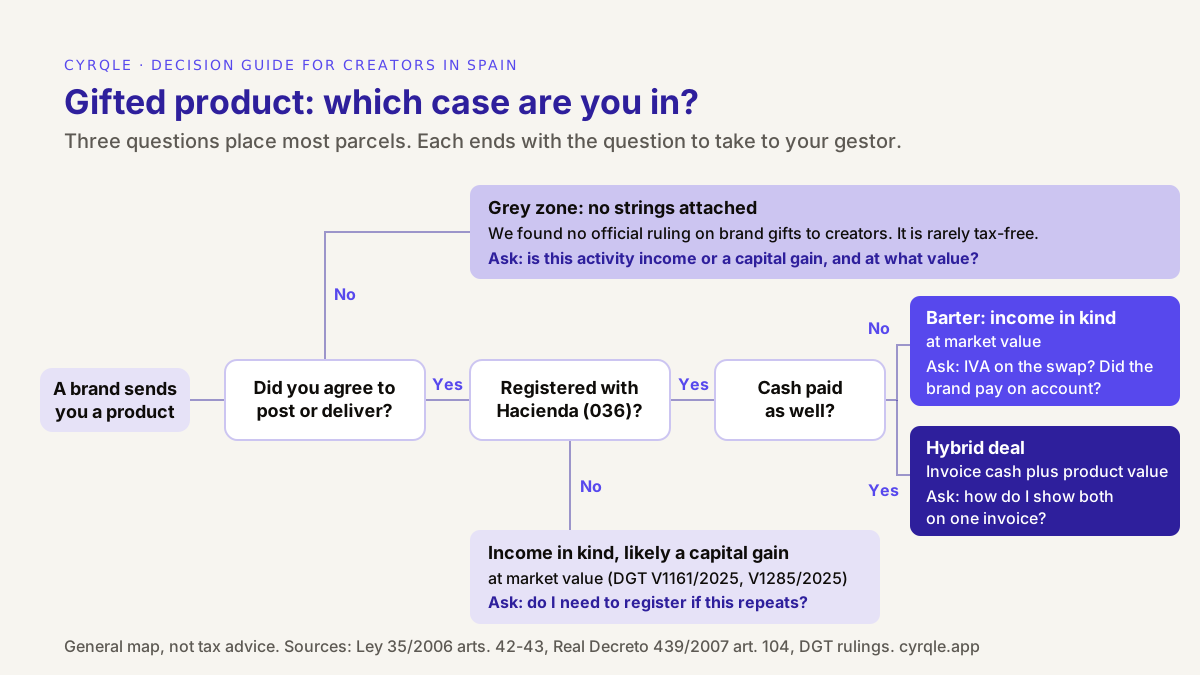
| Likely income tax treatment | IVA | Ask your gestor | |
|---|---|---|---|
| Registered creator, product only, in exchange for content (barter) | Activity income at market value. A Spanish brand may owe a payment on account (15% or 7%) if your activity is professional | Your service is still a supply for consideration. The IVA base is the money value agreed for the product (Ley 37/1992, art. 79.1) | How do we settle IVA on a barter, and did the brand make the payment on account? |
| Registered creator, product plus cash (hybrid) | Activity income: the cash plus the product's market value | 21% on the full base: cash plus agreed product value | How do I show both parts on one invoice? |
| Not registered, occasional product for a review | In the DGT's view, a capital gain in kind at market value, in the general income base (V1161/2025, V1285/2025) | Unsettled. Usually none while you are not acting as a business, but a later DGT ruling reported by secondary sources (V2159-25) treated review-for-product programmes as subject to IVA. Check with a gestor | Do I need to register if this becomes regular? |
| No posting obligation (PR box, seeding) | Grey zone. We found no ruling on brand gifts to creators. If you work as a creator, it is hard to argue the gift is unrelated to your activity | Unclear without an agreed exchange | Is this activity income or a capital gain, and at what value? |
| Loaned product you must return | The DGT has treated the use of a product as income in kind when it has to be returned (V1161/2025) | Depends on whether a service was agreed | How do I value temporary use? |
| You sell products you received | A gain or loss on the sale, or trading income if you sell as a business (V1285/2025) | Selling as a business can make the sale subject to IVA | Do I need a trading registration (IAE) for resale? |
The detail behind each row is below.
You are registered and swap content for product
If you are registered with Hacienda as a creator (census form Modelo 036 or 037, usually as autónomo), a product received for content is part of the income from your activity. Treat it like a fee. Value it at market value, put it on an invoice, and declare it with the rest of your income. The IVA side is covered in the section on disagreements below.
You are not registered and review a product now and then
The Dirección General de Tributos (DGT) has looked at people who receive free products in exchange for testing and reviewing them on a retail platform. In binding rulings V1161/2025 (1 July 2025) and V1285/2025 (10 July 2025), it treated the products as a capital gain in kind, valued at market value and included in the general income base. V1285/2025 added that simply receiving and reviewing products was not an economic activity for the local business tax (IAE) in that case, but that selling the products on would be.
Both rulings concern review programmes on a shopping platform, not creator collaborations. They show the DGT's reasoning for a private person. They do not tell you that a creator who posts sponsored content regularly is a "private person".
The brand sends a PR box with no obligation
This is the case most creators ask about, and the one with the least official guidance. Brands call it product gifting or seeding: send product and hope for coverage. Some advisers argue that a product sent with no conditions is not payment for a service. Others point out that a brand sends it because of your audience, so if you work as a creator, it is linked to your activity. We did not find an official AEAT page or DGT ruling that settles it for creators. What we can say: in income tax, both activity income and a capital gain land in the general income base, so the classification matters mostly for invoicing, IVA and registration, not for whether the value is taxed.
Cash plus product
A hybrid deal is the easiest to handle, because there is already an invoice. Put the cash fee and the agreed value of the product on it. Our guide on how to invoice a brand collaboration in Spain shows the fields, the IVA line and the withholding line, with a template.
Where do sources disagree?
Official texts are clear on the principle: free goods received for private use are income in kind at market value. They are less clear on how that applies to creators. These are the four points where you will hear different answers.
1. Is your activity professional or business?
This decides whether a Spanish brand withholds tax from your cash fee and makes a payment on account on your product. Professional income (section 2 of the IAE tariffs) carries withholding; business income (section 1) usually does not. The DGT placed a content creator in two section 1 headings for video and photography in ruling V0773-22 (2022), and in group 869 of section 2, a professional heading, in ruling V2390/2024 (21 November 2024). Your heading is on your census registration. Tell the brand which one you have, and let your gestor decide which fits your work.
2. Is a no-strings gift income?
See the grey zone above. The honest answer is that it depends on facts: whether there was any understanding about posting, whether you work as a creator, and whether the brand treats it as marketing spend tied to you. If in doubt, record the gift and ask.
3. What is the "normal market value"?
The law says normal market value, not "the price on the brand's invoice" or "zero because you would never buy it". The usual retail price on the day you received the product is the common starting point. A lower price that any customer could get at the time, such as a public sale price, can be a reasonable argument. Whatever you use, write down how you got the number and keep a screenshot.
4. How does IVA work on a barter?
For deals paid in kind, the IVA base is the money value the parties agreed for the non-cash part (Ley 37/1992, article 79.1). At the general rate of 21%, a EUR 250 product deal carries EUR 52.50 of IVA on your service. Strictly, a barter is two supplies: your content to the brand and the brand's product to you, and each side can charge IVA on its part. Practice varies a lot between brands and gestores. Agree in writing who pays which amount, in cash, before you post.
One more point that is not in dispute: Spain's influencer decree, Real Decreto 444/2024, counts income in kind towards its EUR 300,000 threshold for "users of special relevance" (article 3.2). Most creators are far below it, but products and trips count. Our explainer on whether Spain's influencer law affects you as a creator covers the thresholds and the duties.
Worked example: Lucía's three parcels
All figures are illustrative. Lucía is registered as a professional creator and her brands are Spanish businesses that apply the 15% rate.
| Parcel | What she agreed | Income to declare | Paid on account by the brand | IVA on her invoice |
|---|---|---|---|---|
| Skincare set, retail EUR 250 | One Reel, product only | EUR 250 + EUR 37.50 = EUR 287.50 | 15% × 250 = EUR 37.50 | 21% × 250 = EUR 52.50 |
| Bike, retail EUR 600, plus EUR 400 cash | Three posts | EUR 1,000 + EUR 90 = EUR 1,090 | Withholding 15% × 400 = EUR 60; payment on account 15% × 600 = EUR 90 | 21% × 1,000 = EUR 210 |
| PR box, retail EUR 90 | Nothing; she posted a story anyway | EUR 90, classification to confirm | Unclear | Unclear |
How to read the table:
- The skincare set. The brand makes a EUR 37.50 payment on account to Hacienda. If it does not charge that back to Lucía, she declares EUR 287.50 and deducts EUR 37.50 as tax already paid. The EUR 52.50 of IVA is the amount to agree in writing.
- The bike. Lucía's invoice has a base of EUR 1,000. The brand pays her EUR 400 + EUR 210 IVA − EUR 60 withholding = EUR 550 in cash, and hands over the bike. In her return she counts EUR 1,000 of income (plus the EUR 90 payment on account, unless it was charged back to her) and EUR 150 already paid.
- The PR box. Her gestor decides whether it is activity income or a capital gain. Either way, about EUR 90 lands in her general income base. She keeps the note that says "no obligation" in her records.
The lesson for Lucía: the cash she can spend from these three parcels is EUR 550, but the income she reports is around EUR 1,467. At an illustrative marginal rate of 30%, the tax on the product part alone (about EUR 1,067.50) comes to roughly EUR 320. The brands already paid EUR 127.50 of it on account; the rest comes out of her cash. Price product deals with that in mind, as our post on whether to accept a gifted product or a paid collaboration explains.
What records should you keep for each collaboration?
Keep one folder per collaboration with eight items. They let you prove what you received, what you gave in return, and how you valued it.
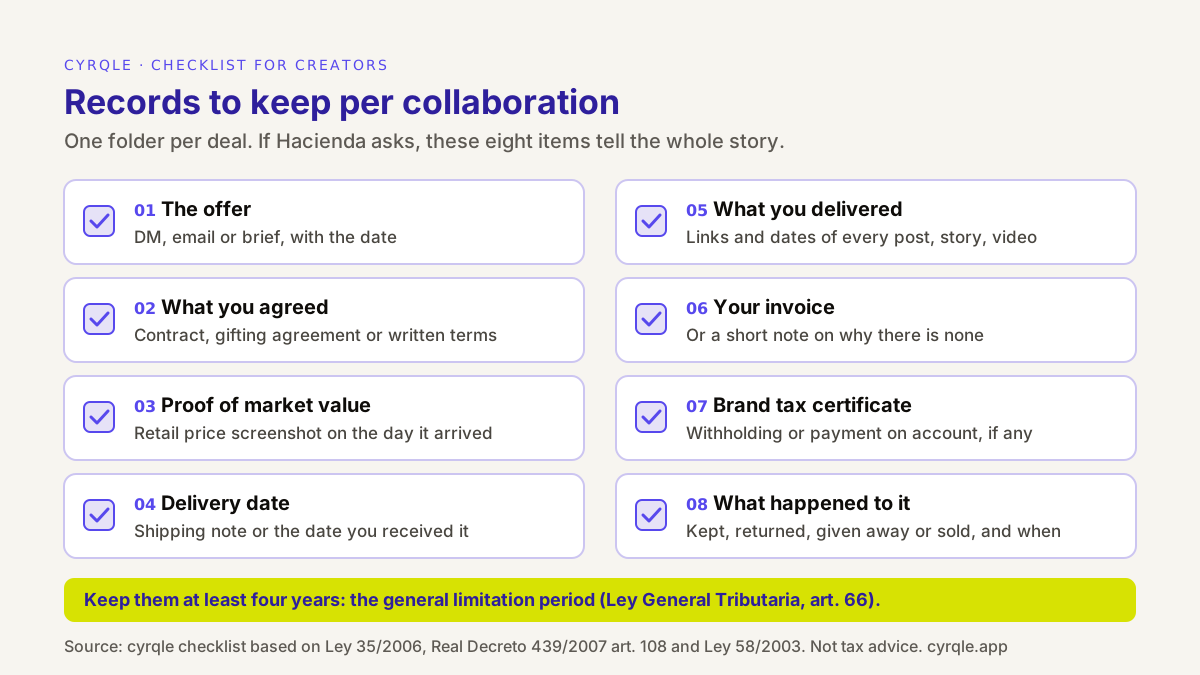
- The offer. The DM, email or brief, with its date. It shows whether posting was a condition.
- What you agreed. A contract, a short gifting agreement, or at least written terms. Our product gifting agreement template covers the basics in Spanish and English.
- Proof of market value. A screenshot of the retail price on the day the product arrived, or the value the brand stated in writing.
- Delivery date. The shipping note or the date you received it. It decides the tax year.
- What you delivered. Links and dates for every post, story and video.
- Your invoice, or a short note on why there is none (for example, "no-obligation gift, no service agreed").
- The brand's tax certificate. A payer that withholds or makes a payment on account must give you a certificate of the amounts before the income tax filing season (Real Decreto 439/2007, article 108.3). Ask for it if it does not arrive.
- What happened to the product. Kept, returned, given away or sold, and when. A sale can change the tax treatment.
Keep the folder for at least four years. Under article 66 of the Ley General Tributaria, that is the general period in which Hacienda can review a tax return, and it starts when the filing period ends, so in practice it runs longer.
When should you talk to a gestor?
Talk to a gestor before the problem grows, not when a letter arrives. These are the moments that justify the fee:
- Before your first paid or product deal, to decide whether to register, under which heading, and how to invoice.
- When product deals become regular. One review a year is one thing; a parcel a week is a pattern.
- When a single product is worth more than a typical cash fee, such as a bike, a trip or a phone.
- When a brand abroad sends product, because the IVA and withholding rules change with where the brand is.
- When you plan to sell products you received.
- When you get a letter or a requirement from the AEAT.
Bring the questions from the decision tree, your folder of records, and a list of every brand you worked with this year. For the wider business side of brand work, pricing and contracts, read the creator's guide to brand deals.
How cyrqle helps
cyrqle does not calculate your tax, file returns or give tax advice. What it does is keep the facts of each deal in one place, which is most of what your gestor needs.
- The deal type is visible before you accept. In the creator app, a brief shows the compensation the brand set: Cash payment, Commission on every sale, Product gift, or a combination. A brand cannot invite you until it has set it, so a product deal is never a surprise.
- The terms are signed and frozen. You and the brand e-sign the Creator Collaboration Agreement, and the terms are frozen at signature. That signed record is item 2 on the checklist.
- Cash payouts have a statement. For cash deals paid through Stripe Connect (available in Europe and the US; elsewhere the brand pays by bank transfer and records it), each payout shows the split, including any tax withheld, with a statement or invoice per payout. Our walkthrough of getting paid through Stripe Connect shows how it works.
See compensation and contracts for how brands set up each deal type. cyrqle for creators is open by waitlist; you can join it from the creators page.
FAQ
Do I have to pay tax on PR packages I did not ask for?
Possibly. A product sent with no obligation is a grey zone, and we found no official ruling that treats it as tax-free for a creator. If you work as a creator, it is hard to argue the gift has nothing to do with your activity. Record it and ask your gestor how to classify it.
How do I value a gifted product for tax?
At its normal market value. The usual retail price on the day you received it is the common starting point. Keep a screenshot and a note of how you got the number.
Does the brand have to withhold tax on a product?
If the brand is a Spanish business and your activity is professional, it generally makes a payment on account of 15%, or 7% in your first years, on the product's market value (Real Decreto 439/2007, article 104). If your activity is classed as business, there is usually no withholding. Ask the brand for its certificate.
Do I need to register as autónomo to receive products?
Not automatically. The DGT treated an occasional product reviewer as a private person with a capital gain, not an economic activity (V1285/2025). If you post sponsored content regularly or invoice brands, registration is likely. Ask a gestor before it becomes a pattern.
What if I give the product away or sell it?
Giving it away does not undo the income you received. Selling it can create a gain or a loss, and selling as a business can mean registering for trade and charging IVA (V1285/2025). Record what you did and when.
Is this the same in Latin America?
No. Each country has its own rules on income in kind and on who must withhold. This guide covers Spain's common tax territory only.
Sources
- Ley 35/2006, del Impuesto sobre la Renta de las Personas Físicas, arts. 33, 42, 43 and 99: https://www.boe.es/buscar/act.php?id=BOE-A-2006-20764
- Real Decreto 439/2007, Reglamento del IRPF, arts. 95, 104 and 108: https://www.boe.es/buscar/act.php?id=BOE-A-2007-6820
- Ley 37/1992, del Impuesto sobre el Valor Añadido, arts. 79 and 90: https://www.boe.es/buscar/act.php?id=BOE-A-1992-28740
- Ley 58/2003, General Tributaria, art. 66: https://www.boe.es/buscar/act.php?id=BOE-A-2003-23186
- Real Decreto 444/2024, art. 3: https://www.boe.es/buscar/act.php?id=BOE-A-2024-8716
- Agencia Tributaria, Manual práctico de Renta 2025, gains not derived from transfers: https://sede.agenciatributaria.gob.es/Sede/ayuda/manuales-videos-folletos/manuales-practicos/irpf-2025/c11-ganancias-perdidas-patrimoniales/determinacion-importe-ganancias-perdidas-patrimon-generales/no-derivadas-transmisiones-elementos-patrimoniales.html
- Agencia Tributaria, Modelo 036 census registration: https://sede.agenciatributaria.gob.es/Sede/procedimientoini/G322.shtml
- Agencia Tributaria, IVA rates: https://sede.agenciatributaria.gob.es/Sede/iva/calculo-iva-repercutido-clientes/tipos-impositivos-iva.html
- Dirección General de Tributos, binding rulings V0773-22, V2390/2024, V1161/2025 and V1285/2025 (search the number in the DGT database): https://petete.tributos.hacienda.gob.es/consultas/
Related field notes.
Should you accept gifted collaborations? A decision guide for creators: product value vs your time, usage rights, disclosure, tax in Spain and how to counter.
Fake brand deal scam? A creator's red-flag checklist: lookalike domains, upfront fees, login links, exposure-only offers, spec work, rights grabs, how to check.
An agency paying influencers on behalf of a client must settle who funds, who invoices, who withholds IRPF and how its fee shows. Worked EUR 1,000 payout split.