
Gifted product or paid collaboration: when should a creator say yes?
Should you accept gifted collaborations? A decision guide for creators: product value vs your time, usage rights, disclosure, tax in Spain and how to counter.
Should you accept a gifted collaboration? Say yes when the gift comes with no obligation and you would use the product anyway, or when its retail value covers what you would normally charge for the work. Counter with a hybrid offer, product plus a fee, when the brand asks for set deliverables, usage rights or paid ads. Decline when the product is worth less than your time and the brand is not a strong fit.
Picture Marta, a skincare creator in Bilbao with 18,000 followers. A brand sends a DM: "We'd love to send you our new serum set. Could you do a Reel and a few stories when it arrives?" No fee, no dates, no mention of how the brand will use the video. The set retails at EUR 45. The Reel and stories will take her most of a working day.
This guide gives Marta, and you, four questions to answer before saying yes, a simple way to put a price on a gift, what changes when rights or ads are involved, the disclosure and tax rules in Spain, and a script for countering with a hybrid. It is written for creators in Spain and Latin America, with euros as the currency. It is not legal or tax advice.
What is the difference between a gift and a paid collaboration?
A gift is product sent with no obligation to post. A paid collaboration is an exchange: you deliver content, and the brand pays you in cash, commission, product or a mix. The moment a gift comes with a request (a Reel, a date, a hashtag, approval of your draft), it is no longer a gift. It is a deal paid in product, sometimes called a canje in Spanish.
Brands use the word "gifting" for both, so read the offer, not the label. Our glossary entry on product gifting describes the brand-side view: send product and hope for coverage. From your side, the question is simple. What do they expect in return?
| True gift | Gift with conditions (barter) | Paid or hybrid collaboration | |
|---|---|---|---|
| Posting obligation | None. You post only if you want to | Yes: set formats, number of posts, dates | Yes, written in a brief and contract |
| What you receive | The product | The product only | Cash, commission, product, or a mix |
| Brand control over content | None | Often: key messages, approval rounds | Agreed approval rounds |
| Usage rights for the brand | None beyond the platform's own share features | Often asked for, rarely priced | Priced and written into the contract |
| Ad label if you post | Yes, if you post about it | Yes | Yes |
| When it is a good deal | You want the product | Product value covers your time and no rights are asked | The fee covers your time, rights and exclusivity |
The four ways brands structure payment are covered in the four creator compensation models. A gift with conditions is the product-seeding model. A hybrid is product or commission plus a cash fee.
Should you accept a gifted collaboration? A four-question test
You can decide almost any gifting offer with four questions. Answer them in order, before the parcel arrives, because once you have opened and used the product, saying no gets harder.
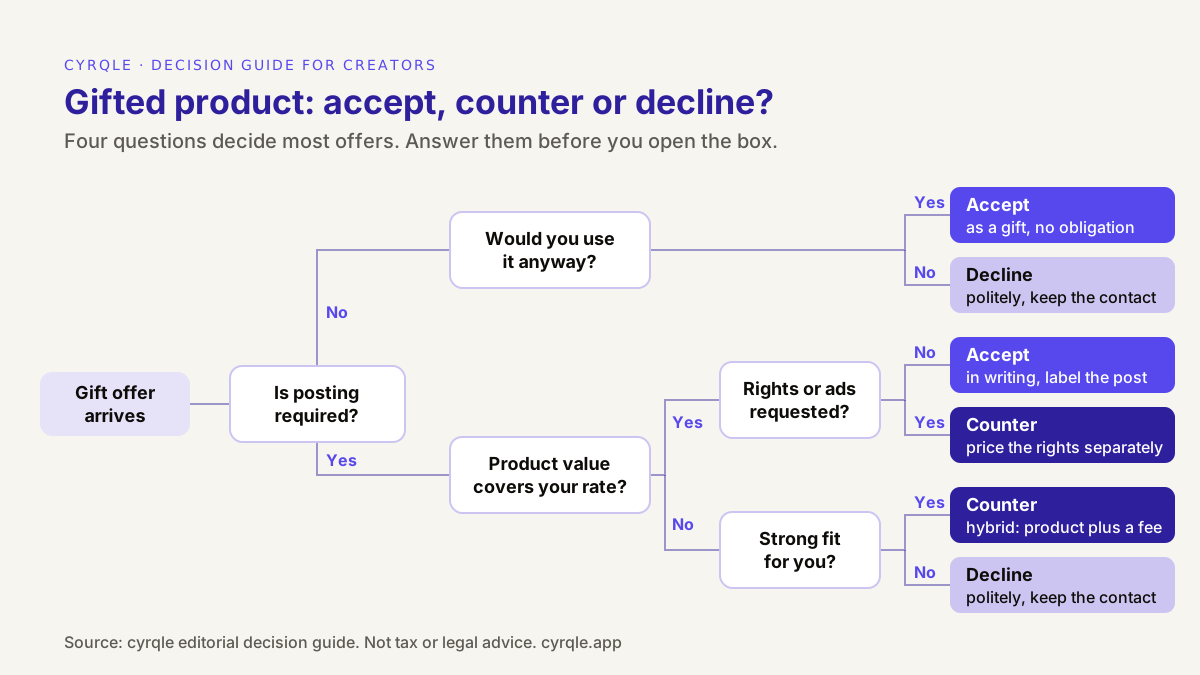
- Is posting required? If the brand says "no strings, post only if you love it", you are looking at a true gift. If it lists formats, dates or hashtags, it is a deal paid in product.
- Would you use it anyway? For a true gift, the only question is whether you want it. If you would not use it, decline. A product you do not want still takes space, and some brands follow up later asking for a post.
- Does the product value cover your rate for the work? Compare the retail value with what you would charge in cash for the same deliverables. The next section shows how.
- Are usage rights or paid ads requested? If yes, those are extra and need a price, even when the product covers your content fee.
If the product does not cover your rate, a fifth question decides between countering and declining: is this brand a strong fit for you? A brand you already buy, in your core topic, that would look good in your media kit, is worth a counter. A random brand outside your niche is not.
How do you work out what a gifting offer really pays?
Divide the retail value of the product by the hours the deliverables will take. That is your effective hourly rate. Then compare it with the hourly rate you need to make your content business work. Count every step: planning, filming, editing, captions, drafts and revisions, posting, and answering comments.
| Deliverable | Typical steps | Time (illustrative) |
|---|---|---|
| 1 Reel or TikTok video | Script, film, edit, caption, one revision | 3 to 4 hours |
| 3 stories | Film, add stickers and link, post across one day | 1 to 2 hours |
| Unboxing or first-impressions post | Light setup, single take | 1 hour |
| Product test over two weeks | Daily use, notes, before and after footage | 2 to 4 hours spread out |
| Extra revision round | Re-edit and re-export | 1 hour |
Times are illustrative. Track your own for a month: most creators underestimate editing and revisions.
Here are three offers, with illustrative numbers.
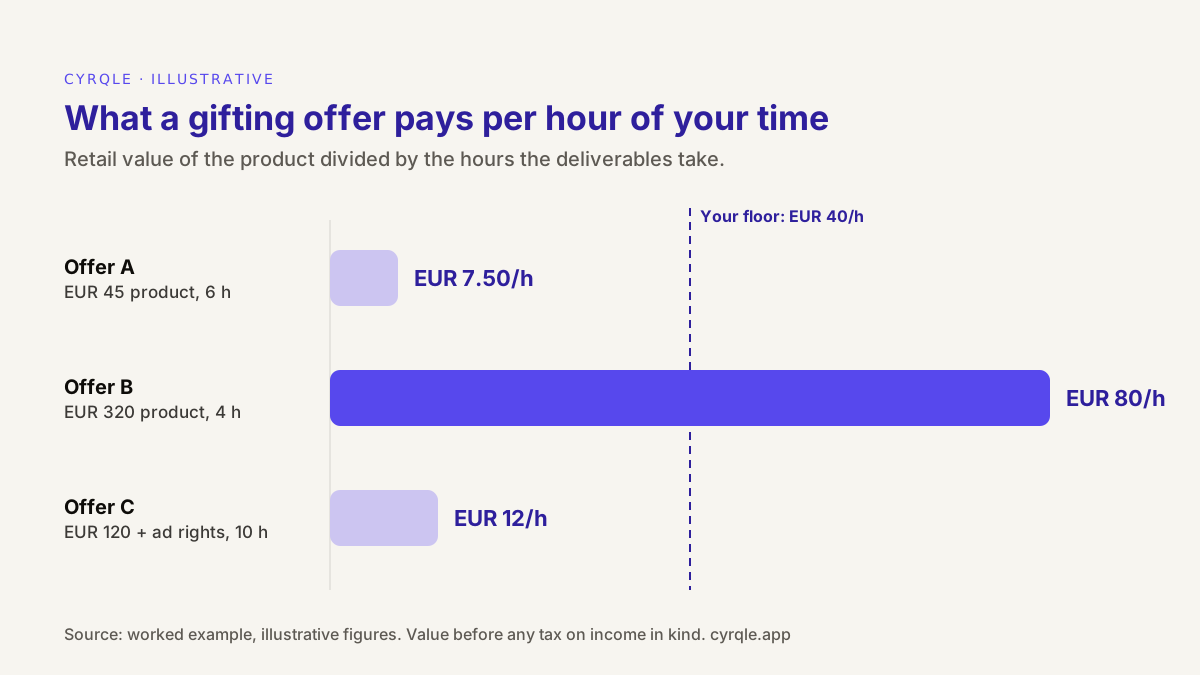
- Offer A: a EUR 45 skincare set for one Reel and three stories. About 6 hours. EUR 45 ÷ 6 = EUR 7.50 an hour.
- Offer B: EUR 320 running shoes you were going to buy anyway, for one Reel. About 4 hours. EUR 320 ÷ 4 = EUR 80 an hour.
- Offer C: a EUR 120 kitchen gadget for three TikTok videos, plus the right to run them as ads for 30 days. About 10 hours. EUR 120 ÷ 10 = EUR 12 an hour, and the ad rights are given away on top.
If your floor is EUR 40 an hour, only offer B works as a pure product deal. Offer A is a polite decline or a small counter. Offer C needs a hybrid counter, because it also asks for paid ads.
Two adjustments make this test more honest:
- Value the product at what it is worth to you. If you would never buy it, its value to you is close to zero, whatever the price tag says. If you would buy it this month, the full retail price counts.
- Remember the tax. In Spain, product received in exchange for content is generally income valued at market price (see the tax section below). A EUR 320 pair of shoes can mean a tax bill paid in cash.
To set the cash rate you compare against, use the method in how much to charge for a sponsored post: median views ÷ 1,000 × a target CPM, adjusted for format. That gives you a per-post price; the hourly view above is a quick sanity check on top of it.
Which usage rights should never come free with a gift?
Paid ads, whitelisting (ads run from your account), use in the brand's own ads or website beyond a repost, long or perpetual licences, and exclusivity should never be bundled into a gift. Each one has value to the brand and limits what you can earn elsewhere, so each one needs its own price.
Watch for phrases like "we may share your content across our channels" or "content may be used in our marketing". These read like a courtesy, but they are a licence. Before you accept, ask the brand to state in writing:
- Which channels: a repost on its Instagram, its website, email, in-store screens, paid ads.
- Which markets: Spain only, the EU, Latin America, worldwide.
- For how long: 30 days, 6 months, 12 months, or "perpetual".
- Exclusivity: whether you must avoid competitors, and for how long.
A repost inside the platform with the native share button is usually fine to allow with a gift. Anything beyond that is a separate item. Our worked calculator for usage rights and exclusivity shows how to turn channels, markets and duration into a number.
Do you still have to label a gifted post as an ad?
Yes. In Spain, the influencer code of conduct by AUTOCONTROL, aea and IAB Spain lists the free delivery of a product as a form of consideration (norm 5). Content that promotes a product and is published as part of a collaboration in exchange for such consideration is advertising (norm 4), and it must be clearly identifiable as advertising (norm 6). Spain's unfair competition law also treats paid promotion presented as information as unfair when it is not clearly identified as advertising (article 26 of Ley 3/1991).
The code also lists signs that the Jurado de la Publicidad can use to infer a collaboration when there is no contract to prove it. These include a request to show the product in a post, a discount code, the same hashtag as other creators that week, a markedly positive tone, and thanking the brand. A "thank you @brand for this gift" post fits that pattern almost exactly.
The practical rule: if you post about a product you received free, label it at the start of the post, in the language of the post. For the full picture of who must do what, read the brand-side legal checklist for influencer marketing in Spain. It is not legal advice: for a specific case, ask a lawyer.
Is gifted product taxable income in Spain?
Generally yes, when you receive it in exchange for content. In Spain, income in kind includes goods obtained free or below market price (article 42.1 of the IRPF law), and it is generally valued at its normal market value (article 43.1). How it is classified depends on your situation, so ask your gestor before you treat a parcel as "free".
What we can say from official sources:
- If you work as a creator professionally (registered with Hacienda, usually as autónomo), product received as payment for content is part of the income from that activity. A gift is payment in another form.
- If you are not registered, the Dirección General de Tributos looked at a person who received free products in exchange for testing and reviewing them on a retail platform (binding ruling V1285/2025, 10 July 2025). It treated the products as a capital gain in kind, valued at normal market value and added to the general income base. It also said that simply receiving and reviewing products was not an economic activity for the local business tax (IAE) in that case, but that selling the products on would be. That ruling is about a review programme, not about creator collaborations, so do not apply it to your case without advice.
- IVA on a barter. If you invoice as a business, content swapped for product is still a supply of services. For deals paid in kind, the IVA base is the money value the parties agreed for the non-cash part (article 79.1 of the IVA law). At the general rate of 21%, a EUR 320 product deal carries EUR 67.20 of IVA. Agree in writing who pays that amount in cash.
- Spain's influencer decree counts gifts. Under Real Decreto 444/2024, the EUR 300,000 income threshold for "users of special relevance" counts payment in kind as well as cash. The status also needs 1 million followers on one platform (or 2 million across several), so most creators are far below it, but product and trips do add up. Our post on Real Decreto 444/2024 explains the thresholds.
This is general information, not tax advice. Rules in Latin America differ by country. For an invoice that covers a mixed deal, see our guide on how to invoice a brand collaboration in Spain, and confirm the details with a gestor or tax adviser.
How do you counter a gifting offer with a hybrid deal?
Price the full request as if it were a cash deal, credit the product at retail value, and ask for the difference as a fee. Offer a smaller scope as an alternative, so the brand can say yes without a bigger budget. A hybrid keeps the product the brand wants to send and gives you a floor for your time.
Worked example: countering offer C
All figures are illustrative.
Javier, a home-cooking creator in Valencia, gets offer C: a EUR 120 kitchen gadget for three TikTok videos, plus 30 days of paid ads. His recent TikTok videos have a median of 12,000 views, and he prices at a CPM of EUR 20.
| Line | How it is calculated | Amount |
|---|---|---|
| 3 TikTok videos | 12,000 ÷ 1,000 × EUR 20 = EUR 240 each | EUR 720 |
| Paid ads, 30 days | 20% of the content price | EUR 144 |
| Value of the full request | EUR 864 | |
| Product, credited at retail | minus EUR 120 | |
| Fee to ask for | EUR 744 |
Javier sends two options, so the brand has a choice instead of a refusal:
- Full scope: the gadget plus EUR 744, for three videos and 30 days of paid ads.
- Smaller scope: the gadget plus EUR 120, for one video, organic only. One video is worth EUR 240; the product covers half.
A third option some brands prefer is product plus a commission code. Commission adds upside, but it does not pay for your time if sales are slow. If you accept it, keep a small fixed fee as the floor. The brand-side economics of this choice are in seeding-only vs hybrid programmes.
A counter-offer script
Thanks for thinking of me. I like the product and I'd be happy to work together. For three TikTok videos with 30 days of paid ads, my rate is EUR 864. If you send the gadget, I'll credit it at EUR 120, so the fee would be EUR 744 plus IVA. If that's above your budget for this round, I can do one organic video for the gadget plus EUR 120. Either way, I'll label the content as an ad and send a draft before posting. Happy to share my media kit with recent views.
Keep it short, friendly and specific. State the deliverables, the rights, the fee and the alternative. Then stop. Our creator's guide to brand deals covers what to check in the brief and contract once the brand agrees.
When should you decline a gifting offer?
Decline when the product is worth less than your time and the brand is not a strong fit, when you would not use or recommend the product, when the brand asks for rights or exclusivity without paying, or when it refuses to put anything in writing. Decline politely and keep the door open: a short "not a fit for my audience right now, happy to talk about a paid collaboration in future" costs nothing.
Some offers are worth accepting even below your rate: a brand you have wanted to work with for a long time, a product in your core topic that adds to your portfolio, or a first collaboration that leads to paid work. Make that choice on purpose, for a limited number of offers, and write down why.
How cyrqle helps
cyrqle is a Creator Commerce OS used by brands and agencies, and the creator app is free. On cyrqle, a brand states the deal type before it can invite you. The options are Cash payment, Commission on every sale, Product gift, and combinations such as Cash & product or Cash, commission & product. Invites stay blocked until the compensation is complete, so you see what is on offer before you reply.
- Terms are written down. You sign a Creator Collaboration Agreement with two-sided e-signature and a frozen snapshot of the terms. Paid-ads use is granted only if the brand ticks that option on the offer, so you can see whether a gift deal asks for ads.
- The cash part is paid through Stripe Connect. For the fee in a hybrid deal, creators in Europe and the US are paid to their bank through Stripe Connect, in EUR. A person at the brand triggers each payout once you deliver.
- One place for briefs and money. The creator app holds your briefs inbox, contracts, payouts ledger and Stripe onboarding.
The compensation and contracts page shows how the brand side is set up. To join, see cyrqle for creators. The creator app has a waitlist today.
FAQ
Should I accept gifted collaborations when I am just starting out?
Sometimes, and on purpose. Early on, a few gifted collaborations with brands you genuinely use can build a portfolio. Accept the ones with no posting obligation or light deliverables, keep your usage rights, and move to paid or hybrid deals as soon as your median views are steady.
How do I say no to a gifting offer without burning the bridge?
Thank the brand, say the offer does not fit right now, and offer an alternative: a paid or hybrid collaboration, with a link to your media kit. Keep it to three sentences. A clear, friendly no often leads to a paid offer later.
Can a brand ask for content if it sent the product without asking me first?
It can ask, but you owe nothing. An unsolicited parcel with no prior agreement does not oblige you to post. If you do post about it, label the post as a gifted collaboration.
Do I need to label a post about a gift I did not ask for?
If the brand sent it to you as part of a collaboration, yes. Spain's AUTOCONTROL code counts free product as consideration, and thanking the brand is one of the signs used to treat a post as advertising. When in doubt, label it.
Do I pay tax on products I receive for content in Spain?
Generally yes: product received in exchange for content counts as income in kind, valued at market price, and it may also carry IVA if you invoice. How it is classified depends on whether you are registered as a business. Ask your gestor for your case.
Sources
- AUTOCONTROL, aea and IAB Spain, Código de Conducta de Publicidad a través de Influencers (2025), norms 4, 5 and 6: https://www.autocontrol.es/app/uploads/codigo-de-conducta-de-publicidad-a-traves-de-influencers-2025.pdf
- Ley 3/1991, de 10 de enero, de Competencia Desleal, art. 26: https://www.boe.es/buscar/act.php?id=BOE-A-1991-628
- Ley 35/2006, del Impuesto sobre la Renta de las Personas Físicas, arts. 42 and 43: https://www.boe.es/buscar/act.php?id=BOE-A-2006-20764
- Ley 37/1992, del Impuesto sobre el Valor Añadido, art. 79: https://www.boe.es/buscar/act.php?id=BOE-A-1992-28740
- Dirección General de Tributos, binding ruling V1285/2025 of 10 July 2025 (search the number in the DGT database): https://petete.tributos.hacienda.gob.es/consultas/
- Agencia Tributaria, IVA rates: https://sede.agenciatributaria.gob.es/Sede/iva/calculo-iva-repercutido-clientes/tipos-impositivos-iva.html
- Real Decreto 444/2024, de 30 de abril: https://www.boe.es/eli/es/rd/2024/04/30/444
Related field notes.
How to negotiate with brands as an influencer: anchor on views, counter with scripts in English and Spanish, trade rights, not your fee, and know when to walk.
How to get brand deals as a creator in Spain and Latin America: how brands find you, how to price on views, what to check in a contract, and how you get paid.
Influencer marketing budget planning for 2027, built bottom-up: objectives, tier mix, pricing model, seasonal peaks in Spain and Mexico and a worked euro model.