
Influencer contract template for Spain and the EU, clause by clause
Influencer contract template for Spain and the EU: ten copyable clauses on deliverables, approvals, disclosure, usage rights, exclusivity, fees and GDPR.
An influencer contract template for Spain needs ten clauses: who the parties are, what the creator delivers and when, how many rounds of draft approval you get, how the post is labelled as advertising, which usage rights you buy (term, territory, media and paid ads), any exclusivity, the fee with payment terms and invoice data, how either side can end the deal, how personal data is handled under GDPR, and the governing law and signatures. Below is each clause as copyable text, with a note on what it protects and what Spanish or EU law sits behind it.
The template is written for a brand in Spain hiring a creator for paid posts on Instagram or TikTok. It works for creators elsewhere in the EU with small changes, and we flag those. It is not legal advice: have your lawyer adapt it to your campaign before you send it, and check the law has not changed since this guide was published.
What an influencer contract in Spain has to cover
Spain has no single "influencer contract" law. The contract sits on top of five bodies of rules: copyright (who may use the content), image rights (who may use the creator's face and voice), advertising law (how the post is labelled), tax and invoicing (how the creator is paid), and data protection. The ten clauses map to those rules.
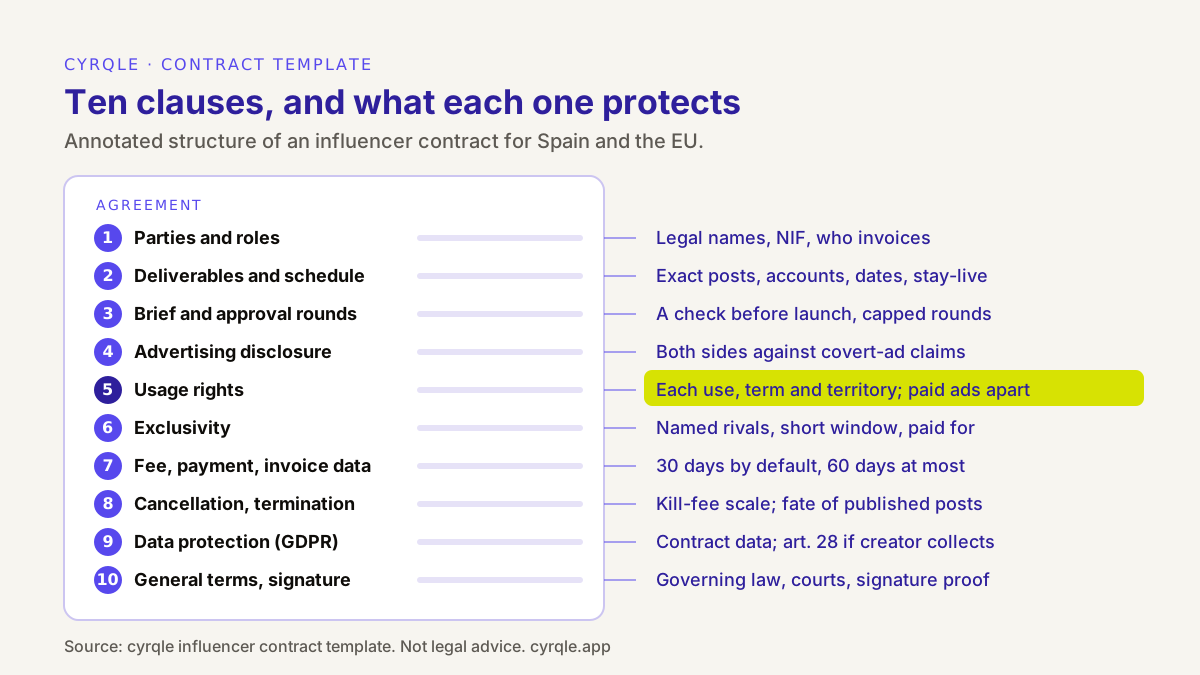
| # | Clause | What it protects | Rule behind it |
|---|---|---|---|
| 1 | Parties and roles | Who signs, who invoices, who is liable | Civil Code, invoicing regulation |
| 2 | Deliverables and schedule | That you get the posts you paid for, on time | Contract terms |
| 3 | Brief, drafts and approval rounds | Your right to check content before it goes live, with a limit | Contract terms |
| 4 | Advertising disclosure | Both sides against covert-advertising claims | Ley 3/1991, art. 26; AUTOCONTROL code; Ley 13/2022, art. 94 |
| 5 | Usage rights | What you may do with the content, where and for how long | Ley de Propiedad Intelectual, arts. 43, 45, 48; LO 1/1982 |
| 6 | Exclusivity | Your category against direct competitors for a set time | Contract terms; LPI art. 43.4 limits |
| 7 | Fee, payment terms, invoice data | The creator's cash flow and your tax position | Ley 3/2004; Ley 35/2006, art. 101; RD 1619/2012 |
| 8 | Cancellation and termination | Both sides when plans or behaviour change | Contract terms |
| 9 | Data protection | Personal data each side receives | GDPR, arts. 6 and 28 |
| 10 | General terms and signature | Which law and courts apply, and proof of agreement | Contract terms; electronic signature |
For the wider legal picture, including who counts as a "user of special relevance", read our legal checklist for influencer marketing in Spain.
Is a DM or an email enough?
A DM thread is evidence, but it is a weak contract. Spanish copyright law says every transfer of exploitation rights must be in writing (article 45 of the Ley de Propiedad Intelectual), and a licence is limited to the uses it names. A thread that says "great, send the reel by Friday" names none.
| DM thread | Email with terms | Signed contract | |
|---|---|---|---|
| Rights in writing | Rarely stated | Yes, if the email lists them | Yes |
| Term and territory of use | Usually missing | Often missing | Stated per use |
| Approval rounds and deadlines | Implied | Partly | Stated |
| Payment term and invoice data | Missing | Sometimes | Stated |
| Proof of who agreed and when | Screenshot | Email headers | Signature record |
| Speed for a one-off gifted post | Fastest | Fast | Slower |
For a one-off gift with no reuse, a short gifting agreement is enough. For any paid post, or any reuse of the content outside the creator's own feed, use a signed contract.
How to use this template
- Copy the clauses below into your own document. Replace every item in square brackets.
- Delete options you do not need. Each clause gives the common options with "OR" between them.
- Attach the brief as Annex 1 and the fee schedule as Annex 2. The contract refers to them, so the main text stays short.
- Send the contract with the offer, not after the post. Terms agreed after delivery are terms agreed under pressure.
- Keep one signed copy per creator, per campaign, with the date of signature.
The template, clause by clause
Clause 1. Parties and roles
1. PARTIES
1.1 [Brand legal name], with NIF [number] and registered office at
    [address] ("the Brand"), represented by [name, role].
1.2 [Creator full legal name], with NIF/NIE [number] and address at
    [address], acting [as a self-employed professional / through the
    company [name], NIF [number]] ("the Creator").
1.3 [If an agency acts: [Agency name], NIF [number], acts on behalf
    of [the Brand / the Creator] and [does / does not] sign as a
    party.]
1.4 Each party confirms it has capacity to sign. If the Creator is
    under 18, a parent or legal guardian signs as well and consents
    to this agreement.
What it protects. The invoice must name the right legal person, and the withholding rules change depending on whether the creator invoices as a self-employed person (autónomo) or through a company. Getting this clause right avoids reissued invoices later.
Fill-in notes. Use the creator's legal name, not the handle. Add the handle in clause 2. For minors, the 2025 AUTOCONTROL code expects the collaboration to rest on a contract with the explicit consent of a parent or guardian.
Clause 2. Deliverables and schedule
2. DELIVERABLES
2.1 The Creator will produce and publish the following content
    ("the Content"):
    - [1] Instagram Reel, [30-60] seconds, on @[handle]
    - [3] Instagram Stories with link sticker to [URL]
    - [1] TikTok video on @[handle]
2.2 Publication window: between [date] and [date]. The Creator will
    not publish before the Brand's written approval under clause 3.
2.3 Each post will stay live on the Creator's account for at least
    [90] days after publication, unless the Brand asks for removal.
2.4 The Creator will include the tracking link or promo code the
    Brand provides, and the handles and hashtags listed in Annex 1.
2.5 The Creator will share post statistics (views, reach, saves,
    link clicks) [7 and 30] days after publication.
What it protects. You pay for specific posts, on specific accounts, in a specific window. The "stay live" line stops a post from being deleted the day after payment. The statistics line gives you the numbers you need for reporting. Stories expire after 24 hours, so ask for their statistics in writing rather than hoping to find them later.
Fill-in notes. Count every deliverable, including Stories frames. If you want raw footage for edits, list it here as its own deliverable; it is not included by default.
Clause 3. Brief, drafts and approval rounds
3. APPROVAL
3.1 The Brand will send the brief (Annex 1) at least [10] days before
    the publication window opens.
3.2 The Creator will send a draft of each item [5] working days
    before the planned publication date.
3.3 The Brand will approve or request changes within [2] working
    days. Silence after that period counts as approval.
3.4 The fee includes up to [2] rounds of changes per item. Further
    rounds, or changes that contradict the brief, are billed at
    [EUR amount] per round or agreed in writing.
3.5 The Brand will not ask for changes that remove or hide the
    advertising label required by clause 4.
3.6 The Creator keeps editorial control of tone and style within
    the brief. Claims about the product must match Annex 1.
What it protects. The brand gets a check before content goes live. The creator gets a limit on endless rework and a clock that stops the brand from blocking publication by not answering. Clause 3.6 matters for regulated categories (food supplements, cosmetics, finance): the creator should not invent product claims.
Fill-in notes. Two rounds is common. If you work with many creators at once, keep the approval window short and staff it.
Clause 4. Advertising disclosure
4. DISCLOSURE
4.1 The Content is advertising. The Creator will label each item as
    advertising in a way that is clear, immediate and visible at the
    start of the post, without the viewer having to click "more".
4.2 The Creator will use the platform's paid-partnership tool where
    available, and the label "[publicidad / publi / patrocinado por
    [Brand]]" in the caption or on screen.
4.3 Labels such as "colab", "sponso", "sp" or a brand hashtag on
    their own are not sufficient.
4.4 If the Brand reposts the Content on another channel, the
    advertising label stays visible or is added on that channel.
4.5 Each party will comply with Spanish advertising law and the
    Código de Conducta de Publicidad a través de Influencers in force.
What it protects. Both sides. Spanish unfair competition law treats paid promotion that is not clearly identified as advertising as a misleading practice (Ley 3/1991, article 26). The AUTOCONTROL, AEA and IAB Spain code that came into force on 1 October 2025 sets out which labels work: platform tools, "publicidad", "publi", "patrocinado por" or "en colaboración con" are valid; vague tags like "colab" or "sp" are not. The code also says a brand may be exempt from responsibility when a breach was an isolated, clear departure from its instructions. A written disclosure clause is that instruction.
Fill-in notes. Creators who meet the thresholds of Real Decreto 444/2024 (at least EUR 300,000 in income from the activity and at least 1,000,000 followers on one platform or 2,000,000 in total, among other conditions) are treated as audiovisual service providers for advertising rules. The disclosure duty applies to everyone else as well.
Clause 5. Usage rights: term, territory, media and paid ads
This is the clause most templates get wrong, and the one with the most money in it.
5. USAGE RIGHTS
5.1 The Creator keeps ownership of the Content. The Creator grants
    the Brand a non-exclusive licence to use the Content as set out
    in this clause and in no other way.
5.2 Uses included in the fee:
    (a) Organic: repost and share the Content on the Brand's own
        social accounts [list handles].
    (b) Owned media: show the Content on the Brand's website,
        product pages, content walls and email.          [YES / NO]
    (c) Paid ads: use the Content in paid advertising run from the
        Brand's accounts.                                [YES / NO]
    (d) Whitelisting: run paid ads from the Creator's own handle,
        with access granted by the Creator.             [YES / NO]
5.3 Term: each use runs for [30 / 90 / 365] days from first
    publication. [Different term per use: organic [ ] days,
    owned media [ ] days, paid ads [ ] days.]
5.4 Territory: [Spain / the European Union / worldwide].
5.5 The Brand may cut, subtitle and resize the Content for these
    uses, but will not change its meaning, add claims the Creator
    did not make, or remove the advertising label.
5.6 The Creator authorises the use of their name, image and voice
    as they appear in the Content, for the uses, term and territory
    above (Ley Orgánica 1/1982).
5.7 At the end of the term the Brand will stop new uses. Paid ads
    end on the last day of the term. Organic posts already published
    on the Brand's accounts [may stay / will be removed within
    [15] days].
5.8 The Creator confirms the Content does not include third-party
    music, images or people without the necessary permissions.
5.9 Extending the term or adding uses requires a written amendment
    and an additional fee.
What it protects. Spanish copyright law reads a licence narrowly. Under article 43 of the Ley de Propiedad Intelectual, a licence is limited to the uses expressly named, the term and the territory stated. If the term is missing, the licence is limited to five years; if the territory is missing, to the country where it was granted; if the uses are not stated, to what is strictly necessary for the purpose of the contract. Article 45 adds that the transfer must be in writing. A vague "the brand may use the content" line leaves you with far less than you think.
Image rights are separate. Under Ley Orgánica 1/1982, a person's consent to the use of their image can be revoked at any time, with compensation for the damage the revocation causes. Clause 5.6 ties the consent to a defined use and term, so both sides know what a withdrawal would cost.
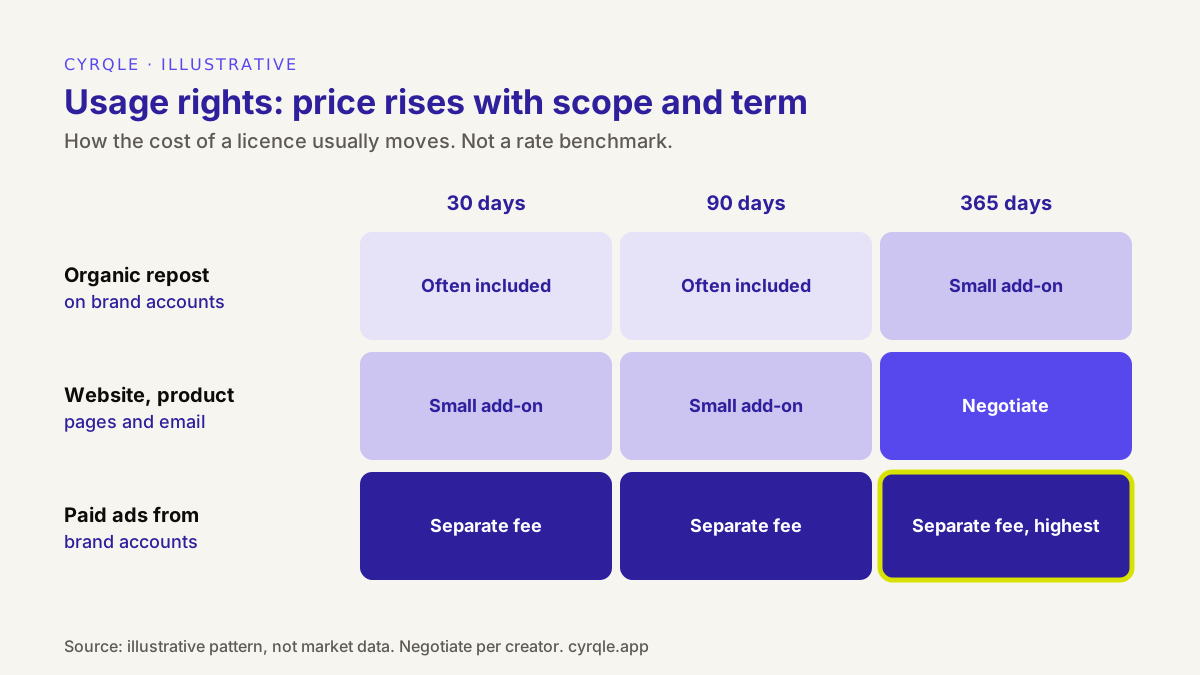
Separate the three uses. A repost on your own feed is a small extension of the creator's post. Your website and email are a bigger one. Paid ads put money behind the content and show it to people the creator never reached, so creators price it separately. Ads run from the creator's own handle need even more: access to their account or a platform partnership code, and a clear end date. For the full background on reuse and consent, read what a usable content licence states in the EU.
Fill-in notes. Pick the smallest scope that does the job, and write the term in days. If you might run ads later, ask now and price it as an option ("paid ads for 90 days, exercisable within 60 days of publication, at EUR [amount]"). If you need an exclusive licence, say "exclusive" explicitly: article 48 of the copyright law requires exclusivity to be granted expressly.
Clause 6. Exclusivity
6. EXCLUSIVITY
6.1 From [date of signature] until [30] days after the last
    publication, the Creator will not publish paid or gifted content
    for the following competitors: [list brands], or for any brand
    in the category [category, e.g. "running shoes"] in [territory].
6.2 This clause does not restrict organic content that does not
    promote a competitor, or work for brands outside the category.
6.3 The exclusivity fee is [EUR amount / included in the fee in
    Annex 2].
6.4 The Creator confirms that no existing agreement conflicts with
    this campaign, and lists current category partners here: [ ].
What it protects. Your campaign against the same creator promoting a rival in the same week. It also protects the creator, because a narrow list and a short window keep the clause reasonable.
Fill-in notes. Keep it narrow: a named competitor list or a tight category, a short period, a defined territory. A broad ban costs the creator real income, and they will price it that way. Keep the clause about promoting competitors, not about creating content in general: article 43.4 of the copyright law voids clauses in which an author promises not to create future works.
Clause 7. Fee, payment terms and invoice data
7. FEE AND PAYMENT
7.1 The Brand will pay the Creator EUR [amount] plus IVA for the
    Content and the rights in clause 5, broken down in Annex 2.
7.2 [Optional] The Brand will also pay a commission of [ ]% on net
    sales attributed to the Creator's code or link, calculated
    monthly on orders net of returns.
7.3 [Optional] Product supplied: [description], market value
    EUR [amount]. The Creator keeps the product.
7.4 The Creator will invoice [on publication of all Content / per
    item / [50]% on signature and [50]% on publication].
7.5 The invoice will include: invoice number and series, date,
    full legal names, NIF of both parties, addresses, description of
    the service, taxable base, IVA rate and amount, IRPF withholding
    where applicable, and the total.
7.6 Where Spanish law requires it, the Brand will withhold IRPF from
    the payment and pay it to the Agencia Tributaria.
7.7 The Brand will pay within [30] days of receiving a correct
    invoice, by bank transfer to the account on the invoice.
7.8 Bank details: IBAN [ ], account holder [ ].
What it protects. The creator's cash flow and your tax position. Under Spain's late payment law (Ley 3/2004, article 4) the default payment term between businesses is 30 days from receipt of the service, and the parties can agree a longer term but never more than 60 days. The invoice contents in 7.5 follow article 6 of the invoicing regulation (Real Decreto 1619/2012).
On withholding: for professional activities the general IRPF withholding rate is 15 percent, with a 7 percent rate for the first years of activity in the cases the regulation sets (Ley 35/2006, article 101.5). Whether withholding applies depends on how the creator is registered and whether they invoice as a person or through a company, so ask your tax adviser and state the result in the contract. Our guide on invoices, IRPF withholding and IVA for influencer payments covers the cases. For what a fair fee looks like, see influencer rates in Spain for 2026.
Fill-in notes. Gifted product is also a form of payment and can be taxable for the creator. Write down its value.
Clause 8. Cancellation and termination
8. CANCELLATION AND TERMINATION
8.1 Either party may end this agreement by written notice if the
    other party materially breaches it and does not fix the breach
    within [7] days of notice.
8.2 If the Brand cancels for convenience:
    - before the Creator starts production: [25]% of the fee;
    - after a draft is delivered: [50]% of the fee;
    - after approval: 100% of the fee.
8.3 The Brand may end the agreement with immediate effect if the
    Creator's public conduct seriously harms the Brand's reputation.
    Fees for Content already published remain payable.
8.4 If the Creator cannot deliver for reasons outside their control,
    the parties will agree a new date or a pro rata refund of any
    advance payment.
8.5 On termination, licences for Content already paid for continue
    for their term. Licences for unpaid Content end.
What it protects. Both sides when a launch moves or a creator becomes a liability. The cancellation scale pays the creator for work done. Clause 8.5 answers the question that usually causes the dispute: what happens to content already published.
Fill-in notes. Define "seriously harms" with examples if your category is sensitive. A one-sided morality clause with no payment for published work is hard to defend and creators push back on it.
Clause 9. Data protection (GDPR)
9. DATA PROTECTION
9.1 Each party processes the other's personal data (names, contact
    details, tax and bank data, signatures) to perform this agreement
    and to meet legal obligations, as an independent controller.
9.2 The Brand will keep the Creator's data only as long as needed
    for this agreement and for the periods required by tax and
    accounting law.
9.3 The Creator will not collect personal data from followers on
    the Brand's behalf (for example, entries to a giveaway) unless
    the parties first sign a data processing agreement under article
    28 GDPR.
9.4 Each party can contact the other's data protection contact at:
    [email].
What it protects. Contract data is personal data. The lawful bases are the contract itself and legal obligations (GDPR, article 6(1)(b) and (c)). The real risk is clause 9.3: if a creator collects entries, emails or addresses for you, they act as your processor, and article 28 requires a written processing agreement before they start.
Fill-in notes. Point to your privacy notice. If the campaign has a giveaway, write separate giveaway terms.
Clause 10. General terms and signature
10. GENERAL TERMS
10.1 This agreement, with Annex 1 (brief) and Annex 2 (fees and
     rights), is the whole agreement between the parties. Changes
     must be in writing.
10.2 The Creator acts independently. Nothing in this agreement
     creates an employment relationship.
10.3 Neither party may transfer this agreement without the other's
     written consent.
10.4 This agreement is governed by Spanish law. The courts of
     [city] have jurisdiction.
10.5 The parties sign electronically. Each party receives a copy of
     the signed agreement.

Signed: the Brand [name, date]   Signed: the Creator [name, date]
What it protects. Proof. An electronic signature with a record of who signed and when is far stronger evidence than a screenshot. The independence line (10.2) keeps the relationship clearly commercial.
Fill-in notes. For a creator based in another EU country, consider which law and courts make sense for both sides, and check local disclosure rules. The European Commission's Influencer Legal Hub summarises the EU consumer law that applies across member states.
Which usage scope and term should you buy?
Buy the smallest scope and the shortest term that covers your plan, and add an option for the rest. The matrix above shows the usual direction of price: it rises with how widely you use the content and for how long.
| Use | 30 days | 90 days | 365 days |
|---|---|---|---|
| Organic repost on brand accounts | Often included | Often included | Small add-on |
| Website, product pages, email | Small add-on | Small add-on | Negotiate |
| Paid ads from brand accounts | Separate fee | Separate fee | Separate fee, highest |
| Paid ads from the creator's handle | Separate fee plus access terms | Separate fee plus access terms | Rarely agreed |
Worked example (illustrative)
A skincare brand in Valencia hires a Madrid creator, registered as autónomo, for one Reel and three Stories. All figures are illustrative, chosen to show the arithmetic, not market rates.
| Line | Amount |
|---|---|
| Base fee: content plus organic repost for 90 days | EUR 1,200 |
| Website and product pages, 365 days (illustrative +20%) | EUR 240 |
| Paid ads from brand accounts, 90 days (illustrative +30%) | EUR 360 |
| Taxable base | EUR 1,800 |
| IVA at 21% | EUR 378 |
| IRPF withholding at 15% (if it applies) | minus EUR 270 |
| Paid to the creator | EUR 1,908 |
| Paid by the brand to the Agencia Tributaria on the creator's behalf | EUR 270 |
The licence lines are written into clause 5 with their terms: organic 90 days, owned media 365 days, paid ads 90 days, territory Spain. On day 91 the ads stop, and the product pages keep the Reel until the end of the year. If the brand wants ads for another quarter, clause 5.9 says that is a new fee, and the creator already knows the price from the option line.
Five mistakes that cost brands later
- "Perpetual, worldwide, all media" as a default. Creators price it as a buyout or refuse. Under Spanish law, a licence never covers media that did not exist or were unknown when it was granted (LPI article 43.5).
- No term on paid ads. An ad still running a year later is the most common creator complaint.
- Unlimited revisions. It slows publication and sours the relationship. Two rounds and a clock work better.
- Disclosure left to the creator. A clear written instruction protects you when a single post goes wrong.
- Invoice data missing. The creator sends an invoice without your NIF, finance rejects it, and payment slips past 30 days.
How cyrqle helps
In cyrqle, the contract is part of the campaign rather than a separate document. When you invite a creator from Campaigns, the offer carries the deal: fee, commission or product, the deliverables, and a rights package line with presets such as "Organic only · 90 days · social channels in scope". There is a separate tick box for paid ads. Invites stay blocked until compensation is complete, so no creator receives an offer without a price.
When the creator accepts, cyrqle produces a Creator Collaboration Agreement:
- Two-sided e-signature. The brand and the creator both sign. The creator can sign from a link without creating an account, and cyrqle records the IP address, device and timestamp of each signature.
- Frozen terms snapshot. The deal terms are frozen into the contract at signing. Later edits to the campaign do not change what was signed, and the signed version is the one on the Agreements page, with a PDF.
- Rights that match the offer. Content-wall and campaign use are always granted by the signed agreement. Paid-ads use is granted only when you ticked it on the offer, so the licence you hold matches the price you paid.
- Your own terms on top. You can link your brand terms to the agreement, for example your exclusivity list or category rules.
After signing, drafts go through optional draft sign-off with an automated check for required hashtags and handles, which supports your disclosure clause. Payments run through Compensation: you fund the campaign, cyrqle schedules each payout when the creator delivers, and a person on your side triggers settlement. Creators in Europe and the US are paid in EUR to their bank through Stripe Connect; elsewhere you pay by bank transfer and record it. Each payout has a statement showing the split.
cyrqle does not replace your lawyer: the platform agreement covers the standard collaboration, and your brand terms carry anything specific to your category. For rights on organic customer posts rather than paid campaigns, see how to request content rights from a creator. To see the contract flow on your own campaign, book a 30-minute walkthrough.
More in this series
- Pricing usage rights and exclusivity: a worked calculator for clause 5 and clause 6.
- Product gifting agreement template: the short form for gifted posts with no fee.
- Contract terms for whitelisting and partnership ads: what to add when ads run from the creator's handle.
- Creator brief template with a filled example: the Annex 1 this contract refers to.
- Choosing a UGC platform for ecommerce: sourcing, licensing and displaying customer content.
FAQ
Is an influencer contract legally required in Spain?
No law requires a contract with that name, but Spanish copyright law requires any transfer of rights to be in writing (LPI article 45). If you want to use the content beyond the creator's own post, you need a written licence, and a signed contract is the cleanest way to have one.
What happens if the contract does not state how long I can use the content?
Under article 43 of the Ley de Propiedad Intelectual, a licence that states no term is limited to five years, and one that states no territory is limited to the country where it was granted. Uses not named are limited to what the contract strictly needs. Write the term, territory and each use explicitly.
Can I use creator content in paid ads if the contract only mentions social media?
Not safely. Paid ads are a different use from an organic repost, and Spanish law limits a licence to the uses it names. Add paid ads as a separate line with its own term and fee, or sign an amendment before you run the ads.
How long can a brand take to pay an influencer in Spain?
Between businesses, the default is 30 days from receipt of the service, and the parties can agree up to 60 days, never more (Ley 3/2004, article 4). Write the term in the contract and require a correct invoice so the clock starts cleanly.
Does the contract need to say how the post is labelled as advertising?
It should. Unlabelled paid promotion is a misleading practice under Spanish law, and the 2025 influencer code says a brand can avoid responsibility when a breach was an isolated departure from its instructions. A clear disclosure clause is that instruction.
Does this template work for creators outside Spain?
For creators in other EU countries, most clauses carry over. Change the tax clause (cross-border invoices follow different IVA rules and Spanish IRPF withholding does not apply in the same way), check local disclosure rules, and agree which law and courts apply.
Sources
- Ley de Propiedad Intelectual (Real Decreto Legislativo 1/1996), articles 43, 45 and 48: BOE-A-1996-8930
- Ley Orgánica 1/1982, image rights, article 2: BOE-A-1982-11196
- Ley 3/1991 de Competencia Desleal, article 26: BOE-A-1991-628
- Ley 13/2022 General de Comunicación Audiovisual, article 94: BOE-A-2022-11311
- Real Decreto 444/2024, users of special relevance: BOE-A-2024-8716
- Código de Conducta de Publicidad a través de Influencers (2025), AUTOCONTROL, AEA and IAB Spain: autocontrol.es
- Ley 3/2004, late payment in commercial transactions, article 4: BOE-A-2004-21830
- Ley 35/2006 del IRPF, article 101.5: BOE-A-2006-20764
- Real Decreto 1619/2012, invoicing regulation, article 6: BOE-A-2012-14696
- European Commission, Influencer Legal Hub: commission.europa.eu
- General Data Protection Regulation (EU) 2016/679: EUR-Lex
Related material.
A step-by-step guide to licensing a creator's or customer's post for your website and channels: writing clear rights terms, sending the request, following up, and keeping track of what you hold.
A practical checklist for your first campaign in cyrqle: drafting the brief, setting compensation and the destination link, choosing deliverables, finding and inviting creators, signing agreements, tracking posts and paying creators.
Free influencer brief template in nine sections, from objective to approval, with a filled Black Friday 2026 example, disclosure wording and usage rights.