
How much does a UGC creator charge in Spain?
How much do UGC creators charge in Spain? Per-video pricing with no audience fee, add-ons for hooks, raw files and paid ads, illustrative EUR bands and a quote.
A UGC creator in Spain charges per video, and the price covers production and an agreed use of the content, not access to an audience. As an illustrative guide, one edited 15 to 45 second video with organic use on the brand's own channels costs between EUR 80 and EUR 600 before IVA. Extra hooks, raw files and a paid-ads licence are priced as separate add-ons on top.
Think of Marta, a creator in Valencia with 3,000 followers and a strong portfolio of product demos. A skincare brand wants three videos for its TikTok and Meta ads. Marta's follower count is irrelevant to the brand: the videos will run from the brand's account, to the brand's audience, with the brand's ad budget behind them. What the brand pays for is Marta's skill on camera, her editing, and the right to use the files. That changes how she should price.
This post gives you illustrative price bands for Spain, the add-ons that every UGC quote should list, a worked quote with the numbers, and the difference between UGC pricing and influencer pricing. Every euro figure here is illustrative, chosen to show the method, not a market benchmark. Rates vary with category, format, experience and the brand's plans for the content, so be wary of any single number, including ours.
What is a UGC creator paid for?
A UGC creator is paid to produce short videos or photos that look like ordinary customer content, and to license them to the brand for use on the brand's channels. The content usually never appears on the creator's own feed. Our glossary entry on user-generated content has the definition; in this post "UGC" means the paid, commissioned kind, sometimes called "UGC-style" content.
Because the creator does not post to their own audience, three things drop out of the price:
- Reach. The brand does not buy the creator's followers or views. It buys files.
- The audience fee. An influencer charges partly for access to the people who follow them. A UGC creator has nothing to sell there.
- Disclosure on the creator's feed. No post on the creator's account means no "ad" label on that account. The brand still has to label its ads as ads.
What is left is production work and rights. A UGC price is the cost of making a usable video plus the value of letting the brand use it, for a set time, in a set way.
How much does a UGC video cost in Spain?
As an illustrative guide, a single UGC video in Spain costs between EUR 80 and EUR 150 from a creator who is starting out, EUR 150 to EUR 300 from an established creator with a steady portfolio, and EUR 300 to EUR 600 or more from a specialist who writes and edits ad-ready scripts. Those bands assume one edited video of 15 to 45 seconds, one hook, two rounds of revisions, and organic use on the brand's own channels for three months.
| Creator level | Who it describes | Illustrative base price per video, before IVA |
|---|---|---|
| Starting out | Fewer than about 10 brand videos in the portfolio, simple formats | EUR 80 to 150 |
| Established | Steady portfolio, repeat clients, reliable delivery | EUR 150 to 300 |
| Specialist | Writes ad scripts, edits for direct response, niche skills such as on-camera demos for skincare or tech | EUR 300 to 600+ |
All bands illustrative. They show the shape of the market, not a rate you can quote a brand as "the going rate". Public rate guides published by UGC marketplaces are mostly in US dollars and based on each marketplace's own listings, so they do not transfer cleanly to Spain.
Format changes the price
The format sets how many hours a video takes, and hours set the base price. A simple unboxing is quicker than a scripted tutorial with a voiceover and a second location.
| Format | Effort compared with a standard testimonial video | Illustrative adjustment to the base |
|---|---|---|
| Unboxing or first impressions | Lower: little scripting, one take | -10 to -20% |
| Testimonial or review to camera | Standard | Base price |
| Tutorial, demo or before-and-after | Higher: several shots, product handling | +20 to +40% |
| Voiceover with B-roll only | Lower on camera, higher in editing | About the base price |
| Photo set (5 to 10 images) | Different skill, less editing | 60 to 100% of a video |
| Skit or multi-scene story | Highest: writing, props, sometimes a second person | +40 to +80% |
Illustrative. If a second person appears on camera, that person's image rights and fee are part of the cost too.
Check the base price against your time
A base price that ignores time is a guess. A simple check: estimate the hours for one video and multiply by the hourly rate you need.
Base price = hours for one video × your hourly rate + direct costs
For a standard testimonial video, an illustrative breakdown is 1 hour for the brief and script, 1.5 hours to film, 2 hours to edit and 0.5 hours for admin and revisions: 5 hours. At EUR 40 an hour, that is EUR 200, plus EUR 20 of props or a location, so about EUR 220. Round up to EUR 250 and you have a base price you can defend line by line.
Your hourly rate has to cover the hours you cannot bill: pitching, invoicing, learning, equipment. If you are self-employed in Spain, it also has to cover your social security contribution as an autónomo. A rate that looks generous per hour often is not, once you count those.
What add-ons should a UGC quote list?
A UGC quote should list the base video first, then every extra as its own line: additional hooks, raw footage, extra cutdowns or aspect ratios, a longer organic use term, a paid-ads licence, exclusivity, rush delivery and extra revisions. Separate lines let the brand remove an extra instead of cutting your base price.
| Add-on | What the brand gets | Illustrative price |
|---|---|---|
| Extra hook | An alternative first 2 to 3 seconds, so the brand can test openings in ads | EUR 20 to 50 each, or 10 to 20% of the base |
| Extra cutdown or aspect ratio | A 15-second cut, a 1:1 or 4:5 version | 10 to 20% of the base each |
| Raw footage | All unedited clips, so the brand can re-edit | 25 to 50% of the base |
| Script or concept by the creator | The creator writes the angle, not just performs it | 10 to 25% of the base |
| Longer organic use | Owned channels beyond the 3 months in the base | +10% per extra 3 months, or +30% for 12 months |
| Paid ads from the brand's ad accounts | The video runs as an ad | +25% for 30 days, +40% for 90 days, +75% for 12 months |
| Paid ads from the creator's handle | The ad runs under the creator's name, often called whitelisting, Spark Ads or partnership ads | +40% for 30 days, +60% for 90 days, +100% for 12 months |
| Exclusivity | No content for named competitors for a set time | +10 to 30% for 30 to 90 days |
| Rush | Delivery in under about 5 days | +15 to 25% |
| Extra revision round | Changes beyond the two included rounds | EUR 30 to 60 per round |
All prices illustrative. Percentages are of the base price for the video concerned, and you add them; you do not multiply them on top of each other.
Why hooks and raw files are worth charging for
Hooks and raw files are worth charging for because they multiply what the brand can do with one shoot. Ad teams test several openings of the same video, because the first seconds decide whether people keep watching. Three hooks give the brand three ads for one production day. Raw footage lets the brand's editor cut new versions for months. Both are real value to the brand and real extra work or extra rights for you, so price them.
The paid-ads licence is the biggest add-on
The paid-ads licence is usually the largest add-on in a UGC quote, for the same reason as in influencer deals: an ad reaches people far beyond any organic audience, for as long as the budget runs, with your face on it. Price it by term (30, 90 or 365 days), by territory, and by whose account the ad runs from.
The percentages are higher here than in our usage rights calculator for influencer deals, and that is consistent. An influencer's base fee already includes the audience, so a paid-ads uplift on it is a smaller share. A UGC base price is production only, and ads are often the whole reason the brand commissions the video. The rights are worth more relative to the base.
Never sell "unlimited use" or "in perpetuity" at the base price. If a brand asks for it, price it as a separate line, or offer 12 months with an option to extend. Under article 43 of Spain's copyright law, the Ley de Propiedad Intelectual, a transfer of rights covers only the modes of exploitation it names, and if it does not state a term it is limited to five years, and to the country where it was granted if it does not state a territory. Write the channels, the term and the markets into the quote and the contract. Our article on what a usable UGC licence states in the EU covers the rights side in more depth. This is general information, not legal advice: for a specific contract, ask your lawyer.
Worked example: Marta's quote for a skincare brand
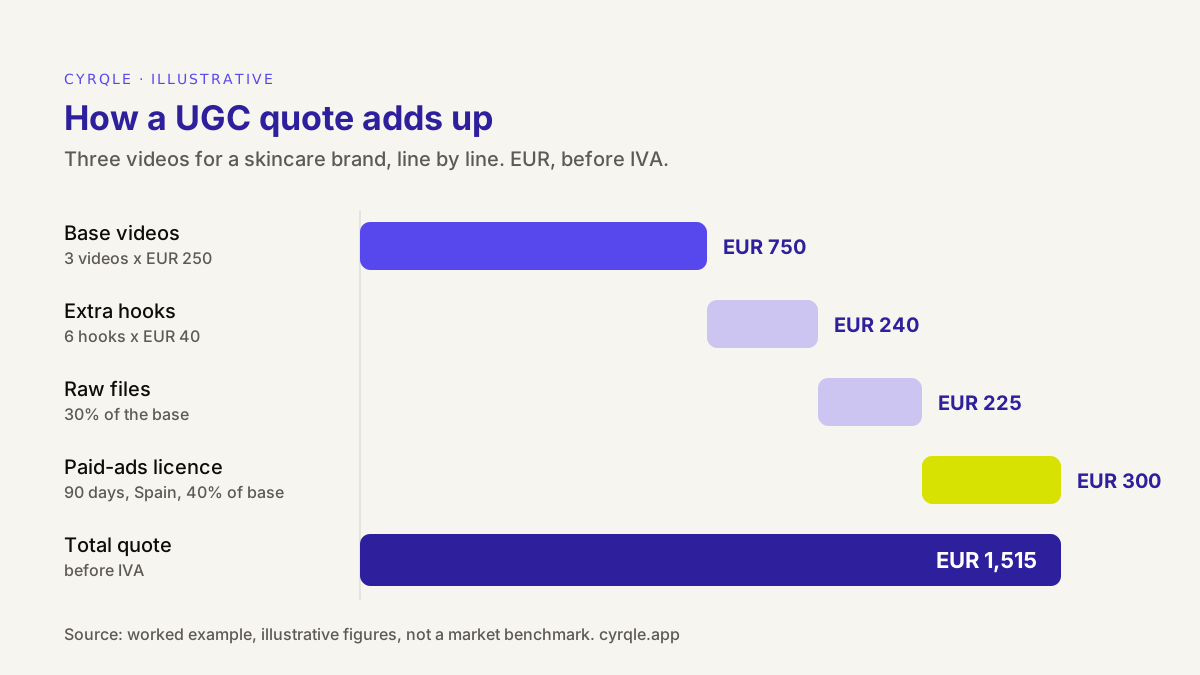
Marta is the Valencia creator from the start of this post. The brand asks for three testimonial videos, three hooks per video, the raw files, and the right to run the videos as ads from its own accounts in Spain for 90 days. All figures are illustrative.
| Line | Calculation | Amount |
|---|---|---|
| Base videos | 3 testimonial videos × EUR 250 | EUR 750 |
| Extra hooks | 2 extra hooks per video × 3 videos × EUR 40 (the first hook is in the base) | EUR 240 |
| Raw files | 30% of the base, EUR 750 | EUR 225 |
| Paid ads from the brand's accounts, Spain, 90 days | 40% of the base, EUR 750 | EUR 300 |
| Total fee before IVA | EUR 1,515 | |
| IVA at 21% | 21% of EUR 1,515 | EUR 318.15 |
| Invoice total | EUR 1,833.15 | |
| IRPF withheld by the brand, if it applies, at 15% | 15% of EUR 1,515 | -EUR 227.25 |
| Paid into Marta's account | EUR 1,605.90 |
Three things in this quote make it easy to approve. Each line names what the brand gets. The base price is unchanged if the brand drops an extra: without raw files, the quote is EUR 1,290. And the ads line states the term and market, so a request to run ads in Mexico or for a year is a new line, not an argument.
The tax lines matter for your cash flow. The general IVA rate in Spain is 21% (Agencia Tributaria), added on top of your fee. If the brand must withhold income tax, the general rate on professional income is 15%, and 7% in the year you start and the two years after (Agencia Tributaria). Whether withholding applies depends on how your activity is classified, so ask your gestor. This is general information, not tax advice. Our guide on how to invoice a brand collaboration in Spain walks through the invoice itself.
How is UGC pricing different from influencer pricing?
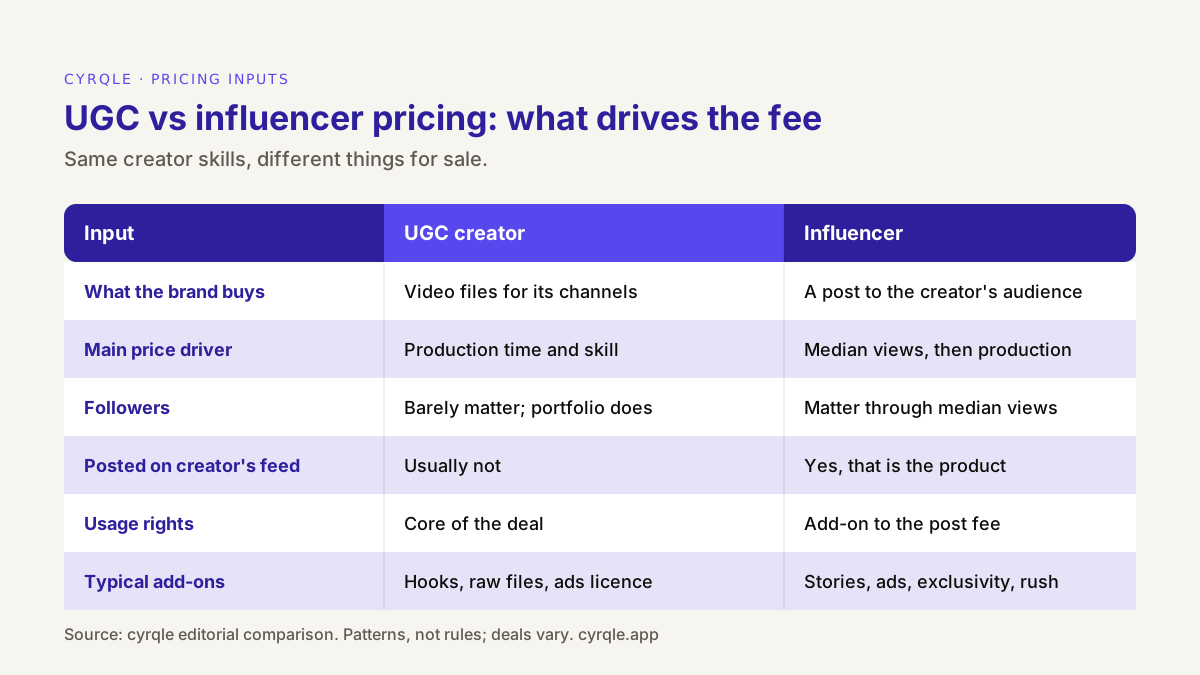
UGC pricing is built on production time and rights, while influencer pricing is built on the creator's audience first and production second. An influencer sells a post to their followers and prices it on views; a UGC creator sells files and a licence and prices them on hours and use. The same person can do both, often for the same brand, and should quote them differently.
| UGC creator | Influencer | |
|---|---|---|
| What the brand buys | Video or photo files for its own channels | A post to the creator's audience, plus the content |
| How the base is set | Hours per video × hourly rate, plus costs | Median views ÷ 1,000 × target CPM × format multiplier |
| Role of followers | Almost none; the portfolio sells | Indirect, through median views |
| Posted on the creator's account | Usually not | Yes |
| Usage rights | The core of the deal, priced by channel and term | An add-on to the post fee |
| Paid-ads licence as a share of the base | Higher, because the base has no audience value | Lower, because the base already includes the audience |
| Typical add-ons | Hooks, raw files, cutdowns, ads licence | Stories, ads use, exclusivity, rush |
If you also take sponsored posts, our guide on how much to charge for a sponsored post on Instagram and TikTok sets out the views-and-CPM method for that side of your work. The site's overview of UGC vs influencer marketing explains the difference from the brand's side.
When a brand asks for both
Sometimes a brand wants a video for its ads and a post on your feed. Quote it as two products: the UGC price for the files and the licence, and an influencer price for the post, based on your median views. Do not give the post away because "the video is already made". The post sells your audience, which the UGC price never included.
What mistakes make UGC creators undercharge?
The most common mistakes are giving away rights, not production. Each one below costs more over a year than a small discount on the base price.
- Bundling paid ads into the base. If the brief says "for social" and the brand later runs the video as an ad, that is a new use. Ask at the start whether the content will run as ads, and quote the licence.
- Accepting "perpetual, worldwide, all media". It is the widest licence possible, and it should carry the highest price. Offer 12 months with a renewal price instead.
- Handing over raw files for free. Raw footage lets the brand make new ads from your shoot without you. Price it.
- Unlimited revisions. State two rounds in the quote and a price for each extra round.
- Product as payment. Keeping the product is not a fee for production work. Our guide on when to accept a gifted product instead of a paid collaboration covers the rare cases where it makes sense.
- Pricing on followers. A small account is not a reason for a small price in UGC. Your portfolio and your hours are.
When a brand pushes back on price, trade scope before you cut your rate: fewer hooks, no raw files, a 30-day ads term instead of 90. Our negotiation scripts in Spanish and English show how to say it.
How to turn this into a UGC rate card
A UGC rate card is a one-page list of your base price per format and every add-on, so a brand can build its own quote. Keep it short and specific:
| Item | Illustrative price, before IVA |
|---|---|
| Testimonial or review video, 15 to 45 s, 1 hook, 2 revisions, 3 months organic use | EUR 250 |
| Tutorial or demo video | EUR 325 |
| Extra hook | EUR 40 |
| Raw footage | 30% of the videos concerned |
| Paid ads from brand accounts, one country | +25% (30 days), +40% (90 days), +75% (12 months) |
| Bundle of 3 videos (optional) | Up to 10% off the base prices; the worked quote above uses none |
| Rush, under 5 days | +20% |
Illustrative. Add a line that says prices exclude IVA and that each licence is for the channels, term and markets stated. Update your prices on purpose, a few times a year, not deal by deal. The rate card template in EUR has a format you can copy, and our creator's guide to brand deals covers the contract and payment steps that come after the quote.
How cyrqle helps
cyrqle for UGC creators gives UGC talent a workspace with a Rate card, Samples and Jobs. You publish your rate card and samples, apply to jobs from brands, and deliver against the deliverables in the brief. It is open as a waitlist.
- Your rate card, in your terms. You set your own prices.
- Paid ads stated up front. When a brand books you for a campaign, you sign a Creator Collaboration Agreement by e-signature, with the terms saved as a fixed snapshot. Campaign and content-wall use are part of every agreement; paid-ads use is included only when the brand ticks it on the offer, so you see it before you sign and can price it. See compensation and contracts.
- Payouts in euros. When you deliver, a payout is scheduled, and a person on the brand side releases it. Creators in Europe and the US are paid in euros to their bank through Stripe Connect, with a statement per payout.
If you also post sponsored content on your own feed, cyrqle for creators is the creator side: connect Instagram and TikTok, receive briefs that state the deal, and sign and get paid in the same place. The Creator plan is free.
FAQ
Do UGC creators need a lot of followers?
No. In UGC, the brand posts the content on its own channels, so your follower count does not change what the brand gets. Brands judge UGC creators on their portfolio: how natural they are on camera, the quality of the edit and how well past videos performed as ads.
How much should I charge for raw footage?
As an illustrative guide, 25 to 50% of the base price of the videos concerned. Raw files let the brand cut new ads from your shoot without paying you again, so price them by how much reuse the brand can get, not by the minutes it takes to upload them.
How much more should I charge if the brand runs my UGC as ads?
Charge a separate paid-ads licence by term and market. In this post's illustrative table it is 25% of the base for 30 days, 40% for 90 days and 75% for 12 months, from the brand's accounts in one country. Ads run from your own handle, sometimes called whitelisting, justify more.
Is UGC cheaper than influencer marketing?
Per piece of content, often yes, because the brand does not pay for an audience. But the brand also gets no organic reach and pays for the media to show the content. UGC and influencer posts do different jobs, so compare them on the cost to reach the goal, not on the fee alone.
Do I charge IVA on UGC work in Spain?
If you invoice as a self-employed professional in Spain, IVA at the general rate of 21% is normally added on top of your fee, and the brand may withhold IRPF. Quote your fee before IVA and say so on the quote. This is general information, not tax advice; ask your gestor.
Sources
- Ley de Propiedad Intelectual (Real Decreto Legislativo 1/1996), article 43, transfer of rights, term and territory: BOE-A-1996-8930
- IVA rates: Agencia Tributaria, tipos impositivos de IVA
- IRPF withholding rates for professional income: Agencia Tributaria, retenciones
Related field notes.
How much to charge for a sponsored post on Instagram and TikTok: price on median views, a target CPM and a format multiplier, then add rights and exclusivity.
A public post is not a licence. What brands in Spain, the EU and Latin America need before they reuse customer and creator content: copyright, image rights, GDPR, clear usage terms and a record you can prove.
Influencer rates in Mexico for 2026: illustrative peso fee bands by tier, euro equivalents for Spanish brands, effective CPM, and how to pay Mexican creators.