
How brands find creators (and how to be found)
How do brands find influencers? They search by topic, then check five signals on your profile. What brand teams look at, and how creators can get found.
Brands find influencers by searching for a topic, not a name. A brand team types what it needs ("running in Madrid", "sensitive-skin routines", "family recipes under 20 minutes") into a platform marketplace or a creator search tool, looks at who already posts about it or about its competitors, and asks agencies for names. Then it cuts a long list down to a short one by checking a few signals on each profile, usually in under a minute per creator.
Picture a skincare brand in Valencia planning a launch. On Monday the marketing lead has 60 names. By Wednesday she has 12. The 48 she dropped were not all too small. Most were dropped because their recent views were unpredictable, their feed jumped between topics, or nothing on the profile showed they had worked with a brand before. This post explains that cut from the brand's side, and what you, as a creator, can do so you stay on the list. It is written for creators in Spain and Latin America who want more paid work, and it pairs with our creator's guide to brand deals, which covers pricing, contracts and getting paid.
Where do brands look for creators?
Brands look for creators in five places, and most brand teams use more than one. Each place rewards slightly different things on your profile, so it helps to know them.
| How the brand searches | What helps you appear | |
|---|---|---|
| Platform creator marketplaces (Instagram, TikTok) | Keyword search plus filters on creator details, audience details and performance, inside the platform's own tool | Opting in, choosing the right interest keywords, steady recent performance |
| Creator search tools and databases | Search by topic, language, market and engagement across public profiles and posts | Clear captions, a recognisable visual style, a bio that states your topic and city |
| Tagged posts and mentions | The brand checks who already tags it, mentions it or posts about its competitors | Honest, organic posts about products you actually use |
| Agencies and talent managers | Agencies keep their own lists and pitch names to clients | A current media kit, reliable delivery on past jobs |
| Open briefs and applications | The brand publishes a brief and reviews who applies | A short, specific pitch that matches the brief |
Platform tools are worth knowing in detail because they show what brands are allowed to filter on. Meta describes Instagram's creator marketplace as a place where brands "search for creators, filtering for creator and audience attributes", and creators join from the professional dashboard in the Instagram app (Meta, February 2024). TikTok's help centre says brands in the TikTok One Creator Marketplace can search by keyword, filter by creator details, audience details and performance metrics, and that the filter metrics include median video views and engagement rate (TikTok Ads help centre). Availability of both tools varies by country and account, so check your own app.
Note what those filters have in common: median views and engagement sit next to follower count. The platforms built them because brands asked for them.
What do brands check on a creator profile?
Brand teams check five signals on a creator profile before they reach out: consistent median views, topic focus, real past collaborations, engagement quality and posting cadence. Follower count still matters, but mostly as a size filter. It sets which band you are in. These five decide whether you make the shortlist.
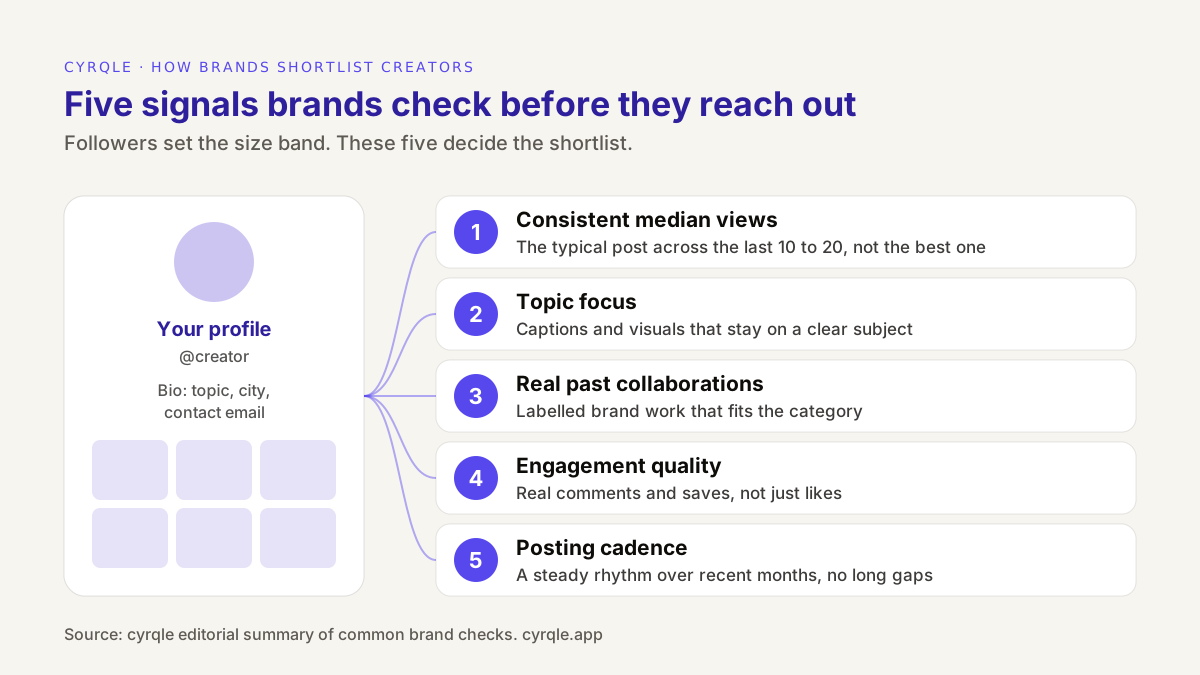
1. Consistent median views
The median is the middle value when you sort your recent posts by views. Brands that buy well take your last 10 to 20 posts and look at the median, because that is what a normal post does, and a normal post is what they are paying for. One viral reel lifts your average a lot and your median hardly at all.
Brands also look at the spread. If most of your posts land close to your median, a brand can plan on you. If your posts swing from 2,000 to 200,000 views, the brand cannot predict what its post will get, and it usually plans on the low end. We explain the maths from the brand's side in choosing creators by views and CPM.
2. Topic focus in captions and visuals
A brand searches for a subject. It finds you if your captions and your visuals both say, clearly and often, what you are about. A creator whose last 20 posts are about trail running, with captions that name the routes, the shoes and the city, appears in a search for "trail running Spain". A creator whose feed mixes running, gaming, travel and food appears in none of them strongly.
Topic focus does not mean posting the same thing every day. It means that a stranger can say what your account is about after looking at nine posts.
3. Real past collaborations
Past brand work tells a brand three things: other brands trusted you, you can deliver to a brief, and you know how to disclose an ad. Brands look for labelled paid partnerships and tagged brands in a related category. A running creator who has worked with a sports drink is a safer bet for a shoe brand than one with no brand work at all.
Too much brand work counts against you. If six of your last ten posts are ads for unrelated products, a brand will expect its post to perform like an ad, not like your content.
4. Engagement quality
Brands read the comments, not only the counts. Real questions ("which size did you get?"), replies from you, saves and shares show that people pay attention. A high like count with generic one-word comments, or comments in a language your audience does not speak, makes a brand suspicious. Our glossary explains engagement rate and why fake followers distort it.
5. Posting cadence
A brand wants to know you will still be active when its campaign runs. A steady rhythm over the last three months, even if it is only two posts a week, reads as reliable. A burst of daily posts followed by six weeks of silence reads as a risk, and long gaps also pull your recent views down.
How do two creators with the same followers compare?
Two creators with the same follower count can look completely different to a brand once it opens their recent posts. Here is a worked example. All figures are illustrative.
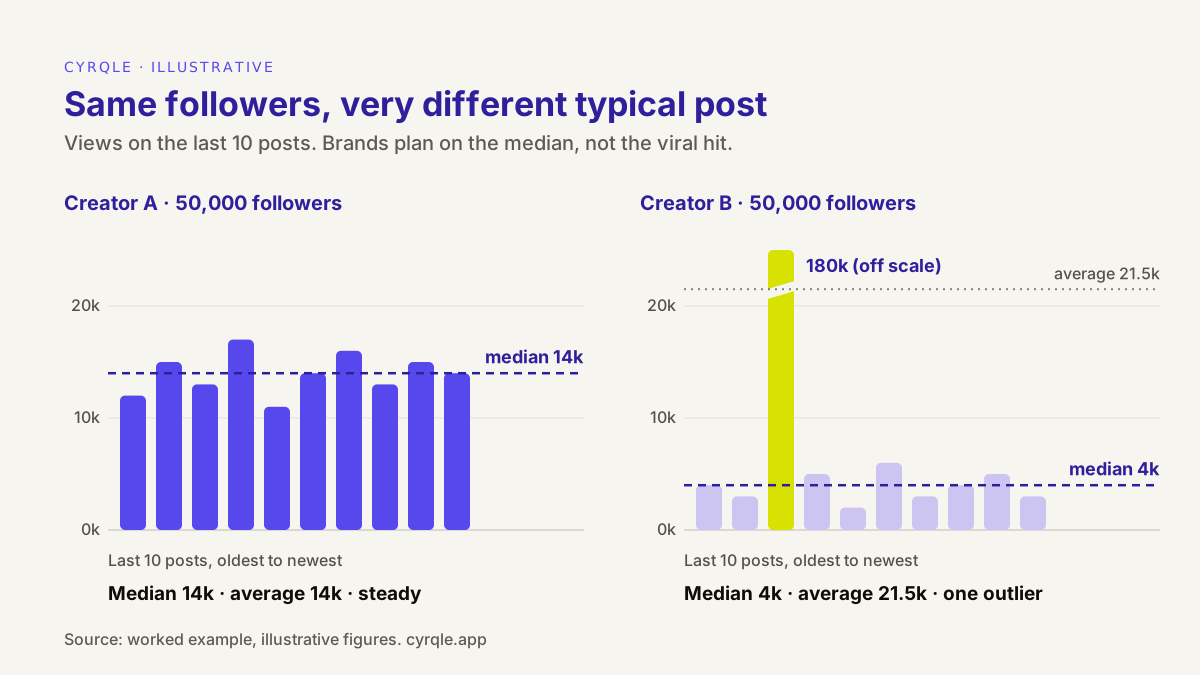
| Creator A | Creator B | |
|---|---|---|
| Followers | 50,000 | 50,000 |
| Views on last 10 posts | 11,000 to 17,000 | 2,000 to 6,000, plus one post at 180,000 |
| Average views | 14,000 | 21,500 |
| Median views | 14,000 | 4,000 |
| Cost per 1,000 views at a EUR 600 fee, on the median | EUR 43 | EUR 150 |
On the average, Creator B looks like the better buy. On the median, Creator A delivers three and a half times the typical views for the same fee. A brand that pays EUR 600 to Creator B is betting that the viral post repeats, and most brands will not take that bet at that price. Creator B is not a bad creator. B is a creator whose price should follow the median, or who should offer a lower fee plus commission so the brand shares the upside.
If you are Creator B, the lesson is not "go viral again". It is to find out what made your normal posts drop to 4,000 views and to raise the floor. For how to turn your median into a rate, see how much to charge for a sponsored post.
How can creators get found by brands?
You get found by making your topic, your numbers and your contact details easy to see. These steps take an afternoon to set up and a few minutes a month to keep up.
- Say your topic and city in your bio. "Trail running and mountain food, Granada" is searchable. "Living my best life" is not.
- Write captions that describe the post. Name the product category, the place and the activity in plain words. Search tools and platform search read text, and many people search in their own language, so write in the language of your audience.
- Keep a recognisable visual style. Brands and visual search tools both notice when your posts look like a set: the same kind of setting, light and framing.
- Label every brand collaboration. Use the platform's paid partnership label and say it is an ad in the caption. Spanish law treats advertising that is not identifiable as advertising as an unfair practice, and the label also builds the record of past work that brands look for. Our post on whether Spain's influencer law affects you covers the rules.
- Post on a rhythm you can keep. Two good posts a week for six months beats daily posts for three weeks and then nothing.
- Track your median views every month. Take your last 15 posts per format and write down the median. Put it in your media kit with the date. Our media kit template has a place for it.
- Make contact easy. Put a business email in your bio and answer brand emails within a few days. A brand that cannot reach you moves to the next name.
- Opt in where brands search. If the creator marketplace is available on your Instagram or TikTok account, opt in and choose interest keywords that match your real topic.
- Post about brands you actually use. Organic, honest posts about products in your category put you on the brand's radar when it checks who already talks about it.
What does not help
Some tactics look like shortcuts and make you harder to hire:
- Buying followers or likes. Brands compare followers with views and comments. A big gap is the first thing they notice.
- Engagement pods. Groups that like and comment on each other's posts add generic comments from people outside your audience. Brands read them.
- Hashtag stuffing. Thirty hashtags do not replace a caption that says what the post is about.
- Chasing one viral post. A single spike raises your average and leaves your median where it was. Brands plan on the median.
How cyrqle helps
cyrqle is a Creator Commerce OS used by brands and agencies to find creators, run campaigns and pay them. On the brand side, Find creators searches by meaning across two lenses, captions and visuals, so a creator whose captions and images clearly show a topic is easier to find for that topic. Each creator profile shows computed engagement, posting cadence, content mix and brand-collaboration history (labelled paid partnerships and tagged brands), along with similar creators. These are the same signals described above. Reach and cost figures in the tool are always shown as estimates, built from public post data.
Brands then build a shortlist in clusters, with a live reach and cost estimate, and compare lists before they invite anyone. The brand ranks and chooses, and a person on the brand side sends every invite. There is no automatic matching that picks creators for a brand. For why a group of well-fitted creators often beats one large account, read why cluster signal beats follower count.
On the creator side, cyrqle for creators is open as a waitlist, and the Creator plan is free. You connect Instagram and TikTok to your profile. Briefs arrive in your briefs inbox, either as a direct invite or as an open brief you can apply to. Every invite states the deal, because in cyrqle a brand cannot send invites until the campaign's compensation is set.
FAQ
How many followers do you need for brands to find you?
There is no fixed minimum. Many brands work with creators who have a few thousand followers when the topic, audience and recent views fit. Follower count decides which size band you appear in; your median views, topic focus and engagement decide whether you make the shortlist inside that band.
Do brands check for fake followers?
Yes, most do, at least informally. They compare your follower count with your views and comments, and they read the comments. A large account with low views and generic comments is the most common warning sign. If you bought followers in the past, your honest views will still show it, so focus on raising your median.
Does working with a competitor stop a brand from hiring you?
Usually not, unless your contract with the competitor has an exclusivity clause that is still running. Past work in the same category often helps, because it shows you know the product type. Check your current contracts before you accept, and tell the new brand about any exclusivity period.
Should you post more often to get found?
Only if you can keep the quality and the rhythm. Brands look at cadence over months, not weeks. Posting more of the same quality can help; posting more at lower quality lowers your median views, which is the number brands plan on.
Do hashtags help brands find you?
A few relevant hashtags help platform search and hashtag-based tools. They do not replace a clear caption and a clear topic. Use a handful that describe the post, and write the caption so that someone who never sees the hashtags still knows what the post is about.
Sources
- Meta, "Making it Easier for Brands and Creators to Collaborate on Instagram", 21 February 2024: about.fb.com
- TikTok Ads help centre, "How to find creators to collaborate with using the creator leaderboard": ads.tiktok.com
- Ley 3/1991 de Competencia Desleal, article 26 (covert advertising): BOE-A-1991-628
Related field notes.
Fake brand deal scam? A creator's red-flag checklist: lookalike domains, upfront fees, login links, exposure-only offers, spec work, rights grabs, how to check.
How to negotiate with brands as an influencer: anchor on views, counter with scripts in English and Spanish, trade rights, not your fee, and know when to walk.
Should you accept gifted collaborations? A decision guide for creators: product value vs your time, usage rights, disclosure, tax in Spain and how to counter.