
How to spot a fake brand deal or an unpaid 'collaboration'
Fake brand deal scam? A creator's red-flag checklist: lookalike domains, upfront fees, login links, exposure-only offers, spec work, rights grabs, how to check.
You spot a fake brand deal by checking five things before you reply: who sent it, whether it asks you for money, whether it asks you to log in or download something, what it pays, and what rights it takes. If the sender's domain does not match the brand, or the message asks you to pay anything, stop there. A real brand pays you, writes the terms down and can wait a day while you check.
Most creators get these messages early. A creator in Sevilla with 8,000 followers gets an email from "the partnerships team" of a cosmetics brand. A creator in Guadalajara gets a DM offering an "ambassador" place. Some are real. Some want your money, your password or your content for free. This guide gives you a checklist to tell them apart, a verification routine that takes about 15 minutes, and what to do if you already clicked.
What are the three kinds of bad offer?
Not every bad offer is a crime. It helps to sort them into three groups, because each one needs a different response.
- Scams. Someone pretends to be a brand to take your money, your account or your personal data. The "deal" does not exist. Your move is to stop and report.
- Unpaid "collaborations". The brand is real, but the offer pays nothing or almost nothing for real work: a full video, fixed deliverables, broad rights. It is legal. Your move is to negotiate or decline.
- Lopsided real deals. A real brand with a real fee, but with clauses that cost you money later: unlimited rights, exclusivity with no end date, payment "after results". Your move is to read the contract and push back.
| Scam | Unpaid 'collaboration' | Real brand deal | |
|---|---|---|---|
| What they want | Your money, password or bank details | Content and reach without paying for it | Agreed content for an agreed fee |
| Direction of money | From you to them | None, or product only | From the brand to you |
| Sender | Lookalike domain, free email or new account | The brand or its agency | The brand or its agency, verifiable |
| Written terms | Vague, or a fake 'contract' file or link | Often none, or a short DM | Brief and contract with both signatures |
| Rights asked | Irrelevant to them | Often all rights, all channels, forever | Scoped by channel, market and term |
| Your move | Stop, do not reply, report | Negotiate or decline | Read, negotiate, sign, deliver |
The checklist below covers all three groups. The first six flags are signs of a scam. The last four are signs of unpaid or lopsided work.
The red-flag checklist: 10 signals to check
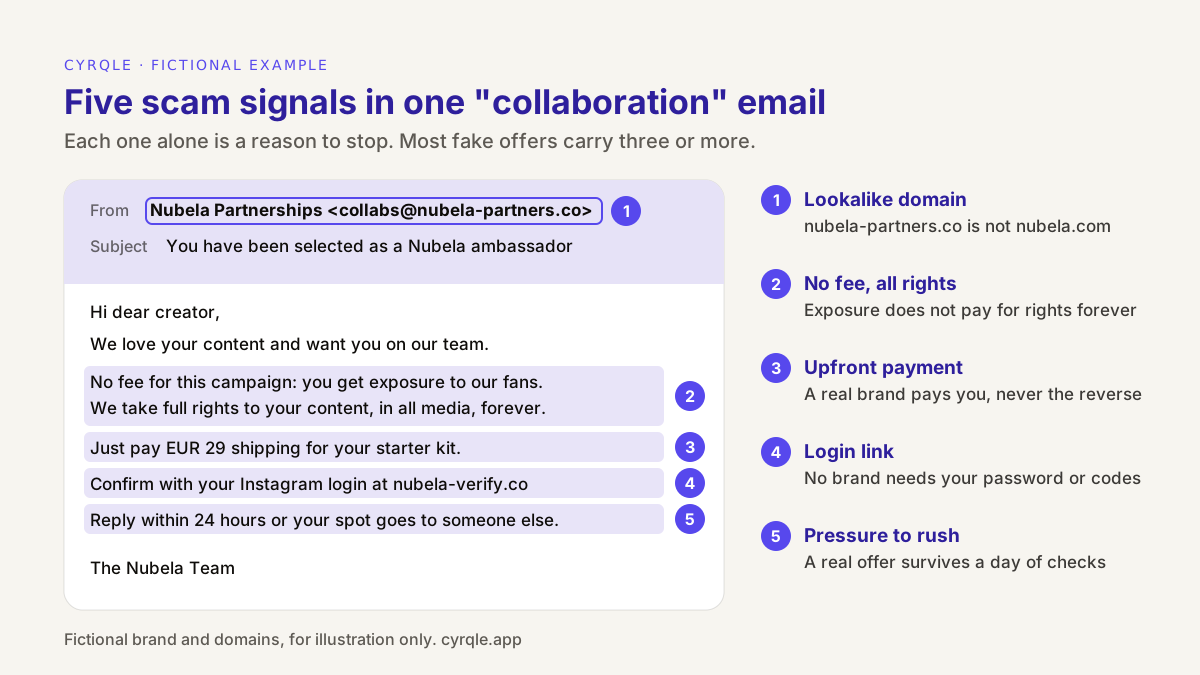
1. The sender domain is a lookalike
Scammers rarely use the brand's real domain. They register one that looks close: nubela-partners.co instead of nubela.com, a capital I in place of a lower-case l, an extra word such as "collabs" or "team", or a different ending (.co, .net, .shop). Read the domain after the @ letter by letter. Also be careful with the display name: "Nubela Partnerships" can sit on top of any address.
Spain's national cybersecurity institute, INCIBE, adds that the sender field itself can be forged, so a correct-looking address is not proof. If the From domain does not match the company, that is a strong warning sign, and if in doubt you should contact the company by phone or through its official site (INCIBE, email spoofing).
2. A brand team writes from a free email or only by DM
A marketing manager at a real company usually writes from the company domain. Agencies write from the agency's domain. A Gmail or Outlook address, or a DM from an account created last month with few posts, is not proof of fraud on its own, but it means you verify before anything else.
3. They ask you to pay first
This is the clearest signal of all. "Pay EUR 29 shipping for your kit." "Buy the product, and we refund you after you post." "There is a small registration fee for our ambassador program." "Pay for verification." A real brand deal moves money from the brand to you. If money moves the other way, it is not a brand deal.
4. They overpay and ask for the difference back
A variant of the same trick. The "brand" sends more than the agreed fee, says it was a mistake, and asks you to send the difference to them or to "the photographer". The first payment later bounces or is reversed, and the money you sent is gone. The US Federal Trade Commission describes this pattern and warns that even if the funds show in your account, "that doesn't mean it's a good check" (FTC, fake check scams). Never send money back from a payment you did not expect.
5. They want you to log in or open a file
"Confirm the collaboration with your Instagram login." "Download the contract" as a .zip, .exe or a document that asks you to enable macros. These are the two common ways to steal accounts and install malware. A brand does not need your password, your two-factor code or a login on a site it sent you. A real contract is a PDF or an e-signature link from a known service, and you can open it without logging in to your social account.
6. They rush you
"Reply within 24 hours or the spot goes to someone else." Real campaigns have deadlines, but a brand that wants you specifically can wait a day while you check who it is. Pressure exists to stop you from checking.
7. No fee, only "exposure"
"We cannot pay, but our page has 200,000 followers." Exposure with fixed deliverables and dates is unpaid work. Sometimes it is worth it, for example a brand you would post about anyway, with no rights attached. Most of the time it is a way to get content for free. Our guide to when to accept a gifted or unpaid offer has a four-question test.
8. A free "test" video
"Send us a full video so we can see if you are a fit." That is spec work: content made to the brand's specification, before any agreement, with no payment. Some brands then use the test content in ads. A short paid test is fine. A free one is a red flag, and your existing posts already show what you can do.
9. A rights grab
"All rights, in all media, worldwide, forever" for one post and a product. Usage rights are where most of the money in a deal sits, especially paid-ads use. A licence should state the channels, the markets and the term. See how to price usage rights and exclusivity for the numbers.
10. No written terms, or payment "after results"
Everything agreed by voice note, nothing in writing. Or a fixed fee that the brand will only pay "if the post performs". A commission deal is a legitimate model, but it has its own tracking and a statement. A fixed fee does not depend on sales.
The checklist in one table
| Signal | What it looks like | What a real brand does |
|---|---|---|
| Lookalike domain | brand-partners.co, brand.shop, letter swaps | Writes from the domain on its own website |
| Free email or new account | Gmail sender, account with few posts | Can be verified through the brand's official channels |
| Upfront payment | Shipping, kit, registration, "verification" fee | Pays you; never charges you to take part |
| Overpayment | Sends too much, asks for the difference back | Pays the agreed amount |
| Login link or file | "Log in to confirm", .zip or .exe "contract" | Sends a brief and a contract you can open without logging in |
| Pressure | 24-hour deadline, "last spot" | Gives you time to read and ask questions |
| Exposure only | No fee for fixed deliverables | Offers a fee, product or commission, stated in writing |
| Free test video | Full content "to check fit" | Pays for tests, or judges your existing posts |
| Rights grab | All rights, all channels, forever | Scopes rights by channel, market and term, and pays more for paid ads |
| No terms, or "pay after results" | Voice notes, vague promises | Signs a contract with a payment date |
How do you verify a brand before you reply?
Verify outside the message. Every check below uses a source the sender does not control. Do them in order, and stop at the first one that fails.
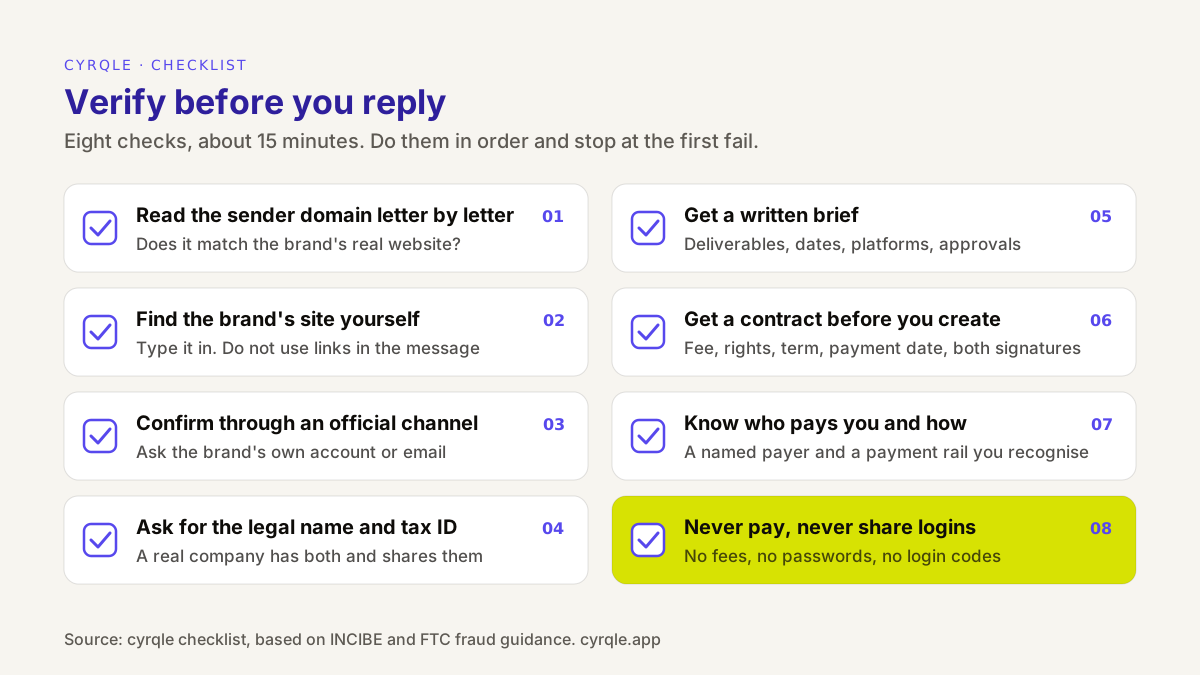
- Read the domain. Compare it, letter by letter, with the brand's real website.
- Find the website yourself. Type the brand's name into a search engine or the address bar. Do not use any link in the message.
- Confirm through an official channel. Write to the brand's official account, or to an email address listed on its own website, and ask whether the campaign and the person are real. If an agency contacted you, check that the agency exists and that it lists the brand as a client, or ask the brand.
- Ask for the legal name and tax ID. A company in Spain has a registered name (razón social) and a tax ID (NIF). You need both for your invoice anyway, so it is a normal question. A scammer usually goes quiet here.
- Ask for a written brief. Deliverables, platforms, dates, approval steps and the fee. A real campaign has these before it contacts you.
- Get a contract before you create. It names both parties, the fee, the deliverables, the rights and their term, and the payment date. Our influencer contract template for Spain and the EU shows each clause.
- Know who pays you and how. A named company paying to your bank, or a payment platform you know. Not crypto, not gift cards, not "our partner will contact you".
- Never pay and never share logins. No fee, no password, no two-factor code, no screen-share of your account.
None of these checks is rude. Real brand teams answer them every day, and a quick, clear answer is itself a good sign. For how brand teams usually find and contact creators, see how brands find creators.
Worked example: two offers, side by side
All figures are illustrative. Marta is a lifestyle creator in Valencia. Her usual fee for one reel and three stories is EUR 600. She receives two offers in the same week.
| Offer A: "ambassador program" | Offer B: "collaboration" | |
|---|---|---|
| Sender | team@nubela-partners.co | Brand marketing manager, company domain |
| What they offer | Product worth EUR 80 | EUR 400 fee |
| What they ask | 1 reel + 3 stories, all rights forever | 1 reel + 3 stories, 12 months of paid ads |
| Money Marta pays | EUR 29 "shipping" | Nothing |
| Written terms | None | Brief, no contract yet |
| Verdict | Scam. Stop. | Real, but under-priced. Negotiate. |
Offer A fails at the first check: the domain does not match the brand's site. The shipping fee confirms it. If Marta pays, the best case is that she loses EUR 29 and gets nothing. The worst case is that she also enters her card details on a fake checkout page.
Offer B is real but lopsided. The fee is EUR 200 below Marta's rate, and it includes 12 months of paid-ads use, which is a bigger use than a post on her own account. Suppose Marta charges an extra 30% of her fee for each year of paid use (an illustrative rule of thumb, not a market standard). Her quote becomes EUR 600 + EUR 180 = EUR 780, against the EUR 400 on the table. She can counter with the itemised quote, or keep the fee near EUR 400 and remove the paid-ads use. Our guide on how to negotiate your rate with a brand has scripts for both.
Then there is the overpayment trap. Suppose the "brand" in Offer B had agreed EUR 400, sent EUR 1,900 "by mistake" and asked Marta to transfer EUR 1,500 to its photographer. If the incoming payment is later reversed, Marta has sent EUR 1,500 of her own money and earned nothing. The rule is simple: if you are overpaid, the payer sorts out the refund, from their side, after the money has cleared. You do not send money.
How do a signed contract and a known payment rail protect you?
A contract protects you against lopsided deals. A known payment rail protects you against scams. You want both.
The contract turns a promise into terms you can enforce. It fixes the fee, the deliverables, the rights and the payment date before you spend time on the content. It also names the legal entity that owes you the money. If the brand pays late, you point to the date. If the brand uses your video in ads you did not license, you point to the rights clause. Without it, every one of those is your word against theirs. The creator's guide to brand deals lists the clauses that matter most.
The payment rail is the route the money takes. A rail you recognise has three properties that scams cannot fake easily:
- Money only moves to you. You receive a payout or a bank transfer. Nothing asks you to send money or "unlock" a payment.
- Identity is checked by the payment provider, not by a stranger. On Stripe Connect, for example, Stripe runs onboarding and identity verification for the connected account, so the brand never asks for your ID documents by email (Stripe, Express accounts).
- There is a record. Each payment has a reference, a date and an amount you can match against your contract and your invoice.
One caution: scammers also copy payment platforms. A link to "claim your payment" on a site you do not recognise is the same login trap as flag 5. Open your payment account by typing its address yourself. For a full walkthrough of the onboarding steps and what to expect, read getting paid through Stripe Connect.
What should you do if you already clicked or paid?
Act fast, and in this order.
- Secure your accounts. Change the password of any account you entered on the fake page, and of any account that uses the same password. Turn on two-factor authentication. Log out of all other sessions from the account's security settings.
- Call your bank. If you paid by card or transfer, ask your bank to block the card and to try to stop or reverse the payment. The sooner you call, the better the chance.
- Keep the evidence. Screenshots of the messages, the sender's address and profile, the links, and any payment receipts.
- Report it. Report the account or email to the platform. Tell the real brand: it wants to know that someone uses its name. In Spain, INCIBE runs a free and confidential cybersecurity helpline on 017, also on WhatsApp and Telegram (INCIBE, 017). If you lost money, file a report (denuncia) with the police.
- Warn your community, if you want. A short story post naming the fake domain helps other creators. Do not name the real brand as the culprit.
This section is general safety guidance, not legal advice. For a specific case, ask a lawyer or the police.
How cyrqle helps
cyrqle is a creator commerce platform where brands run campaigns and pay creators. The creator side is built so that the checks above are part of the deal, not extra work. cyrqle for creators is open as a waitlist, and the Creator plan is free, so there is nothing for you to pay to take part.
- Terms before the invite. A brand cannot send campaign invites until the campaign's compensation is complete. Every invite in your briefs inbox states the deal type, such as cash payment, commission on every sale or product gift, and the fee.
- A contract you sign, and so does the brand. You sign a Creator Collaboration Agreement by e-signature, and the brand signs too. The agreed terms are saved as a fixed snapshot. Content-wall and campaign use are part of every agreement, and paid-ads use is included only when the brand ticks it on the offer, so you see it before you sign. See compensation and contracts.
- No passwords. You connect Instagram and TikTok to your profile through the app. Signing a contract does not ask for your social login.
- A known payment rail. The brand funds the campaign, and a payout is scheduled when you deliver. A person on the brand side releases it, so it is not instant. Creators in Europe and the US are paid in euros to their bank through Stripe Connect, with a statement for each payout. Elsewhere, the brand pays by bank transfer and records the payment in cyrqle.
- Drafts with a check. You submit drafts in the campaign, and an automatic check flags missing required hashtags and handles before you post. See campaigns in cyrqle.
cyrqle does not vet every message you receive outside the platform. The verification routine in this guide still applies to any offer that arrives by email or DM.
FAQ
How do I know if a brand deal is real?
Check that the sender's domain matches the brand's own website, then confirm the campaign through the brand's official account or an email address listed on its site. A real deal comes with a written brief, a fee and a contract, and it never asks you to pay, log in or download a file.
Is it normal for a brand to ask me to pay for shipping?
No. A brand that wants you to post about its product sends the product at its own cost. Requests to pay shipping, buy a starter kit or pay a registration fee are the most common sign of a fake brand deal.
Is an exposure-only offer a scam?
Usually not. It is a real brand asking for unpaid work. It becomes a problem when the offer includes fixed deliverables, dates or broad usage rights. Counter with a fee, a product-plus-fee mix or a commission, or decline politely.
Should I make a test video for a brand before we agree?
Only if they pay for it. A free test video is spec work, and some brands reuse it. Point the brand to your recent posts and media kit, or offer a short paid test with the rights stated in writing.
What should I do if someone is using a brand's name to contact creators?
Do not reply or click. Report the account or email to the platform and tell the real brand through its official channel. In Spain, you can also call INCIBE's 017 helpline for advice, and file a police report if you lost money.
Sources
- INCIBE, Email spoofing: comprueba quién te envía un correo sospechoso: sender addresses can be forged; a From domain that does not match the company is suspicious; confirm through the company directly.
- INCIBE, Línea de Ayuda en Ciberseguridad 017: free and confidential helpline by phone, WhatsApp and Telegram.
- US Federal Trade Commission, How to spot, avoid and report fake check scams: overpayment scams and why visible funds are not proof of a good payment.
- Stripe, Using Express connected accounts: Stripe handles onboarding and identity verification for connected accounts.
Related field notes.
How do brands find influencers? They search by topic, then check five signals on your profile. What brand teams look at, and how creators can get found.
How to negotiate with brands as an influencer: anchor on views, counter with scripts in English and Spanish, trade rights, not your fee, and know when to walk.
Should you accept gifted collaborations? A decision guide for creators: product value vs your time, usage rights, disclosure, tax in Spain and how to counter.