
How to negotiate your rate with a brand (scripts in Spanish and English)
How to negotiate with brands as an influencer: anchor on views, counter with scripts in English and Spanish, trade rights, not your fee, and know when to walk.
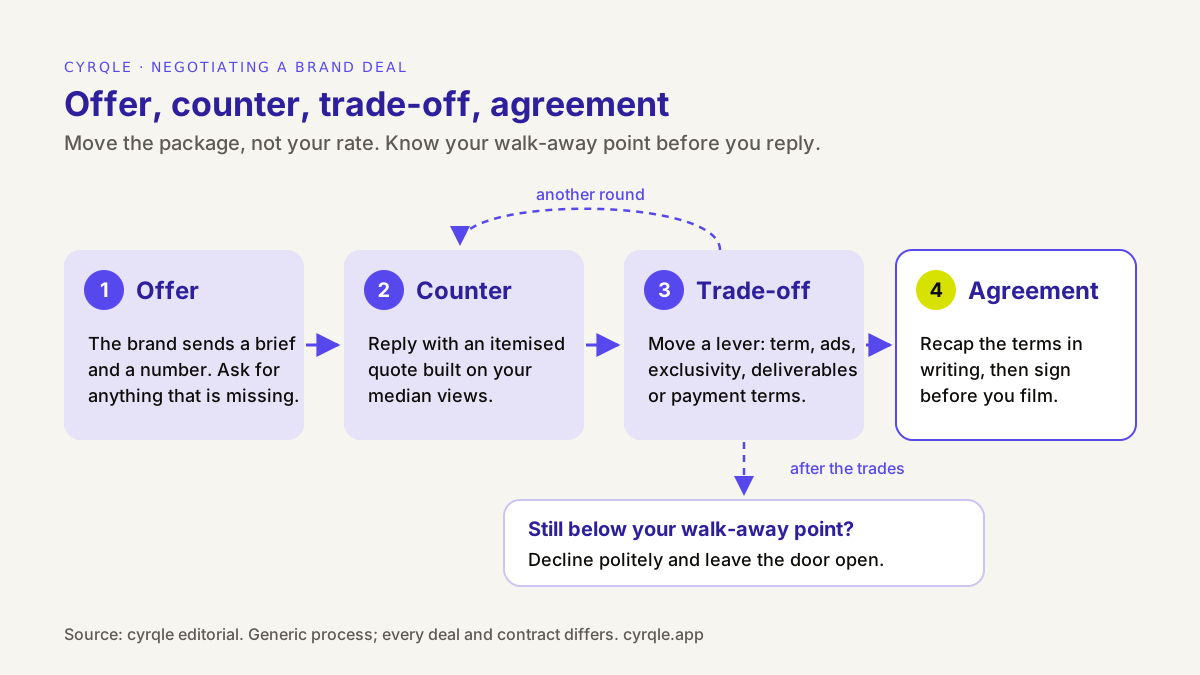
To negotiate with brands as an influencer, do not argue about a single number. Reply with an itemised quote built on your median views, then trade parts of the package (the usage-rights term, paid ads, exclusivity, the number of deliverables, the payment terms) instead of cutting your base rate. Decide your walk-away point before you send anything, and get every agreed term in writing before you film.
Picture Irene, a trail-running creator in Granada with 31,000 followers. An outdoor brand emails her a brief: two Reels and a set of stories, six months of paid ads with her Reels, no other running brands for 90 days, payment 60 days after the invoice. The offer is EUR 900, "all in". Irene's instinct is to accept, because the brand is one she likes. Her second instinct is to ask for EUR 1,500 and hope. Neither is a negotiation.
This guide gives you a method and the words. It covers the three numbers to set before you reply, how to anchor on views, eight email scripts in English and Spanish, the five levers you can trade, the payment terms to ask for, and when to walk away. It is written for creators in Spain and Latin America, with euros as the currency. Every price in the worked example is illustrative.
What should you know before you reply to a brand's offer?
Before you reply to any offer, know three numbers: your anchor, your target and your walk-away point. The anchor is the full itemised price for exactly what the brief asks. The target is the deal you would be happy with. The walk-away point is the lowest deal you will accept. Brands arrive with a budget ceiling already set, so you should arrive with a floor.
| Number | What it is | How to set it |
|---|---|---|
| Anchor | Your full quote for the brief as written | Median views ÷ 1,000 × your target CPM × format multiplier, plus every add-on the brief asks for |
| Target | The deal you would sign happily | Usually the anchor with one or two levers moved, not a lower rate |
| Walk-away point | The lowest total you will accept | Your lowest acceptable CPM on the content, or your minimum fee per job, whichever is higher, plus the rights you cannot give away for free |
The base of all three is the same formula. If you have not built it yet, our guide on how much to charge for a sponsored post walks through median views, a target CPM, format multipliers and add-ons step by step. Your rate card is the short version of that calculation, written down so you quote the same way every time.
Set the walk-away point in CPM, not in euros
A walk-away point in euros changes with every brief. A walk-away point in CPM does not. Irene's target CPM is EUR 25 per thousand views and her lowest acceptable CPM is EUR 18. For any brief, she can calculate both prices in two minutes. She also has a minimum fee of EUR 250 per job, because even a small brief takes half a day of planning, filming and messages.
How do you anchor your rate on views?
Anchor on views by putting the calculation in your first reply. Show the brand your median views per format, the price per deliverable and each add-on as its own line. A number with a visible reason is much harder to cut than a round figure, and it lets the brand compare you on cost per thousand views, which is how many brands compare creators. We explain that method from the brand side in choosing creators by real views and CPM.
Irene's anchor for the brief as written (all figures illustrative, before IVA):
| Line | Calculation | Amount |
|---|---|---|
| 2 Reels | 16,000 median views ÷ 1,000 × EUR 25 × 1.3, each | EUR 1,040 |
| 1 story set, 3 frames | 3 × (3,000 ÷ 1,000 × EUR 25 × 0.8) | EUR 180 |
| Content subtotal | EUR 1,220 | |
| Paid ads from brand accounts, Spain, 180 days | 45% of the Reels used (between the 90-day +30% and 365-day +60% rows of the calculator) | EUR 468 |
| Exclusivity, whole running category, 90 days | 30% of content | EUR 366 |
| Anchor before IVA | EUR 2,054 |
The rights percentages follow the illustrative uplifts in our usage rights and exclusivity calculator, which is written for brands. Using the same structure as the brand's own spreadsheet makes your quote easy to approve or to adjust line by line.
Her walk-away check: at EUR 18 CPM, the content alone is worth about EUR 878. The brand's EUR 900 "all in" pays for the content at her lowest acceptable CPM and gives away six months of ads and 90 days of category exclusivity for free. So EUR 900 for this brief is below her walk-away point. EUR 900 for a smaller brief might not be.
Email scripts for each stage of the negotiation
These are short templates you can paste into an email or a DM and adapt. Each one comes in English and Spanish, because many creators in Spain and Latin America work with brands and agencies in both languages. Replace the parts in square brackets. Keep the tone friendly and specific: you are solving a budget problem together, not winning an argument.
Script 1: the offer has no fee or no details
Use it when the first message says "we would love to collaborate" and nothing else. Do not quote until you know what they want.
English. Hi [name], thanks for thinking of me, I like what [brand] is doing with [product]. To send you a proper quote, could you share: the deliverables and platforms, the posting window, whether you want to reuse the content (where and for how long, and whether as paid ads), any exclusivity, and your budget range? I will come back within [two working days].
Español. Hola, [nombre]: gracias por pensar en mí, me gusta lo que hace [marca] con [producto]. Para enviarte un presupuesto en condiciones, ¿me cuentas los entregables y las plataformas, las fechas de publicación, si queréis reutilizar el contenido (dónde, cuánto tiempo y si es para anuncios), si hay exclusividad y vuestro rango de presupuesto? Te respondo en [dos días laborables].
Script 2: the itemised quote (your anchor)
Use it as your first price. It shows the reason behind each line and offers the brand an easy way to adjust.
English. Thanks for the brief. My quote is based on the median views of my last 15 Reels (16,000) and stories (3,000), and I can share screenshots. Two Reels: EUR 1,040. Story set: EUR 180. Paid ads in Spain for 180 days: EUR 468. Running-category exclusivity for 90 days: EUR 366. Total EUR 2,054 before IVA. Each line is separate, so if the budget is tighter we can adjust the package rather than the quality.
Español. Gracias por el brief. Mi presupuesto se basa en la mediana de visualizaciones de mis últimos 15 Reels (16.000) y de mis historias (3.000); puedo enviarte capturas. Dos Reels: 1.040 EUR. Serie de historias: 180 EUR. Anuncios en España durante 180 días: 468 EUR. Exclusividad en la categoría de running durante 90 días: 366 EUR. Total 2.054 EUR más IVA. Cada línea va por separado, así que si el presupuesto es más ajustado podemos cambiar el paquete en lugar de la calidad.
Script 3: the counter to a low offer
Use it when the brand replies with a number well below your anchor. Offer two packages at or near their budget, each with less in it. Never just split the difference.
English. I understand the budget is [EUR 1,100]. I would rather fit the package to it than lower my rate. Two options: (A) one Reel and two story sets, paid ads for 90 days, exclusivity limited to three named competitors for 60 days; or (B) two Reels and one story set, organic use only, no exclusivity. Both come in between [EUR 1,100 and EUR 1,220]. Which works better for your plan?
Español. Entiendo que el presupuesto es de [1.100 EUR]. Prefiero ajustar el paquete a bajar mi tarifa. Te propongo dos opciones: (A) un Reel y dos series de historias, anuncios durante 90 días y exclusividad limitada a tres competidores concretos durante 60 días; o (B) dos Reels y una serie de historias, solo uso orgánico y sin exclusividad. Las dos rondan [1.100-1.220 EUR]. ¿Cuál encaja mejor con vuestro plan?
Script 4: "other creators charge less" or "we pay everyone the same"
Use it when the brand compares you with a flat rate. Bring the conversation back to views, which is what they are buying.
English. That makes sense for a fixed budget. My price follows my recent views rather than my follower count: a Reel is [EUR 520] for a median of [16,000] views, about [EUR 32] per thousand views, and that is a number you can check against other creators. If the flat rate is fixed, I am happy to reduce the deliverables to match it.
Español. Tiene sentido con un presupuesto cerrado. Mi precio sigue mis visualizaciones recientes, no mis seguidores: a [25 EUR] por cada mil visualizaciones, un Reel sale a [520 EUR], y es una cifra que puedes comparar con otros creadores. Si la tarifa fija no se puede mover, puedo reducir los entregables para que encaje.
Script 5: product only, or "exposure"
Use it when the offer is product or visibility with fixed deliverables. Counter with a hybrid: product plus a smaller fee. Our guide on gifted product or paid collaboration helps you decide when product alone is fine.
English. Thank you, I would genuinely use [product]. For a Reel with set dates and usage, I work with a fee. I can offer a hybrid: the product plus [EUR 300] for one Reel, organic use only. If you only want to send the product with no posting commitment, I am also happy to receive it and post if it fits.
Español. Muchas gracias, de verdad usaría [producto]. Para un Reel con fechas y derechos de uso cerrados, trabajo con tarifa. Te propongo una fórmula mixta: el producto más [300 EUR] por un Reel, solo con uso orgánico. Si preferís enviarlo sin compromiso de publicación, también encantada de recibirlo y publicarlo si encaja.
Script 6: payment terms
Use it once the package is close, and before you sign. Payment terms are a lever, so ask for them openly.
English. Before I sign, could we set the payment terms? I propose 50% on signing and the balance within 15 days of the post going live, by bank transfer against my invoice. If 50% upfront is not possible, payment within 30 days of delivery works too. With either, I can round the total down to [EUR 1,100].
Español. Antes de firmar, ¿cerramos las condiciones de pago? Te propongo un 50% a la firma y el resto en los 15 días siguientes a la publicación, por transferencia contra factura. Si el 50% por adelantado no es posible, también me vale el pago a 30 días desde la entrega. En cualquiera de los dos casos, puedo redondear el total a [1.100 EUR].
Script 7: the written recap
Use it the moment you agree. A recap email turns a conversation into terms you can point to, and it is the base for the contract.
English. Great, confirming what we agreed: one Reel and two story sets on Instagram, posting window [dates], two revision rounds included. Paid ads from [brand]'s accounts in Spain for 90 days from the first post. No content for [Brand X, Brand Y, Brand Z] for 60 days. Fee EUR 1,100 before IVA, 50% on signing and 50% within 15 days of posting. Please send the contract with these terms and I will sign it.
Español. Perfecto, te confirmo lo acordado: un Reel y dos series de historias en Instagram, publicación entre [fechas], dos rondas de revisión incluidas. Anuncios desde las cuentas de [marca] en España durante 90 días desde la primera publicación. Sin contenido para [Marca X, Marca Y, Marca Z] durante 60 días. Tarifa de 1.100 EUR más IVA, 50% a la firma y 50% en los 15 días siguientes a la publicación. Envíame el contrato con estas condiciones y lo firmo.
Script 8: walking away
Use it when the offer stays below your walk-away point after the trades. Be brief, thank them and leave a reason they can act on later.
English. Thanks for working through this with me. At this budget I cannot deliver the package at the standard you would want, so I will pass on this one. If the budget or the scope changes, or for a future campaign, I would be glad to hear from you.
Español. Gracias por buscar una solución conmigo. Con este presupuesto no puedo entregar el paquete con la calidad que buscáis, así que esta vez lo dejo pasar. Si cambia el presupuesto o el alcance, o para una próxima campaña, me encantará volver a hablar.
What can you trade instead of cutting your fee?
Trade the parts of the package that change what the brand gets, not your rate. Every lever below moves the total price, and every one has a reason the brand understands. Cutting your rate has no reason except "you asked", and it becomes the starting point for your next deal with that brand.
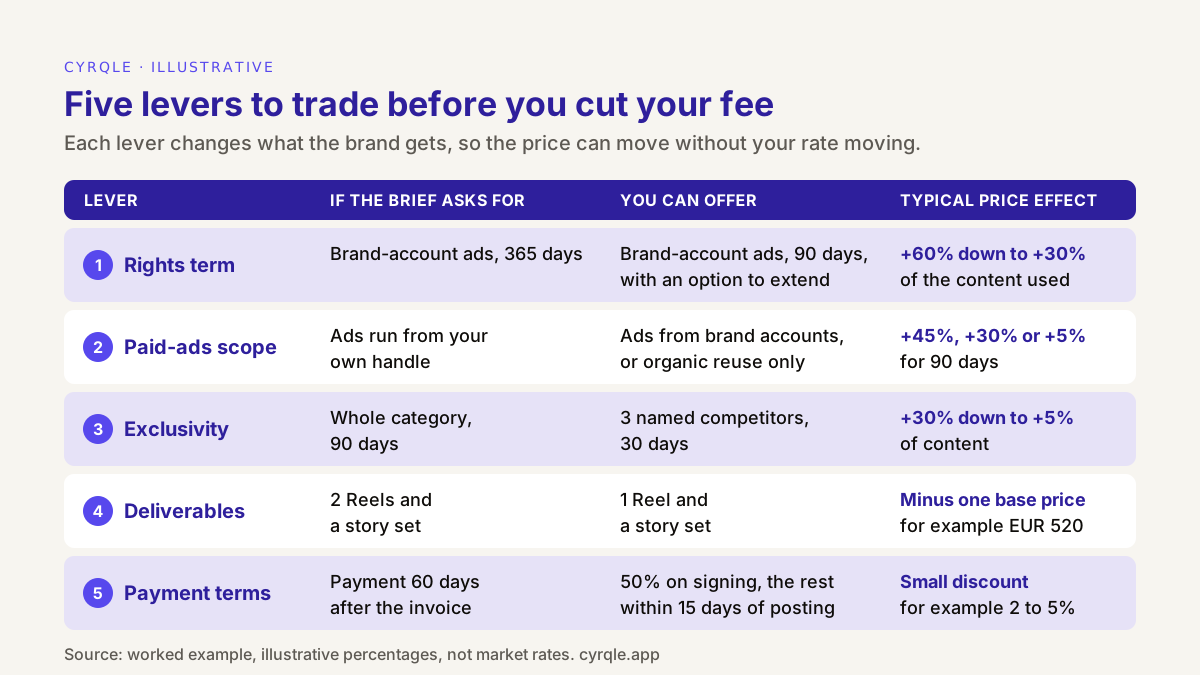
| What you change | Typical price effect (illustrative) | Why the brand accepts it | |
|---|---|---|---|
| 1. Usage-rights term | Brand-account paid ads for 90 days instead of 365: from +60% to +30% of the content used | A paid push often runs for weeks, not a year. Offer an option to extend at a set price | |
| 2. Paid-ads scope | For 90 days: ads from brand accounts +30%, ads from your handle +45%, organic reuse only +5% | Many briefs ask for ads by default. Ask whether the media plan really needs them | |
| 3. Exclusivity | Whole category for 90 days +30%; three named competitors for 30 days +5% | A short list of real rivals covers the brand's actual risk | |
| 4. Deliverable count | One fewer Reel removes one base price; a repeat booking can justify a lower price per post | Fewer pieces at full quality beat more pieces made in a rush | |
| 5. Payment terms | 50% on signing, or payment in 15 days instead of 60: worth a small discount, for example 2 to 5% | Paying earlier costs the brand little and gives you certainty |
Rights and exclusivity are where the money is
The first three levers carry most of the value, because they limit what you can earn elsewhere. A licence to run your face in ads for a year is a much bigger use than one organic post. In Spain, the law also reads a rights transfer narrowly: article 43 of the Ley de Propiedad Intelectual limits a transfer to the uses expressly provided for, and if no duration is stated, the transfer lasts five years. So a brief that says "we can use the content" is worth clarifying before you price it, and a term in days is worth writing into every line. Our guide to content rights in the EU explains why a public post is not a licence.
Deliverables and repeat bookings
Dropping a deliverable is the cleanest trade: the brand pays less and gets less. A repeat booking works the other way. If a brand commits to three posts over three months, a lower price per post can be fair, because you save time on onboarding and you get predictable income. Agree the total in the contract, not just the first post.
Payment terms are worth more than they look
Fast payment costs the brand very little and is worth a lot to a self-employed creator. It is the one lever where a small discount is often the right move, because you get something real in return: cash earlier and less risk.
Which payment terms should you ask for?
Ask for a payment date, a payment method, and an advance when the brand is new to you. A good default for creators is 50% on signing and the balance within 15 days of posting, or payment within 30 days of delivery. Put it in the contract, and say in every quote that prices are before IVA.
What Spanish law says, for deals between businesses and self-employed professionals in Spain:
- 30 days by default. If the contract sets no date, the brand must pay within 30 calendar days of receiving the service (article 4.1 of Ley 3/2004).
- 60 days at most. The parties can agree a longer term, but never more than 60 calendar days (article 4.3). "Payment 90 days after the end of the month" is not a valid term between businesses in Spain.
- Late payment costs the brand. If no rate is agreed, late payment interest is the European Central Bank's main refinancing rate plus eight percentage points (article 7.2), and the creditor can claim a fixed EUR 40 for collection costs (article 8).
Other terms worth asking for:
- A kill fee. If the brand cancels after you have started, you are paid for the work done, for example 50% after the draft is delivered.
- Revision rounds. Two rounds included, extra rounds at a fixed price. Unpaid revisions are the most common hidden discount.
- Who pays transfer costs. For brands outside Spain, or creators in Latin America working with European brands, agree the currency and who pays the bank fees in the contract.
- Commission statements. In a commission or hybrid deal, ask how sales are counted, the attribution window, whether refunds are deducted, and a statement with every payment.
IVA and IRPF withholding are added to, or deducted from, the invoice, not negotiated away. This is general information, not legal or tax advice: for your own case, ask a gestor or a lawyer. Our creator's guide to brand deals covers invoices, withholding and contracts in more detail, and the influencer contract template shows the clauses a careful brand will propose.
Worked example: how Irene's negotiation ends
The brand replies to Irene's EUR 2,054 anchor with a budget of EUR 1,100. She sends script 3 with two options. The brand picks option A, because its media plan needs one Reel as an ad and its real worry is three named competitors, not the whole category. Then she uses script 6 to trade a small rounding for better payment terms. All figures illustrative, before IVA.
| Line | Brief as written (anchor) | Agreed package |
|---|---|---|
| Reels | 2 Reels: EUR 1,040 | 1 Reel: EUR 520 |
| Story sets | 1 set: EUR 180 | 2 sets: EUR 360 |
| Paid ads, Spain | 180 days, 45% of the Reels: EUR 468 | 90 days, 30% of the Reel: EUR 156 |
| Exclusivity | Whole category, 90 days, 30% of content: EUR 366 | 3 named competitors, 60 days, 10% of content: EUR 88 |
| Payment | 60 days after the invoice | 50% on signing, 50% within 15 days of posting |
| Total | EUR 2,054 | EUR 1,124, rounded to EUR 1,100 |
What changed and what did not:
- Her rate did not move. The Reel is still priced at EUR 25 CPM with the 1.3 multiplier. Next time this brand books her, the starting point is the same.
- The brand got what its plan needed. One Reel to run as an ad for a 90-day campaign, more story coverage, and protection against its three real competitors.
- The only discount bought something. Irene gave up EUR 24 in exchange for half the money upfront and the rest in 15 days instead of 60.
- The first offer would have cost her. EUR 900 for the original brief meant two Reels, six months of ads and 90 days out of the whole running category. The agreed deal pays EUR 200 more for less of her time and fewer restrictions.
When should you walk away from a brand deal?
Walk away when the best offer, after the trades, is still below your walk-away point, or when the terms put you at risk regardless of the fee. A polite no protects your rate: a price you accept below your floor becomes the reference for that brand's next offer.
Walk away, or pause and ask questions, when:
- The total is below your lowest acceptable CPM or your minimum fee after you have offered a smaller package.
- Rights are unlimited. "All channels, all markets, forever" for the price of one post.
- Exclusivity is broad and long with no matching fee, such as a whole category for six months.
- Payment is open-ended or depends on "results" in a deal that is not a commission deal.
- Nothing is in writing. No recap, no contract, only voice notes.
- You are asked to pay, to buy the product first, or to share your account password. These are signs of a scam, not a negotiation.
Walking away is not the same as burning the bridge. Script 8 leaves the brand a reason to come back when its budget grows.
How cyrqle helps
cyrqle for creators is open as a waitlist, and the Creator plan is free. It shows the terms of a deal before you say yes.
- Invites that state the deal. In cyrqle, a brand cannot send campaign invites until the campaign's compensation is complete. Every invite shows the deal type (cash payment, commission on every sale, product gift, or a combination) and the terms, so you start from a real number, not "can we collaborate?".
- Estimates brands can see. You connect Instagram and TikTok. Brands searching in cyrqle see estimates built from observed post data, such as estimated reach and a cost estimate. These are estimates for comparing creators, not your price. Your quote is still yours to set.
- Paid-ads use in the offer. You sign a Creator Collaboration Agreement by e-signature, and the agreed terms are saved as a fixed snapshot. Campaign and content-wall use are part of every agreement. Paid-ads use is included only when the brand ticks it on the offer, so you see it before you sign and can price it. See compensation and contracts.
- Payouts after delivery. The brand funds the campaign, and a payout is scheduled when you deliver. A person on the brand side releases it, so it is not instant. Creators in Europe and the US are paid in euros through Stripe Connect, with a statement for each payout. Elsewhere, the brand pays by bank transfer and records it.
On the brand side, the outreach thread and deal terms for each creator live inside the campaign in cyrqle campaigns. If you want to see how a brand prepares for the same conversation, read how brands decide what to pay a micro-influencer. It uses the same view-based method from the other side of the table.
FAQ
Is it rude to negotiate with a brand?
No. Brands expect a counter-offer, and many first offers leave room for one. What reads as rude is a bare number with no reason, or silence. A short, friendly reply with an itemised quote and two options shows you are easy to work with.
How much higher than the brand's first offer can I ask?
There is no fixed percentage. Quote what the brief as written is worth on your views, even if that is double the offer, and then show what fits their budget. The gap is a scope question, not a politeness question.
Should I give a discount for a long-term partnership?
You can, if the commitment is written into the contract: a set number of posts, dates and a total fee. A lower price per post for a confirmed series is fair. A discount now for a vague promise of "more work later" is not.
Should I negotiate in Spanish or in English?
Use the language the brand writes in, and keep the contract in a language you fully understand. If the brand is in another country, confirm the currency, the IVA treatment and who pays bank fees in writing, whatever the language.
Can I renegotiate after I have signed?
Only by agreement. A signed contract binds both sides. If the brand asks for more after signing, such as longer ads, extra posts or more revisions, treat it as a new request and quote it as a new line.
Sources
- Ley 3/2004 on late payment in commercial transactions, articles 4, 7 and 8: BOE-A-2004-21830
- Ley de Propiedad Intelectual (Real Decreto Legislativo 1/1996), article 43: BOE-A-1996-8930
Related field notes.
Should you accept gifted collaborations? A decision guide for creators: product value vs your time, usage rights, disclosure, tax in Spain and how to counter.
How to get brand deals as a creator in Spain and Latin America: how brands find you, how to price on views, what to check in a contract, and how you get paid.
Influencer marketing budget planning for 2027, built bottom-up: objectives, tier mix, pricing model, seasonal peaks in Spain and Mexico and a worked euro model.