
Media kit template for creators (free, in Spanish and English)
Free influencer media kit template, in English and Spanish: eight sections from median views to rates and usage rights, with a filled example.
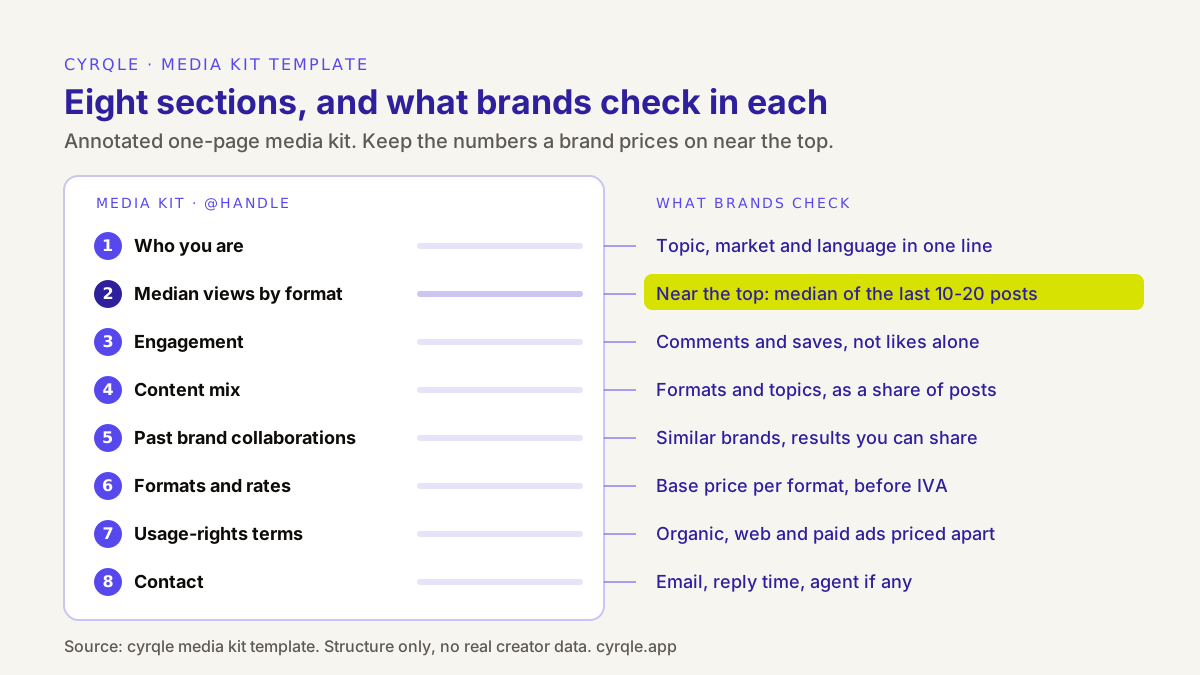
An influencer media kit template needs eight sections: a one-line summary of who you are and who watches you, your median views per format, your engagement, your content mix, past brand collaborations, your formats and rates, your usage-rights terms, and how to contact you. Put the numbers a brand prices on near the top, date them, and keep the whole kit to one page.
Below is each section as copyable text in English, with a note on what brands check and how to fill it in. The Spanish version of this guide has the same template in Spanish, so you can send the right one to each brand. At the end there is a filled example for an illustrative running creator in Valencia, and a comparison of a follower-led kit against a view-led one.
What does a brand read first in a media kit?
A brand reads a media kit in the order it makes a decision. First it checks fit: does this creator post about our category, for people in our market, in our language? Then it checks size and price: how many people see a normal post, and what does each thousand views cost? Only after that does it look at past collaborations, rates and terms.
That is why the template puts the summary line first and median views second. A marketing manager with a pile of kits to get through will often decide in the first screen whether to keep reading. If the topic is wrong, nothing else matters. If the topic is right but the views are missing or vague, the manager has to go and count them on your profile, and many will not.
| Order | Section | The question the brand is answering |
|---|---|---|
| 1 | Who you are | Is this creator in our category, market and language? |
| 2 | Median views by format | How many people will see the post we pay for? |
| 3 | Engagement | Does the audience pay attention, or just scroll past? |
| 4 | Content mix | Which formats and topics does this creator actually make? |
| 5 | Past brand collaborations | Has this creator delivered for brands like us? |
| 6 | Formats and rates | What does it cost, and is the price explained? |
| 7 | Usage-rights terms | What can we do with the content after it goes live? |
| 8 | Contact | Who do we write to, and how fast will they answer? |
Our creator's guide to brand deals covers the wider picture: how brands find creators, what to check in a brief, contracts and getting paid. This page is the template.
How to use this template
- Copy the eight blocks below into your design tool, a document or a slide. Replace everything in square brackets.
- Collect your numbers first: open Instagram's professional dashboard and TikTok Analytics, and note the views on your last 10 to 20 posts per format.
- Delete any line you cannot back up with a screenshot. A short, true kit beats a long one with guesses.
- Write the date of your numbers at the top. "Numbers as of [month year]" tells the brand you are not hiding an old peak.
- Export as a one-page PDF under about 5 MB, and keep a link version (a page or a shared document) for your bio and email signature.
- Keep an English and a Spanish version if you work with brands in both languages. The Spanish template is on the Spanish version of this page.
The media kit template, section by section
Section 1. Who you are
[Your name] · @[instagram handle] · @[tiktok handle]
[Topic] creator for [audience] in [market], posting in [language].
Example line: Running and trail creator for amateur runners
in Valencia and the rest of Spain, posting in Spanish.

Platforms: Instagram [followers], TikTok [followers]
Based in: [city, country]
Numbers as of: [month year]
What brands check. Fit, in one line: topic, audience, market and language. A sports retailer selling in Spain wants to know in five seconds that you post about running, for people in Spain, in Spanish.
Fill-in notes. Name one topic, not five. "Lifestyle" says nothing; "budget home cooking for students" says a lot. Followers go here, as context, not as your headline number. Add the "numbers as of" date on every version you send.
Section 2. Median views by format
TYPICAL VIEWS PER POST (median of recent posts)
Instagram Reel ........ [median] views  (last [N] Reels)
TikTok video .......... [median] views  (last [N] videos)
Instagram carousel .... [median] views  (last [N] carousels)
Instagram story ....... [median] views per frame (last [N] frames)

Best recent post: [views] ([format], [month year])
Screenshots of insights available on request.
What brands check. How many people a normal post reaches, per format. This is the number a brand uses to compare you with other creators and with what it pays for reach in paid social.
Instagram now reports views as its headline metric across formats. Meta's developer documentation lists a views metric for feed posts, Reels and stories, and marks the older impressions metric as deprecated for media created after 2 July 2024 (Meta for Developers, Instagram Media Insights). TikTok Analytics also shows views per video. So views are the one number every brand can compare across your formats and with other creators.
Why the median, not the average. The median is the middle value when you sort your posts by views. The average adds every post and divides, so one viral post drags it up. In the illustrative chart below, one Reel reached 210,000 views and the other eleven sat between 9,000 and 17,000. The average is 29,333; the median is 13,000. Eleven of twelve posts fell below the average.
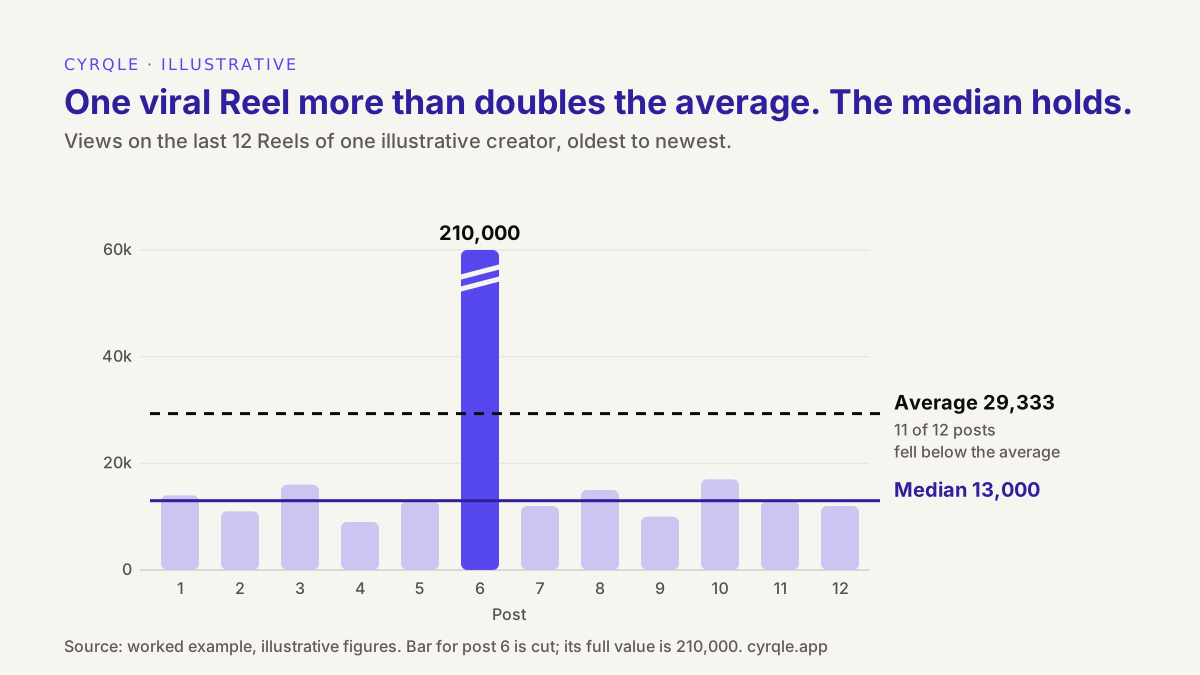
If your kit says "average 29,000 views per Reel", a brand that scrolls your profile sees 12,000, 15,000, 10,000. Your kit now looks inflated, even though the number is technically correct. If it says "median 13,000 per Reel, best recent Reel 210,000", the brand gets a number it can trust and an upside it can see. The same logic, from the brand's side, is in choosing creators by real views and CPM.
Fill-in notes. Use one format per line, because Reels and stories reach different numbers of people. Take the last 10 to 20 posts of each format, or the last 60 to 90 days if you post less often. Fewer than five posts makes the median fragile; say so if that is your case. Show your best recent post separately, labelled as your best, not as your typical.
Section 3. Engagement
ENGAGEMENT (last [N] posts)
Engagement rate by views: [x.x]%
  = (likes + comments + saves + shares) ÷ views
Typical comments per Reel: [median]
Typical saves per Reel: [median]
Typical shares per Reel: [median]
What brands check. Whether the audience pays attention. A high view count with almost no comments or saves can point to passive reach. Saves and shares matter because they show people want to come back to the post or pass it on.
Fill-in notes. Engagement rate can be calculated against followers or against views, and the two give very different numbers. Say which one you use. Engagement by views is the fairer choice once views are your headline metric, because it compares interactions with the people who actually saw the post. Do not mix: a rate by followers next to views by median invites questions. Also list the raw medians for comments, saves and shares. A brand can sanity-check those on your profile in a minute.
Section 4. Content mix
WHAT I POST (last [90] days)
Formats: Reels [x]% · stories [x]% · carousels [x]% · TikTok [x]%
Topics:  [topic A] [x]% · [topic B] [x]% · [topic C] [x]%
Posting rhythm: [n] feed posts and [n] story days per week
Sponsored share: about [1 in n] posts is a paid partnership
What brands check. What you actually make, and how often. A brand that needs a Reel wants to see that you make Reels regularly, not once a quarter. The topic split shows whether its product sits inside your normal content or would look out of place.
Fill-in notes. Count, do not guess: list your last 30 to 50 posts and tag each with a format and a topic. Include the share of sponsored posts. A feed where every second post is an ad worries brands, and saying it openly when the share is low is a selling point.
Section 5. Past brand collaborations
SELECTED COLLABORATIONS
[Brand] · [format] · [month year]
  Result: [views / link clicks / code uses / saves], if shareable
[Brand] · [format] · [month year]
  Result: [...]
[Brand] · [format] · [month year]
  Result: [...]
Categories I have worked in: [category], [category]
What brands check. Proof that you can deliver for brands like them: on brief, on time, and with results. Brands also check this section against your profile, because paid partnerships are labelled on the platforms.
Fill-in notes. Pick two to four collaborations close to the brands you want next. Only share results the brand agreed you could share, and keep them factual ("3,100 link clicks in 7 days"), not adjectives ("amazing results"). Leave out anything under exclusivity or confidentiality. If you have no paid collaborations yet, list gifted or self-initiated content about brands you use, and label it honestly.
Section 6. Formats and rates
RATES (EUR, before IVA)
Instagram Reel ............ EUR [price]
TikTok video .............. EUR [price]
Instagram carousel ........ EUR [price]
Story set, [3] frames ..... EUR [price]
Minimum fee per brief ..... EUR [price]
Includes: one organic post on my account, [2] revision rounds,
post stays live [90] days, statistics at [7 and 30] days.
Not included: usage rights, paid ads, exclusivity, raw files, rush.
OR: Rates on request. Base price per format depends on the brief.
What brands check. Whether the price is clear, what it includes, and whether it lines up with your views. A brand will divide your Reel price by your median Reel views and multiply by 1,000 to get an effective cost per thousand views. If that number is far above what it pays elsewhere for the same audience, it will push back.
Fill-in notes. Build each base price from your median views: median views ÷ 1,000 × the CPM you choose × a format multiplier. The full method, with multipliers per format, is in how much to charge for a sponsored post. For market context in Spain, see the influencer rates for Spain in 2026. Quote before IVA and say so. Whether you publish rates or write "rates on request" is your choice: published rates filter out brands that cannot pay; "on request" leaves room when rights and exclusivity change the deal a lot.
Section 7. Usage-rights terms
USAGE RIGHTS (priced separately)
Organic reuse on brand accounts and website: +[x]% per [3] months
Paid ads with my content: +[x]% per [3] months, per country
Category exclusivity: +[x]% per [30] days, named competitors only
Raw footage: on request
Every licence states its use, term and territory in writing.
What brands check. What they may do with the content after it goes live, and what it costs. Many brands want to repost a creator's video on their own account, put it on a product page or run it as an ad. Each of those is a different use.
Fill-in notes. A public post is not a licence. Our article on UGC rights in the EU explains why. Under Spanish copyright law, if nothing is agreed in writing, a transfer is presumed to last five years and to cover only the country where it is granted (Ley de Propiedad Intelectual, article 43.2, BOE). So write the use, the term and the territory for each extra, and price paid ads highest, because an ad can reach many times your organic audience. For the clause wording a brand will send you, see the influencer contract template for Spain. This is general information, not legal advice.
Section 8. Contact
CONTACT
Email: [address]   (replies within [2] working days)
Management: [agent or agency name, email], if any
Invoicing as: [autónomo / company name], [country]
Languages: [Spanish, English]
What brands check. Who to write to, how fast you answer, and whether an agent is involved. "Invoicing as" saves a step later, because the brand's finance team needs to know who sends the invoice.
Fill-in notes. Use an email address, not "DM me". Brands work in email, and a DM gets lost. If you have a manager, give one contact, not two. Put the same email in your Instagram and TikTok bios.
Filled example: Marta's media kit (illustrative)
Marta is an illustrative running creator in Valencia with 31,000 Instagram followers and 18,000 on TikTok. All numbers below are invented for the example. Her CPM choice and format multipliers follow the method in the sponsored-post pricing guide: a EUR 25 CPM, 1.3 for Reels and TikTok videos, 1.0 for carousels and 0.8 per story frame.
| Section | What Marta writes |
|---|---|
| Who you are | Running and trail creator for amateur runners in Valencia and the rest of Spain, posting in Spanish. Numbers as of May 2026. |
| Median views | Reel 13,000 (last 12) · TikTok 9,500 (last 15) · carousel 7,000 (last 10) · story 2,400 per frame (last 30). Best recent Reel 210,000, March 2026. |
| Engagement | 3.7% by views, median of last 12 Reels. Median per Reel: 46 comments, 310 saves, 120 shares. |
| Content mix | Reels 55%, stories daily, carousels 15%, TikTok 30%. Topics: training plans 45%, races 30%, kit reviews 25%. About 1 in 8 posts is paid. |
| Past collaborations | A running shoe brand, Reel, February 2026: 2,300 link clicks in 7 days (shared with the brand's permission). A sports nutrition brand, story set, January 2026. |
| Formats and rates | Reel EUR 420 · TikTok EUR 310 · carousel EUR 175 · story set of 3 frames EUR 145 · minimum fee per brief EUR 140. Before IVA, two revision rounds. |
| Usage rights | Organic reuse +15% per 3 months · paid ads +30% per 3 months, per country · exclusivity +15% per 30 days, named competitors. |
| Contact | Email, replies within 2 working days. Invoices as autónoma in Spain. Spanish and English. |
The rates come straight from the median views. The Reel line is 13,000 ÷ 1,000 × EUR 25 × 1.3 = EUR 422.50, rounded to EUR 420. The story set is 3 × 2,400 ÷ 1,000 × EUR 25 × 0.8 = EUR 144, rounded to EUR 145.
Now the same Reel priced on the average instead: 29,333 ÷ 1,000 × EUR 25 × 1.3 = EUR 953. A brand that checks Marta's profile sees typical Reels around 13,000 views, so the EUR 953 price works out to about EUR 73 per thousand typical views. The median-based EUR 420 works out to about EUR 32 for the same views. A brand comparing creators will see the first price as more than double what the post delivers, and will either push back or move on.
Follower-led kit or view-led kit: which one gets answered?
Most media kits still open with a follower count. A view-led kit opens with the numbers a brand prices on. The difference shows up as soon as the brand starts checking.
| Follower-led kit | View-led kit (this template) | |
|---|---|---|
| Headline number | Total followers | Median views per format, dated |
| What a brand can verify on the profile | Follower count only | Views on recent posts, format by format |
| Effect of one viral post | Hidden, or shown as an average | Shown separately as best recent post |
| Engagement | Rate by followers, often undefined | Rate by views, with the formula stated |
| Price explained | Rarely | Base price per format tied to median views |
| Usage rights | Usually missing | Priced per use, term and territory |
| Effort to keep it current | Low | Higher: refresh every one or two months |
| Works best for | A first contact when views are still small | Paid deals, repeat brands, agencies |
The follower-led kit is quicker to keep up to date, and it is not wrong when you are just starting out and your views are still small. Once you are quoting paid deals, the view-led kit wins, because every number in it can be checked and every price can be explained.
How should a media kit look, and how often should you update it?
A media kit should be one page, readable on a phone, and dated. Brands open kits on laptops and phones between meetings, so a single page with large numbers works better than a 12-slide deck.
- Format. A one-page PDF for email, plus a link version for your bio. Name the file clearly:
media-kit-marta-runs-2026-05.pdf. - Design. Your own colours and one good photo are enough. Numbers should be the largest text after your name.
- Language. Send the kit in the brand's working language. Keep separate English and Spanish versions rather than mixing both on one page.
- Updates. Refresh the numbers every one or two months, and after any big change in your views. Change the "numbers as of" date each time.
- Proof. Keep screenshots of the insights behind every number in a folder, ready to send when a brand asks.
Mistakes that cost creators deals
- Followers as the only number. The brand has to go and count views itself, and many will not.
- The average instead of the median. It looks inflated as soon as the brand scrolls your profile.
- Engagement with no formula. A rate without its denominator cannot be compared with anyone else's.
- Rates that bundle everything. A single price for "post + rights + exclusivity" gives the brand nothing to remove except your fee.
- No date. An undated kit looks like an old peak.
- Results you were not allowed to share. One leaked figure can end a brand relationship.
How cyrqle helps
cyrqle for creators is open as a waitlist, and the Creator plan is free. Once you are in, you connect Instagram and TikTok, and brands searching in cyrqle see estimates built from observed post data, such as estimated reach and a cost estimate. These are estimates for comparing creators, not your price. Your rates stay yours to set, which is why your own media kit still matters.
On the brand side, cyrqle has a Creator media kit report in Reports. A brand or agency can export it as a PDF or CSV for a single creator. It shows the creator's profile, followers, engagement, post count, size tier, category, location, last post date and biography, plus what the creator posts about (the share of posts and average interactions per topic), the hashtags they use and the brands they mention. Agencies can export it as a white-label report for their clients.
Two practical points follow for you as a creator:
- Keep your public profile and your kit consistent. A brand may read a report built from your public posts next to the kit you send. If your topic, location and brand mentions line up, your kit gains credibility.
- Your kit carries what public data cannot. The Creator media kit report does not include audience demographics. Your kit is where you add audience basics from your own insights, your rates and your usage-rights terms.
If most of your work is content for brand channels rather than your own feed, see cyrqle for UGC creators, where you publish a UGC rate card.
FAQ
What should an influencer media kit include?
An influencer media kit should include eight things: a one-line summary of your topic, audience, market and language; median views per format; engagement with its formula; your content mix; two to four past brand collaborations; formats and rates; usage-rights terms; and contact details. Date the numbers and keep it to one page.
Should I put follower count or views in my media kit?
Put both, but lead with median views per format. Followers show the size of your account; views show how many people see a normal post, which is what a brand pays for. Keep followers in the summary line as context.
Do I need a media kit if I have fewer than 10,000 followers?
Yes. A short, honest kit makes you easier to judge than a larger creator without one. If your views are small, lead with topic fit, engagement and content you have already made about brands you use, and write "rates on request" until your numbers are steady.
How do I calculate engagement rate for a media kit?
Add likes, comments, saves and shares on each recent post, divide by that post's views, and take the median across your last 10 to 20 posts. State the formula on the kit. If you calculate it against followers instead, say so, because the two methods give very different numbers.
Should my media kit be in Spanish or English?
Send it in the language the brand works in. If you pitch brands in Spain and abroad, keep two separate one-page versions with the same numbers. The English template is on this page; the Spanish template is on the Spanish version of this guide.
Sources
viewsmetric for feed posts, Reels and stories, andimpressionsdeprecation for media created after 2 July 2024: Meta for Developers, Instagram Media Insights- Term and territory of a licence that does not state them: Real Decreto Legislativo 1/1996, Ley de Propiedad Intelectual, article 43, BOE-A-1996-8930
Related material.
Influencer platform comparison template: a weighted scorecard for brands and agencies, with score definitions, demo evidence and a TCO line for Q4 renewals.
Justify your influencer marketing budget on one page: spend, attributed revenue as a range, MER, payback, holdout result and risks, with a worked euro example.
Free influencer brief template in nine sections, from objective to approval, with a filled Black Friday 2026 example, disclosure wording and usage rights.