
Influencer marketing law in Spain: a legal checklist for brands
Influencer marketing law in Spain for brands: disclosure labels, RD 444/2024, the AUTOCONTROL code, Ley 3/1991, image rights and minors in a 10-point checklist.
Influencer marketing in Spain is legal, but the brand carries real obligations. Every paid or gifted post must be clearly identified as advertising. The AUTOCONTROL code, the most detailed reference, asks for the label at the start of the message and in the language of the post. Creators who pass the thresholds in Real Decreto 444/2024 must also follow audiovisual advertising rules. And a covert ad is an unfair commercial practice under Ley 3/1991, which names the business that pays for the promotion.
This post is a checklist for the advertiser, not the creator. It covers the legal map, who counts as a "usuario de especial relevancia", the disclosure labels that pass and fail, image rights, minors and record keeping. For each item it says what to put in the brief and what to put in the contract. It is not legal advice: for a specific campaign, ask your lawyer.
What does Spanish law require from brands running influencer campaigns?
Spanish law requires that advertising is identifiable as advertising. No single "influencer law" exists. Four layers apply at the same time, and a brand that works with creators in Spain should know all four.
| Rule | Type | What it requires | Who it binds |
|---|---|---|---|
| Ley 3/1991, de Competencia Desleal, art. 26 | Law | Content paid for by a business and shown as information on social networks is a misleading practice unless it is clearly identified as advertising | Every business, including the brand |
| Ley 34/2002 (LSSI), art. 20 | Law | Electronic commercial communications must be clearly identifiable, and so must the business on whose behalf they are made | Every business advertising online |
| Ley 13/2022, General de Comunicación Audiovisual, art. 94 + RD 444/2024 | Law + decree | "Users of special relevance" follow audiovisual rules on minors and commercial communications, and register with the state | Large creators on video-sharing platforms |
| Código de Conducta de Publicidad a través de Influencers (AUTOCONTROL, aea, IAB Spain) | Self-regulation | What counts as advertising, which labels pass, where the label goes, minors, shared liability | Members of the three bodies and anyone who adheres; a reference for everyone else |
Two more laws sit next to these. Ley Orgánica 1/1982 protects each person's right to their own image, and the GDPR plus the Spanish LOPDGDD govern the personal data in every photo and video. Our post on UGC rights in the EU covers those two in depth.
Which rules apply, and since when?
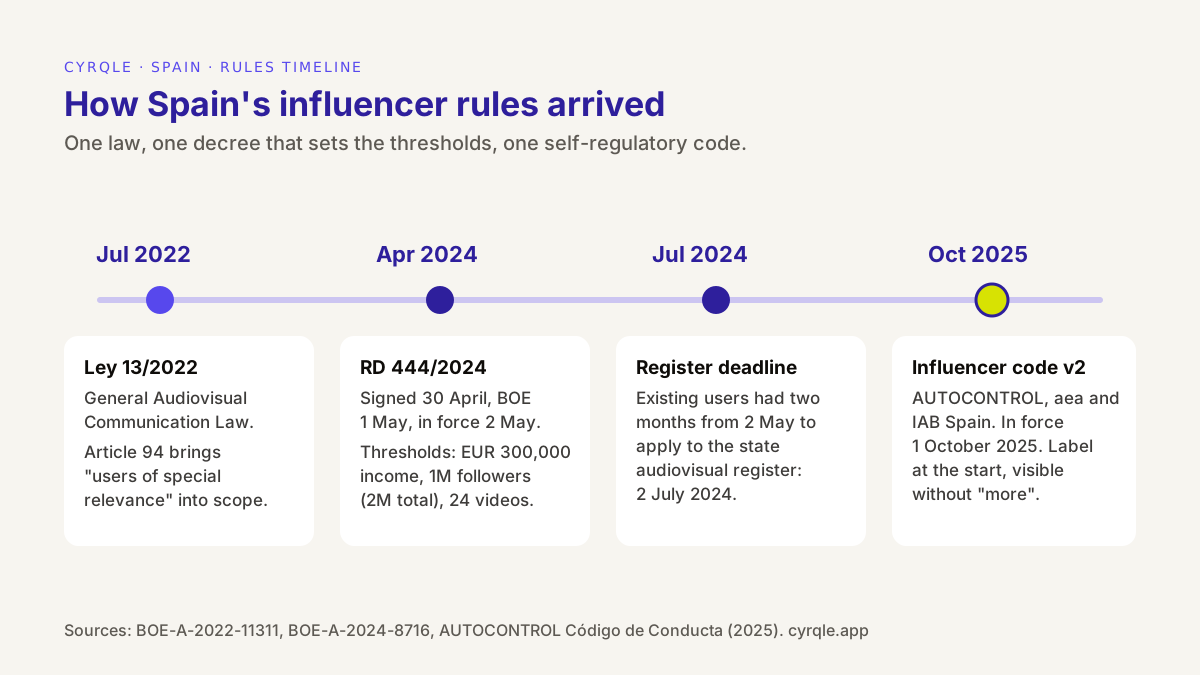
The current set is recent. Ley 13/2022 created the category of "users of special relevance" in July 2022. Real Decreto 444/2024 set the thresholds in April 2024. Existing creators had until 2 July 2024 to apply to the state register. The second version of the AUTOCONTROL code came into force on 1 October 2025, with IAB Spain joining the aea and AUTOCONTROL as co-owner.
Who counts as a "usuario de especial relevancia"?
A "usuario de especial relevancia" is a creator on a video-sharing platform who meets every threshold in Real Decreto 444/2024 at the same time. Articles 3 and 4 of the decree set three numbers, all measured over the previous calendar year:
| Threshold | RD 444/2024 | Detail |
|---|---|---|
| Income | Art. 3 | Gross income of EUR 300,000 or more from the creator's activity on video-sharing platforms |
| Audience | Art. 4.1.a | 1,000,000 followers or more on one platform, or 2,000,000 or more across all platforms |
| Volume | Art. 4.1.b | 24 videos or more in the year, of any length |
The other conditions of article 94.2 of Ley 13/2022 also apply: the creator has editorial responsibility for the content, the activity is economic, and the creator is established in Spain.
Most creators a brand hires are not in this group. The income threshold alone excludes the long tail. But the large ones often are, and for them article 94.1 of Ley 13/2022 applies the audiovisual rules on protecting minors and on commercial communications, including the ban on covert audiovisual advertising in article 122.3.
What it means for the brand. You cannot see a creator's income, so you cannot check the status yourself. Ask.
- In the brief: note that large creators must follow the audiovisual rules for any sponsored video.
- In the contract: a declaration of whether the creator is registered as a user of special relevance, and a commitment to tell you if that changes during the term.
The 10-point checklist for brands
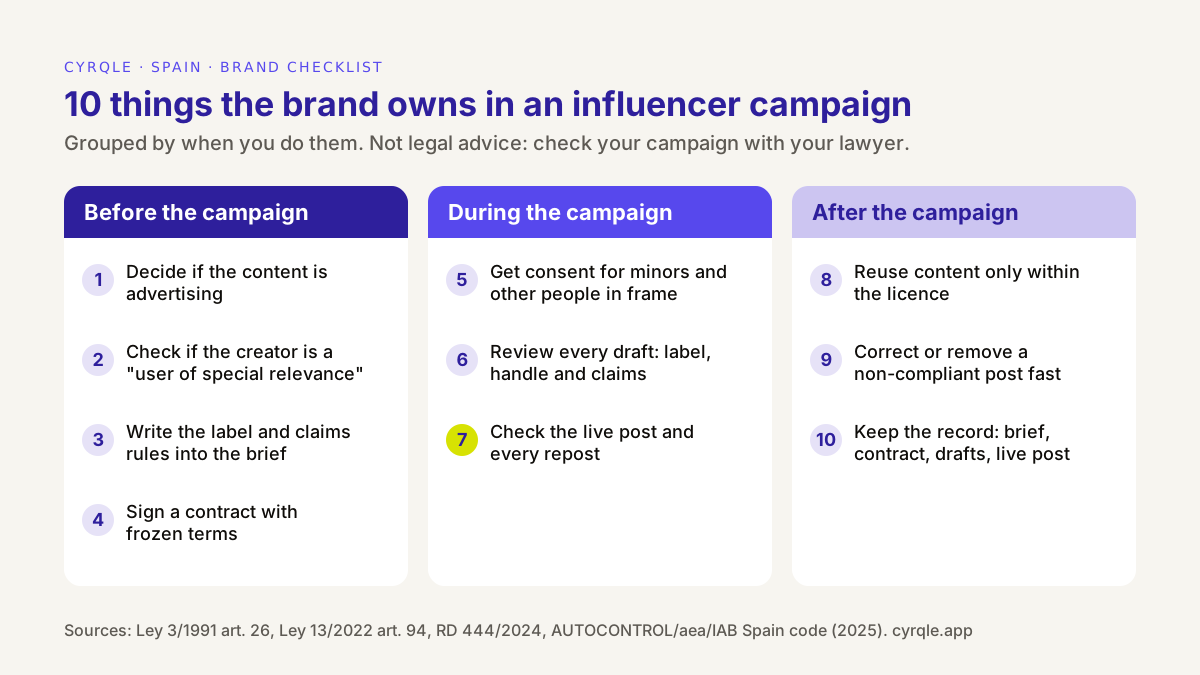
The ten obligations below follow the order of a campaign. Each one names what goes in the brief and what goes in the contract.
Before the campaign
1. Decide if the content is advertising
Content is advertising under norm 4 of the AUTOCONTROL code when it promotes a product or service and it is published as part of a collaboration in exchange for a payment or other consideration. Norm 5 lists what counts as consideration: direct or indirect payment, free product, free entry to events, free services (including make-up, hair, a courtesy car, hotel or meals), affiliate links, gift cards, gift bags and trips.
So a gifted product with a request to post is advertising. Without direct proof, the code lets the Jurado de la Publicidad infer it from signs: a discount code, an affiliate link, the same hashtag as other creators that week, a positive review the brand asked for, or brand control over tone and structure.
- In the brief: state that the content is advertising and must be labelled, even when the only payment is product.
- In the contract: describe the consideration in full (fee, product, commission, travel) so nobody can argue later that it was "just a gift". Our guide on how to pay influencers in Spain covers the invoice, IRPF and IVA side.
2. Check the creator's status under RD 444/2024
Covered above. Ask for the declaration, and keep it with the contract.
3. Write the disclosure label and the claims rules into the brief
Norm 6 of the code says the advertising nature must be identifiable. When it is not obvious from the content itself, the post needs an explicit, immediate label. These are the code's own examples:
| Enough? | Examples from the code | |
|---|---|---|
| Platform tool | Yes, preferred | 'Colaboración pagada con [marca]' on Instagram, 'contenido promocional' or 'colaboración de pago' on TikTok, 'incluye contenido promocional' on YouTube |
| Clear generic words | Yes | 'publicidad', 'publi', 'en colaboración con', 'colaboración pagada', 'embajador de [marca]', 'patrocinado por' |
| Vague words or another language | No | 'información', 'legal', 'Colab', 'Sponso', 'sp', 'gracias a [marca]', 'regalo de [marca]', 'viaje patrocinado', and 'Ad' or 'Advertising' in a Spanish post |
| Brand hashtag only | No | The brand's own hashtag does not, by itself, identify the content as advertising |
Placement matters as much as the word. The label goes at the start of the commercial message and must be easy to see. A label buried among other hashtags, or one the viewer only sees after tapping "more", is not enough. For stories the code's annex asks for the label at the start of each story, over the image or video. For live streams it goes in from the start of the promotional part.
- In the brief: the exact label (for example "Publicidad" plus the paid-partnership toggle), where it goes, the brand handle to tag, and the claims the creator must not make. Read our disclosure label rules entry for the definitions.
- In the contract: an obligation to use that label in that position on every piece, including stories and reposts.
Sector rules come on top. Norm 2 of the code points to the extra rules for alcohol, gambling, financial products and similar sectors. If you sell in one of them, give your lawyer the brief before the creators see it.
4. Sign a contract with frozen terms
Norm 3 of the code says contracts with influencers must include the duty to comply with the code. The aea publishes a model influencer services and image-rights agreement for this. Whatever template you use, the signed version must not move after signature: if the deliverables, label or usage scope change, both sides sign again.
- In the contract: deliverables, dates, the disclosure duty, compliance with the code, the brand's right to ask for corrections or removal, the usage licence (see item 8), the consideration, and who pays for what if a post breaks the rules.
During the campaign
5. Get consent for minors and other people in the frame
Norm 8 of the code says commercial content by a creator under 18 must rest on a contract with the explicit consent of the parents or guardians, who are responsible, and must protect the minor from exploitation. The minor also signs when mature enough, and always between 14 and 18. Content with minors must suit their age. Ley Orgánica 1/1982 protects the minor's honour, privacy and image, and article 7 of the LOPDGDD sets 14 as the age of consent for data processing.
The same logic applies to any adult in the shot. A creator can license their own image, not their friend's.
- In the brief: say whether minors may appear. Many brands say no by default.
- In the contract: a warranty that every recognisable person has consented, and a parent or guardian signature where a minor appears or is the creator.
6. Review every draft for label, handle and claims
Draft approval is where most problems are cheapest to fix. The AUTOCONTROL code treats brand control over content as a sign of advertising, so reviewing drafts does not create the advertising relationship: you already have it. It does let you catch a missing label before the post is public.
Check four things on each draft: the label is present, the label is at the start, the brand handle is tagged, and no claim goes beyond what you can prove. AUTOCONTROL also offers a voluntary, confidential prior review of influencer briefs ("Copy Advice Briefing Influencers") if you are unsure.
7. Check the live post and every repost
A compliant draft can still go live wrong: a caption edited at the last minute, a paid-partnership toggle switched off, a story posted without the overlay. Norm 6.e of the code adds that when content is shared or reposted on other networks or websites, the label must be kept or added.
- In the contract: a short deadline (for example 24 hours) for the creator to fix a post when the brand asks.
After the campaign
8. Reuse content only within the licence
The creator owns the copyright, and the people in the content have image and data rights. Reposting a creator's video on your own site, in email or as an ad is a new use that needs a licence with a stated scope: channels, markets and term. Paid amplification (often called whitelisting) is a separate and bigger use than organic posting on your own account. If you republish advertising content, keep the label (norm 6.e).
- In the contract: the usage rights granted, by channel, market and duration, with paid ads stated separately.
9. Correct or remove a non-compliant post fast
If a post goes out without a proper label, ask for the fix in writing the same day and keep the reply. Under norm 12 of the code, liability can reach everyone involved in the commercial communication. A brand can escape it only if it proves the breach was a one-off, clear failure to follow the instructions it gave.
10. Keep the record
That norm 12 defence only works if you can show the instructions. Keep, per creator: the brief with the label rule, the signed contract with its date, every draft and your comments, the live post as published, and any correction request. Article 7 of Ley 3/1991 is also relevant: it treats omitting material information as misleading.
- In the contract: the creator's duty to keep posts up for the agreed period and to send the live link, plus the brand's right to archive the content for compliance.
Worked example: a five-creator launch
An illustrative skincare brand in Valencia launches a serum with five creators. All figures are illustrative.
| Creator | Facts | What it triggers | Brief and contract lines |
|---|---|---|---|
| A, TikTok | 1.4M followers, about 60 videos last year, says income is above EUR 300,000 | Probably a user of special relevance | Registration declaration; audiovisual rules apply to the sponsored video |
| B, Instagram | 85,000 followers, product only, asked to post a reel | Advertising: free product is consideration (norm 5) | "Publicidad" at the start plus the paid-partnership tool |
| C, Instagram | 40,000 followers, discount code for her audience | Advertising: a discount code is a sign (norm 4) | Label at the start; the code does not replace the label |
| D, Instagram | 120,000 followers, her 9-year-old appears in the video | Minor in content (norm 8, LO 1/1982) | Written parental consent; age-appropriate content |
| E, TikTok and stories | 22,000 followers, one video plus three stories | Each story needs its own label (Annex I) | Label at the start of each story, over the image |
The cost of the checklist is small. Five briefs share one label rule. Five contracts share one template, with two extra clauses for creator A and creator D. The extra work sits in draft review: about eight pieces (four posts and creator E's four items) to check against four points each.
How cyrqle helps
cyrqle does not replace your lawyer, but it puts the checklist into the workflow, so the record builds itself. In Campaigns, the brief, invites, contract, drafts and posts for each creator live in one workspace.
- Required hashtags and handles on drafts. You set the required hashtags and the brand handle in the brief. With draft sign-off turned on, cyrqle checks each draft caption and flags a missing hashtag or handle before you approve. After the post goes live on Instagram or TikTok, cyrqle reads the live caption and flags missing elements again. The check confirms the text is present. For campaigns in Spain, the built-in disclosure rule also accepts "#ad", which the AUTOCONTROL code rejects in a Spanish post, so add "#publicidad" as a required hashtag yourself. The check does not judge position, so a reviewer still confirms the label sits at the start and the platform's paid-partnership label is on. Stories are not tracked automatically, so check those by hand.
- Frozen contract terms. Each creator signs the Creator Collaboration Agreement by two-sided e-signature. cyrqle stores a frozen snapshot of the terms with the IP address, device and timestamp of each signature. You can link your own brand terms. Content-wall and campaign use are granted; paid-ads use only when you tick it on the offer.
- Deals and payouts on record. Fee, commission and product are set per creator in Compensation and contracts, so the consideration in item 1 is written down, not implied.
For the full flow, see how to run a creator campaign end to end, or the step-by-step guide to launching your first creator campaign. To see it on your own category, read more about cyrqle for brands or book a 30-minute walkthrough.
More in this series
- Real Decreto 444/2024 explained for brands
- The AUTOCONTROL influencer code, October 2025 version
- A compliance audit: what to log for every post
- Who is liable for a creator's post in Spain
- Influencer advertising rules in Mexico, Colombia, Argentina and Chile
- Spain's influencer law from the creator's side
FAQ
Is "#ad" enough for an influencer post in Spain?
No, not for a post in Spanish. The AUTOCONTROL code lists "Ad" and "Advertising" as insufficient because they are in a different language from the message. Use "publicidad", "publi" or "colaboración pagada", or the platform's paid-partnership tool, at the start of the caption.
Does a gifted product count as advertising?
Yes, when the creator promotes it as part of a collaboration. Norm 5 of the AUTOCONTROL code lists free product, free services, event tickets, trips and affiliate links as consideration. If you sent the product and asked for a post, label it.
Is the brand responsible if the creator forgets the label?
It can be. Article 26 of Ley 3/1991 describes the business paying for the promotion, and the AUTOCONTROL code says liability can reach everyone involved. The brand's defence under the code is proof that the creator broke clear instructions, so keep the brief, contract and correction requests.
Is the AUTOCONTROL code mandatory?
It binds members of AUTOCONTROL, the aea and IAB Spain, and anyone who adheres to it. For everyone else it is self-regulation, not law. It is still the most detailed reference for what "clearly identified" means in Spain, and the disclosure duty itself comes from Ley 3/1991 and the LSSI, which bind every business.
Do these rules apply to a Spanish brand working with creators in Latin America?
Spanish law applies to advertising aimed at Spanish consumers. A campaign aimed at Mexico, Colombia or Argentina also has to follow local rules. When one post reaches both, follow the stricter rule.
Do I have to check that a creator is registered under RD 444/2024?
The duty to register is the creator's, not the brand's. A declaration in the contract is still cheap protection, because a large creator's sponsored videos also fall under the audiovisual advertising rules.
Sources
- Real Decreto 444/2024, de 30 de abril (BOE-A-2024-8716): https://www.boe.es/eli/es/rd/2024/04/30/444
- Ley 13/2022, de 7 de julio, General de Comunicación Audiovisual, arts. 94 and 122: https://www.boe.es/buscar/act.php?id=BOE-A-2022-11311
- Ley 3/1991, de 10 de enero, de Competencia Desleal, arts. 7 and 26: https://www.boe.es/buscar/act.php?id=BOE-A-1991-628
- Ley 34/2002 (LSSI), art. 20: https://www.boe.es/buscar/act.php?id=BOE-A-2002-13758
- Ley Orgánica 3/2018 (LOPDGDD), art. 7: https://www.boe.es/buscar/act.php?id=BOE-A-2018-16673
- AUTOCONTROL, aea and IAB Spain, Código de Conducta de Publicidad a través de Influencers (in force 1 October 2025): https://www.autocontrol.es/app/uploads/codigo-de-conducta-de-publicidad-a-traves-de-influencers-2025.pdf
Related field notes.
What the AUTOCONTROL influencer code of conduct (October 2025) asks of brands: accepted labels, placement by format, the #ad question and a brand checklist.
Spain's influencer law, Real Decreto 444/2024, explained for brands: who is a usuario de especial relevancia, the BOE thresholds, the registry and your duties.
Influencer regulation in Latin America: what PROFECO, SIC, CONARP and SERNAC expect, the label each market wants and one caption that fits all four.