
Planning your 2027 creator budget: a worked model
Influencer marketing budget planning for 2027, built bottom-up: objectives, tier mix, pricing model, seasonal peaks in Spain and Mexico and a worked euro model.
Influencer marketing budget planning works best bottom-up. Start from what each campaign must achieve, count the creators each seasonal peak needs, price every slot by creator tier and pricing model, and add the costs that are not fees: product, usage rights, commission, tools and a contingency. Then check the total against a break-even return before anyone signs it off.
It is November, and finance wants the 2027 number. The easy answer is last year's spend plus a percentage. The trouble is that a top-down number cannot tell you whether it buys four micro creators for the winter rebajas or forty, or whether there is enough left for Buen Fin in Mexico once Black Friday in Spain is booked. A bottom-up model can, and it gives you something to defend line by line.
This guide builds that model in seven steps for an illustrative mid-market fashion and beauty brand that sells online in Spain and Mexico. Every figure in it is illustrative, not market data. Copy the structure, then replace the numbers with your own.
How do you build an influencer marketing budget bottom-up?
A bottom-up creator budget is a list of slots. A slot is one creator delivering one package of content for one campaign wave. Each slot has a tier, a fee, a pricing model and a date. The budget is the sum of the slots plus the costs that travel with them.
| Step | Question it answers | Output |
|---|---|---|
| 1. Objectives | What must the money do, and what return makes it worth it? | A revenue or reach target and a break-even ROAS |
| 2. Tier mix | Which creator sizes, in what proportion? | A fee per slot for each tier |
| 3. Pricing model | Flat fee, commission, product, or a mix? | Fixed cost per slot and variable cost per sale |
| 4. Calendar | When are the peaks, and when must you book? | Slots per quarter |
| 5. Hidden lines | What else does each slot cost? | Product, rights, commission, tools, contingency |
| 6. The model | What does it add up to? | Spend by quarter and by line |
| 7. Payback check | Does it clear break-even, and what if it does not? | Target ROAS, sensitivity range and a stop rule |
Step 1: Start from objectives and a break-even line
Write down what each wave must do before you price anything. A sales wave needs an attributed revenue target. An awareness wave needs a reach or cost-per-view target. A UGC wave needs a count of licensed assets. Mixing these in one number is how budgets become impossible to judge later.
For sales waves, set the break-even line first. Break-even ROAS is 1 divided by your gross margin. At a 55% gross margin it is 1 ÷ 0.55 = 1.82x: every euro of creator spend must bring back EUR 1.82 of revenue, net of refunds and VAT, just to cover itself. Our guide to measuring creator ROI beyond the discount code explains why the revenue side should be reported as a range, not one number.
The illustrative brand in this guide has a 55% gross margin and wants creators to bring EUR 400,000 of attributed revenue in 2027, on the balanced view (promo code plus same-session sales).
Step 2: Choose the creator mix by tier
Each tier does a different job, so set the mix by job, not by habit. Nano and micro creators give you many voices, cheap content and the best cost per view in most categories. Mid-tier creators give you reach with credibility. Macro creators give you one big moment, usually at the peak.
The planning fees below sit inside the illustrative bands in our guide to what influencers charge in Spain in 2026. A slot here is one reel plus stories, organic use only, before VAT.
| Tier | Followers | Illustrative fee per slot | Job in the plan | Slots in 2027 |
|---|---|---|---|---|
| Nano | 1k-10k | EUR 150 (or product only) | Volume, local voices, UGC | 130 |
| Micro | 10k-50k | EUR 500 | Efficient reach, codes that convert | 72 |
| Mid | 50k-500k | EUR 2,000 | Reach with credibility, ad-ready content | 23 |
| Macro | 500k-1M | EUR 6,000 | One headline moment per peak | 5 |
Illustrative planning fees, not quotes. Slots are creator-waves, so one micro creator who posts in three waves counts as three slots. Repeat creators usually get cheaper and convert better, so plan for some.
Do not price a tier by followers alone. Two creators with the same following can deliver very different views. Convert every quote into an effective CPM before it goes into the plan.
For Mexico, use Mexican rates, not Spanish ones converted. Our guide to influencer rates in Mexico in 2026 has the bands. In this model, the Hot Sale and Buen Fin waves use Mexican creators and sit inside the Q2 and Q4 totals.
Step 3: Pick the pricing model for each slot
The pricing model decides how much of the budget is fixed and how much moves with sales. A flat fee is fixed: you know the cost on the day you sign. Commission is variable: it grows with revenue. A hybrid is a smaller flat fee plus a commission. Our comparison of CPM, CPE, CPA and flat-fee pricing shows who carries the risk under each.
For planning, treat each model like this:
- Flat fee. Budget the full fee. It is in the fee lines of the model.
- Commission. Budget it as a percentage of the revenue target, not as zero. It is a cost the moment the target is met.
- Product only. Budget the product at cost plus shipping. It is still money.
- Hybrid. Split it: the fee in the fee line, the commission in the commission line.
The illustrative brand pays a 10% commission to the creators on hybrid deals, and expects 40% of attributed revenue to come from them. So commission is 10% × 40% = 4% of attributed revenue. On EUR 400,000 that is EUR 16,000.
Step 4: Place the money on the 2027 calendar
Seasonal peaks decide when the slots happen, and the booking lead time decides when the work starts. Plan six to twelve weeks of preparation for each peak: shortlist, negotiate, sign, ship product, approve drafts and mint codes.
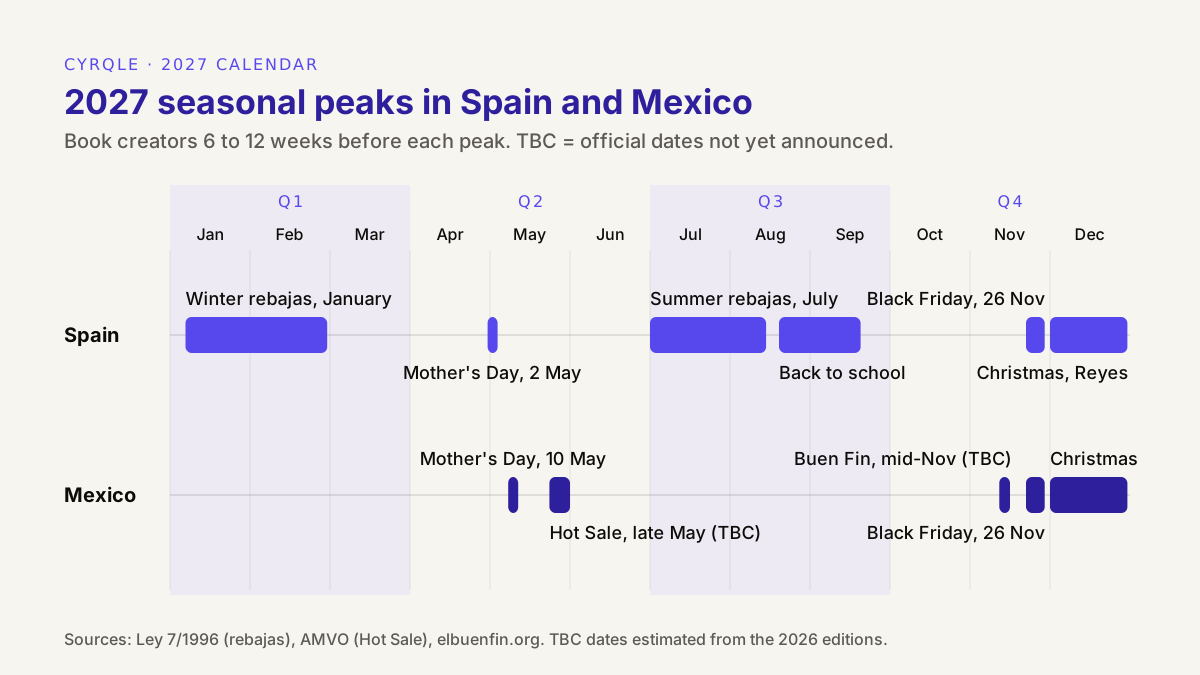
| Peak | Market | 2027 date | Start booking by | Quarter |
|---|---|---|---|---|
| Christmas tail and Reyes | Spain | to 6 January | Booked in the 2026 plan | Q1 |
| Winter rebajas | Spain | Early January; each retailer sets its own dates | Late November 2026 | Q1 |
| Mother's Day | Spain | Sunday 2 May | Mid-March | Q2 |
| Día de las Madres | Mexico | Monday 10 May | Mid-March | Q2 |
| Hot Sale | Mexico | Late May, dates set by AMVO (TBC) | Mid-April | Q2 |
| Summer rebajas | Spain | From about 1 July; each retailer sets its own dates | Mid-May | Q3 |
| Back to school | Spain | Late August to mid-September | Late June | Q3 |
| El Buen Fin | Mexico | Mid-November (TBC) | Late August | Q4 |
| Black Friday and Cyber Monday | Spain and Mexico | Friday 26 and Monday 29 November | Early September | Q4 |
| Christmas and Reyes | Spain and Mexico | December to 6 January 2028 | Early October | Q4 |
A few dates need care:
- Rebajas are not fixed by law. Article 25 of the Ley 7/1996 de Ordenación del Comercio Minorista lets each retailer choose when its sales run and for how long. Early January and 1 July are habits, not rules, so plan around your own sale dates.
- Hot Sale 2027 is not announced yet. The 2026 edition ran from 25 May to 2 June. AMVO confirms the dates each spring on hotsale.com.mx. Our Hot Sale creator playbook has the six-week plan.
- Buen Fin 2027 is not announced yet. The 2026 edition runs from 13 to 17 November and includes the Revolution Day long weekend, as reported by UnoTV. Expect 2027 to fall in mid-November again. Check elbuenfin.org before you lock dates. Our Buen Fin playbook explains how to plan it together with Black Friday.
- Black Friday 2027 is Friday 26 November, the day after US Thanksgiving, and Cyber Monday is 29 November. The 12-week Black Friday timeline works the same way for 2027: shift every week by one day.
The result is a lumpy year. Q4 holds Buen Fin, Black Friday and Christmas in about six weeks, so most of the budget lands there. That also means Q4 money is committed in September, which matters for cash planning.
Step 5: Add the lines most budgets forget
Creator fees are only part of the cost. In the model they are 65% of the total. The rest is the cost of making the fees work.
| Line | How to estimate it | In the model |
|---|---|---|
| Product and shipping | Number of slots × product at cost + shipping | EUR 50 per parcel × 230 slots = EUR 11,500 |
| Usage rights and exclusivity | A percentage of the fee for the content you will run as ads | +30% on half of mid and macro fees = EUR 11,400 |
| Commission | Commission rate × share of revenue on commission deals × revenue target | 10% × 40% × EUR 400,000 = EUR 16,000 |
| Tools and measurement | Your software and tracking quotes, per month | Placeholder EUR 1,500 a month = EUR 18,000 |
| Contingency | 10% of creator fees | EUR 13,150 |
Illustrative. The tools line is a placeholder so the model is complete. It is not a quote from any vendor, cyrqle included. Replace it with your own quotes.
Two more things belong next to the budget, not inside it:
- Internal time. Someone has to brief, negotiate, approve drafts and chase invoices. Count the hours, even if finance does not charge them to the creator line. It is the cost that grows fastest with the number of slots.
- Tax and cash timing. Plan fees before VAT. For a VAT-registered brand in Spain, the VAT on a creator's invoice is normally recoverable, and any personal income tax you withhold from a self-employed creator is part of the fee, not on top of it. Both change the cash you pay out and when, not the cost. Our breakdown of the true cost of a creator collaboration walks through fee, commission, withholding, VAT and payment fees. It is not tax advice: confirm your case with your adviser.
The worked model: EUR 201,550 for 2027
Here is the full illustrative model, by quarter and by line. Fees use the planning fees from Step 2 and the slot counts below.
| Slots per quarter | Q1 | Q2 | Q3 | Q4 | Year |
|---|---|---|---|---|---|
| Nano | 20 | 30 | 30 | 50 | 130 |
| Micro | 10 | 16 | 16 | 30 | 72 |
| Mid | 3 | 5 | 5 | 10 | 23 |
| Macro | 0 | 1 | 1 | 3 | 5 |
| Budget line (EUR, before VAT) | Q1 | Q2 | Q3 | Q4 | Year |
|---|---|---|---|---|---|
| Nano fees | 3,000 | 4,500 | 4,500 | 7,500 | 19,500 |
| Micro fees | 5,000 | 8,000 | 8,000 | 15,000 | 36,000 |
| Mid fees | 6,000 | 10,000 | 10,000 | 20,000 | 46,000 |
| Macro fees | 0 | 6,000 | 6,000 | 18,000 | 30,000 |
| Creator fees | 14,000 | 28,500 | 28,500 | 60,500 | 131,500 |
| Product and shipping | 1,650 | 2,600 | 2,600 | 4,650 | 11,500 |
| Usage rights and exclusivity | 900 | 2,400 | 2,400 | 5,700 | 11,400 |
| Commission (4% of revenue target) | 1,600 | 3,400 | 3,400 | 7,600 | 16,000 |
| Tools and measurement (placeholder) | 4,500 | 4,500 | 4,500 | 4,500 | 18,000 |
| Contingency (10% of fees) | 1,400 | 2,850 | 2,850 | 6,050 | 13,150 |
| Total spend | 24,050 | 44,250 | 44,250 | 89,000 | 201,550 |
| Revenue target, balanced view | 40,000 | 85,000 | 85,000 | 190,000 | 400,000 |
| Target ROAS | 1.66x | 1.92x | 1.92x | 2.13x | 1.98x |
All figures illustrative. The chart shows the same split.
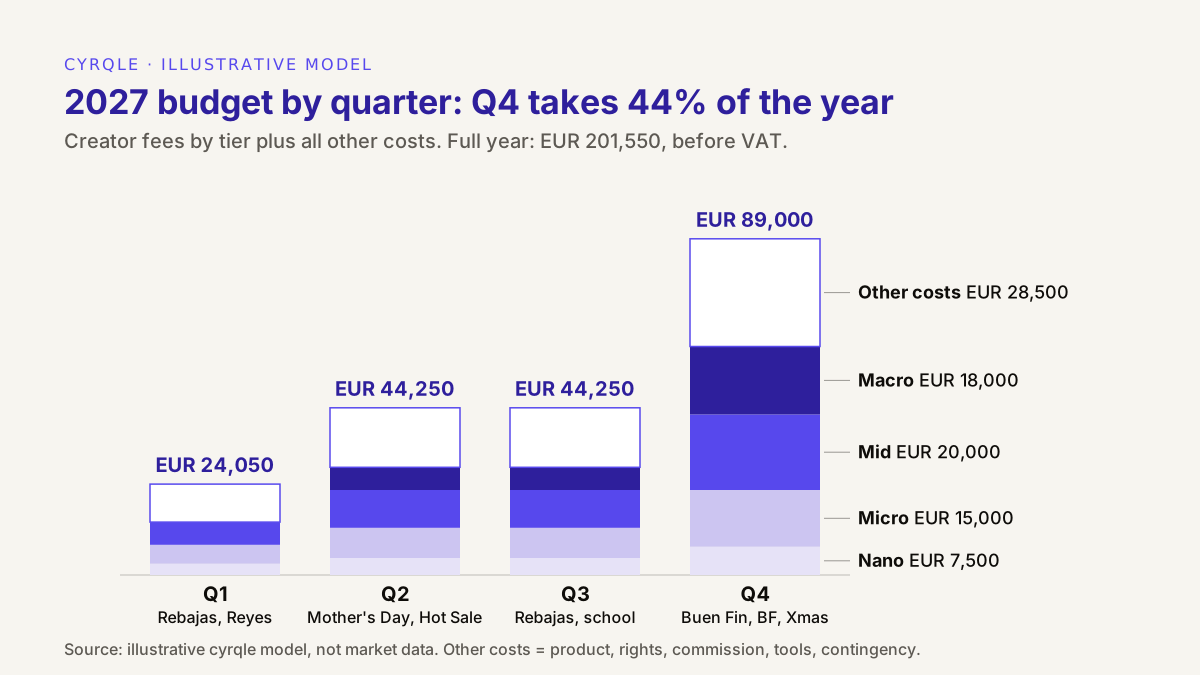
Three things stand out:
- Q4 is 44% of the year. That is the calendar, not a choice. If cash is tight, it is the quarter to protect.
- Mid-tier creators carry the plan. At EUR 46,000 they are the biggest fee line. They deliver reach and ad-ready content without the single-creator risk of a macro.
- Q1 sits below break-even on purpose. At 1.66x against a 1.82x line, Q1 is the test quarter: smaller waves, new creators, new codes. It tells you which creators to rebook for the peaks.
Does the model pay back, and what if it does not?
On the balanced view, the model returns 1.98x against a break-even of 1.82x. That is a thin margin of safety, which is normal for a first year and is exactly why the attribution view matters.
| Attribution view | What it counts | Revenue (illustrative) | ROAS | Against 1.82x |
|---|---|---|---|---|
| Conservative | Promo-code sales only | EUR 280,000 | 1.39x | Below |
| Balanced | Code plus same-session sales | EUR 400,000 | 1.98x | Above |
| Full | Adds sales within a 30-day cookie window | EUR 480,000 | 2.38x | Above |
Illustrative. The conservative view assumes 70% of balanced revenue comes through codes; the full view adds 20%.
Repeat purchases and reusable content are not in this table. They are upside, so leave them out of the break-even test and mention them separately.
Write a release rule into the plan so the budget is not one bet:
- Tranche 1 (Q1 and Q2, EUR 68,300) is approved now.
- Tranche 2 (Q3 and Q4, EUR 133,250) is released if first-half balanced ROAS is at or above 1.82x by 15 July, after refunds. The model's first-half target is EUR 125,000 on EUR 68,300, or 1.83x.
- Stop rule. If any wave runs below 1.4x on the balanced view, pause rebooking for that tier until you know why.
The Q4 bookings start in early September, so the 15 July check comes in time to act on. That is the format finance trusts. Our one-page template for justifying a creator budget to your CFO puts this model, the range and the stop rule on one sheet.
How should you adapt the model to your brand?
Keep the structure and change four inputs: the revenue target, the margin, the tier mix and the markets.
- Smaller budget, about EUR 50,000. Drop macro creators, keep one mid creator per peak and spend the rest on nano and micro. Run fewer peaks well rather than all peaks thinly. Keep the contingency.
- Spain only. Remove the Hot Sale and Buen Fin waves and move part of that money into summer rebajas or back to school.
- Mexico-heavy. Give Hot Sale its own Q2 peak and treat Buen Fin and Black Friday as one Q4 wave with a reminder. Plan payments early: payouts through Stripe Connect cover Europe and the US, so creators in Mexico are usually paid by bank transfer.
- Awareness first. Replace the revenue target with a cost-per-view target, drop the commission line and compare effective CPM with your paid social benchmark.
- Lower margin. At a 40% margin, break-even is 2.5x. The same model then fails, so shift fees toward commission and hybrid deals, which move cost from fixed to variable.
How cyrqle helps
cyrqle does not build your annual budget. It gives you the inputs for each wave, and the actuals to compare against the plan.
- Plan each wave. In Clusters and planning, build a shortlist with a live reach and cost estimate, run budget what-ifs, and compare up to four clusters side by side before you push one to a campaign. The cost and reach figures are estimates for comparing options, not quotes.
- Set the pricing model per creator. In Compensation and contracts, structure deals as cash payment, commission on every sale, product gift or a mix, and sign them with two-sided e-signature. The brand funds the campaign, and a payout is scheduled when the creator delivers. Creators in Europe and the US are paid through Stripe Connect, in EUR. Commission owed is calculated and shown; paying it is a separate step.
- Read actuals in the same three views. In Attribution, each creator gets a promo code and a tracking link, and every sale gets a confidence tier: Tier 1 — promo code, Tier 2 — same-session, Tier 3 — cookied later. That matches the conservative, balanced and full rows above, so plan and actuals use the same language.
Pricing for brands and agencies is a custom monthly base plus usage; see cyrqle pricing and put the quote in your tools line. To see the planner and the attribution tiers on your own category before the 2027 budget closes, book a 30-minute demo.
FAQ
How much should I budget for influencer marketing in 2027?
There is no right percentage. Build it bottom-up: count the slots each peak needs, price them by tier, add product, rights, commission, tools and a 10% contingency, and check the total against your break-even ROAS. The illustrative model in this guide comes to EUR 201,550 for a brand in Spain and Mexico.
How do I split a creator budget across the year?
Follow the calendar. Put the most money where your sales peaks are, which for most retail brands is Q4, and keep a smaller Q1 as a test. In the illustrative model, Q4 takes 44% of the year and Q1 takes 12%.
What share of the budget should go to creator fees?
In the illustrative model fees are 65% and other costs 35%. Your split depends on product cost, how much content you license for ads and how many deals pay commission. If fees are above 85% of your plan, you have probably left out product, rights or commission.
Should I plan for micro or macro influencers?
Plan for a mix, set by job. Nano and micro creators give volume and efficient reach, mid-tier creators give credible reach and ad-ready content, and macro creators give one big moment at a peak. Compare all of them by effective CPM, not by followers.
When should I start booking creators for Black Friday 2027?
Start in early September 2027, about 12 weeks before Black Friday on 26 November. If you also sell in Mexico, Buen Fin usually falls about two weeks earlier, so start in late August.
Sources
- Ley 7/1996, de 15 de enero, de Ordenación del Comercio Minorista, article 25 (BOE): boe.es
- AMVO, Hot Sale official site: hotsale.com.mx
- UnoTV, "El Buen Fin 2026 durará cinco días: la edición 16 será del 13 al 17 de noviembre" (31 August 2026): unotv.com
- El Buen Fin official site: elbuenfin.org
All figures in the model are illustrative and do not describe a real brand. This guide is not financial, accounting or tax advice.
Related field notes.
Influencer CPM vs CPA, CPE and flat fee: one campaign priced four ways, who carries the risk under each, and a decision tree matching the model to your goal.
The cost of an influencer collaboration in Spain, worked in euros: fee, commission, product, IRPF withholding, IVA, and payment, platform and agency fees.
How to negotiate with brands as an influencer: anchor on views, counter with scripts in English and Spanish, trade rights, not your fee, and know when to walk.