
How to pay influencers in Spain: invoices, IRPF withholding and IVA
How to pay influencers in Spain as a brand: what the invoice must show, when you withhold IRPF, how IVA works for EU and non-EU creators, and gifted products.
To pay an influencer in Spain, you need three things before money moves: a valid invoice from the creator, a decision on IVA (Spanish VAT), and a decision on income-tax withholding. Which rules apply depends on who sends the invoice: a Spanish autónomo, a Spanish company, a creator elsewhere in the EU, a creator outside the EU, or nobody, because you paid in product.
This guide is written for the people who pay: brand finance, marketing operations and the agency teams who run payments for clients. It explains each scenario, shows a worked example with numbers, and lists the official sources. Read it as a map for the conversation with your advisor. It is not tax advice: tax rules change, Spanish tax authority rulings answer specific cases, and your gestor or tax advisor should confirm the treatment for your company.
What should a creator's invoice include?
A creator's invoice in Spain must carry the content set out in Article 6 of the invoicing regulation, Real Decreto 1619/2012. If any of these items is missing, ask for a corrected invoice before you pay. Finance cannot deduct IVA or support the expense from a document that does not meet the rules.
| Field | What to check |
|---|---|
| Number and date | A sequential invoice number in the creator's series, and the date of issue. |
| Full legal names | The creator's legal name (not the handle) and your company's registered name. |
| Tax IDs | The creator's NIF (or EU VAT number for EU creators) and your company's NIF. |
| Addresses | Both parties' addresses. |
| Description | What was delivered: for example "2 Instagram reels and 3 stories, campaign X, March 2026". Name the usage rights if they are paid separately. |
| Taxable base | The fee before tax, with any discount shown. |
| IVA rate and amount | 21% for most Spanish creators, or a reverse-charge note for creators established outside Spain. |
| IRPF withholding | The percentage and amount, when withholding applies. The invoice total is the amount you actually pay. |
Two practical points help. First, put the invoicing requirements in the brief or the contract, not in an email after the post goes live. Second, ask new creators for their tax status at contract stage: are they an autónomo, a company, or established abroad? That one question decides most of what follows.
When do you withhold IRPF from an influencer?
You withhold IRPF when a Spanish-resident individual invoices you for a professional activity. The Spanish income tax regulation, Real Decreto 439/2007 (RIRPF), lists income from professional activities as subject to withholding (Article 75) and sets the rate in Article 95.1: 15% of the gross fee, or 7% in the year the creator starts a professional activity and the two years after, if they did not work as a professional the year before. The creator must tell you in writing to get the 7% rate, and you keep that signed notice.
Article 95.1 also gives a 7% rate to some professional groups, including group 869 of section two, when the creator's income from those activities in the previous year was under 15,000 euros and made up more than 75% of their activity and employment income. Again, the creator has to notify you.
Companies and businesses that pay professionals are the ones that must withhold (Article 76 RIRPF). You pay the withheld amount to the Agencia Tributaria in your quarterly Modelo 111 and report each payee in the annual Modelo 190.
Is an influencer a professional or a business?
This is where secondary sources disagree, because the answer depends on how the creator is registered in the IAE (the Spanish register of economic activities):
- Professional (section 2 of the IAE). In ruling V2390-24 (21 November 2024), the Dirección General de Tributos (DGT) said an influencer who creates content personally, on their own account and without a business structure, should register in group 869 of section 2, a professional activity. Professional income is subject to withholding.
- Business (section 1 of the IAE). In an earlier ruling, V0773-22 (11 April 2022), the DGT placed a content creator in section 1 headings for video production (961.1) and photography (973.1). Income from business activities in section 1 is generally not subject to IRPF withholding.
So for two creators doing similar work, one invoice can show a 15% withholding line and the other none. Do not pick a rule for the whole roster. Ask each creator which IAE heading they are registered under (they can see it on their census registration, the Modelo 036 or 037), and let your gestor confirm the treatment.
What changes when the creator invoices through a company?
When a creator invoices through their own Spanish company (usually a sociedad limitada, S.L.), you normally do not withhold IRPF on a standard service fee. The company pays corporate income tax, and the corporate tax regulation (Real Decreto 634/2015, Article 60) does not list ordinary service fees among the income a payer must withhold on. The invoice still carries 21% IVA (Ley 37/1992, Article 90).
One exception to watch: payments described as a licence of image rights follow separate withholding rules. Article 60 of the same regulation lists income from the assignment of the right to exploit a person's image as subject to withholding, even when it is business income. Article 75.2 RIRPF does the same for individuals. If a contract splits a creator's fee into a service fee and an image-rights fee, ask your advisor how to treat each part.
How do you pay a creator in another EU country?
When a creator established in another EU country invoices your Spanish company, two separate questions apply: IVA and non-resident income tax.
IVA. For business-to-business services, the place of supply is where the customer is established (Ley 37/1992, Article 69). The creator's service is therefore taxed in Spain, but the creator does not charge Spanish IVA. You, the Spanish business, account for it under the reverse charge (inversión del sujeto pasivo, Article 84.Uno.2º). In practice the creator's invoice shows no IVA and a reverse-charge note, and you enter the same amount as IVA charged and IVA deductible in your Modelo 303. Ask for the creator's EU VAT number and check it in the EU VIES system.
Non-resident income tax (IRNR). Spanish law can treat services that are used in Spain as income obtained in Spain (Real Decreto Legislativo 5/2004, Article 13.1.b). The default rate for residents of another EU or EEA state with effective tax information exchange is 19% (Article 25). A Spanish company that pays this income must withhold it (Article 31) and file it in Modelo 216 and the annual Modelo 296.
Most EU countries have a double tax treaty with Spain. Under a typical treaty, business profits of a creator with no permanent establishment in Spain are taxed only in the creator's country. To apply the treaty and withhold nothing, you usually need the creator's tax residence certificate from their own tax authority. Article 31.4 of the same law removes the withholding duty for income that a treaty exempts. Treaties also have a separate article for artists and entertainers, and advisors disagree on when content creation falls under it. This is one more reason to agree the treatment with your gestor before you pay.
How do you pay a creator outside the EU?
A creator outside the EU, for example in Mexico, the United Kingdom or the United States, follows the same pattern with two differences.
- IVA: the reverse charge still applies, because the service is supplied to a business established in Spain. The creator's invoice carries no Spanish IVA, and you self-assess it in your Modelo 303.
- IRNR: the default rate is 24% instead of 19%. A treaty with the creator's country can reduce it or remove it if you hold a valid tax residence certificate.
Collect the certificate at contract stage, not at payout. Certificates usually cover a period, so ask for a new one when it expires.
Is gifted product a payment?
Yes. When you send product in exchange for a post, the product is the payment, and the tax rules treat it that way. The scenarios differ by who receives it.
- A professional creator. A product given in return for content is income in kind from the creator's activity. Article 104 RIRPF says the payer of in-kind payment for economic activities must make a payment on account (ingreso a cuenta): the withholding percentage applied to the product's market value. With a 15% creator, a 300-euro product means a 45-euro payment on account that you pay to the Agencia Tributaria, even though no cash changed hands.
- The IVA side. When a service is paid for with goods, the transaction is a barter. Ley 37/1992 (Article 79.Uno) says that when the consideration is not money, the taxable base is its value in money. In practice the creator may owe IVA on their service, valued at the product's worth, and your company may owe IVA on the product it handed over. Many brands and creators skip this. Your gestor will tell you how to document it.
- An occasional reviewer with no activity. In rulings V1161-25 and V1285-25 (July 2025), about a product-review programme, the DGT said products received by someone who reviews as an ordinary consumer, not as part of a professional activity, are capital gains in kind for that person, valued at market value. Selling the products changes the picture.
The line between "occasional reviewer" and "professional creator" is a judgement about the person, not about the post. A creator who has an IAE registration and invoices other brands is very unlikely to be an occasional reviewer. For a creator-side explainer of these rules, see the analysis by Garrigues.
The scenarios side by side
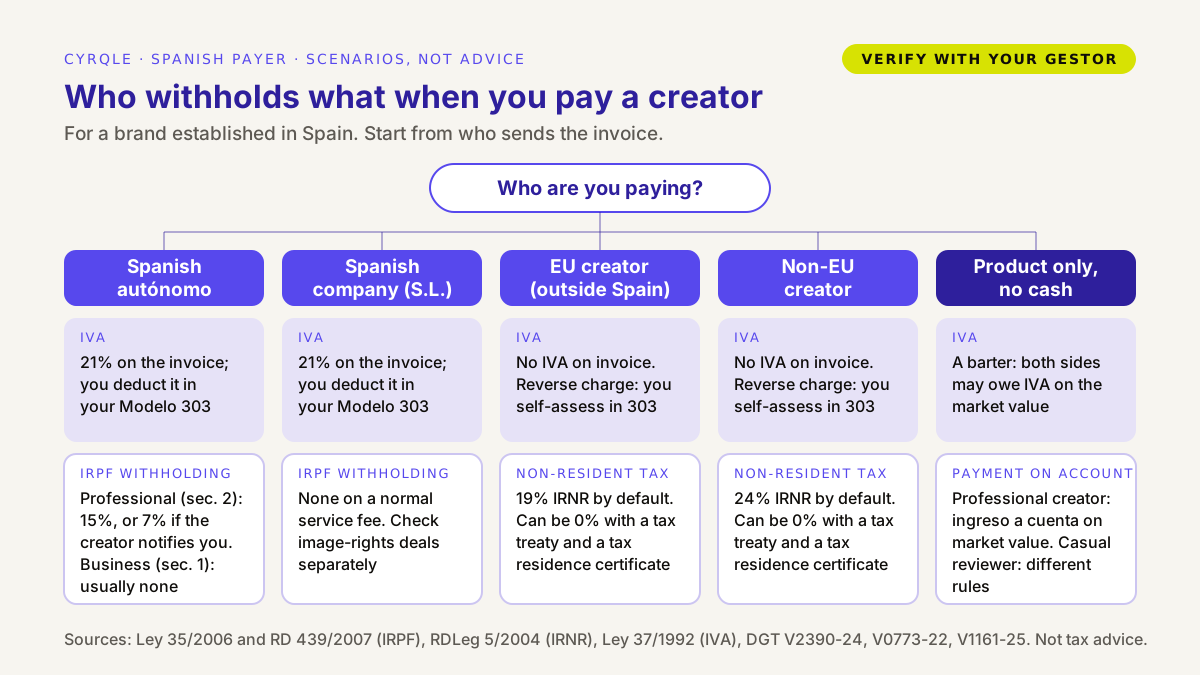
The table below sums up the five scenarios for a brand established in mainland Spain or the Balearic Islands. The Canary Islands, Ceuta and Melilla have their own indirect taxes (IGIC and IPSI) and are outside this table.
| IVA on the invoice | Withholding you pay | Return you file | Document to collect | |
|---|---|---|---|---|
| Spanish autónomo, professional (section 2) | 21% | IRPF 15%, or 7% with written notice | Modelo 111 quarterly, 190 annual | Invoice; 7% notice if claimed |
| Spanish autónomo, business (section 1) | 21% | Usually none | None for withholding | Invoice; IAE heading on file |
| Spanish company (S.L.) | 21% | None on a service fee; check image-rights fees | None for withholding | Invoice with company NIF |
| Creator in another EU country | None; you self-assess (reverse charge) | IRNR 19%, or 0% under a treaty | Modelo 303; 216 and 296 if you withhold | EU VAT number; tax residence certificate |
| Creator outside the EU | None; you self-assess (reverse charge) | IRNR 24%, or less under a treaty | Modelo 303; 216 and 296 if you withhold | Tax residence certificate |
| Product only, professional creator | Barter; IVA on market value may apply on both sides | Payment on account on market value | Modelo 111 (or 216 for non-residents) | Product value record; creator invoice |
Checked on 23 March 2026 against the BOE consolidated texts and the Agencia Tributaria pages linked in this article. Tax law changes; re-check before each tax year.
Worked example: one fee, four invoices
The same 1,000-euro fee for two reels looks different depending on who invoices. All figures are illustrative.
| Autónomo, professional, 15% | Autónomo, new, 7% | Spanish S.L. | Creator in Portugal, no treaty certificate | |
|---|---|---|---|---|
| Fee (taxable base) | 1,000 EUR | 1,000 EUR | 1,000 EUR | 1,000 EUR |
| IVA on invoice | +210 EUR | +210 EUR | +210 EUR | 0 (reverse charge) |
| IRPF / IRNR withheld | -150 EUR | -70 EUR | 0 | -190 EUR |
| You pay the creator | 1,060 EUR | 1,140 EUR | 1,210 EUR | 810 EUR |
| You pay the Agencia Tributaria | 150 EUR (Modelo 111) | 70 EUR (Modelo 111) | 0 | 190 EUR (Modelo 216) |
| IVA you recover (if fully deductible) | 210 EUR | 210 EUR | 210 EUR | Self-assessed and deducted in the same return |
| Net cost to your company | 1,000 EUR | 1,000 EUR | 1,000 EUR | 1,000 EUR |
Two lessons come out of the table. First, the net cost is the same when you can deduct IVA fully, but the cash you transfer to the creator differs by up to 400 euros, so finance needs to know the scenario before it schedules the transfer. Second, withholding is your debt, not the creator's. If you pay the gross amount and forget to withhold, the Agencia Tributaria can still claim the withholding from you. If the Portuguese creator had sent a valid tax residence certificate and the treaty exempted the income, you would pay the full 1,000 euros and withhold nothing.
For gifted product, add the line you cannot see on a bank statement: a 300-euro product sent to a professional creator at 15% means a 45-euro payment on account in your Modelo 111, plus any IVA your gestor says the barter carries.
Which payment method should you use?
Pay creators by bank transfer to an account in their name, or through a regulated payout provider, against a valid invoice. Avoid cash and personal payment apps for creator fees: they leave a weak record, and Ley 7/2012, Article 7 bans cash payments of 1,000 euros or more when one party acts as a business or professional. Whatever method you use, keep a link between the invoice, the contract, the published post and the transfer. When your auditor or the tax authority asks why you paid 810 euros instead of 1,000, that chain is the answer.
The payment method does not change the tax. A payout through Stripe, a SEPA transfer and an international wire all need the same invoice and the same withholding decision.
A payer's checklist
- At brief stage: choose the compensation model (fixed fee, commission, product or a mix) and state that payment needs a valid invoice. The guide to the four creator compensation models explains the trade-offs.
- At contract stage: collect the creator's legal name, tax ID, country of residence, IAE status, and any 7% notice or tax residence certificate.
- At delivery: check the deliverable against the brief before you approve payment.
- Before payout: check the invoice fields, the IVA treatment and the withholding line against the scenario.
- After payout: file Modelo 111 or 216 for any withholding, keep the payout statement with the invoice, and include the creator in the annual 190 or 296.
How cyrqle helps
cyrqle runs the payment side of a creator campaign in one workspace, from the deal terms in the brief to the payout statement. It does not decide your tax treatment, collect tax forms or file returns for you. That stays with your finance team and your gestor.
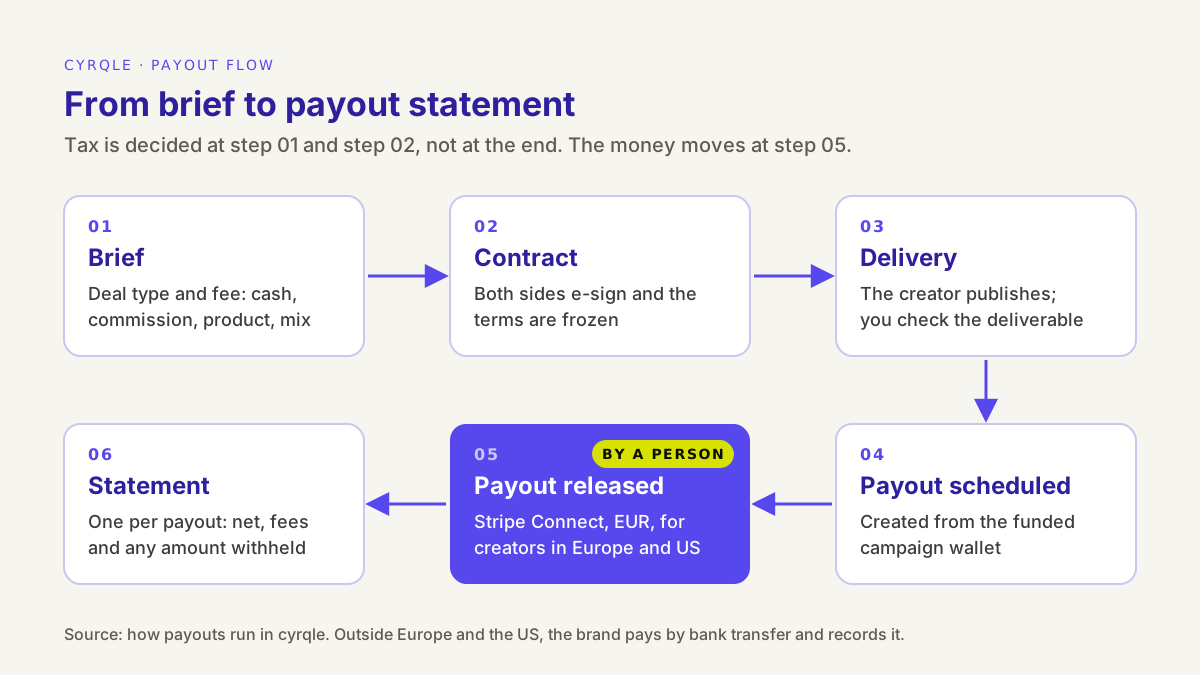
- Deal terms first. In compensation and contracts, you set the deal type in the brief: Cash payment, Commission on every sale, Product gift, or a combination. Invites stay blocked until compensation is complete, so no creator receives an offer without terms.
- A signed contract. Both sides e-sign the Creator Collaboration Agreement, and the terms are frozen at signature, with the IP address, device and time recorded.
- Campaign wallet. You fund the campaign. When a creator delivers, cyrqle schedules the payout. A person on your side releases it. Settlement is not fully automatic, so finance keeps control of each transfer.
- Stripe Connect payouts. Creators in Europe and the US onboard to Stripe Connect and get paid to their bank. Settlement is in euros. See the Stripe integration for how onboarding works. For creators in other regions, you pay by bank transfer and record the payment in cyrqle.
- One statement per payout. Each payout has a split (creator net, cyrqle commission, any agency fee and any amount withheld) and a statement or invoice, so finance can match it to the creator's invoice and the withholding return.
- Commission is shown, not paid automatically. Revenue share owed is calculated in reports as "Affiliate / rev-share owed". Paying it is a separate step.
For the full campaign lifecycle around the payment, read how to run a creator campaign end to end. If you lead a brand team, cyrqle for brands shows the rest of the workflow. Brand and agency plans are quoted after a short call; the pricing page explains how they are structured.
More in this series
- The influencer invoice checklist for Spanish brands, field by field.
- Paying creators in other countries, with the EU, the UK and Latin America in more detail.
- The true cost of a creator collaboration: fee, commission, withholding, IVA and payment fees in one model.
- How gifted products are taxed for creators in Spain.
- How agencies pay creators on behalf of clients.
- Paying commission to affiliate creators every month without spreadsheets.
FAQ
Do I always have to withhold 15% IRPF from an influencer?
No. You withhold 15% only when a Spanish-resident individual invoices you for a professional activity. The rate is 7% if the creator notifies you that they qualify, for example in their first three years. Creators who invoice through a company, or who are registered in a business (section 1) activity, usually get no IRPF withholding. Creators abroad fall under non-resident tax instead.
Can I pay an influencer without an invoice?
Not safely. Without a valid invoice your company cannot deduct the IVA or easily support the expense, and you still carry any withholding duty. Ask for the invoice before you release the payment. Product-only deals need a record of the product value as well, because they can create IVA and a payment on account.
What if a foreign creator does not send a tax residence certificate?
Without a certificate you usually cannot apply the treaty, so the default non-resident rate applies: 19% for EU and EEA residents, 24% for others. You withhold it and file Modelo 216. If the creator later sends a certificate, ask your gestor whether a refund claim makes sense.
Does the brand or the creator pay the reverse-charge IVA?
The brand. When a creator established outside Spain supplies a service to your Spanish business, you account for the IVA yourself in Modelo 303. If your company can deduct IVA in full, the charge and the deduction cancel out in the same return.
Can cyrqle withhold IRPF or file Modelo 111 for us?
No. cyrqle records the payout split, including any amount withheld, and gives you a statement per payout. Deciding the tax treatment, paying the Agencia Tributaria and filing returns stay with your company and your advisor. cyrqle does not collect tax forms or remit tax.
Sources
- Ley 35/2006, del IRPF: BOE-A-2006-20764
- Real Decreto 439/2007, Reglamento del IRPF (Articles 75, 76, 95 and 104): BOE-A-2007-6820
- Real Decreto Legislativo 5/2004, Ley del IRNR (Articles 13, 25 and 31): BOE-A-2004-4527
- Ley 37/1992, del IVA (Articles 69, 79, 84 and 90): BOE-A-1992-28740
- Real Decreto 1619/2012, Reglamento de facturación (Article 6): BOE-A-2012-14696
- Real Decreto 634/2015, Reglamento del Impuesto sobre Sociedades (Article 60): BOE-A-2015-7771
- Ley 7/2012, cash payment limits (Article 7): BOE-A-2012-13416
- Agencia Tributaria, Modelo 111 and Modelo 216
- DGT binding rulings V0773-22, V2390-24, V1161-25 and V1285-25: Dirección General de Tributos rulings database
- Garrigues, "Soy influencer, ¿tengo que tributar por ello?": garrigues.com
Related field notes.
How to pay international influencers from Spain: invoice and withholding by creator country, payment rails and bank fees, who pays FX, and where Stripe works.
An agency paying influencers on behalf of a client must settle who funds, who invoices, who withholds IRPF and how its fee shows. Worked EUR 1,000 payout split.
The cost of an influencer collaboration in Spain, worked in euros: fee, commission, product, IRPF withholding, IVA, and payment, platform and agency fees.