
Set up a creator affiliate program for your store: commission tiers, codes and payouts
Influencer affiliate program setup for online stores: work out the commission you can afford, build a three-tier ladder, issue codes and pay net of returns.
To set up a creator affiliate program, decide the commission you can afford from your margin, give each creator a unique promo code and tracking link, define in the contract which orders count, and pay once a month after the return period has passed. The rest of the work is a tier ladder that rewards the creators who sell, and a monthly run that pays them on revenue you actually keep.
Most setup guides stop at "define a commission". This playbook does the arithmetic for one illustrative Spanish online store: an average order of EUR 96.80 including IVA (EUR 80 without it), a 60% gross margin and a 20% return rate. The calculator lets you replace each number with your own. It is written for ecommerce brands in Spain first, with pointers for the EU and the US.
What is a creator affiliate program?
A creator affiliate program pays creators an affiliate commission: a share of the sales they drive, tracked through a personal code or link. It differs from a classic affiliate network in who promotes you. A network gives you coupon sites, cashback portals and comparison pages. A creator program gives you people who make content for an audience that trusts them. Creators are fewer, they need a brief and a contract, and their codes can leak to the coupon sites a network would have used. The comparison of affiliate marketing and creator commerce covers the difference in depth.
Commission only, or commission plus a fee?
Commission only works for creators who already sell and for products with a short buying cycle. A creator with a large audience and no sales history carries all the risk, so a hybrid deal (a small fixed fee plus commission) often gets the "yes". The guide to the four creator compensation models compares the options. This playbook covers the commission part, whichever deal it sits in.
Step 1: Work out the commission you can afford
The commission you can afford is the share of each order that is left after product cost, returns and leakage, minus what you need to keep for overheads and profit. Work it out per order before you look at what anyone else pays.
Start from one order
Take one order of EUR 96.80 paid by the customer. Remove the 21% IVA, which belongs to the tax authority, and the order is worth EUR 80 to you. With a 60% gross margin, EUR 32 goes to product cost, fulfilment and payment fees.
Now add returns. If one order in five comes back, you lose the margin on that order (EUR 48) and pay about EUR 6 to handle the return. Spread across all orders, that is 20% of EUR 54, or EUR 10.80 per order. Commission at 12% is paid on the revenue you keep after refunds: 12% of EUR 64 (EUR 80 minus 20%), which is EUR 7.68. That leaves EUR 29.52.
That EUR 29.52 still pays for the team, the warehouse, the software and profit. A commission that looks small against the price is a large share of what is left.
The break-even formula
Break-even is the commission rate at which a creator-driven order adds nothing to your bottom line. Written out in words:
- Order value without IVA = order value with IVA / (1 + IVA rate). EUR 96.80 / 1.21 = EUR 80.00.
- Commission base = order value without IVA x (1 - return rate). EUR 80 x 0.8 = EUR 64.00.
- Contribution per attributed order = commission base x gross margin - return rate x handling cost. EUR 64 x 0.6 - 0.2 x EUR 6 = EUR 37.20.
- Incremental contribution after leakage = (1 - leakage) x contribution - leakage x the discount given away on a sale you would have made at full price. 0.9 x EUR 37.20 - 0.1 x EUR 8.89 = EUR 32.59.
- Break-even commission = incremental contribution / commission base. EUR 32.59 / EUR 64 = 50.9%.
- Usable ceiling = break-even x (1 - share you want to keep). If you want to keep 70% of the contribution for overheads and profit: 50.9% x 0.3 = 15.3%.
Break-even at 51% sounds generous, but it is the rate at which the program makes zero contribution. Nobody runs a program for zero. The usable ceiling, about 15% here, is the number to design the tier ladder around.
The formula treats every non-leaked order as one you would not otherwise have had. That is optimistic: some of those customers would have found you anyway. If you want to measure how much of the creator revenue is truly incremental, run a holdout test with creators and lower the ceiling to match.
Leakage: some code orders are not the creator's
Promo code leakage is what happens when a creator's code spreads beyond their audience, to coupon sites, deal forums or browser extensions that auto-apply codes at checkout. A customer who was already buying takes the discount, and the creator earns commission on a sale they did not cause.
Leakage costs you twice: a commission on an order you would have had anyway, and a discount on a sale you would have made at full price. The formula subtracts both. A 10% allowance assumes one code order in ten is leaked; long-lived, generous codes leak more. Step 4 lists the code rules that keep it down.
Calculate your own ceiling
Break-even and usable commission rate for one product line, from order value, margin, returns and leakage.
Illustrative defaults, not benchmarks. Enter figures for one product line. Commission is assumed to be paid on revenue without IVA and after refunds. Fixed fees, gifted product and the lifetime value of a new customer are not included.
Try three changes to see what moves the ceiling. Raise the leakage allowance to 25%, which a long-lived code on coupon sites can reach, and the ceiling falls to about 12.0%. Raise the return rate to 35% and the ceiling only drops to about 14.6%, because the commission base shrinks with the refunds; what you keep per order at 12%, though, falls from EUR 24.91 to EUR 19.06. Raise the margin to 75% and the ceiling climbs to about 19.3%. A single rate for the whole catalogue is rarely right: if your margins differ a lot by category, run the calculator per category and use the lowest result. For the campaign-level view of returns, see returns-adjusted ROAS for fashion.
Should new customers earn a higher rate?
Some brands pay more on a customer's first order, because a new customer is worth more than one sale. One vendor quotes 10% to 15% for new customers and about 2% for returning ones (Traackr, 2023, US data); treat it as a vendor figure, not a market rate. If you split rates, define "new customer" in the contract (no previous order with the same email, for example) and check that your order data can tell the two apart.
Step 2: Define the commission base in the contract
The commission base is the revenue the percentage applies to. Define it before the first post. Here are the terms to agree, with the default this playbook recommends.
| Term | Recommended default | Why it matters |
|---|---|---|
| Rate | Tier rate (Step 3), as a % of the base | A rate without a base is not a number |
| Base | Order value without IVA, without shipping, after discounts | IVA is not your revenue; shipping is not the creator's sale |
| Refunds and cancellations | Deducted before commission | You pay on revenue you keep |
| Attribution window | 30 days from the click | Sets which later orders count (see attribution window) |
| Orders that count | Code orders and link orders, one creator per order | Avoids paying two creators for one order |
| Hold period | Orders close at the end of the month after delivery | Covers the legal withdrawal period |
| Refund after payment | Deducted from the next statement (clawback) | Keeps late returns fair |
| Leaked codes | Rotated on notice; orders on the old code stop earning from the rotation date | Clear and enforceable |
| Minimum payout | For example EUR 50; smaller amounts roll over | Saves fees on tiny transfers |
| Payment date | For example by the 15th of the month after close | Creators plan around it |
| Invoice | Paid against a valid invoice for the statement amount | Finance cannot pay without one |
| Disclosure | Advertising label on every post with the code or link | Required by law and by the code of conduct |
The hold period comes from consumer law. In Spain, a consumer who buys online has 14 calendar days from receiving the goods to withdraw (RDLeg 1/2007, art. 104), then 14 days to send them back (art. 108.1). You must refund within 14 days of being told, but you may hold the refund until the goods or proof of return arrive (art. 107). The same 14-day rule applies across the EU under Directive 2011/83/EU. From delivery to refund, the worst case is about four weeks plus transit, so closing orders at the end of the month after delivery covers it. If your own returns policy is longer, hold longer.
The guide to running commission payments every month walks through the monthly mechanics. To offer these terms to a creator, use the commission request templates in Spanish.
Step 3: Build the tier ladder
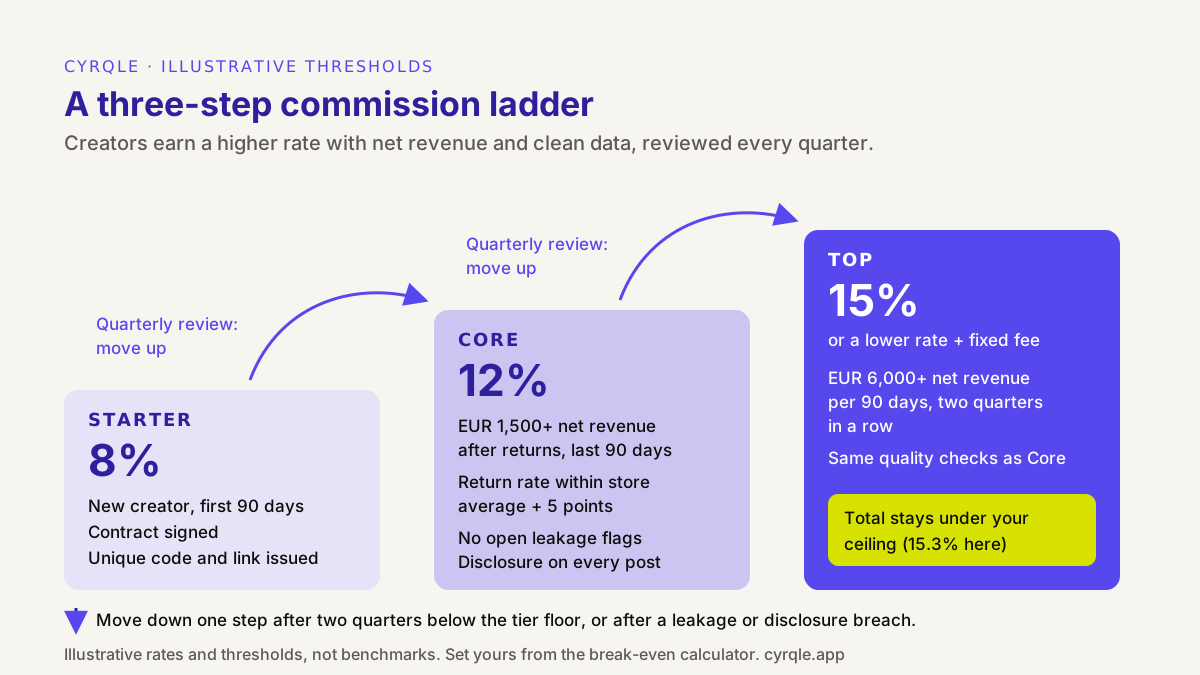
A tier ladder pays creators more as they prove they sell. Three steps are enough: a starter rate for everyone, a core rate for creators with steady sales, and a top rate for the few who drive most of the revenue.
Starter, core and top: who qualifies
| Tier | Illustrative rate | Entry criteria | What you give |
|---|---|---|---|
| Starter | 8% | Contract signed; first 90 days | Code, link, brief, product sample if relevant |
| Core | 12% | EUR 1,500+ net revenue after returns in the last 90 days; return rate no more than 5 points above store average; no open leakage flags; disclosure on every post | Early access to launches, a higher code discount if margin allows |
| Top | 15%, or a lower rate plus a fixed fee per post | EUR 6,000+ net revenue per 90 days for two quarters in a row; same quality checks | Planned content, paid usage of their posts, a named contact |
Measure tiers on net revenue after returns, not on follower count or gross sales: a creator whose audience returns at twice the store average costs more than they bring. A 90-day window smooths out one viral post.
At these rates, a core creator at the EUR 1,500 floor earns EUR 180 a quarter and a top creator at EUR 6,000 earns EUR 900. That is small for a full-time creator, which is why many top tiers pair a lower rate with a fixed fee: predictable income for them, a variable cost under the ceiling for you.
When a creator moves up, and when they move down
Review the ladder once a quarter, on the same date, using the same report.
- Move up when a creator meets every entry criterion of the next tier at the review date. Tell them in writing, with the new rate and the date it starts. Apply the new rate to orders placed after that date, not back-dated.
- Move down one step after two quarters in a row below the floor of their tier, or straight away after a leakage breach they caused (for example, posting the code on a coupon site) or a missing advertising label. Write both rules into the contract so a demotion is never a surprise.
Keep the top rate under your ceiling
The top rate, plus any fixed fee spread over the expected orders, must stay under the usable ceiling from Step 1. In the example, the ceiling is 15.3%, so a 15% top tier is at the limit. If a top creator wants a fixed fee of EUR 300 a month and drives about 60 net orders a month, the fee adds EUR 5 per order, or 7.8% of the EUR 64 base. In that case the commission part should drop to about 7.5%. Rerun the calculator each quarter, because returns and margins move.
Step 4: Give each creator a code and a link
Every creator gets a personal promo code and a personal tracking link. The code works where links cannot, such as a spoken mention in a video. The link tracks the click, so it attributes orders where no code was used. The comparison of discount codes, tracking links and the pixel explains what each method can and cannot prove.
Code rules that limit leakage
- One code per creator, never one code shared by the whole program. A shared code makes leakage impossible to trace.
- An end date on campaign codes, and a quarterly review of evergreen ones.
- One use per customer, and a total usage cap if your store supports it. In Shopify, a one-use-per-customer limit belongs to that one discount: if you delete the code and create a duplicate with the same limit, customers who used the old one can use the new one once more (Shopify Help). Rotate with a new code name instead.
- Watch for outside use. A spike in code orders with no new post is a sign of leakage. Check the main coupon sites and rotate the code if you find it.
For the Shopify side of the setup, see the guide to influencer tracking on Shopify.
Which orders earn commission: tracking by confidence
Not every attributed order carries the same proof. Sort them by how sure you can be, and decide in the contract which ones pay.
| Confidence tier | What happened | What it proves | Suggested commission rule |
|---|---|---|---|
| Tier 1, promo code | The order used the creator's code | The customer had the code. It may have leaked | Pays commission; leakage is priced into the rate |
| Tier 2, same-session | The customer clicked the creator's link and bought in the same visit | Direct link from the post to the order | Pays commission |
| Tier 3, cookied later | The customer clicked the link and came back to buy within 30 days | A click, then a later purchase | Pays commission inside the window; if another creator's code was used on the order, the code wins |
Tier 3 depends on storing an identifier on the visitor's device. In Spain, that requires the visitor's informed consent under LSSI art. 22.2, and the AEPD cookie guide covers affiliate tracking. Visitors who reject cookies cannot be matched later, so expect Tier 3 to undercount. Tell creators up front.
In-store and offline sales
If you also sell in shops, decide whether in-store code redemptions earn commission. If they do, the cashier must record the code, and the same base and refund rules apply as online.
Step 5: Run commission every month
The monthly run turns attributed orders into a payment. In short:
- Close the orders placed in the period at the agreed cut-off.
- Net out refunds, cancellations and orders outside the rules (expired window, rotated codes).
- Hold until the return period has passed, then confirm.
- Send a statement to each creator: orders, gross, refunds, net, rate, commission, any clawback.
- Pay against the invoice, then reconcile the transfer to the statement.
Revenue must be net of refunds at every step, or the statement will not match the creator's invoice. The full walk-through, with a worked statement, is in how to run commission payments every month.
Step 6: Pay creators and keep the tax right
Spain: IVA, IRPF and Modelo 111
A Spanish creator who earns commission usually does so as a professional. In binding ruling V2428-25 (December 2025), the Dirección General de Tributos treated per-sale commissions earned by a creator as a professional activity (group 869 of section 2 of the IAE). You can search for the ruling in the DGT rulings database. In practice:
- IVA. The creator's invoice usually carries 21% IVA (Ley 37/1992, art. 90) on the commission amount. The commission base you agreed in the contract (revenue without IVA) and the IVA on the creator's invoice are two separate things.
- IRPF. When a Spanish-resident individual invoices you for professional income, you usually withhold IRPF: 15%, or 7% in the year they start and the two following, if they tell you in writing (RD 439/2007, art. 95.1).
- Filing. You pay the withheld amount in Modelo 111, quarterly for most companies, and report each creator in the annual Modelo 190.
- Other cases. A creator who invoices through a company (S.L.) usually gets no IRPF withholding. Creators abroad follow different rules.
For example (illustrative), a commission of EUR 307.20 invoiced by a professional autónomo at 15% becomes EUR 307.20 + EUR 64.51 IVA - EUR 46.08 IRPF = EUR 325.63 transferred, and EUR 46.08 in your next Modelo 111. The guide to paying influencers in Spain covers every scenario, and the influencer invoice checklist lists the fields to check before you pay.
United States: Form 1099-NEC
For US creators, the Form 1099-NEC reporting threshold is USD 2,000 for payments in tax years beginning after 2025, indexed for inflation from 2027 (IRS instructions). Collect tax details at contract stage.
Paying the commission
Pay to a bank account in the creator's name, against a valid invoice, on the contract date, and keep the chain from statement to invoice to transfer. The guide to creator payouts with Stripe Connect explains one way to run the transfers.
Disclosure: affiliate links are advertising
A post with a commission code or affiliate link is advertising, and it needs a clear label. In Spain, the influencer code of conduct from Autocontrol, the AEA and IAB Spain lists affiliate links among the things that make content advertising, and it prefers Spanish labels such as "publi" or "publicidad". The guide to the 2025 Autocontrol influencer code has the details. In the US, the same principle comes from the FTC Endorsement Guides. Put the disclosure duty in the contract and make it a tier criterion, as in Step 3.
Launch checklist
Common mistakes
- Copying a competitor's rate. Their margin, returns and leakage are not yours.
- Commission on the price with IVA. On a EUR 96.80 order, 12% of the price is EUR 11.62; 12% of the net base is EUR 7.68.
- Paying before the return period ends. Clawbacks from creators who have spent the money are hard.
- One code for every creator, or no leakage clause. You cannot see who sells or stop a leak cleanly.
- Tiers on follower count. Followers predict reach at best, not net sales.
How cyrqle helps
cyrqle covers the setup and tracking side of a creator affiliate program and shows you what is owed. Paying it stays a separate step that a person on your team starts.
- Commission deals in the brief. In compensation and contracts, you set the deal type to Commission on every sale, or a combination such as Cash & commission or Commission & product. Both sides e-sign the contract in the platform.
- A code and a link per creator. cyrqle mints per-creator promo codes and tracking links in bulk and exports them. With the Shopify integration, it can optionally create the matching discount in your store once you paste an Admin API token and set a percentage.
- Tracking by confidence tier. Attribution reports sales, revenue and clicks by Tier 1, promo code, Tier 2, same-session and Tier 3, cookied later (30-day window), with an audit chain from each sale to the post, code and creator. Revenue is net of refunds. Data comes from the cyrqle tag, the Shopify web pixel and signed order webhooks from Shopify, WooCommerce and Magento, and you can record an offline-attributed sale.
- Commission owed, calculated and shown. Reports show Affiliate / rev-share owed; it is not turned into an automatic payout. Tier reviews, leakage checks and rate changes are policies you run with these reports.
- Payouts a person triggers. When you pay, creators in Europe and the US receive the transfer to their bank through Stripe Connect, settled in EUR. Elsewhere, you pay by bank transfer and record it. Each payout shows the split (creator net, cyrqle commission, any agency fee, tax withheld) and comes with a statement or invoice. cyrqle does not file Modelo 111 or collect tax forms.
Book a demo to see it with your store. cyrqle for brands shows the rest of the workflow, and the pricing page explains how plans are structured.
FAQ
What commission should I pay influencers in an affiliate program?
Pay below the ceiling your own numbers allow, worked out from order value without IVA, gross margin, return rate, a leakage allowance and the share of contribution you want to keep. With a EUR 80 order, 60% margin, 20% returns and 10% leakage, the illustrative ceiling is about 15% of net revenue. Vendor figures of 10% to 15% are US data, not your margin.
Should commission be calculated before or after IVA and shipping?
After. Calculate commission on the order value without IVA and shipping, after discounts and refunds, and write that base into the contract. The IVA on the creator's own invoice is a separate amount added on top of the commission.
Do I pay commission on returned orders?
No, if the contract says so, and it should. Deduct refunds and cancellations before calculating commission. If a refund arrives after payment, deduct it from the next statement. Holding orders until the return period ends keeps that rare.
How long should I wait before paying affiliate commission?
Until the withdrawal period has passed. In Spain and the EU, the customer has 14 days from delivery to withdraw and 14 more to send the goods back, so closing each month's orders at the end of the following month covers it. A longer returns policy needs a longer hold.
How do I stop creator codes from leaking to coupon sites?
Give each creator a personal code with an end date, one use per customer and a total cap where your store allows. Rotate a leaked code under a new name, under a rule written into the contract, and price the leakage you cannot stop into the rate.
Do I withhold IRPF on affiliate commission in Spain?
Usually, yes, when a Spanish-resident individual invoices you as a professional. The rate is 15%, or 7% for a creator in their start year and the two after, if they notify you in writing. You pay it in Modelo 111. Creators who invoice through a company usually get no withholding. This is not tax advice; confirm each case with your gestor.
Sources
- Real Decreto Legislativo 1/2007 (TRLGDCU), articles 104, 107 and 108: BOE-A-2007-20555
- Directive 2011/83/EU on consumer rights, article 9: EUR-Lex
- Ley 37/1992, del IVA, articles 78 and 90: BOE-A-1992-28740
- Real Decreto 439/2007, Reglamento del IRPF, article 95: BOE-A-2007-6820
- Dirección General de Tributos, binding ruling V2428-25: DGT rulings database
- Ley 34/2002 (LSSI), article 22.2: BOE-A-2002-13758
- AEPD, guide on the use of cookies: aepd.es
- IRS, Instructions for Forms 1099-MISC and 1099-NEC: irs.gov
- FTC Endorsement Guides, 16 CFR Part 255: eCFR
- Shopify Help Center, discount usage limits: help.shopify.com
- Traackr, affiliate and influencer program tips (vendor data, 2023): traackr.com
Related material.
How to track influencer sales on Shopify step by step: per-creator codes and links, a custom pixel, an on-page tag and signed order webhooks, read by tier.
A step-by-step guide to putting rights-cleared creator content on your Shopify store: importing products, building and tagging a wall, adding it to a page or product template, publishing, and connecting tracking.
Justify your influencer marketing budget on one page: spend, attributed revenue as a range, MER, payback, holdout result and risks, with a worked euro example.