
Influencer outreach email templates in Spanish: paid, gifted, commission and rights requests
Influencer outreach email templates in Spanish: paid, gifted, commission, rights, with a terms block, GDPR note and Spain/Mexico/Argentina tone.
An influencer outreach email that gets a yes in one reply has six parts: a subject line that names the deal, one sentence on why you chose this creator, the ask, a complete terms block, a short data-protection note and one closing question. This pack gives you that email in seven scenarios, in Spanish, with tone variants for Spain, Mexico and Argentina.
Picture a skincare brand in Valencia that wants twelve creators in Spain, Mexico and Argentina for a September launch. It sends one template, translated from English. Lucía in Madrid replies "¿Cuánto pagáis?". Mariana in Mexico City asks whether the rights include ads. Tomás in Córdoba does not reply, because "vosotros" and "os escribimos" read as a message for someone else. Three threads, three wasted days, and the deal terms are still not on the table.
The templates below fix that. Each one carries the offer terms, so the creator can decide at once. They are written in neutral Spanish with notes on what to change per country, and the English text explains each block. The templates sit next to our one-page creator brief template, which you attach to the email, and the influencer contract template for Spain, which makes the terms binding once the creator says yes.
What should an influencer outreach email include?
An influencer outreach email should include six parts in this order: subject, why you, the ask, the terms block, the data note and one question. Keep everything above the terms block under about 150 words. The creator reads the opening to decide whether you are serious and the terms block to decide whether to say yes.
- Subject line. Name the deal type and the month: "Colaboración pagada con [marca] en septiembre". A vague subject such as "Propuesta" looks like a mass mailing.
- Why you. One specific sentence about a real post: the topic, the format, a detail. "Me encanta tu contenido" proves nothing.
- The ask. One sentence: what you want and when.
- The terms block. Fee, deliverables, dates, rights, exclusivity, payment, disclosure. See the next section.
- The data note. Three lines on who you are, where you got the address and how to opt out.
- One question. "¿Te encaja?" or "¿Te interesa?". One question, one decision.
The table shows how the six scenarios in this pack differ in those parts.
| Subject line | First sentence | Terms block must state | Follow-up timing | |
|---|---|---|---|---|
| Paid post (fixed fee) | Colaboración pagada con [marca] en [mes]: 1 reel + 3 stories | Vi tu reel sobre [tema] y encaja con nuestro lanzamiento de [producto]. | Fee + IVA, deliverables, dates, rights scope and term, paid-ads use, exclusivity, payment terms, label | About day 5 and day 10, then close |
| Gifting (no posting duty) | ¿Te enviamos [producto]? Sin compromiso de publicar | Vi cómo usas [producto similar] en tu rutina y nos gustaría que probaras el nuestro. | Product and value, no obligation, label if they post, no reuse without a separate yes | One follow-up at about day 5 |
| Commission only | Programa de afiliación de [marca]: [X] % por venta con tu código | Ya nos has mencionado en [fecha], así que te proponemos ganar por cada venta. | Rate, what counts as a sale, refunds, code and link, attribution window, payout schedule | About day 5 and day 10, then close |
| Hybrid (fee plus commission) | Colaboración con [marca]: pago fijo + comisión por venta | Tu serie sobre [tema] es justo el formato que buscamos para [producto]. | Fixed fee, commission rate and basis, deliverables, rights, payment for each part | About day 5 and day 10, then close |
| Rights request (existing post) | ¿Podemos usar tu publicación del [fecha] en nuestra web? | Vimos tu [reel/foto] del [fecha] con [producto] y nos gustaría mostrarlo. | Which post, uses, markets, term, paid use yes or no, credit, compensation, how to withdraw | One reminder at about day 5 |
| Follow-up 1 and 2 | Re: [asunto original] | Te escribo de nuevo por la propuesta de [marca] para [mes]. | Repeat the single key term (fee and dates); follow-up 2 states the close date | Follow-up 2 is the last message |
The offer-terms block: copy it into every template
The offer-terms block is a short, labelled list of the deal terms: fee, deliverables, dates, usage rights, exclusivity, payment and disclosure. It turns a pitch into an offer that the creator can accept with one word. It also protects you, because the terms you send are the terms the creator quotes back when the contract arrives.
CONDICIONES DE LA PROPUESTA
Pago: [importe] € + IVA, por transferencia a [30] días de la factura.
Entregables: [1 reel de 30 a 60 s y 3 stories con enlace] en [Instagram].
Fechas: borrador antes del [fecha]; publicación entre el [fecha] y el [fecha].
Derechos de uso: compartir en las redes y la web de [marca] durante [6] meses, en [España].
Uso en anuncios pagados: [no incluido] / [incluido por [importe] € más, durante [3] meses].
Exclusividad: [ninguna] / [sin otras marcas de [categoría] durante [30] días].
Identificación: etiqueta «Colaboración pagada» de la plataforma y «Publicidad» al inicio del texto.
Siguiente paso: si te encaja, responde «sí» y te enviamos el brief y el contrato.
What each line says, in English:
- Pago (fee). A number, not "a discutir". If you cannot fix it, give a firm range. State "+ IVA" for Spanish creators and say when you pay. For rate ranges by tier, see our influencer rates in Spain for 2026; for withholding and invoices, see how to pay influencers in Spain.
- Entregables (deliverables). Count, format, length and platform. "1 reel + 3 stories" is clear; "contenido para redes" is not.
- Fechas (dates). The draft date and the posting window.
- Derechos de uso (usage rights). Channels, term and territory. Under Spanish copyright law, a licence covers only the uses written down, so a vague rights line helps nobody. Paid-ads use is a separate line and usually a separate fee: price it with our usage-rights pricing calculator.
- Exclusividad (exclusivity). None, or a category and a number of days. Exclusivity costs the creator income, so expect to pay for it.
- Identificación (disclosure). Spain's influencer advertising code, in force since 1 October 2025 and promoted by AUTOCONTROL, the aea and IAB Spain, prefers the platform's paid-partnership tool and a clear label such as "publicidad" at the start of the message. Labels such as "Ad", "colab" or "regalo de [marca]" are not enough. See the code page at AUTOCONTROL and our disclosure guide for the EU and Latin America.
- Siguiente paso (next step). Tell the creator exactly what "yes" triggers.
Attach the brief as a one-page PDF, not a twelve-page deck. The brief explains the creative job; the terms block explains the deal.
What data-protection note does the first email need?
The first email to a creator in the EU must tell them who you are, why you are writing, where you got their address and how to object. The rule comes from GDPR article 14: when you did not get the data from the person, you must inform them "at the latest at the time of the first communication". Article 21(4) adds that the right to object must be shown "clearly and separately from any other information" in that first message.
In practice, most brands rely on legitimate interest (GDPR article 6(1)(f)) to write to a creator who publishes a business email. Spain's data protection law, the LOPDGDD, presumes legitimate interest for the contact data of sole traders and professionals used in that capacity (article 19), and allows a short basic information layer that must also name the data categories and the source (article 11.3). A creator who works as an autónomo fits that reading, but it is a reasonable reading, not a settled rule. Read the GDPR glossary entry for the basics.
Spain's e-commerce law adds a second layer. LSSI article 21 bans unsolicited "comunicaciones publicitarias o promocionales" by email. Whether a one-to-one proposal to hire a creator counts as a commercial communication is open: the law's definition covers the direct or indirect promotion of a company's image, so a brand pitch can fall inside it.
So write outreach that reduces the risk: one creator at a time, relevant to their work, sent to an address they published for business, with a clear way to say no. Paste this note under your signature:
Te escribimos a [email] porque lo publicas como contacto profesional en tu perfil de [Instagram/TikTok]. Usamos este dato solo para proponerte esta colaboración y no lo cedemos a terceros. Si no quieres recibir más mensajes nuestros, responde «baja» y no volveremos a escribirte. Responsable: [Marca, S.L.], [email de privacidad]. Más información: [enlace a la política de privacidad].We are writing to [email] because you list it as your business contact on your [Instagram/TikTok] profile. We use it only to propose this collaboration and do not share it. If you do not want more messages from us, reply "unsubscribe" and we will not write again. Controller: [Brand Ltd], [privacy email]. More information: [privacy policy link].For Latin America, adapt the last line:
- Mexico. The private-sector data protection law (LFPDPPP) was replaced by a new law published in the Diario Oficial on 20 March 2025, listed by the Cámara de Diputados. Mexican practice expects a privacy notice (aviso de privacidad) at first contact when the data did not come from the person, so link yours in the note.
- Argentina. Ley 25.326 article 27.3 lets a person ask at any time to be removed from a database used for advertising. Your "responde «baja»" line covers this; honour it at once.
An email address in an Instagram bio is not a legal "public access source" in Mexico or Argentina. Both laws define that term narrowly, so a public bio does not remove your duty to inform.
Two delivery points also matter. Send from your own domain, not a free mailbox, and keep volumes low: Google's sender guidelines require SPF or DKIM for every sender and ask you to keep the spam rate under 0.10%, never reaching 0.30%. And keep a record of every opt-out, so nobody on your team writes again from a different address.
Template 1: Paid post (fixed fee)
Use it when you pay a fixed fee for set deliverables. This is the default template; the others change only the terms block and the first lines.
Asunto: Colaboración pagada con [marca] en septiembre: 1 reel + 3 stories

Hola, [nombre]:

Soy [tu nombre], de [marca]. Vi tu reel sobre [tu rutina de noche con retinol] y la forma en que explicas [cada paso] encaja con el lanzamiento de [producto] en septiembre.

Te proponemos una colaboración pagada. Abajo tienes todas las condiciones, para que puedas decidir con una sola respuesta.

CONDICIONES DE LA PROPUESTA
Pago: 450 € + IVA, por transferencia a 30 días de la factura.
Entregables: 1 reel de 30 a 60 s y 3 stories con enlace, en Instagram.
Fechas: borrador antes del 2 de septiembre; publicación entre el 8 y el 14 de septiembre.
Derechos de uso: compartir en las redes y la web de [marca] durante 6 meses, en España.
Uso en anuncios pagados: no incluido. Si más adelante nos interesa, te haremos una oferta aparte.
Exclusividad: ninguna.
Identificación: etiqueta «Colaboración pagada» de Instagram y «Publicidad» al inicio del texto.
Siguiente paso: si te encaja, responde «sí» y te enviamos el brief y el contrato.

Te adjunto el brief de una página. ¿Te encaja?

Un saludo,
[Nombre Apellido], [cargo], [marca]
[web]

[nota de protección de datos]
In English: the opening names a real post and the launch; the second paragraph says the full terms follow; the terms block makes the offer (the 450 EUR fee is illustrative, not a benchmark); the close asks one question. For Mexico and Argentina, state the fee as "450 EUR, importe en euros, pago por transferencia internacional" and drop "+ IVA" unless your advisor says otherwise.
Template 2: Gifting (product, no posting duty)
Use it when you send product with no obligation to post. Be honest about that, and say what happens if the creator does post. Our guide to choosing between gifting and a paid collab explains when each one works.
Asunto: ¿Te enviamos [producto]? Sin compromiso de publicar

Hola, [nombre]:

Soy [tu nombre], de [marca]. Vi cómo usas [producto similar] en tu rutina y nos gustaría que probaras [producto].

QUÉ TE PROPONEMOS
Producto: [producto], valor de venta aproximado [importe] €.
Obligación de publicar: ninguna. Es para que lo pruebes.
Si decides publicarlo: identifícalo con la etiqueta «Colaboración pagada» de la plataforma, porque te lo envía la marca.
Uso de tu contenido: no reutilizamos nada sin pedirte permiso aparte.
Envío: en [3] días laborables desde que nos des una dirección.
Siguiente paso: si te apetece probarlo, responde con la dirección de envío.

¿Te lo enviamos?

Un saludo,
[firma]

[nota de protección de datos]
In English: a gift with a clear "no obligation" line and a clear disclosure line. Instagram's branded content rules treat free products as something of value, and Spain's code counts gifted product as consideration, so a post about a gift is still advertising.
Template 3: Commission only
Use it with creators who already use or mention your product. Commission-only offers to cold creators rarely work, because the creator carries all the risk. The terms block must explain how a sale is counted, or the creator cannot judge the offer.
Asunto: Programa de afiliación de [marca]: 10 % por venta con tu código

Hola, [nombre]:

Soy [tu nombre], de [marca]. Nos mencionaste en tu story del [fecha], así que te proponemos ganar una comisión por cada venta que generes.

CONDICIONES DEL PROGRAMA
Comisión: 10 % del importe neto de cada pedido (sin IVA ni gastos de envío).
Cómo se cuenta una venta: pedido con tu código [CODIGO] o a través de tu enlace en los 30 días siguientes al clic.
Devoluciones: los pedidos devueltos se descuentan.
Liquidación: mensual, por transferencia, con el detalle de pedidos.
Duración: 3 meses, renovable si a los dos nos funciona.
Publicaciones: sin mínimo. Te enviamos [producto] para que tengas contenido.
Identificación: los enlaces y códigos de afiliado son publicidad; usa la etiqueta de la plataforma.
Siguiente paso: si te interesa, responde «sí» y te enviamos tu código y tu enlace.

¿Te interesa?

Un saludo,
[firma]

[nota de protección de datos]
In English: the rate, the base (net of tax and shipping), the counting rule (code or a tracking link within a 30-day window), refunds netted, and the payout schedule. All numbers are illustrative; set your own rate from your margin after returns.
Template 4: Hybrid (fee plus commission)
Use it when you want guaranteed content and an incentive to sell. A hybrid deal pays a lower fixed fee plus a commission, so state each part with its own payment terms.
Asunto: Colaboración con [marca]: pago fijo + comisión por venta

Hola, [nombre]:

Soy [tu nombre], de [marca]. Tu serie sobre [tema] es el formato que buscamos para presentar [producto] en octubre.

CONDICIONES DE LA PROPUESTA
Pago fijo: 300 € + IVA por los entregables, por transferencia a 30 días de la factura.
Comisión: 8 % del importe neto de cada pedido con tu código [CODIGO] o tu enlace, durante 60 días desde la publicación; devoluciones descontadas; liquidación mensual.
Entregables: 1 reel y 2 stories con enlace, en Instagram.
Fechas: borrador antes del [fecha]; publicación entre el [fecha] y el [fecha].
Derechos de uso: redes y web de [marca] durante 6 meses, en España. Anuncios pagados: no incluidos.
Exclusividad: ninguna.
Identificación: etiqueta «Colaboración pagada» y «Publicidad» al inicio del texto.
Siguiente paso: si te encaja, responde «sí» y te enviamos el brief y el contrato.

¿Te encaja?

Un saludo,
[firma]

[nota de protección de datos]
In English: the fixed fee and the commission each get a line with their own base, window and payment date. All numbers are illustrative.
Template 5: Content-rights request for an existing post
Use it to reuse a post that already exists, such as a customer's photo or a creator's organic reel. This is a licence, not a new collaboration, so the terms block lists the uses, the term and how the creator can withdraw. For the full process, see how to request content rights from a creator.
Asunto: ¿Podemos usar tu publicación del [fecha] en nuestra web?

Hola, [nombre]:

Soy [tu nombre], de [marca]. Vimos tu [reel/foto] del [fecha] con [producto] ([enlace]) y nos gustaría mostrarlo en nuestra web.

QUÉ TE PEDIMOS
Publicación: [enlace a la publicación].
Usos: la web de [marca] y la ficha de [producto]; compartirla en nuestras redes con tu mención.
Anuncios pagados: no.
Territorio y duración: [España], 12 meses desde que aceptes.
Crédito: tu usuario @[usuario] junto a la publicación.
Compensación: [importe] € / [producto] / ninguna, solo el crédito.
Retirada: puedes retirar el permiso cuando quieras; la quitamos en [5] días laborables.
Siguiente paso: responde «acepto» y te enviamos la confirmación por escrito.

¿Nos das permiso?

Un saludo,
[firma]

[nota de protección de datos]
In English: the request names one post, lists every use, rules out paid ads, sets territory and term, and gives a simple withdrawal route.
Follow-up 1 and follow-up 2
Use follow-up 1 about five days after the invite and follow-up 2 about five days later. Reply in the same thread, so the creator sees the original terms. Each follow-up repeats one key term and asks one question.
Asunto: Re: Colaboración pagada con [marca] en septiembre: 1 reel + 3 stories

Hola, [nombre]:

Te escribo de nuevo por la propuesta de [marca]: 450 € + IVA por 1 reel y 3 stories, publicación entre el 8 y el 14 de septiembre. Las condiciones están en el mensaje de abajo.

¿Te interesa, o prefieres que no te escribamos más sobre esta campaña?

Un saludo,
[firma]
Asunto: Re: Colaboración pagada con [marca] en septiembre: 1 reel + 3 stories
Hola, [nombre]:
Es mi último mensaje sobre esta propuesta. Si no tengo respuesta antes del [fecha], cierro el hilo y no volveremos a escribirte por esta campaña.
Si ahora no te va bien, también podemos enviarte [producto] sin compromiso o hablar para la campaña de [mes].
Gracias por leerlo,
[firma]In English: follow-up 1 restates the offer in one line and gives an easy way to say no. Follow-up 2 states a close date, offers a smaller alternative and then stops.
How do you adapt the email for Spain, Mexico and Argentina?
Use tú by default in all three markets, and vos in Argentina. The difference that trips up most brands is the plural: Spain uses vosotros ("os proponemos"), while Latin America uses ustedes ("les proponemos"), as the Real Academia's guide to ustedes explains. In Argentina the standard form, even in business writing, is voseo: "tenés", "podés", "contame", "avisame", as described in the Diccionario panhispánico de dudas.
| Spain | Mexico | Argentina | |
|---|---|---|---|
| Address one creator | tú: «te escribo» | tú: «te escribo» | vos: «te escribo» |
| Duo or team account | vosotros: «os proponemos» | ustedes: «les proponemos» | ustedes: «les proponemos» |
| Closing question | «¿Te encaja?» | «¿Te interesa?» | «¿Te interesa?» |
| Ask for a reply | «Dime si te va bien» | «Avísame si te funciona» | «Avisame si te sirve» |
| Availability | «¿Tienes disponibilidad?» | «¿Tienes disponibilidad?» | «¿Tenés disponibilidad?» |
| Point to the brief | «Mira el brief adjunto» | «Revisa el brief adjunto» | «Mirá el brief adjunto» |
| Words for things | móvil, vídeo | celular, video | celular, video |
| Fee line | «450 € + IVA» | «450 EUR, importe en euros, transferencia internacional» | «450 EUR, importe en euros, transferencia internacional» |
| Sign-off | «Un saludo» | «Saludos» | «Saludos» (later, «Un abrazo») |
| Avoid in a first email | «tío», «guay» | «güey», «¿te late?» | «che», «¿te copa?» |
Here is the opening of Template 1 in Argentine register, so you can see how few words change:
Hola, [nombre]:

Soy [tu nombre], de [marca]. Vi tu reel sobre [tema] y la forma en que explicás [cada paso] encaja con el lanzamiento de [producto] en septiembre.

Te proponemos una colaboración pagada. Abajo tenés todas las condiciones, para que puedas decidir con una sola respuesta.

[condiciones]

Mirá el brief adjunto y avisame si te interesa.

Saludos,
[firma]
Switch to usted when the creator writes to you in usted, when the profile is professional (doctors, lawyers, financial advisors) or when the audience is older and formal. Do not mix forms inside one email: a message that starts with tú and closes with "quedamos a su disposición" reads as machine-translated. And if the creator answers with "os" or "vos", follow their lead in the reply.
How often should you follow up, and when do you stop?
Follow up twice at most, about five days apart, then close the thread. Any reply stops the sequence: yes, no, "más adelante" or "baja". If the launch date is close and you send by hand, compress the gaps to three or four days, but keep the same number of messages.
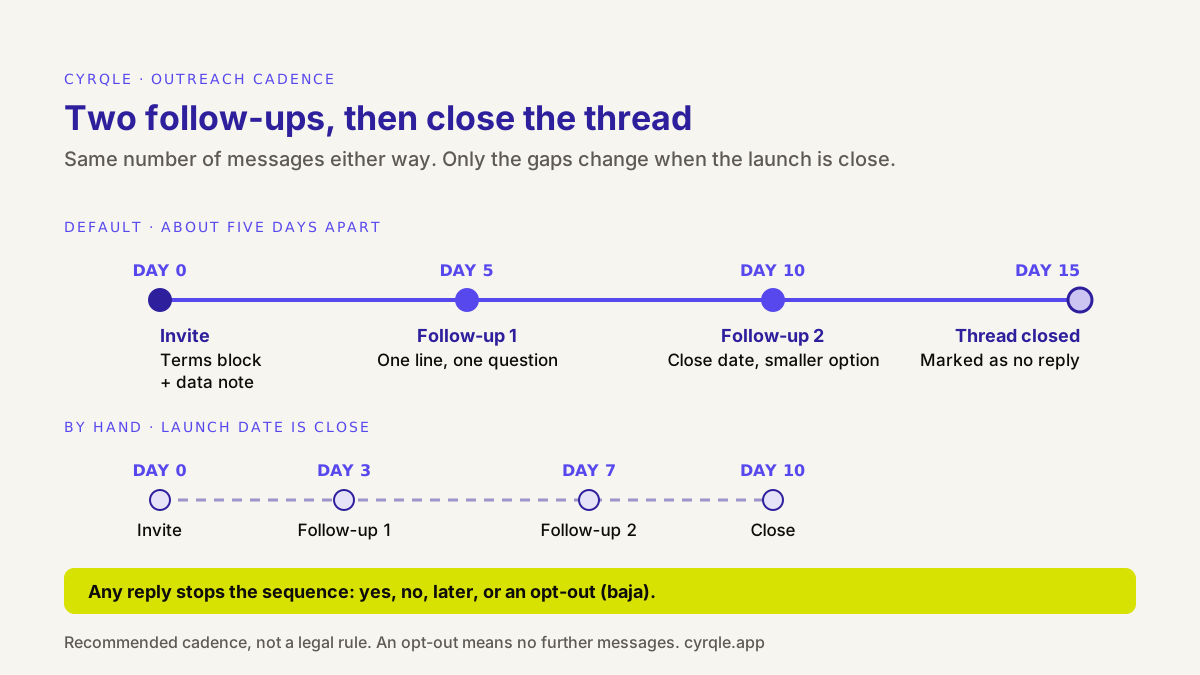
| Step | Default day | Close launch, by hand | What to say | Stop rule |
|---|---|---|---|---|
| Invite | 0 | 0 | Full template: terms block and data note | Stop on any reply |
| Follow-up 1 | about 5 | 3 | One line with the key term, one question, easy no | Stop on any reply |
| Follow-up 2 | about 10 | 7 | "Cierro el hilo" with a date; offer a smaller alternative | Stop on any reply |
| Close | about 15 | 10 | Nothing. Mark the creator as no reply | Do not switch to DM to chase |
| Opt-out ("baja") | any day | any day | One line confirming you will not write again | Never write again about this campaign |
Three rules keep the cadence clean. Do not chase in DMs after an email opt-out. Do not open a new thread with a new subject to restart the sequence. And if a creator says "later", write down the month they gave and send one fresh invite then, with updated terms. For tracking who is where, see when a spreadsheet stops being enough for influencer CRM.
How cyrqle helps
In Campaigns, you write the invite and follow-up templates once and send them to many creators. Bulk invites go out in Spanish or English by market, and each invite gets two automatic follow-ups, about five days apart. The follow-ups stop when the creator answers, and each creator sits in a your move or their move bucket so nobody gets chased after a reply.
cyrqle will not send an invite until the compensation is complete, so the terms block is never missing. Deal types match the scenarios in this pack: Cash payment, Commission on every sale, Product gift, and combinations such as Cash & commission. The deal terms stay in the outreach thread and flow into the Creator Collaboration Agreement, a two-sided e-signature contract with a frozen copy of the terms. Content-wall and campaign use are always granted; paid-ads use is granted only if you tick it on the offer.
For commission and hybrid deals, each creator gets a promo code and a tracking link in Attribution, and the commission owed is calculated and shown in reports. Paying it is a separate step that you trigger. For Template 5, Request rights on a post card emails the creator (or gives you a link to send by DM), with automatic email reminders and rights templates per language in workspace settings.
Put the data-protection note in your own invite template: cyrqle sends the text you write. To set up your first campaign end to end, follow launch your first creator campaign in cyrqle, or book a demo.
FAQ
How do I write an email to an influencer for a collaboration?
Use six parts: a subject that names the deal, one specific sentence on why you chose the creator, the ask, a complete terms block, a short data note and one closing question. Keep the text above the terms block under about 150 words. The creator should be able to say yes with one reply.
Can I email an influencer without their consent in Spain?
Many brands do, on the basis of legitimate interest, when they write one to one to an address the creator published for business. The GDPR then requires a notice in the first email: who you are, where you got the address and how to object. Spain's LSSI bans unsolicited promotional email, so avoid bulk sends and honour every opt-out. It is not legal advice: for a specific campaign, ask your lawyer.
How many times should I follow up with an influencer, and how long should I wait?
Twice at most, about five days apart, then close the thread around day 15. If the launch is close, compress to day 3 and day 7. Any reply, including no, stops the sequence, and an opt-out means you never write again about that campaign.
Should I use tú or usted with a creator?
Use tú in Spain and Mexico and vos in Argentina. Switch to usted when the creator writes in usted, when the profile is professional or when the audience is formal. Never mix forms in one email, and for duo accounts use vosotros only in Spain and ustedes in Latin America.
Should I put the fee in the first email?
Yes. The fee is the first thing creators ask about, and an email without it costs you a round trip. If the fee is not fixed, give a firm range and say what moves it, such as paid-ads use or exclusivity.
What is the difference between asking for a collaboration and asking for content rights?
A collaboration asks the creator to make new content for a fee or product. A rights request asks for a licence to reuse a post that already exists. The rights request needs its own terms: which post, which uses, which markets, how long, any paid use and how to withdraw.
Sources
- Regulation (EU) 2016/679 (GDPR), articles 6, 14 and 21: EUR-Lex
- Ley Orgánica 3/2018 (LOPDGDD), articles 11 and 19: BOE-A-2018-16673
- Ley 34/2002 (LSSI), articles 20, 21, 38 and 39 and annex: BOE-A-2002-13758
- Ley Federal de Protección de Datos Personales en Posesión de los Particulares (Mexico, DOF 20 March 2025): Cámara de Diputados
- Ley 25.326 de Protección de los Datos Personales (Argentina), article 27: InfoLEG
- Código de conducta sobre el uso de influencers en la publicidad: AUTOCONTROL
- Instagram branded content policies: Instagram Help Center
- Email sender guidelines: Google Workspace Admin Help
- Diccionario panhispánico de dudas, "voseo" and "ustedes": RAE
Checked on 4 November 2026. Laws and platform rules change; re-check before a large campaign.
Related material.
Free influencer brief template in nine sections, from objective to approval, with a filled Black Friday 2026 example, disclosure wording and usage rights.
A practical checklist for your first campaign in cyrqle: drafting the brief, setting compensation and the destination link, choosing deliverables, finding and inviting creators, signing agreements, tracking posts and paying creators.
Influencer platform comparison template: a weighted scorecard for brands and agencies, with score definitions, demo evidence and a TCO line for Q4 renewals.