
Influencer invoice checklist for brands in Spain
Influencer invoice requirements in Spain as a printable checklist: mandatory fields, IRPF and IVA lines, foreign creators, gifted product and what to file.
The influencer invoice requirements in Spain come from article 6 of the invoicing regulation, Real Decreto 1619/2012. An influencer invoice must show the content set out there: a sequential number and series, the issue date, the full legal names, tax IDs and addresses of the creator and your company, a description of what was delivered, the taxable base, and the IVA rate and amount shown separately. On top of that, finance checks one line the regulation does not list: the IRPF withholding. If a field is missing or wrong, ask for a corrected invoice before you release the payment.
This guide turns those rules into a checklist that brand finance and marketing operations can print and use on every creator payment. It covers the mandatory fields, the withholding line, the IVA line, the variants for creators abroad and for agencies, product-only collaborations, and the documents to keep with each payout. It is not tax advice: the treatment of each creator depends on how they are registered, and your gestor or tax advisor should confirm it. For the reasoning behind each scenario, read the companion guide on how to pay influencers in Spain, with IRPF and IVA.
How to use this checklist
Use the checklist at three moments, not one. Most invoice problems start before the invoice exists.
- At contract stage. Collect the creator's legal name, tax ID, address, country of residence and tax status. Put the invoice data and the payment term in the contract. Our influencer contract template for Spain has a fee and invoice clause you can copy.
- When the invoice arrives. Check every field in the table below, then the IVA and withholding lines against the creator's scenario.
- Before and after you pay. Match the invoice total to the payout amount, then file the payout record, the withholding return and the supporting documents together.
Send the scenario table and any doubtful case to your gestor once, at the start of a campaign, rather than one invoice at a time.
Which fields must an influencer invoice include?
A full invoice (factura completa) from a creator to your company must include every field in article 6.1 of Real Decreto 1619/2012 that applies to the operation. The table lists them in the order finance usually checks them.
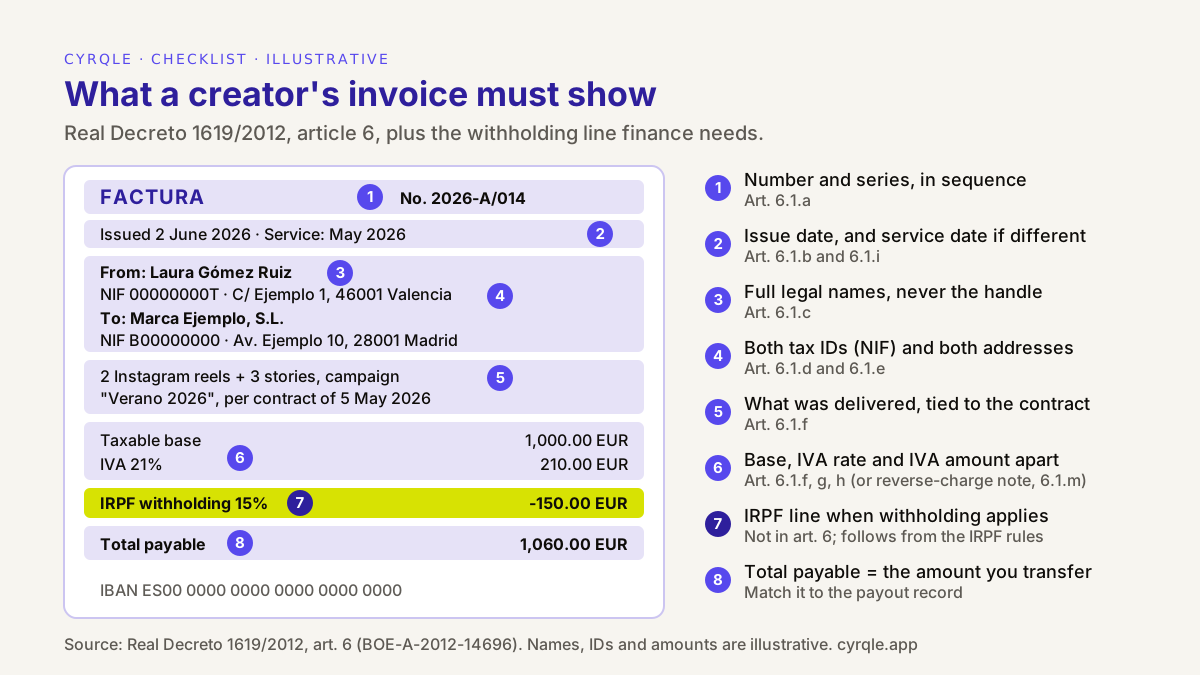
| # | Field | Article | What to check |
|---|---|---|---|
| 1 | Number and series | 6.1.a | A number in the creator's own series, in sequence. A missing number is the most common reason to reject an invoice. |
| 2 | Issue date | 6.1.b | The date the invoice was issued. |
| 3 | Date of the operation | 6.1.i | Needed when it differs from the issue date, for example posts published in May and invoiced in June. |
| 4 | Full legal names | 6.1.c | The creator's full name and surnames, or company name, and your company's registered name. Never the social handle. |
| 5 | Tax IDs (NIF) | 6.1.d | The creator's NIF and your company's NIF. Your NIF is mandatory in some cases, such as reverse charge, and in practice you want it on every invoice you will deduct. |
| 6 | Addresses | 6.1.e | Both parties' addresses. |
| 7 | Description | 6.1.f | What was delivered, with enough detail to set the taxable base: formats, number of posts, campaign, period. Name usage rights or exclusivity if they are priced separately. |
| 8 | Unit price and discounts | 6.1.f | The price before tax per item, and any discount not already included in it. |
| 9 | IVA rate | 6.1.g | 21% for most Spanish creators. |
| 10 | IVA amount | 6.1.h | The IVA charged, shown on its own line. |
| 11 | Separate bases | 6.2 | If one invoice mixes rates, or mixes taxed and reverse-charged items, each base is shown separately. |
| 12 | Exemption reference | 6.1.j | Only if the creator treats the operation as exempt: the invoice must cite the legal provision or say it is exempt. Ask your gestor before you accept an exempt invoice for content services. |
| 13 | Reverse-charge note | 6.1.m | "Inversión del sujeto pasivo" (or the creator's equivalent wording) when you, the customer, are the person liable for the IVA. |
A few rules around the fields matter as much as the fields themselves:
- Ask for a full invoice. A simplified invoice (factura simplificada) is allowed up to 400 euros including IVA in most cases (article 4), but for a business expense you want your company's name, NIF and address, and the IVA amount on its own line.
- Deadline. When the customer is a business, the creator must issue the invoice before the 16th day of the month after the month the IVA fell due (article 11), and send it within the same deadline (article 18).
- Language and currency. An invoice may be in any language and any currency (article 12). The tax authority can ask for a translation, so a Spanish or English invoice is easier to defend.
- Corrections. If an invoice is wrong, the creator issues a corrective invoice (factura rectificativa, article 15) that refers to the original. Do not accept a new invoice with the same number and different amounts.
When should the invoice show IRPF withholding?
The invoice should show IRPF withholding when a Spanish-resident individual invoices you for a professional activity. The general rate is 15% of the taxable base, and 7% for a creator in their first years of professional activity who tells you so in writing (Real Decreto 439/2007, article 95). Article 6 of the invoicing regulation does not list the withholding line, but the duty to withhold is yours as the payer, so finance should see the percentage and amount on the invoice and the total payable after it.
Check the line against the creator's status:
- Autónomo in a professional activity (section 2 of the IAE). Expect 15%, or 7% with a signed notice you keep on file. The Dirección General de Tributos placed a content creator working personally in group 869 of section 2 in ruling V2390-24.
- Autónomo in a business activity (section 1 of the IAE). Usually no IRPF withholding. An earlier ruling, V0773-22, placed a creator in section 1 headings for video and photography. Keep a note of the creator's IAE heading.
- Creator invoicing through a Spanish company. Usually no withholding on a service fee. Watch for fees described as a licence of image rights, which follow their own withholding rules.
- Creator resident abroad. No IRPF line. Non-resident income tax may apply instead (19% for EU and EEA residents, 24% for others by default), unless a tax treaty and a tax residence certificate remove it. The full reasoning, with sources, is in the guide on invoices, IRPF withholding and IVA for creator payments.
Two red flags on the withholding line: a Spanish autónomo invoice with no IRPF line and no explanation, and an invoice where the total payable equals base plus IVA even though the creator told you they are a professional. In both cases ask before you pay. If you pay the gross and forget to withhold, the tax authority can still claim the withholding from your company.
Which IVA line is correct?
The IVA line depends on where the creator is established, not on where the audience is.
| Creator | IVA line on the invoice | What you do |
|---|---|---|
| Spanish autónomo or company, mainland Spain or the Balearic Islands | 21% IVA, rate and amount shown | Deduct it in your Modelo 303 if your activity allows it. |
| Established in another EU country | No Spanish IVA; reverse-charge note; creator's EU VAT number | Check the VAT number in the EU VIES system, then self-assess the IVA in your Modelo 303. |
| Established outside the EU | No Spanish IVA | Self-assess the IVA under the reverse charge. Ask your gestor whether you also issue a self-invoice (autofactura) for the operation. |
| Established in the Canary Islands, Ceuta or Melilla | Not Spanish IVA; local indirect taxes (IGIC, IPSI) have their own rules | Ask your gestor. |
The reverse charge comes from Ley 37/1992 on IVA (articles 69 and 84): a business-to-business service is taxed where the customer is established, and the Spanish customer accounts for the IVA. For a creator in another EU country, the invoice follows the invoicing rules of the creator's own country, which come from the same EU VAT Directive (Directive 2006/112/EC, articles 219a and 226). Expect the creator's VAT number, your company's VAT number and the words "Reverse charge" or the local equivalent.
Checklist variants by type of creator
Most of the checklist stays the same for every creator. What changes is the tax line and the extra document you must hold.
| IVA line | Withholding line | Extra document to hold | |
|---|---|---|---|
| Spanish autónomo, professional activity | 21% | IRPF 15%, or 7% with notice | Signed 7% notice, if claimed |
| Spanish autónomo, business activity | 21% | Usually none | Note of the IAE heading |
| Creator's own Spanish company (S.L.) | 21% | Usually none; check image-rights fees | Company NIF on the contract |
| Creator in another EU country | None; reverse-charge note | None, or non-resident tax 19% without a treaty certificate | VIES check; tax residence certificate |
| Creator outside the EU | None; you self-assess | None, or non-resident tax 24% without a treaty certificate | Tax residence certificate |
| Talent agency invoicing for the creator | 21% if the agency is Spanish | Usually none on a company invoice | Contract showing the agency may invoice for the creator |
| Product only, no cash | Barter; ask your gestor | Payment on account for professionals | Record of the product's market value |
Checked on 1 June 2026 against the BOE consolidated texts linked in this guide. Tax law changes; re-check before each tax year.
Talent agencies and management companies. When a management agency invoices you for a creator, the agency's invoice is the one you check, against the agency's name and NIF. Make sure the contract says the agency can invoice and collect for the creator. Do not pay the agency on the creator's invoice, or the creator on the agency's.
Your own agency. If a marketing agency runs the campaign and re-invoices you, you get one invoice from the agency for the creator costs and its fee. The agency then checks each creator's invoice. Ask the agency to keep the creator invoices available to you.
Product-only collaborations: what do you file when no cash moves?
A product-only collaboration still needs paperwork, because product given in exchange for content is a payment in kind. For a professional creator, Spanish rules require the payer of in-kind income for an economic activity to make a payment on account (ingreso a cuenta) on the product's market value (Real Decreto 439/2007, article 104). With a 15% creator and a 300-euro product, that is 45 euros you pay to the Agencia Tributaria in your Modelo 111, although no money went to the creator.
The IVA side can apply too. When a service is paid in goods, Ley 37/1992 takes the taxable base to be the amount, expressed in money, agreed between the parties (article 79). In practice, the creator may owe IVA on the service and your company may owe IVA on the product. Ask your gestor how to document the exchange: usually an invoice from the creator for the service at the product's value, and a record of the product you handed over.
For people who review products as ordinary consumers, without a professional activity, the DGT has treated the products as a capital gain in kind for that person (rulings V1161-25 and V1285-25). The line between a consumer reviewer and a professional creator is a judgement about the person. A creator who is registered with an IAE heading and invoices other brands is a professional.
For every product-only collaboration, file:
- the gifting terms or contract, with the deliverables;
- the product list with its market value (the retail price on the day you shipped is a sound reference);
- the shipping or delivery record;
- the creator's invoice, if the creator is a professional;
- the payment on account in your Modelo 111, if it applies.
The printable checklist
Print this section, or copy it into your payment procedure. Tick every box before a creator payment leaves your account.
At contract stage
- Creator's full legal name, or company name, matches their ID or company registry.
- Tax ID collected: NIF for Spain, EU VAT number for the EU, local tax ID elsewhere.
- Country of tax residence recorded.
- Tax status recorded: autónomo (professional or business), company, or established abroad.
- 7% IRPF notice signed and filed, if the creator claims the reduced rate.
- Tax residence certificate collected for creators abroad, with its validity period.
- Contract states the fee, what it covers, the payment term and the invoice data.
When the invoice arrives
- Number and series present, in the creator's sequence.
- Issue date present; date of the operation shown if different.
- Both legal names, both tax IDs and both addresses present.
- Description matches the contract: formats, number of posts, campaign, period, any priced usage rights.
- Taxable base matches the agreed fee.
- IVA line matches the scenario: 21%, reverse-charge note, or a reason your gestor accepts.
- Withholding line matches the scenario: 15%, 7% with notice, none, or non-resident tax.
- Total payable = base + IVA − withholding.
- EU VAT number checked in VIES, for EU creators.
Before you pay
- Deliverables approved and the posts are live.
- The amount to transfer equals the invoice total payable.
- The bank account or payout account is in the name of the person or company on the invoice.
- Cash avoided: cash payments of 1,000 euros or more are not allowed when one party acts as a business (Ley 7/2012, article 7).
After you pay
- Withholding entered in Modelo 111 (residents) or Modelo 216 (non-residents) for the period.
- Creator included in the annual Modelo 190 or Modelo 296.
- Reverse-charge IVA entered in Modelo 303.
- Withholding certificate issued to the creator for the year (Real Decreto 439/2007, article 108.3).
- Payout record filed with the invoice and the documents below.
What to file with each payout record
File one folder (or one record in your finance system) per creator per payment, with every document that explains why you paid that amount. When an auditor or the Agencia Tributaria asks why you transferred 1,060 euros on a 1,000-euro fee, the folder is the answer.
| Document | Why you keep it |
|---|---|
| Signed contract or offer, with the fee and deliverables | Shows what the payment was for and the agreed amount. |
| Creator's invoice, and any corrective invoice | Supports the expense and the IVA deduction. |
| Link to each published post, with the approval record | Shows the service was delivered. |
| Payout record or bank transfer receipt | Shows what was paid, when and to whom. |
| 7% notice, IAE note, VIES check or tax residence certificate | Explains the withholding and IVA treatment you applied. |
| Withholding return reference (Modelo 111 or 216) | Shows the withheld amount reached the tax authority. |
| Product value record, for product or mixed deals | Supports the payment on account and any barter IVA. |
Keep the set for at least six years. Spanish tax law can review a tax year for four years after the return was due (Ley 58/2003 General Tributaria, article 66), and the Commercial Code asks businesses to keep their books and supporting documents for six years (article 30). Article 19 of the invoicing regulation also asks you to keep received invoices in their original content and in order.
Worked example: checking one invoice against one payout
A brand in Madrid books a creator in Valencia for two reels and three stories at a fee of 1,000 euros. The creator is an autónomo in a professional activity and has not claimed the 7% rate. An agency runs the campaign for the brand. All figures are illustrative.
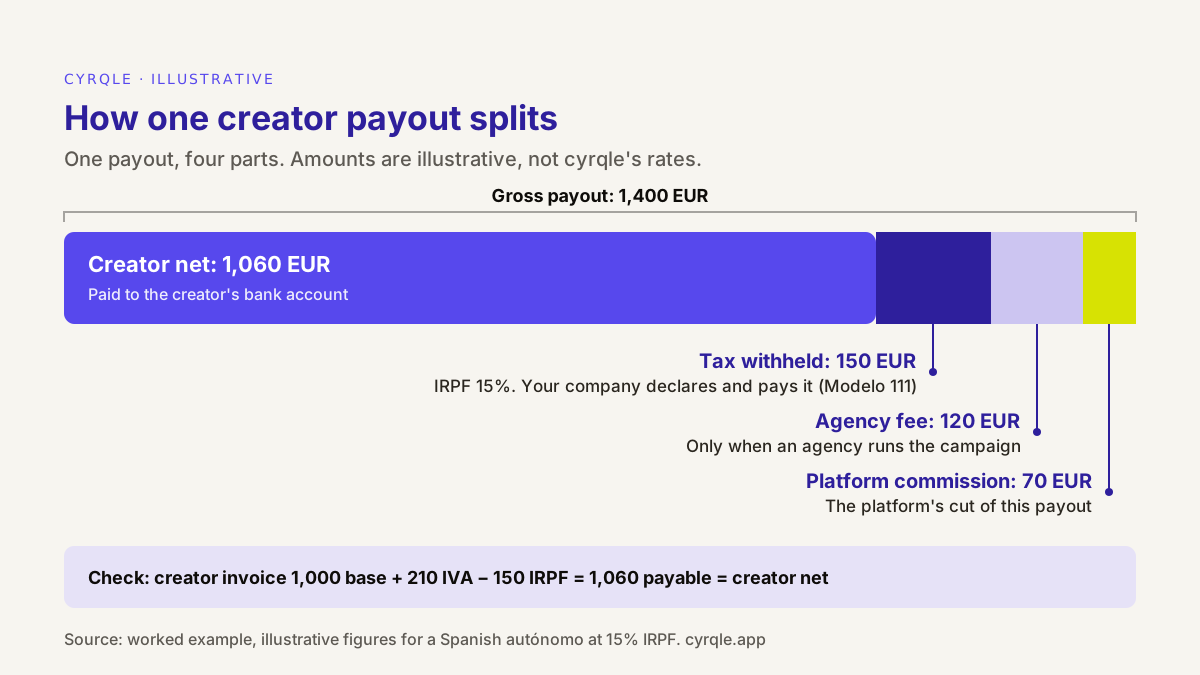
| Line | Invoice | Payout record | Match? |
|---|---|---|---|
| Taxable base | 1,000 EUR | ||
| IVA 21% | +210 EUR | ||
| IRPF 15% | −150 EUR | Tax withheld: 150 EUR | Yes |
| Total payable | 1,060 EUR | Creator net: 1,060 EUR | Yes |
| Agency fee | Not on the creator's invoice | 120 EUR | On the agency's own invoice |
| Platform commission | Not on the creator's invoice | 70 EUR | On the platform's own billing |
Three checks come out of the example:
- The creator net equals the invoice total payable. If the creator sent an invoice for 1,210 euros (base plus IVA, with no IRPF line), the payout of 1,060 would not match. Ask for a corrective invoice before you pay, not after.
- The withheld 150 euros is your debt. It goes into your Modelo 111 for the quarter. The creator deducts it in their own income tax return.
- Fees are not the creator's income. The agency fee and the platform commission belong on the agency's and the platform's own invoices to you. They never appear on the creator's invoice, and the creator should not invoice you for them.
What about Verifactu and e-invoicing?
Verifactu changes the software that issuers use to produce invoices, not the field list you check. Real Decreto 1007/2023 sets requirements for invoicing software, and Real Decreto-ley 15/2025 moved the deadlines to 1 January 2027 for corporate income taxpayers and 1 July 2027 for everyone else, including autónomos. From those dates, invoices from creators who use invoicing software will come from compliant systems. Your checklist stays the same. Mandatory electronic invoicing between businesses is a separate project with its own dates; follow the Agencia Tributaria's announcements.
Questions to take to your gestor
Ask these once per roster or campaign, then write the answers into your payment procedure:
- Which IAE heading do we accept as "professional" for withholding, and what do we ask a creator to show?
- How do we document product-only and mixed (cash and product) collaborations, on both the IRPF and the IVA side?
- Do we issue a self-invoice for creators established outside the EU?
- Which treaties apply to our usual creator countries, and does the artists and entertainers article change anything for content creators?
- How do we treat fees described as image-rights licences?
How cyrqle helps
cyrqle keeps the payment side of a creator campaign in one place, so the invoice check has something to match against. It does not decide your tax treatment, collect tax forms, issue the creator's tax invoice or file returns. That stays with your finance team and your gestor.
- Terms before invites. In compensation and contracts you set the deal type in the brief: Cash payment, Commission on every sale, Product gift, or a combination. Invites stay blocked until compensation is complete, so the fee you check the invoice against is always on record.
- A signed agreement. The brand and the creator e-sign the Creator Collaboration Agreement. The terms are frozen at signature and the signed PDF sits on the Agreements page, ready for the payout folder.
- Payouts a person releases. You fund the campaign, cyrqle schedules a payout when the creator delivers, and someone on your side releases it. Finance can hold a payout until the invoice passes the checklist.
- The split on every payout. Each payout records creator net, cyrqle commission, any agency fee and any tax withheld. You can download a document per payout and a statement per creator per campaign that lists every payment against the agreed amount, with the Stripe transfer reference. The payee is named by the legal name verified during onboarding, not by the handle.
- Stripe Connect, in euros. Creators in Europe and the US onboard to Stripe's connected-account payouts and get paid to their bank. Settlement is in EUR. Outside those regions, you pay by bank transfer and record the payment in cyrqle. For the background, read what Stripe Connect solves for creator payouts.
- Commission is shown, not paid automatically. Revenue share owed appears in reports as "Affiliate / rev-share owed". Paying it is a separate step, with its own invoice from the creator.
Be clear about one limit: cyrqle's payout documents are payment records, not tax invoices. File them next to the creator's invoice, not instead of it. Agencies paying creators for several clients can keep per-client terms and fees in the agency console. To see how the payment flow fits into a campaign, read how to run a creator campaign end to end, or book a 30-minute walkthrough.
FAQ
Can I pay a creator without an invoice in Spain?
Not safely. Without a valid invoice your company cannot deduct the IVA and has a weaker record of the expense, and you still carry any withholding duty. Ask for the invoice before you release the payment. For product-only deals, keep a record of the product's market value as well.
Does an influencer invoice need my company's NIF?
In practice, yes. The regulation makes the recipient's NIF mandatory in specific cases, such as reverse charge, but you want your full company name, NIF and address on every invoice you will deduct, as well as the creator's own. Send your billing data with the contract so the first invoice is right.
What if the creator's invoice has no IRPF line?
Ask why before you pay. A creator who invoices through a company, who is registered in a business activity, or who lives abroad usually has no IRPF line. A Spanish autónomo in a professional activity usually should. If withholding applies and you pay the gross, the tax authority can still claim it from your company.
How should a creator fix a wrong invoice?
The creator issues a corrective invoice (factura rectificativa) that refers to the original invoice and shows the correct figures. Do not accept a replacement with the same number and different amounts. File the original and the corrective invoice together.
Can a foreign creator invoice in English or in another currency?
Yes. The invoicing regulation allows any language and any currency (article 12 of Real Decreto 1619/2012). The tax authority can ask for a translation, and your accounts are in euros, so record the exchange rate you used. cyrqle payouts settle in EUR.
Is the cyrqle payout statement an invoice?
No. The statement and the per-payout document record what was paid, the split and the Stripe reference. They are payment records. The creator's invoice remains the tax document, and you need both in the payout folder.
More in this series
- How to pay influencers in Spain: the full reasoning on IRPF, IVA, foreign creators and gifted product.
- Influencer contract template for Spain and the EU: clause 7 sets the fee, payment term and invoice data.
- The four creator compensation models: fixed fee, revenue share, product seeding and hybrid.
- The creator's guide to brand deals: send it to creators who ask how to invoice you.
Sources
- Real Decreto 1619/2012, Reglamento de facturación (articles 4, 6, 11, 12, 15, 18 and 19): BOE-A-2012-14696
- Real Decreto 439/2007, Reglamento del IRPF (articles 95, 104 and 108): BOE-A-2007-6820
- Ley 37/1992, del IVA (articles 69, 79 and 84): BOE-A-1992-28740
- Directive 2006/112/EC on the common system of VAT (articles 219a and 226): EUR-Lex
- Ley 58/2003, General Tributaria (article 66): BOE-A-2003-23186
- Ley 7/2012, cash payment limits (article 7): BOE-A-2012-13416
- Real Decreto 1007/2023, invoicing software requirements: BOE-A-2023-24840
- Real Decreto-ley 15/2025, new Verifactu dates: BOE-A-2025-24446
- DGT binding rulings V0773-22, V2390-24, V1161-25 and V1285-25: Dirección General de Tributos rulings database
Related material.
How to invoice a brand as an influencer in Spain: the required fields, which IVA and IRPF lines apply by where the brand is, product deals, and a free template.
Influencer rate card template in EUR: tier, format, base fee, CPM check, rights, exclusivity and rush uplifts, with spreadsheet formulas and a filled example.
A step-by-step guide to collecting customer and creator posts about your brand from Instagram and TikTok: choosing terms, picking a fetch mode, scheduling monitors with a budget cap, and reviewing the queue.