
Paying commission to creators every month without spreadsheets
How to pay influencer commission every month: count attributed orders net of refunds, hold for returns, send a statement, pay against an invoice, reconcile.
To pay influencer commission without a spreadsheet war every month, treat it as a fixed monthly run: take the orders attributed to each creator in one period, remove refunds and cancellations, hold them until the return window has passed, then send a statement, collect an invoice and pay. Each step has one owner and one cut-off date, so the numbers match from month to month.
Picture a sportswear brand in Valencia with 25 creators on a revenue-share deal. Each one has a promo code and a tracking link. In October, three creators ask why their numbers differ from what they saw on their own dashboards, one creator asks to be paid for orders that were later returned, and finance cannot match two transfers to any invoice. None of this is fraud. It is what happens when the rules for a commission payment live in someone's head.
This guide is for the people who run creator programs and the finance teams who pay them. It covers the contract terms that make a commission run possible, each step of the monthly run, a worked statement with numbers, and the checks that keep payments reconciled. If you are still choosing a deal shape, start with fixed fee, revenue share, seeding and hybrid deals, then come back here.
What is a monthly commission run?
A commission run is the routine that turns attributed sales into a commission payment. It has five steps, and it runs on the same dates every month.
| Step | What you do | Who owns it | Output |
|---|---|---|---|
| 1. Cut off | Freeze the orders placed in the period, for example 1 to 31 August | Creator ops | A list of attributed orders per creator |
| 2. Net out | Remove refunds, returns and cancellations | Creator ops with ecommerce | Net revenue per creator |
| 3. Hold | Wait until the return window for those orders has passed | Policy, set once | Confirmed revenue |
| 4. State | Apply the rate, adjustments and minimums; send the statement | Creator ops | One statement per creator |
| 5. Pay and reconcile | Collect the invoice, pay, and match statement, invoice and transfer | Finance | A closed month |
The run is slow on purpose. Paying commission per order, the moment it comes in, means paying on orders that may come back. Paying only at the end of a campaign makes creators wait months. A monthly run with a hold period sits between the two.
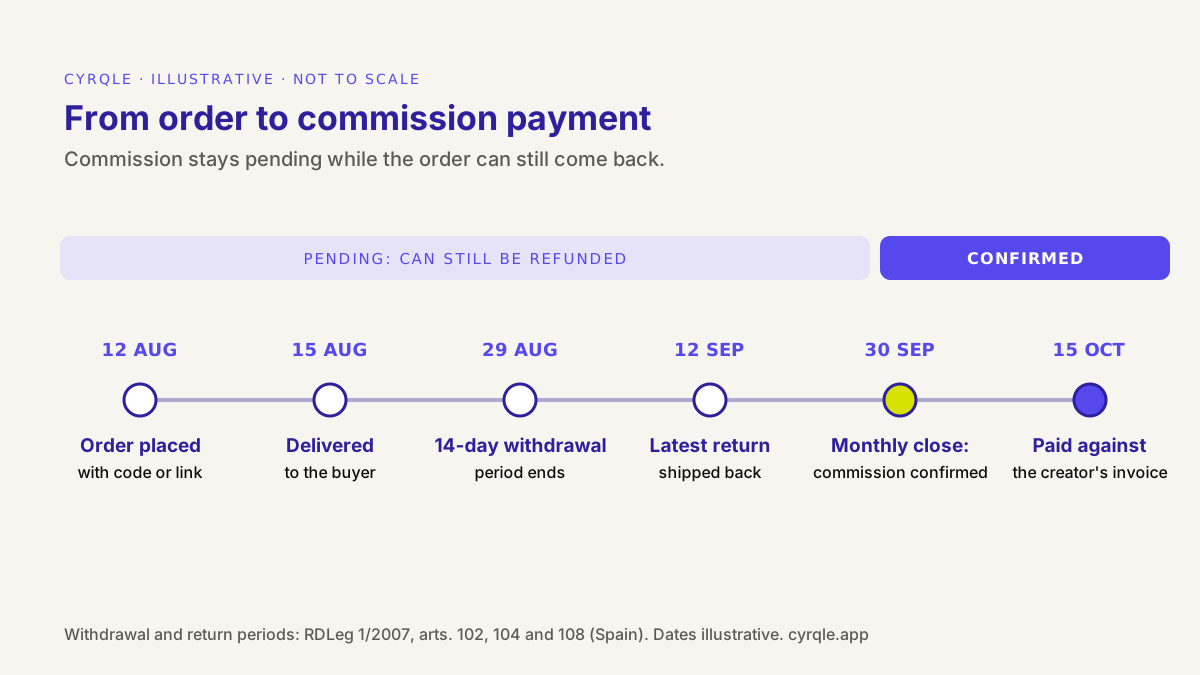
Step 0: Put the rules in the contract before the first sale
You cannot run a clean commission payment on rules you write after the sales arrive. Agree these terms before the creator posts. The full cost model of a creator deal shows why a missing base can move the commission by more than you expect.
| Term | What to write | Why it matters |
|---|---|---|
| Rate | A percentage, for example 10% | The only number most people agree on |
| Base | Revenue net of IVA, excluding shipping, after discounts, refunds and cancellations | "10% of sales" read as gross with IVA pays 21% more on the same orders |
| Attribution methods | Which methods count: promo code, tracking link, later visits inside a window | Decides which orders belong to the creator |
| Attribution window | For example 30 days from the click | Stops old clicks from claiming new orders |
| Period and cut-off | Calendar month, by order date | Stops the same order from landing in two runs |
| Hold period | For example, orders placed in month M are confirmed at the end of month M+1 | Keeps you from paying on orders that come back |
| Minimum payout | For example EUR 50; lower amounts roll over | Saves invoices and transfer fees on small amounts |
| Clawback | Refunds after confirmation are deducted from the next statement | Handles late refunds without asking for money back |
| Invoice | Commission is paid against a valid invoice for the statement amount | Finance cannot pay or deduct IVA without it |
| End of deal | Orders placed before the end date stay payable through the final run | Avoids a dispute on the last month |
The numbers in the table are examples, not market rates. Choose your own and write them down.
Step 1: Pull the attributed orders for the period
Start with the orders placed between the first and last day of the period, assigned to each creator by the methods your contract names. Use your order data, not the creator's screenshots or a platform's own affiliate dashboard, as the source of truth.
Three checks before you move on:
- Count each order once. A buyer can use a creator's code and click their link. Summed by method, the same order can appear twice. Our comparison of discount codes, tracking links and the pixel shows how quickly double counting adds up.
- Decide conflicts between creators. If one buyer clicked creator A's link and then used creator B's code, your contract decides who gets the order. A common rule is that a code beats a link, because the buyer typed it.
- Add sales the store did not see. In-store sales with a creator code need to be recorded by someone, or they never reach the statement.
Step 2: Net out refunds and cancellations
Commission is paid on revenue you keep. Subtract three things from each creator's gross attributed revenue:
- Returns that were refunded, in full or in part. A partial refund reduces the base by the refunded amount.
- Orders cancelled before shipping. They never became revenue.
- Chargebacks and fraud you identified, if your contract allows it. State this in the contract, or creators will dispute it.
Keep each deduction as its own line, with an order count. A creator who sees "net revenue: EUR 4,000" asks questions. A creator who sees gross revenue, nine returns and two cancellations can check them.
Step 3: How long should the hold period be?
Set the hold period from the longest time an order can still come back. In Spain, the law gives the floor for online sales:
- A buyer can withdraw from a distance sale within 14 calendar days (RDLeg 1/2007, article 102), counted from the day they receive the goods (article 104).
- After notifying you, the buyer has up to 14 more days to send the goods back (article 108.1).
- You must refund within 14 days of the notice, but you can hold the refund until the goods arrive or the buyer proves they sent them (article 107).
So a refund can land around a month after delivery even under the legal minimum. The same 14-day withdrawal right applies across the EU under the Consumer Rights Directive 2011/83/EU. Many stores offer longer voluntary returns, often 30 days or more, and then the hold must be longer too.
A simple rule that works for most brands: orders placed in one month are confirmed at the close of the next month. An order placed on 31 August gets 30 days of hold, and one placed on 1 August gets 60. The last days of a month are the tight spot: a 31 August order delivered on 3 September can still be returned into the first days of October, so a late refund goes in the clawback line. If your returns policy is longer than 30 days, move the close one more month out. Fashion brands with high return rates feel this most; the rebajas playbook for fashion brands shows how returns change which creators actually sold.
Tell creators about the hold up front. A creator who knows that August orders are paid in October does not chase you in September.
Step 4: Build the statement
The statement is the document both sides agree on. It shows how the commission was calculated, line by line, and it is what the creator invoices against.
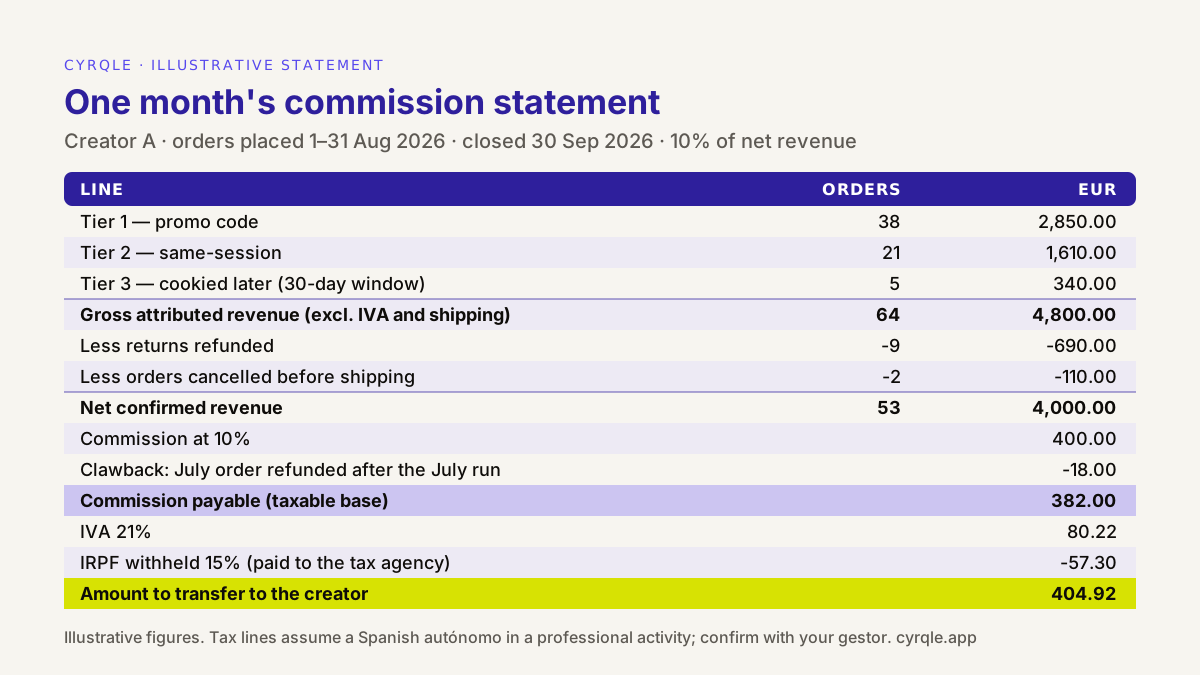
Worked example
All figures are illustrative. Creator A has a 10% commission on net revenue, excluding IVA and shipping. The run on 30 September closes the orders placed in August.
| Line | Orders | EUR |
|---|---|---|
| Promo code orders | 38 | 2,850.00 |
| Tracking link, same session | 21 | 1,610.00 |
| Tracking link, later visit inside 30 days | 5 | 340.00 |
| Gross attributed revenue | 64 | 4,800.00 |
| Less returns refunded | -9 | -690.00 |
| Less cancelled before shipping | -2 | -110.00 |
| Net confirmed revenue | 53 | 4,000.00 |
| Commission at 10% | 400.00 | |
| Clawback: a July order refunded after the July run | -18.00 | |
| Commission payable (taxable base) | 382.00 | |
| IVA at 21% | 80.22 | |
| IRPF withheld at 15% | -57.30 | |
| Amount to transfer | 404.92 |
Three things in this statement do the work a spreadsheet usually hides:
- The clawback. A July order passed its hold, was paid in the July run, and was then refunded as a goodwill gesture. Its EUR 180 of revenue comes off this month's commission at 10%: EUR 18. Nobody asks the creator to send money back.
- The split by method. If a creator disputes the number, you can show which orders came from the code and which from the link.
- The tax lines. The commission owed (EUR 382) and the transfer (EUR 404.92) are different numbers. The tax lines here assume a Spanish autónomo in a professional activity. A creator invoicing through a company, or from another country, gets different lines.
If the payable amount is below your minimum, the statement still goes out, with "carried forward" instead of a payment. That keeps the creator informed and the ledger complete.
Step 5: Collect the invoice and pay
Commission is income for the creator in the same way as a fixed fee, so the same invoicing and withholding rules apply. A Spanish creator registered as a professional autónomo usually invoices 21% IVA, and you withhold 15% IRPF (7% in some cases) under Real Decreto 439/2007, article 95, then pay it in your quarterly Modelo 111. Creators who invoice through a company, creators registered in a business activity and creators abroad follow different rules. Our guide to paying influencers in Spain, with IRPF and IVA by scenario covers each case, and paying creators in other countries covers the EU, the UK and Latin America.
Practical rules for the payment step:
- Send the statement first, then ask for the invoice. The invoice should quote the statement period and amount. One statement, one invoice.
- Check the invoice against the statement. Taxable base, IVA rate and withholding line must match. If they do not, ask for a corrected invoice before you pay.
- Pay on a fixed day. For example, the 15th of the month after the close, for every invoice received by the 10th.
- Pay the commission separately from fees. If the creator also has a fixed fee, keep it on its own invoice and payout. It is paid on delivery, not after a hold.
The influencer invoice checklist for Spain lists every field to check before you release money.
This is not tax advice. Rates and treatment depend on the creator's registration and residence, so confirm each case with your gestor or tax advisor.
Step 6: Reconcile and close the month
A month is closed when three numbers agree for every creator: the statement, the invoice and the transfer (plus any withholding paid to the tax agency). Keep them together.
- Statement total = invoice taxable base. Any difference is a correction for next month, written as its own line.
- Invoice total minus withholding = transfer. Any difference is a payment error to fix now.
- Withholding in the Modelo 111 matches the sum of the IRPF lines for the quarter.
- Carried-forward amounts and clawbacks appear on the next statement, so the ledger never loses a euro.
Keep the order list behind each statement. When a creator or an auditor asks about an order six months later, you need to show why it was in, or out.
Pay per order, monthly, or at the end of the campaign?
The cadence changes cash flow for the creator and risk for you.
| Per order | Monthly run with a hold | End of campaign | |
|---|---|---|---|
| When the creator is paid | Days after each order | Once a month, after the hold | Once, after the last hold |
| Risk of paying on returned orders | High | Low; late refunds go in a clawback line | Lowest |
| Invoices per creator per year | Many | Up to 12, fewer with a minimum payout | One per campaign |
| Creator motivation | Strong | Steady | Weak for long campaigns |
| Best for | Rarely a good fit | Always-on ambassador and affiliate programs | Short campaigns of 4 to 6 weeks |
For an always-on program, the monthly run wins. For a single campaign that lasts a few weeks, one statement after the final hold is simpler. Either way, the steps are the same.
Common mistakes in a commission run
- No cut-off date. Orders slip between months and get paid twice, or not at all.
- Paying on gross revenue with IVA. The rate applies to a base that includes tax you never keep.
- Using the creator's numbers. Creators see clicks and code uses, not your refunds. Use your order data and show them the lines.
- Mixing fee and commission in one payment. Finance cannot tell what each transfer was for.
- No clawback rule. Then a late refund means either asking the creator for money or absorbing the loss.
How cyrqle helps
cyrqle covers the attribution and the calculation. Paying the commission stays a separate step that a person on your team triggers.
- Deal terms in the brief. In compensation and contracts, you choose Commission on every sale, or a combination such as Cash & commission. Invites stay blocked until compensation is complete, and the signed contract freezes the terms each creator agreed to.
- Attributed orders, net of refunds. In creator attribution, each creator gets a promo code and a tracking link, and order webhooks from Shopify, WooCommerce or Magento record sales and refunds. Each sale carries a confidence tier: Tier 1 — promo code, Tier 2 — same-session or Tier 3 — cookied later (30-day window). Revenue is shown net of refunds, and an operator can Record offline-attributed sale for in-store orders. The audit chain links each sale to the post, code and creator.
- Commission owed, calculated. The campaign report shows Affiliate / rev-share owed per creator: attributed revenue times the creator's rate. Use it as the input to your statement. Your hold period and monthly cut-off are rules you apply when you read it; see reports and exports for the CSV.
- Paying is a separate step. cyrqle does not turn commission into an automatic payout. When you pay, creators in Europe and the US can be paid in EUR to their bank through Stripe Connect, and each payout has a split (creator net, cyrqle commission, any agency fee and any tax withheld) with a statement. Elsewhere, you pay by bank transfer and record it.
To see the commission numbers on your own category, book a 30-minute demo.
FAQ
How do you pay commission to an influencer?
Run it monthly. Take the orders attributed to the creator in one period, subtract refunds and cancellations, wait out a hold period for returns, send a statement with the commission, then pay against the creator's invoice. Keep statement, invoice and transfer together so the month reconciles.
How long should I wait before paying commission on a sale?
At least until the return window has passed. In Spain the buyer has 14 days from delivery to withdraw and 14 more to send the goods back, so many brands confirm orders at the close of the following month. If your store accepts returns for longer, hold longer.
Should commission be calculated before or after IVA?
After, on revenue net of IVA, and usually excluding shipping. Write this into the contract. If the base is not defined, a creator can read "10% of sales" as 10% of the total with IVA, which is 21% more on the same orders in Spain.
What happens if an order is refunded after I paid the commission?
Deduct it from the creator's next statement as a clawback line, if your contract allows it. That avoids asking the creator to send money back. If the creator has no further sales, the contract should say whether you absorb it or invoice it.
Does the creator need to send an invoice for commission?
Yes, in Spain. Commission is income for the creator like a fixed fee, so you need a valid invoice to pay it, deduct the IVA and apply any IRPF withholding. Ask for one invoice per statement, quoting the period and amount.
Can cyrqle pay commission automatically?
No. cyrqle calculates and shows the commission owed per creator in the campaign report. A person on your team decides when to pay it, which is also what lets you apply your hold period before money moves.
Sources
- Real Decreto Legislativo 1/2007, consumer protection law, articles 102, 104, 107 and 108 (withdrawal and refunds): https://www.boe.es/buscar/act.php?id=BOE-A-2007-20555
- Directive 2011/83/EU on consumer rights: https://eur-lex.europa.eu/eli/dir/2011/83/oj
- Real Decreto 439/2007, IRPF regulation, article 95 (withholding rates): https://www.boe.es/buscar/act.php?id=BOE-A-2007-6820
Related field notes.
An agency paying influencers on behalf of a client must settle who funds, who invoices, who withholds IRPF and how its fee shows. Worked EUR 1,000 payout split.
How to get paid as a creator with Stripe Connect: what onboarding asks for and why, when a payout is scheduled and released, and how to read your statement.
The cost of an influencer collaboration in Spain, worked in euros: fee, commission, product, IRPF withholding, IVA, and payment, platform and agency fees.