
The AUTOCONTROL influencer code (October 2025 version): what brands must do
What the AUTOCONTROL influencer code of conduct (October 2025) asks of brands: accepted labels, placement by format, the #ad question and a brand checklist.
The AUTOCONTROL influencer code asks brands to make every paid or gifted creator post identifiable as advertising. That means a clear label such as "Publicidad", "Publi" or the platform's paid-partnership tool, written in the language of the post and placed at the very start of the message. The October 2025 version also puts the duty in the contract, lets liability reach the brand, and sets placement rules for each platform.
Picture a skincare brand in Valencia sending serum to twelve creators for an autumn launch. Three captions come back ending in "#skincare #glow #ad". One story set carries "Publi" on the first frame only. A TikTok says "gracias a @marca". All five pieces break the code, and all five are easy to fix before they go live if the brief was right.
This post walks through what the second version of the Código de Conducta de Publicidad a través de Influencers asks of advertisers, norm by norm. It shows which labels pass, where the label goes on a Reel, a Story and a TikTok, and where the reports disagree about "#ad". For the wider legal map, read our legal checklist for influencer marketing in Spain. This is not legal advice: for a specific campaign, ask your lawyer, and check the current code text on autocontrol.es before you publish a brief.
What is the AUTOCONTROL influencer code, and does it bind your brand?
The AUTOCONTROL influencer code is a self-regulatory code of conduct on advertising through influencers. The Asociación Española de Anunciantes (aea) and AUTOCONTROL published the first version in 2020, in force from 1 January 2021. The second version, with IAB Spain as a third co-owner, came into force on 1 October 2025.
Norm 1 says who it binds: member companies of the aea, AUTOCONTROL and IAB Spain, plus influencers, influencer agencies, ad agencies and any other company that adheres. Adherents also accept the rulings of AUTOCONTROL's Jurado de la Publicidad, the independent panel that hears complaints. Under section C of the code, almost anyone can file one: the three associations, public bodies, competitors, consumer associations and individual consumers.
Self-regulation versus the law
The code is not a law, but the duty behind it is. Article 26 of Ley 3/1991, de Competencia Desleal treats as misleading any promotion that a business pays for and presents as information without making clear that it is advertising. Article 20 of the LSSI (Ley 34/2002) requires electronic commercial communications to be clearly identifiable. Both bind every business, adherent or not.
The relationship works like this:
| Layer | Source | Binds | Who enforces |
|---|---|---|---|
| Duty to identify advertising | Ley 3/1991, art. 26; LSSI, art. 20 | Every business, including the brand that pays | Courts, consumer authorities |
| Audiovisual rules for large creators | Ley 13/2022, art. 94; Real Decreto 444/2024 | "Users of special relevance" (UER) | CNMC |
| How to label, where, and who is liable | AUTOCONTROL influencer code, 2025 | Members of aea, AUTOCONTROL, IAB Spain, and adherents | Jurado de la Publicidad |
Two points make the code matter even if you never signed it. First, it is the most detailed public statement of what "clearly identified" means in Spain, so it shapes how everyone else reads the law. Second, article 5.2 of Ley 3/1991 treats breaking a code of conduct you claim to follow as an unfair practice in its own right. Our explainer on Real Decreto 444/2024 for brands covers who counts as a user of special relevance.
What changed in the October 2025 version?
The 2025 version is longer, stricter on labels and explicit on placement and liability. The introduction says it builds in five years of Jurado decisions and the changes from the EU Digital Services Act, the European Commission's guidance on unfair commercial practices and Ley 13/2022. The table compares the two published texts.
| Topic | 2020 version (in force 1 Jan 2021) | 2025 version (in force 1 Oct 2025) |
|---|---|---|
| Owners | aea, AUTOCONTROL | aea, AUTOCONTROL, IAB Spain |
| When content is advertising | Three cumulative conditions: promotion, payment, and editorial control by the brand | Two conditions: promotion and payment or other consideration. Editorial control moves to a list of signs. The creator's own brands also count |
| Consideration | Payment, free product, event tickets, free services, gift cards, gift bags, trips | Adds affiliate links and complementary services (make-up, hair, courtesy car, hotel, meals) |
| Platform tools | Mentioned for Instagram only ("Paid partnership tag") | Recommended first, with examples for YouTube, TikTok and Instagram |
| Accepted labels | Included "Gracias a [marca]", "Regalo de [marca]", "Viaje patrocinado" | Those three are now not enough; "Ad" and "Advertising" are rejected as another language; a brand hashtag alone is not enough |
| Placement | Annex of recommended positions | Norm 6.d: at the start, easy to see, not mixed with other hashtags, not behind "more" |
| New norms | None | Minors (8), third-party trademarks (9), claiming a sponsor you do not have (10), AI (11), liability (12) |
| Platforms in the annex | 8 entries | 14 entries, including TikTok, Threads, Discord, Twitch, Spotify and X |
The practical effect for a brand: briefs written for the 2020 version, with "Gracias a [marca]" or "#ad" as the label, now fail.
When is a creator post advertising under the code?
A creator post is advertising under norm 4 when two things are true at once: it promotes a product or service, and it is published as part of a collaboration in exchange for a payment or other consideration from the advertiser. Norm 5 lists what counts as consideration: direct or indirect payment, free product, free entry to events, free services, affiliate links, gift cards, gift bags and trips.
When there is no direct proof of a deal, the Jurado can infer one from signs. Norm 4 lists them, and every brand should read the list as a description of its own campaign:
- Proof of a past or future collaboration between the brand and the creator.
- The same or similar messages or hashtags from other creators in the same period.
- Specific prices, or a discount code for the brand.
- A direct call to buy.
- Repeated references to one brand, with no mention of competitors.
- Editorial control: the brand suggests tone or structure, asks for a positive review, sets a number of posts, or asks for the product to be shown.
- A strongly laudatory tone, or thanks to the brand.
- No editorial or personal interest beyond the promotion.
- Affiliate links.
The consequence is simple. If you sent product and a brief, the post is advertising, and it needs a label. Purely editorial or personal content is outside the code.
Which labels does the code accept?
Norm 6 says advertising must be identifiable. When that is not obvious from the content itself, the post needs an explicit, immediate label suited to the medium. The code gives three groups of examples:
- 6.a, preferred: the platform's own tools, such as "colaboración pagada con [marca]" on Instagram, "contenido promocional" or "colaboración de pago" on TikTok, and "incluye contenido promocional" on YouTube.
- 6.b, accepted: clear generic words: "publicidad", "publi", "en colaboración con", "colaboración pagada", "Embajador de [marca]", "patrocinado por".
- 6.c, not enough: vague words ("información", "legal", "Colab", "Sponso", "sp", "Gracias a [marca]", "Regalo de [marca]", "Viaje patrocinado"), words in a language other than the post, such as "Ad" or "Advertising", and the brand's hashtag on its own.
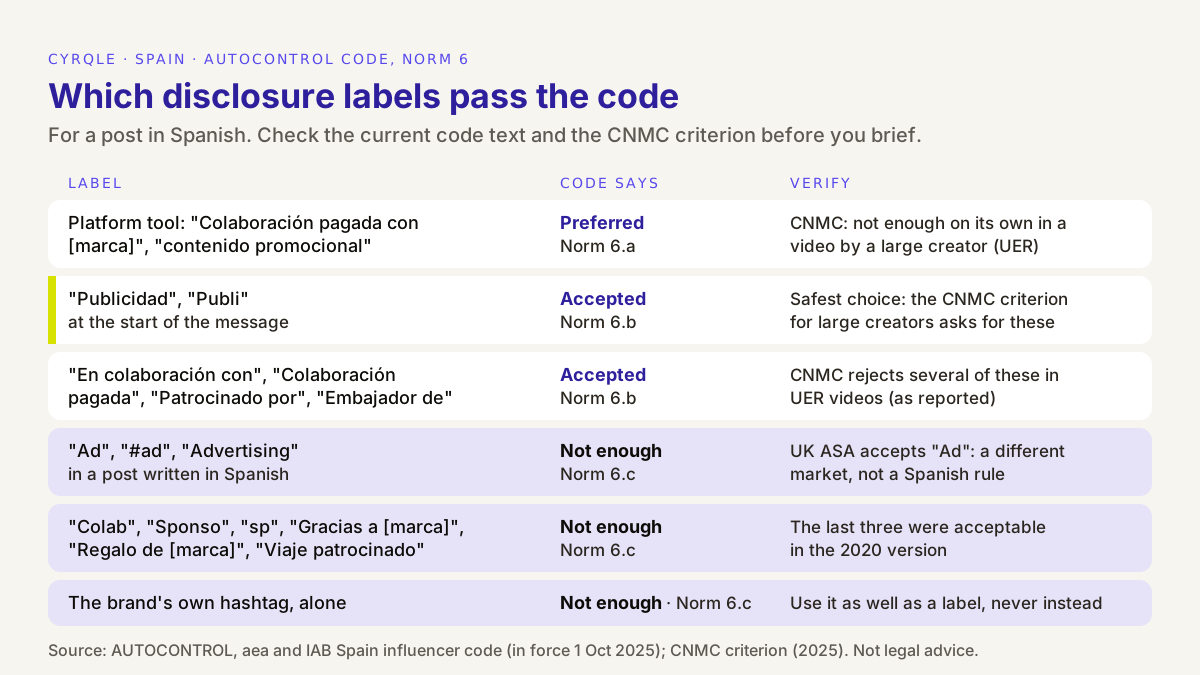
The figure adds a "verify" column, because one regulator reads some of these labels differently. The section on "#ad" below explains why. For definitions you can share with your team, our glossary entry on what disclosure means in creator marketing covers the basics.
Where must the label go on a Reel, a Story and a TikTok?
The label goes at the start of the commercial message, where the viewer sees it without doing anything. Norm 6.d says a label mixed with other information, such as at the end of a run of hashtags, or one that needs a tap on "more", is not enough. Annex I then gives positions by platform:
| Format | Where the label goes (Annex I) | Common failure |
|---|---|---|
| Instagram post | At the start of the text, or over the image or video from the start | "#ad" after ten other hashtags |
| Instagram Reel | At the start of the text, or over the video from the start | Label only in the part of the caption hidden behind "more" |
| Instagram or Facebook Story | At the start of each story, over the image or video | Label on the first frame of a set only |
| Live stream (Instagram, TikTok, YouTube) | From the start of the promotional part | Label added only at the end, or never said aloud |
| TikTok post | At the start of the text, or over the video from the start | "Sponso" or "gracias a @marca" as the only signal |
| YouTube video or Short | From the start of the promotional part; can be said aloud | Platform label only, with the promotion far from it in time |
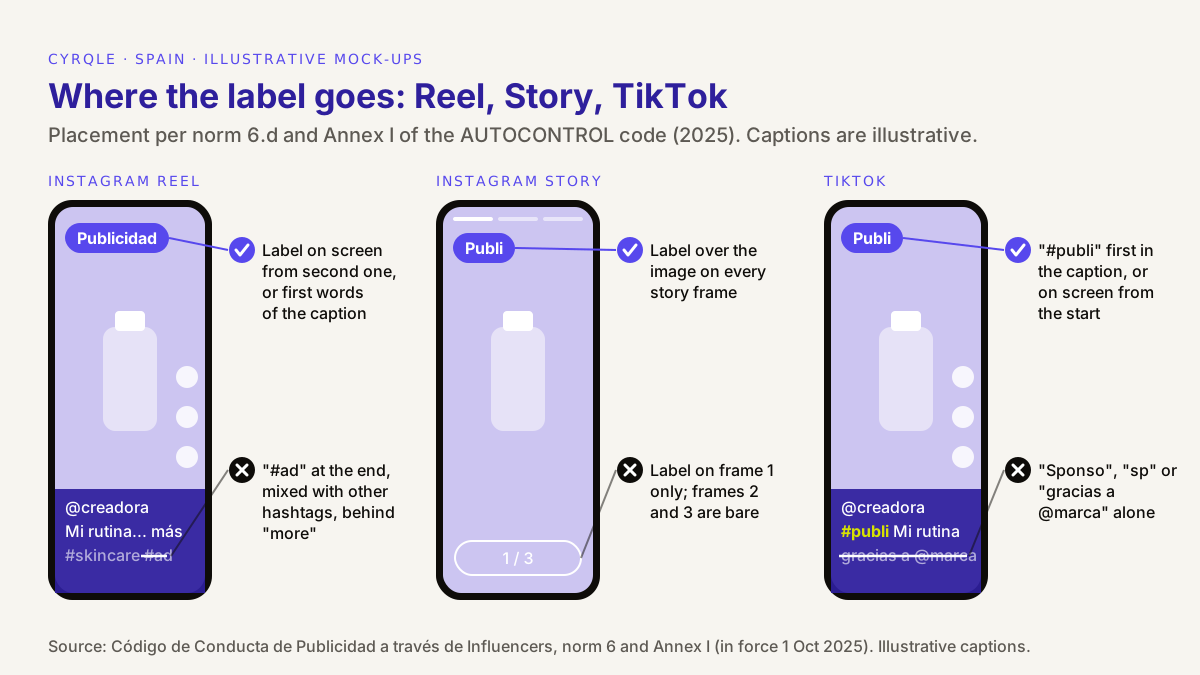
Two more placement rules catch brands out. Norm 6.e says that when content is shared or reposted on other networks, platforms or websites, the label must stay or be added. That includes your own repost of the creator's video and any UGC you put on your site; check the licence terms for that reuse separately. And the annex reminds creators that a platform label must survive the repost, or a written label must replace it.
Is "#ad" enough? Why the reports conflict
No, not for a post written in Spanish. Norm 6.c of the 2025 code names "Ad" and "Advertising" as labels that should not be used when the post is in another language. The confusion comes from three sources that say different things, and each one is right for its own context.
- The AUTOCONTROL code (Spain, self-regulation). "Ad" in a Spanish post is not enough because it is in a different language from the message. The rule is about language, so the code does not ban "#ad" in a post written entirely in English. It still has to sit at the start, not among other hashtags.
- The UK ASA (another market). The Advertising Standards Authority's guidance recommends "Ad" as a clear upfront label. Many English-language guides and global brand playbooks copy this advice, and that is where "#ad is enough" comes from. It is a UK rule.
- The CNMC (Spain, law, large creators). For users of special relevance under Ley 13/2022, the CNMC applies its own interpretative criterion from June 2025 (file IFPA/DTSA/171/24). In its 3 June 2026 press release on requirements sent to five creators, the CNMC says "publicidad" or "publi" must appear visibly inside the video, and that "ad", "embajadora", a "#publi" outside the video, or the platform tool alone were not enough. As reported by Cuatrecasas, the criterion also rejects "colaboración pagada" and "en colaboración con", which the AUTOCONTROL code accepts.
So the code and the regulator overlap but do not match. The practical answer is the label that passes every test: "Publicidad" or "Publi", at the start, in the caption and on screen in the video, plus the platform's paid-partnership tool. Treat the CNMC criterion as binding for any creator who may be a user of special relevance, and check the CNMC file for the current text before you brief.
For the same question in other markets, see our disclosure rules by country and the EU and Latin America disclosure guide.
What else does the code ask of advertisers?
Labels get the attention, but six other norms put duties on the brand directly.
Norm 3: put the code in the contract
Companies that adhere must tell creators the code exists and encourage them to adhere. Contracts with creators must include the duty to comply with the code's ethical norms. The aea publishes a model influencer services and image-rights agreement that you can use.
Norm 8: minors
A creator under 18 needs a contract with the explicit consent of the parents or guardians, who are responsible. The minor also signs when mature enough, and always between 14 and 18. Content with minors must suit their age and respect Ley Orgánica 1/1982 on honour, privacy and image.
Norms 9, 10 and 11: trademarks, fake sponsorship and AI
Posts must not refer to third-party trademarks outside lawful use or lawful comparative advertising. A creator must not imply a sponsorship that does not exist. If content is generated or materially changed with AI, the legal requirements apply and the content must not mislead.
Norm 12: liability reaches the brand
Liability for a breach can reach everyone involved in the commercial communication. A party escapes only by proving that the breach came from a one-off, clear failure to follow the instructions given to the creator. When a creator posts on their own initiative, with no link to the advertiser, liability can sit with the creator alone. The defence depends on paper: a brief with the label rule, a contract with the duty, and a record of what you checked.
Section B: internal controls and Copy Advice
Adherent companies must set internal controls to make sure their creator advertising follows the code. If you are unsure, AUTOCONTROL's Gabinete Técnico offers a voluntary, confidential and non-binding prior review, including a service called Copy Advice Briefing Influencers that reviews the brief you will give creators.
Worked example: auditing five pieces before they go live
A similar launch produces five pieces to review before they go live. All captions are illustrative.
| Piece | Draft as submitted | Verdict under the code | Fix |
|---|---|---|---|
| Instagram Reel, creator A | "Mi rutina de noche con @marca ... #skincare #glow #ad" | Fails 6.c and 6.d: "#ad" is another language and sits among hashtags | "Publicidad" as the first word, paid-partnership tool on, "Publi" on screen from the start |
| Story set, creator B (3 frames) | "Publi" on frame 1 only | Fails Annex I: each story needs its own label | "Publi" over the image on frames 1, 2 and 3 |
| TikTok, creator C | "gracias a @marca por el regalo" | Fails 6.c: thanks and "regalo" are not enough | "#publi" first in the caption and on screen from the start |
| Instagram carousel, creator D | "Publi · Colaboración pagada con @marca" first line, discount code below | Passes the code | None. Check D's status under RD 444/2024 |
| Brand repost of creator A's Reel on the brand's own account | Original caption dropped | Fails 6.e: the label must stay when content is reposted | Keep "Publicidad" in the repost caption and on screen |
Result: four of five pieces fail on first submission, and each fix takes minutes at draft stage. The same fix after publication means a correction request, a reply to keep on file and a live post that was non-compliant for hours or days. If creator D is a user of special relevance, the CNMC criterion also asks for "publicidad" or "publi" inside the video, so a carousel of still images is safer than a video for that creator unless the overlay is in the brief.
A brand checklist for the 2025 code
- Decide whether each piece is advertising under norms 4 and 5. Gifted product counts.
- Write the exact label into the brief: "Publicidad" or "Publi", at the start, plus the paid-partnership tool.
- Ask for the label on screen in every video and on every story frame.
- Ban "#ad", "colab", "sp" and thanks-only wording in Spanish posts, in writing.
- Put the duty to comply with the code in the contract, with a correction deadline.
- Ask each large creator whether they are registered as a user of special relevance.
- Review every draft for label, position, brand handle and claims.
- Check the live post and every repost, including your own.
- Keep the brief, the contract, every draft with your comments and the live post.
- Recheck the code text and the CNMC criterion each quarter, because both are recent.
How cyrqle helps
cyrqle does not decide whether a post is legal, but it puts the code's checks into the campaign workflow and keeps the record that norm 12 asks you to show. In Campaigns, each creator's brief, offer, contract, drafts and live posts sit in one place.
- Required hashtags and handles on drafts. You set the brand handle and the brand hashtags in the brief. With draft sign-off turned on, cyrqle checks each draft caption for the brand handle, the required hashtags and a disclosure hashtag, and flags what is missing before you approve. Add your exact label, for example #publi, to the brief's hashtags so a missing label is flagged by name. The built-in Spanish disclosure rule currently recognises #publicidad and #ad only, so a draft that uses #publi alone can show the generic disclosure chip as missing even though the label is right; use #publicidad in the caption or treat that chip as advisory.
- What the check does not do. It confirms that text is present. It does not judge the language or the position, so "#ad" at the end of a caption still contains a disclosure tag. A reviewer confirms that the label is the first thing in the caption and that the paid-partnership tool is on.
- Live posts. Published posts on Instagram and TikTok are tracked, and the live caption is checked against the same required elements. Stories are not tracked automatically, so check each frame by hand.
- Contract terms on record. Each creator signs the Creator Collaboration Agreement by two-sided e-signature, with a frozen snapshot of the terms. You can link your own brand terms, which is where the norm 3 clause on complying with the code belongs.
To see how it fits a brand team, read about cyrqle for brands or book a 30-minute demo.
FAQ
Is the AUTOCONTROL influencer code mandatory?
It binds members of the aea, AUTOCONTROL and IAB Spain, and any company or creator that adheres. For other brands it is self-regulation, not law. The duty to identify advertising still applies to every business through article 26 of Ley 3/1991 and article 20 of the LSSI.
Is "#ad" allowed in Spain?
Not as the only label on a post in Spanish. Norm 6.c of the 2025 code rejects "Ad" and "Advertising" when the post is in another language. In a post written entirely in English the language objection falls away, but "Publicidad" or "Publi" at the start remains the safer choice for a Spanish audience.
Is the Instagram paid-partnership label enough on its own?
Under the code it is the preferred option, as long as it is visible at the start. The CNMC's criterion for users of special relevance says platform tools alone are not enough in a video. Use the tool and a written label, "Publicidad" or "Publi", in the caption and on screen.
Does the code apply to gifted product with no fee?
Yes. Norm 5 lists free product, free services, event tickets, trips and affiliate links as consideration. If you sent the product as part of a collaboration and the creator promotes it, the post is advertising and needs a label.
Can my brand be held responsible if a creator forgets the label?
Yes. Norm 12 says liability can reach everyone involved. The brand's defence is proof that the creator broke clear instructions in a one-off way, so keep the brief, the contract, your draft comments and any correction request.
When did the October 2025 version replace the old code?
The second version came into force on 1 October 2025 and replaced the first version, which had applied since 1 January 2021. Briefs and contract templates written for the old version should be updated, because some labels it accepted now fail.
Sources
- AUTOCONTROL, aea and IAB Spain, Código de Conducta de Publicidad a través de Influencers, second version, in force 1 October 2025: https://www.autocontrol.es/app/uploads/codigo-de-conducta-de-publicidad-a-traves-de-influencers-2025.pdf
- aea and AUTOCONTROL, Código de Conducta sobre el uso de influencers en la publicidad, first version, in force 1 January 2021 (copy published by Reason Why): https://www.reasonwhy.es/media/library/codigo_de_conducta_publicidad_influencers.pdf
- Ley 3/1991, de 10 de enero, de Competencia Desleal, arts. 5 and 26: https://www.boe.es/buscar/act.php?id=BOE-A-1991-628
- Ley 34/2002 (LSSI), art. 20: https://www.boe.es/buscar/act.php?id=BOE-A-2002-13758
- CNMC, press release on requirements to influencers, 3 June 2026: https://cnmc.es/prensa/requerimientos-influencer-20260603
- CNMC, interpretative criterion IFPA/DTSA/171/24: https://www.cnmc.es/expedientes/ifpadtsa17124
- Cuatrecasas, "La CNMC actúa: requerimientos a influencers por publicidad": https://www.cuatrecasas.com/es/spain/propiedad-intelectual/art/cnmc-actua-requerimientos-influencers-publicidad
- Advertising Standards Authority (UK), "#Ad(vice): making clear that an ad is an ad": https://www.asa.org.uk/news/ad-vice-making-clear-that-an-ad-is-an-ad.html
Related field notes.
Influencer marketing law in Spain for brands: disclosure labels, RD 444/2024, the AUTOCONTROL code, Ley 3/1991, image rights and minors in a 10-point checklist.
Spain's influencer law, Real Decreto 444/2024, explained for brands: who is a usuario de especial relevancia, the BOE thresholds, the registry and your duties.
Influencer regulation in Latin America: what PROFECO, SIC, CONARP and SERNAC expect, the label each market wants and one caption that fits all four.