
Creator campaign proposal template for agencies
Influencer marketing proposal template for agencies: eight sections from objective to fees, a creator shortlist with labelled estimates and a Q4 worked example.
An influencer marketing proposal template for agencies should cover eight sections in the order a client decides: what the campaign is for and how it will be judged, who it must reach, which creators and at what estimated reach and cost, what they will make and where it can be reused, how they are paid, how results will be measured, when it happens, and what the agency charges. Everything that supports the shortlist goes in an appendix.
Picture an agency in Valencia in late August. A skincare brand that sells online in Spain wants "a creator plan for Black Friday and Christmas" and has asked three agencies for a proposal by the first week of September. The brand's head of ecommerce will read each proposal once, forward it to finance, and choose. The proposal that wins is rarely the one with the most creators. It is the one where the numbers are clearly labelled, the costs add up, and nothing on page one has to be walked back in November.
This guide gives you the template section by section as copyable text, explains how to present estimated reach and cost honestly, works through a full Q4 example with illustrative numbers, and lists the mistakes that lose pitches. It pairs with our influencer campaign report template for agency clients: the proposal sets the targets and definitions, and the report measures against them.
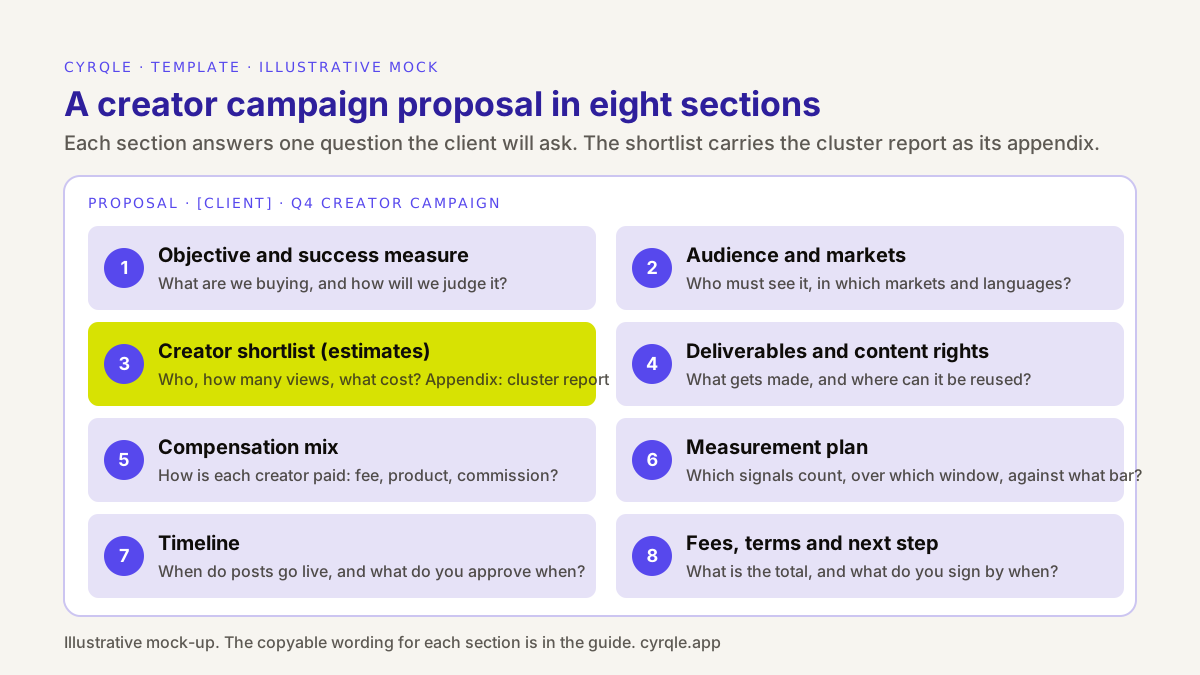
What goes in an influencer marketing proposal?
An influencer marketing proposal answers the client's buying questions in the order they ask them: what are we buying, who will see it, who are the creators, what do we get, how are they paid, how will we know it worked, when, and how much in total. Eight sections cover that order. Each section has one job and fits on one page or one slide.
| Section | What it shows | The client's question | Where the inputs come from |
|---|---|---|---|
| 1. Objective and success measure | One objective, the primary KPI, the target and the bar for success | What are we buying, and how will we judge it? | The client's brief and their margin |
| 2. Audience and markets | Who must see the content, in which countries and languages | Who must see it, and where? | The client's customer data and target markets |
| 3. Creator shortlist | Named creators with estimated views, estimated cost and estimated CPM | Who, how many views, at what cost? | Your discovery work; full roster in the appendix |
| 4. Deliverables and content rights | Posts per creator, formats, platforms, usage rights and their duration | What gets made, and where can we reuse it? | The creative idea and the client's paid-media plan |
| 5. Compensation mix | How each creator is paid: fee, product, commission or a mix | How is each creator paid, and what is variable? | The objective and the creators' rates |
| 6. Measurement plan | The tracking method, which signals count, the window and the reporting rhythm | How will we know it worked? | The client's store and tracking setup |
| 7. Timeline | Dates for approval, contracts, product shipping, drafts, posts and the report | When do posts go live, and what do we approve when? | The campaign moment, counted backwards |
| 8. Fees, terms and next step | Total cost to the client, agency fee, assumptions, validity and the decision needed | What does it cost in total, and what do we sign? | Your fee model and contract |
The order matters. A client who reads the fee before the objective judges the proposal on price. A client who reads the objective, the bar for success and the shortlist first judges the fee against what it buys.
The template, section by section
Copy each block into your document or slides. Replace everything in square brackets. Delete any line you cannot support with data.
Section 1. Objective and success measure
Objective: [Sales | Lead gen | Traffic | Free trial | Booking | UGC | Awareness | Engagement]
Why now: [the moment, e.g. Black Friday week and Christmas gifting]
Primary KPI: [e.g. ROAS on net attributed revenue, Tier 1 + Tier 2]
Break-even: [1 / gross margin, e.g. 1 / 0.60 = 1.67x]
Target: [value above break-even, e.g. 2.0x]
Guardrail: [e.g. effective CPM no higher than EUR [x] in the planning case]
We will call the campaign a success if: [one sentence with the number]
What clients check. Whether there is one objective or five. A proposal that promises awareness, sales and UGC at once cannot be judged on any of them.
Fill-in notes. Choose one objective and one primary KPI. Our guide to influencer marketing KPIs by objective lists the right primary KPI and guardrail for each of the eight common objectives. For a sales objective, ask the client for their gross margin before you write this section. The break-even ROAS is 1 divided by the gross margin, and the target should sit above it. Do not write a sales forecast here. Write the bar the campaign must clear.
Section 2. Audience and markets
Primary audience: [who, in plain words, e.g. women 25-44 in Spain who buy skincare online]
Markets: [countries]   Languages: [es-ES | ca | en ...]
Where they are: [Instagram | TikTok], formats [Reels | carousels | short video]
Who we will not target: [e.g. under-18 audiences; creators who promoted a direct competitor in the last 90 days]
Evidence: [the client's own customer data, search data, past campaign results]
What clients check. That the audience is theirs, not a generic persona. The client knows their buyers better than you; mirror their data back to them.
Fill-in notes. Name the exclusions as clearly as the targets. Competitor exclusivity and age restrictions change which creators you can put on the shortlist, so settle them before section 3.
Section 3. Creator shortlist with estimated reach and cost
Shortlist: [n] creators, [n] posts. Full roster: Appendix A (cluster report).
                                     Est. views   Est. cost   Est. CPM
  @[handle]  [tier]  [platform]       [n]          EUR [x]     EUR [x]
  @[handle]  ...
  Planning case total:                [n]          EUR [x]     EUR [x]
  Conservative case ([x]% of views):  [n]          EUR [x]     EUR [x]
Method: est. views = median views of the last [15] posts x posts planned.
        Est. cost = proposed fee, before negotiation. All figures are estimates,
        not guarantees, and depend on availability and final terms.
Reserve creators: [n] alternates per tier in Appendix A.
What clients check. Whether they recognise the creators, whether the numbers look inflated, and whether the total cost matches section 8.
Fill-in notes. Show six to twelve names in the body, with two or three reserves per tier in the appendix, because some creators will decline or price above budget. Base estimated views on the median of recent posts, not on followers, and not on the average, which one viral post can distort; our post on choosing creators by median views and effective CPM explains why. Write the word "estimate" in the column header and in the method line. The next section of this guide covers how to present the numbers.
Section 4. Deliverables and content rights
Per creator: [n] x [format] on [platform], [n] stories (screenshots of insights required)
Draft approval: [yes/no], [n] rounds of changes, response within [n] working days
Disclosure: every post labelled as advertising, in the language of the post
Usage rights included: organic reposting by the brand and use on the brand's website, [n] months
Usage rights optional: paid ads with the creator's content, [n] posts, [n] days, EUR [x]
Exclusivity: [none | category, [n] days], priced separately
What clients check. What they can do with the content after the campaign, and whether paid-ads use is included. Clients often assume they own the content. They do not, unless the contract or a licence says so.
Fill-in notes. Separate the rights that come with the fee from the rights that cost extra, and price the extras as their own line. Our usage rights and exclusivity calculator works through how to price them. On disclosure, Spanish law requires every paid post to be identifiable as advertising, whatever the creator's size. Real Decreto 444/2024 adds obligations for "users of special relevance" (for example, 1,000,000 followers on one platform or 2,000,000 combined, plus EUR 300,000 in income and 24 videos a year, per the BOE text). Our explainer on Spain's influencer law for brands covers what that means for the brand. It is not legal advice: for a specific campaign, ask your lawyer.
Section 5. Compensation mix
Model per creator:
  Macro and mid-tier: fixed fee per deliverable set
  Micro-tier: fixed fee + [x]% commission on attributed net sales
  Nano / seeding: product + [x]% commission on attributed net sales
Commission: on [Tier 1 | Tier 1 + 2] net revenue, [n]-day window, refunds deducted,
            estimated at EUR [x]; paid [monthly | at campaign end]
Product: [n] units at cost EUR [x] per creator, shipped by [date]
Payment terms to creators: [x]% on signature, [x]% on delivery of the last post
What clients check. What is fixed, what is variable, and what the variable part could cost if the campaign does well.
Fill-in notes. Match the model to the creator's role. Large creators with reach the client needs are usually paid a fixed fee. Smaller creators with strong buying audiences are good candidates for a fee plus commission, which shares the risk. Show the commission as an estimate with its rules: which sales count, the window, and whether refunds are deducted. For the economics of fee, commission, product and hybrid deals, read our guide to creator compensation models.
Section 6. Measurement plan
Tracking: per-creator promo code + per-creator tracking link; [store tag | Shopify pixel | order webhooks]
Signals that count toward the headline KPI: [Tier 1 promo code + Tier 2 same-session]
Shown as a range: Tier 1 only / Tier 1+2 / all tiers
Attribution window: [30] days from each post   Revenue: net of VAT and refunds
Optional proof: holdout [region | period], agreed before launch
Reporting: live link during the campaign; [weekly] update; final report by [date]
What we will not claim: [e.g. sales without a code or tracked click]
What clients check. Whether the agency will be marking its own homework. Agree the rules now, in writing, before anyone sees a result.
Fill-in notes. Name the tracking method for each creator and which signals count. Our comparison of discount codes, tracking links and the pixel covers what each one proves. If the client is sceptical, offer a holdout region; our 30-day pilot plan for sceptical clients shows how to set one up. Then promise the same definitions in the final report, so the proposal and the report read as one document.
Section 7. Timeline
Proposal approved:           [date]
Creators confirmed, contracts signed:  [date range]
Product shipped:             [date]
Drafts submitted / approved: [date range]
Posts live:                  [date range]
Codes valid until:           [date]
Final report:                [date]
Client approvals needed: shortlist [date], drafts within [n] working days
What clients check. That the posts land before the moment, and what they personally have to approve and when.
Fill-in notes. Count backwards from the date the content must be live. Q4 creator calendars tend to fill early, because every brand wants the same weeks. Put the client's own deadlines in bold; a late shortlist approval is the most common reason a Q4 campaign slips.
Section 8. Fees, terms and next step
Total cost to client: EUR [x] excl. VAT
  Creator fees:          EUR [x]   (or one combined line, per contract)
  Product at cost:       EUR [x]
  Commission (estimate): EUR [x]   paid only on attributed sales
  Agency fee:            EUR [x]   [model: retainer | % of creator spend | fixed + %]
  Optional: paid-ads usage rights  EUR [x]
Assumptions: rates before negotiation; creator availability not confirmed until signature
Valid until: [date, e.g. 14 days]
Decision needed: approve the shortlist and budget by [date]
What clients check. That the total matches the sum of the lines, what is variable, and how long the price holds.
Fill-in notes. State your fee model in the proposal, not only in the contract. Our guide to how agencies price influencer services compares retainer, percentage of spend and performance fees, and shows where each one breaks. Decide now whether creator fees will be visible to the client or folded into one line, because the same choice has to hold in every report that follows. Give the proposal a validity date: creator rates and availability change fast in Q4.
How do you show estimated reach and cost without overpromising?
Show estimated reach and cost as labelled estimates with a stated method, a planning case and a conservative case. Estimated views should come from each creator's median views on recent posts multiplied by the number of posts planned. Estimated cost is the proposed fee before negotiation. Estimated CPM is estimated cost divided by estimated views, times 1,000.
Three rules keep the shortlist credible:
- Write "est." on every number that is not a signed fee or a measured result. A client's finance team will copy numbers from the proposal into their own plan. If a figure has no label, they will treat it as a commitment.
- Give a range, not a point. Creator views vary from post to post. A conservative case at 60% to 70% of the planning case is a simple, honest way to show that, and it protects you when one post underperforms.
- Do not convert views into sales. Views are an input you can estimate from public data. Sales depend on the offer, the product page and the price. Put the sales bar in section 1 and leave the forecast out.
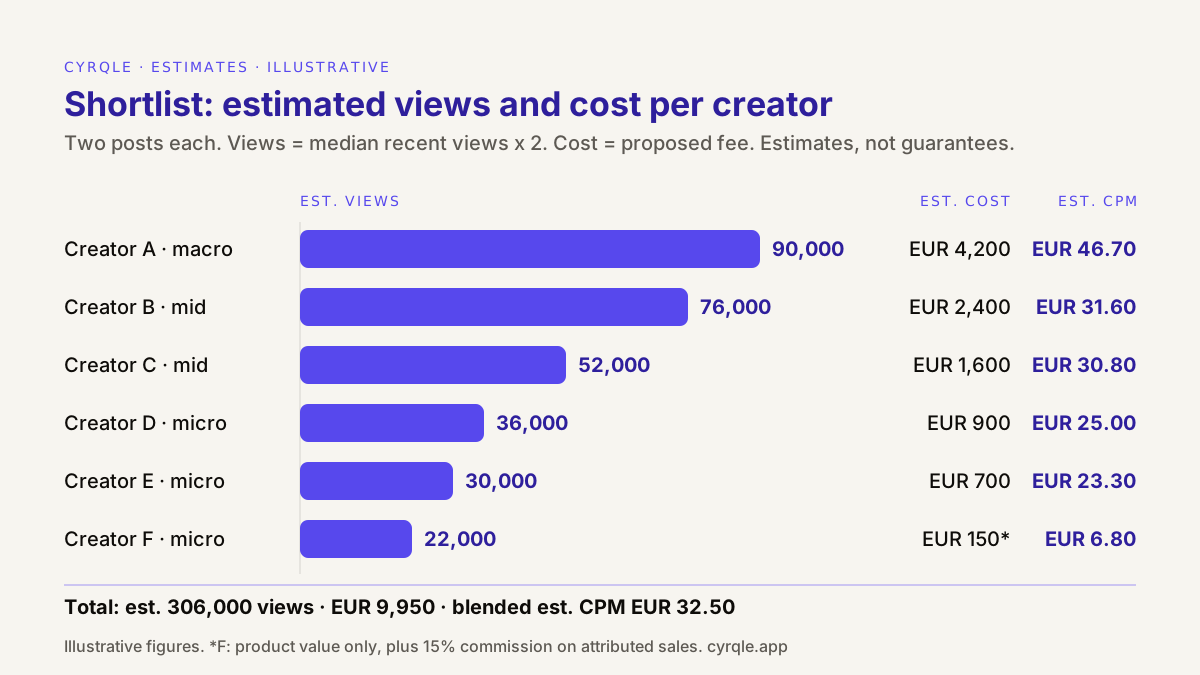
The chart shows why a shortlist should be mixed. Creator A brings the most estimated views in one booking, but at an estimated CPM of EUR 46.70. The four smaller creators together bring more views than A for less money. A proposal that shows this trade-off openly lets the client choose between reach in one name and efficiency across several.
Worked example: a Q4 proposal for a skincare brand
An agency proposes a Black Friday and Christmas campaign to a skincare brand that sells online in Spain through a Shopify store. The brand's gross margin is 60%. All figures are illustrative.
Section 1. Objective: Sales. Primary KPI: ROAS on net attributed revenue, Tier 1 promo code plus Tier 2 same-session sales. Break-even ROAS: 1 ÷ 0.60 = 1.67x. Target: 2.0x.
Section 3. Six creators, two posts each, as in the chart above. Planning case: 306,000 estimated views for EUR 9,950 of creator cost, an estimated CPM of EUR 32.50. Conservative case at 70% of views: 214,200 views, an estimated CPM of EUR 46.45.
Section 5. Creators A, B and C on a fixed fee. D and E on a fixed fee plus 10% commission on attributed net sales. F on product plus 15% commission.
Section 8. The cost to the client adds up like this:
| Line | Amount (excl. VAT) | Fixed or variable |
|---|---|---|
| Creator fees, A to E | EUR 9,800 | Fixed |
| Product at cost, creator F | EUR 150 | Fixed |
| Commission, D, E and F (estimate) | EUR 600 | Variable, paid only on attributed sales |
| Agency fee: strategy and reporting | EUR 2,500 | Fixed |
| Agency fee: management at 20% of creator fees | EUR 1,960 | Fixed |
| Total cost to client | EUR 15,010 | |
| Optional: paid-ads use of two posts, 60 days | EUR 800 | Fixed, if chosen |
The bar. At the 2.0x target, the campaign must produce EUR 15,010 × 2.0 = EUR 30,020 of net attributed revenue in Tier 1 and Tier 2. At the break-even of 1.67x, it needs about EUR 25,020. The proposal states both numbers and makes no forecast of which one the campaign will reach.
If fees are private. When the client sees one total instead of the creator lines, calculate the estimated CPM on the total cost: EUR 15,010 ÷ 306,000 × 1,000 = EUR 49.05 in the planning case. Do the same in the final report, so the client can compare like with like and no creator fee can be worked back from the numbers.
Section 7. Black Friday 2026 falls on Friday 27 November, and Cyber Monday on 30 November. Counted backwards:
| Step | Date (2026) |
|---|---|
| Proposal sent | 4 September |
| Proposal and shortlist approved | 15 September |
| Creators confirmed, contracts signed | 16 September to 9 October |
| Product shipped | 12 to 16 October |
| Drafts submitted and approved | 19 October to 6 November |
| Posts live | 9 to 27 November |
| Promo codes valid until | 30 November |
| Final report | 15 December |
What makes a weak proposal and a strong one?
A weak proposal lists creators and a price. A strong proposal states the bar for success, labels every estimate, separates fixed and variable cost, and fixes the measurement rules before launch. The table below compares the two section by section.
| Weak proposal | Strong proposal | |
|---|---|---|
| Objective | Awareness, engagement and sales at once | One objective, one primary KPI, a numeric target above break-even |
| Shortlist numbers | Follower counts and promised reach | Estimated views from median recent views, labelled estimates, planning and conservative case |
| Creator list | Forty names in the body | Six to twelve names in the body, full roster and reserves in an appendix |
| Rights | Not mentioned | Included rights and paid-ads rights priced as separate lines |
| Compensation | One fee per creator, no detail | Fixed, product and commission per creator, with commission rules and an estimate |
| Measurement | We will report results | Tracking per creator, signals that count, window, range of tiers, agreed before launch |
| Cost | One number, no breakdown, no validity date | Lines that add up, fixed versus variable, assumptions and a validity date |
The most expensive mistake is the promised number. If the proposal says "500,000 views" and the campaign delivers 380,000, the client remembers the miss, not the sales. Label it as an estimate with a range and the same result reads as inside the plan.
What goes in the shortlist appendix?
The shortlist appendix is the evidence behind section 3. It lists every creator you considered for the client, including reserves, so the client's team can check names, sizes and costs without asking for a call. A good appendix has:
- The full roster. Handle, platform, size tier, followers, engagement rate and an estimated rate per creator.
- Composition. How the roster splits by size tier, platform and country, so the client sees the balance at a glance.
- Reserves. Two or three alternates per tier, marked as reserves.
- The method. How views and cost were estimated, the date the data was taken, and the words "estimates, not quotes".
- Exclusions applied. For example: no creators who promoted a direct competitor in the last 90 days.
Date the appendix. Creator numbers move every week, and an undated roster invites the question "is this current?"
How cyrqle helps
In Clusters & planning, you build the shortlist as a cluster and the planner updates a live estimate of reach and cost as you add or remove creators. A budget slider lets you model what-ifs, and you can save several versions of the shortlist and compare up to four side by side on reach, cost, markets and member overlap. That is a fast way to put a "reach" option and an "efficiency" option in front of the client. The forecast is an estimate from your inputs, not measured performance, so keep the "est." labels in the proposal.
The Cluster report in Reports is the appendix. It exports as a PDF or a CSV with the cluster's creators, summed reach, median engagement and a total estimated cost, a breakdown by size tier, platform and country, and a roster table with followers, engagement and an estimated rate per creator. Two details to know before you attach it. The report's total reach is summed followers, not expected views, so add your own estimated-views column from section 3 to the proposal body. And the total estimated cost is for a single activation; if a creator has no follower signal to price from, the report says how many were not estimated, so treat the total as a floor. When you export from your agency workspace for a client, the cover reads "Prepared by [your agency] for [client]"; a small cyrqle mark stays on the cover.
When the client approves, push the cluster into a campaign so the roster is not rebuilt by hand. From there the brief, invites, contracts, promo codes and tracking links run in the same client workspace, and your per-client terms and Act-As access sit in the agency console on cyrqle for agencies. For the operational side of running many clients, read our guide to influencer software for agencies. If you want to see a cluster built for your client's category before the pitch, book a 30-minute walkthrough.
FAQ
What should an influencer marketing proposal include?
An influencer marketing proposal should include eight sections: objective and success measure, audience and markets, a creator shortlist with estimated reach and cost, deliverables and content rights, the compensation mix, the measurement plan, the timeline, and fees with terms and a validity date. Put the full creator roster in an appendix.
Should an agency forecast sales in a proposal?
No. A sales forecast depends on the offer, price and product page, which the agency does not control. State the break-even ROAS (1 divided by the client's gross margin) and a target above it, then agree which attribution tiers count. That gives the client a clear bar without a promise you cannot keep.
How many creators should a proposal shortlist?
Show six to twelve creators in the proposal body for a campaign of this size, plus two or three reserves per tier in the appendix. Some creators will decline, be unavailable or price above budget, and reserves let you replace them without a new approval round.
Should the proposal show individual creator fees?
Only if your contract with the client promises cost transparency. If fees stay private, show one creator-cost line and calculate the estimated CPM on the client's total cost. Whichever choice you make, keep it in the final report too, so the client compares like with like.
How early should a Q4 creator proposal go out?
For Black Friday posts in November, send the proposal by early September. Contracts, product shipping and draft approvals usually need six to eight weeks, and creators' Q4 calendars tend to fill early. Later proposals are possible, but the shortlist shrinks and rates rise.
Sources
- Real Decreto 444/2024, de 30 de abril, on users of special relevance of video-sharing platform services, BOE: https://www.boe.es/buscar/act.php?id=BOE-A-2024-8716
Related material.
Influencer campaign report template for agencies: a one-page client report in seven blocks plus an appendix, in slide and sheet form, with a worked example.
Influencer platform comparison template: a weighted scorecard for brands and agencies, with score definitions, demo evidence and a TCO line for Q4 renewals.
Justify your influencer marketing budget on one page: spend, attributed revenue as a range, MER, payback, holdout result and risks, with a worked euro example.