
Prove creator ROI to a sceptical client in 30 days
How to prove influencer marketing ROI to a client in 30 days: one objective, a small creator cluster, per-creator codes, an agreed holdout region, a fixed bar.
To prove influencer marketing ROI to a client who does not believe in it, do not argue. Run a 30-day pilot that the client designs with you: one objective, a small cluster of creators in a test region, a code and a link per creator, a holdout region with no creators, and a success threshold signed before launch. On day 30 you compare the result with the threshold, and the client's own order data decides.
The sceptical client is common in agency work. A head of ecommerce in Valencia may have seen a creator report claim EUR 40,000 in "media value" with no visible change in sales. A CFO in Madrid asks why the code orders are not just customers who would have bought anyway. Both objections are fair. A pitch deck does not answer them. A well-designed pilot does.
This playbook covers the pilot charter, how to pick the objective, the creators and the holdout region, what to do during the 30 days, a worked readout in euros, and the decision rules that turn the result into a next step.
Why do clients doubt creator ROI?
Clients doubt creator ROI because most creator reports measure the wrong thing, or measure the right thing without proof of cause. Each common objection maps to one part of the pilot design.
| Client objection | What usually causes it | Pilot design that answers it |
|---|---|---|
| "Media value is not money." | Reports lead with reach, EMV or engagement | One sales objective, measured in orders and euros |
| "The code buyers would have bought anyway." | Attribution shows correlation, not cause | A holdout region with no creators, compared with the test region |
| "You moved the goalposts." | Success defined after the results | A written threshold, signed in week 0 |
| "One viral post is luck." | A single creator carries the result | A cluster of 6 to 10 creators, results shown per creator |
| "The numbers include returns and VAT." | Gross revenue reported as return | Revenue net of VAT, discounts and refunds |
| "We cannot audit your figures." | Agency-owned data the client cannot check | The client's own store export is the source of truth |
The full method for measuring creator ROI past the discount code explains the formulas behind this table. This post is about the pilot: how to get the client to agree, in advance, on what proof looks like.
What does a 30-day creator pilot look like?
A 30-day creator pilot is a short, controlled test in five phases. Week 0 sets the rules. Days 1 to 7 put the posts live. Days 8 to 21 run without changes. Days 22 to 28 close the measurement period. Day 30 is the readout.
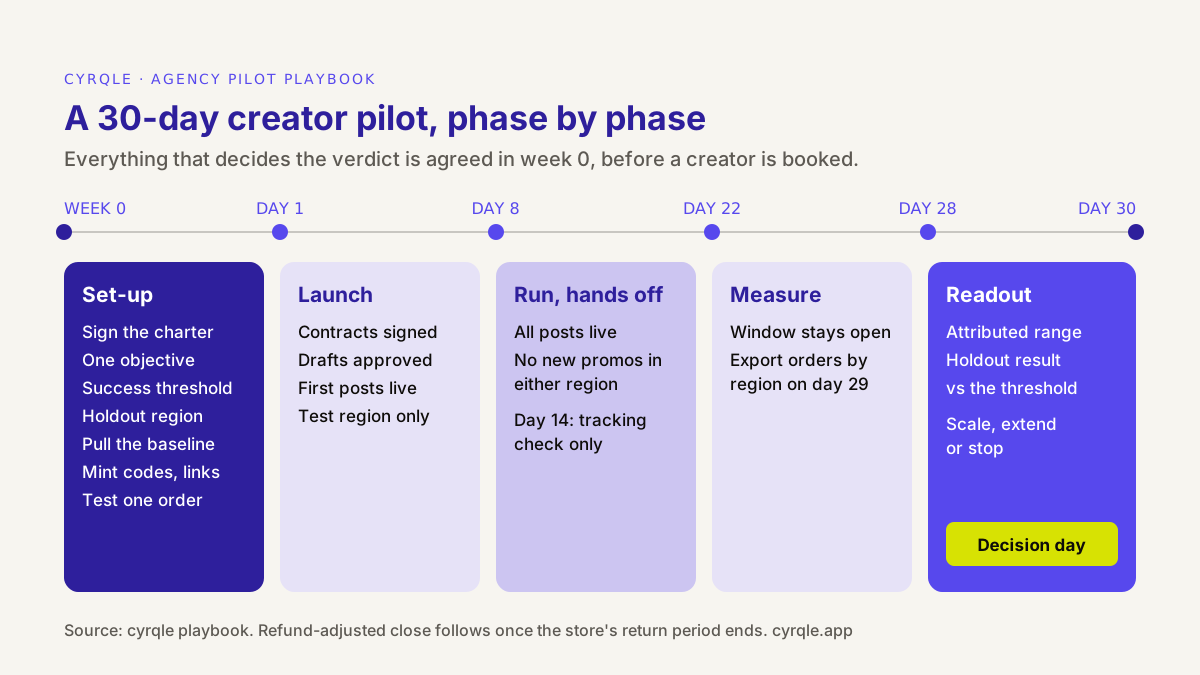
The measurement period is the four weeks from day 1 to day 28. You compare it with the four weeks before day 1, so the pilot and the baseline cover the same number of days of the week.
Week 0: write the pilot charter before you book anyone
The pilot charter is a one-page document that the client signs before you contact a creator. It fixes everything that could be argued about later. If a field is empty on launch day, the pilot is not ready.
| Charter field | What to write | Example (illustrative) |
|---|---|---|
| Objective | One objective, one primary KPI | Online sales: orders in the test region |
| Test region | Where the creators post and where their audience lives | Valencia, Alicante, Castellón and Murcia provinces |
| Holdout region | Comparable provinces with no pilot creators | Zaragoza, Málaga, Sevilla and Valladolid provinces |
| Baseline | Orders per region per week, last 8 to 12 weeks | Client exports orders with shipping province |
| Creators | Number, size band, fee range | 8 creators, EUR 300 to 800 each |
| Tracking | One promo code and one tracking link per creator | Codes and links minted, one test order placed |
| Attribution window | Days after a click or code that still count | 30 days |
| Freeze rules | What may not change in either region | No regional promos, paid social changes or email pushes |
| Success threshold | The number that means "scale" | Incremental ROAS at or above 1.67x on creator cost |
| Readout | Date, format and who attends | Day 30, 45 minutes, CMO and head of ecommerce |
Choose one objective
Pick one objective, and make it sales unless the client has a strong reason not to. A holdout comparison needs a number that the client's own systems count by region, and orders by shipping address are the easiest one. Traffic and sign-ups can work if the client's analytics can split them by region. Awareness is a poor fit for a 30-day proof, because the effect is slow and hard to count. Our guide to influencer marketing KPIs by objective shows which numbers belong to which goal.
Set the success threshold as a number
The threshold is the result that makes the client say yes to the next phase. Base it on margin, not on a feeling. The simplest version is break-even ROAS: break-even ROAS = 1 ÷ gross margin. For a client with a 60% gross margin, every euro of creator cost needs EUR 1.67 of net revenue to pay for itself. So "incremental ROAS at or above 1.67x" is a threshold that finance can check.
Agree in writing whether the agency fee for the pilot sits inside the cost. Many agencies keep a one-off set-up fee out of the threshold, because it does not repeat when the programme scales. Either choice is fine. Changing it after the readout is not.
Pick the holdout region with the client
A holdout test keeps part of the market away from the campaign, so you can see what would have happened without it. For a creator pilot, the practical version is a geographic holdout: creators post for a test region, and a comparable region gets nothing.
Let the client choose the holdout from a shortlist you prepare. When the client picks it, the client cannot later say the comparison was rigged. Good holdout regions:
- Have similar sales history. Total orders in the same range as the test region, and a similar trend over the last 8 to 12 weeks.
- Move together. Compute the weekly ratio of test orders to holdout orders for the last 8 weeks. If the ratio swings by 3% from week to week, a lift below that is noise. That swing is the smallest effect the pilot can detect.
- Are far enough apart. Creator audiences do not stop at a border. Distance reduces, but does not remove, leakage into the holdout.
- Have no special events in the pilot weeks. A local festival, a store opening or a regional holiday in one group distorts the comparison.
This method has a long track record in advertising. Google described randomised geo experiments for measuring ad effectiveness in 2011, and Meta's open-source GeoLift package measures lift at the geographic level. A 30-day creator pilot is a simple, hand-run version of the same idea.
How many creators should the pilot use?
Use 6 to 10 creators whose audience is concentrated in the test region. Fewer than six, and one viral post or one dud decides the result. More than ten, and the pilot budget and the coordination stop being small.
- Pick local creators. Look for creators who post about the test cities and speak to that audience. Ask each one for a screenshot of their audience by city before you sign.
- Give each creator their own code and link. One promo code and one tracking link per creator, so every attributed order points to one person. The comparison of discount codes, tracking links and the pixel explains what each one catches.
- Use one offer. The same discount and landing page for every creator. If the offers differ, you test the offers, not the creators.
- Post early. All first posts should be live by day 7, so each one has at least three weeks inside the measurement period.
Budget the pilot so the client can afford to lose it. A pilot that would hurt the client if it fails puts pressure on everyone to read the result kindly.
Days 1 to 28: run the pilot without touching the dials
During the pilot your job is to keep the test clean. Three rules do most of the work.
- Freeze both regions. The client agrees not to launch regional promotions, change paid social targeting by region or send region-specific emails. National activity is allowed if it hits test and holdout equally. Keep an exceptions log, and write down anything that slipped through.
- Check tracking once, on day 14. Confirm that codes are redeeming, links are recording clicks and orders arrive with a shipping province. Fix broken tracking. Do not swap creators, change the offer or add budget because early numbers look weak.
- Keep the attribution window open. Orders keep arriving after the last post. Export the order data on day 29, after the full measurement period.
Day 30: the readout, with a worked example
The day-30 readout shows two results side by side: the attributed range and the incremental lift. Then it applies the threshold from the charter. All figures in this example are illustrative.
The client is an online skincare brand in Spain. Gross margin is 60%, so the threshold is an incremental ROAS of 1.67x. Average order value is EUR 48, net of VAT and discounts. Eight creators cost EUR 4,000 in fees, plus EUR 500 in product and shipping: EUR 4,500 of creator cost.
Result 1: the holdout comparison
| Region | 4 weeks before | 4 pilot weeks | Change |
|---|---|---|---|
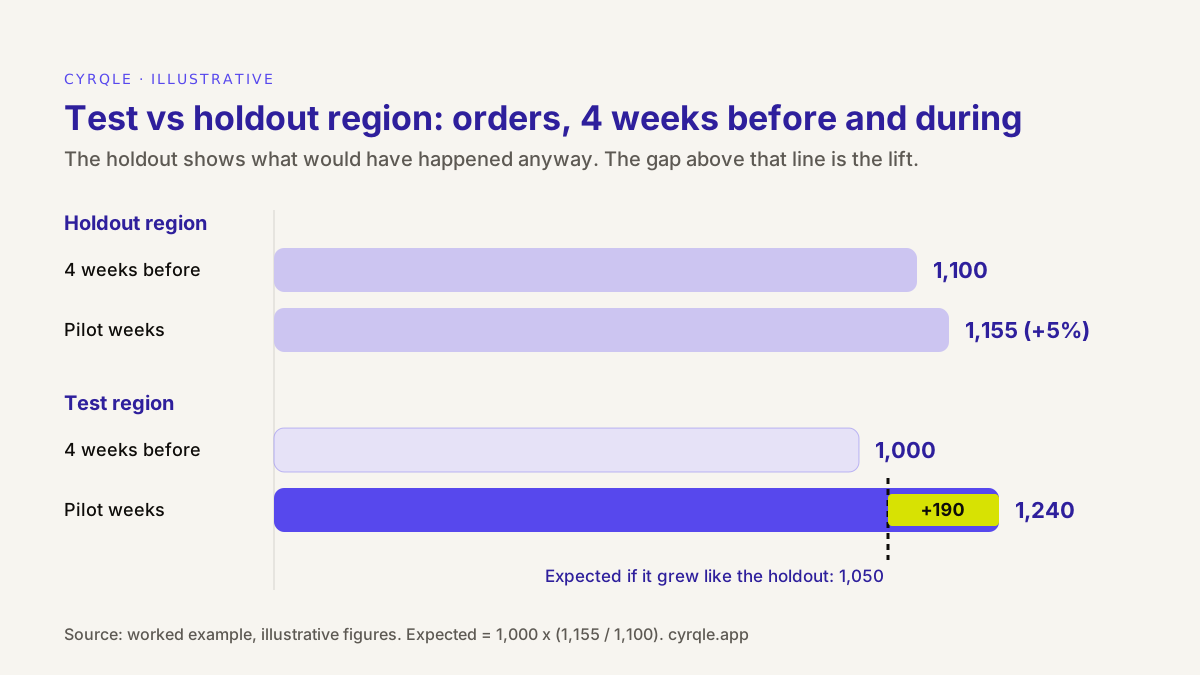
| Holdout (no creators) | 1,100 orders | 1,155 orders | +5% |
| Test (8 creators) | 1,000 orders | 1,240 orders | +24% |
The holdout grew 5% without any creators: seasonality, a national email, general demand. If the test region had grown at the same rate, it would have done 1,000 × (1,155 ÷ 1,100) = 1,050 orders. It did 1,240. The difference, 190 orders, is the incremental effect of the creators.
- Incremental revenue: 190 × EUR 48 = EUR 9,120
- Incremental ROAS: EUR 9,120 ÷ EUR 4,500 = 2.03x
- Incremental contribution at 60% margin: EUR 5,472, which is EUR 972 above the creator cost
Result 2: the attributed range
The codes and links tell a different story, and the difference is useful.
| View | Orders tied to creators | Revenue | ROAS |
|---|---|---|---|
| Promo code only | 120 | EUR 5,760 | 1.28x |
| Code + same-session link clicks | 200 | EUR 9,600 | 2.13x |
| All tiers, including buyers who came back later | 250 | EUR 12,000 | 2.67x |
Attribution counts 250 orders, and 228 of them shipped to the test region. The holdout says 190 were incremental. So about one in six of the test-region orders tied to creators would likely have happened anyway: people who already knew the brand and picked up a code on the way. That is the client's original objection, measured instead of argued.
The two methods also check each other. The code-only number (1.28x) is below the threshold, and a client who only saw that number would stop the programme. The holdout shows that it undercounts: many buyers clicked or came back later without using a code.
Note the limits in the deck
- Leakage. In the example, 22 of the 250 attributed orders shipped outside the test region, some of them to holdout provinces. Creator audiences spill over, so the holdout grew a little because of the creators, and the lift is understated.
- Noise. A lift of 18% over expected is far above a 3% week-to-week swing. A lift of 4% would not be.
- Refunds. In Spain, online buyers can withdraw within 14 calendar days of delivery (longer if the seller did not give the required information). Treat the day-30 numbers as preliminary and send a refund-adjusted close once that period has passed for the last orders.
- One run. A single 30-day test is evidence, not certainty. Plan to repeat it.
How do you turn the readout into a decision?
Turn the readout into a decision with rules written in the charter. The meeting then confirms an outcome rather than negotiating one.
| Result | Decision |
|---|---|
| Incremental ROAS at or above the threshold, lift above the noise | Scale. Extend to more regions, and keep one rotating holdout region each quarter |
| Incremental ROAS between 1.0x and the threshold | Extend. Run 30 more days with the best half of the creators and a stronger offer |
| Lift inside the noise | Inconclusive. Larger regions, more creators or a longer test, or stop |
| Incremental ROAS below 1.0x | Stop, or test a different objective or category |
In the example, 2.03x clears 1.67x and the lift is well above the noise, so the charter says scale. If the agency's EUR 1,500 set-up fee had been inside the cost, the incremental ROAS would be 9,120 ÷ 6,000 = 1.52x, and the charter would say extend. That is why the cost definition goes in the charter.
Also show the result per creator. Rank the eight on attributed contribution per euro, rebook the top half for the scale phase and replace the bottom two. For the report itself, the influencer campaign report template for agency clients gives a structure the client can forward to finance.
Which proof should you show: attribution or the holdout?
Show both. They answer different questions, and a sceptical client needs both answers.
| Attribution (codes, links, pixel) | Holdout comparison | |
|---|---|---|
| Question it answers | Which creator did each sale follow? | Did the creators cause extra sales? |
| Granularity | Per creator, per post, per order | Whole test region only |
| Main weakness | Counts buyers who would have bought anyway | Leakage and noise; cannot rank creators |
| Who runs it | The tracking set-up, every campaign | The agency, with the client's order export |
| Use it to | Pay commission, rank and rebook creators | Prove the programme is worth scaling |
How cyrqle helps
cyrqle runs the pilot itself and the attribution side of the readout. The holdout comparison is yours: cyrqle does not compute incrementality, pick holdout regions or run lift tests. You run the test-versus-holdout maths in a spreadsheet with the client's order export, as shown above.
- Agency workspace. From the Clients list on the agency console, create a managed brand for the client or request access to their workspace, then use Act As to run the pilot inside it.
- Creators for the test region. In Find creators, search by meaning for creators who post about the test cities, check engagement and past brand collaborations, and save the shortlist to a list.
- Codes and links. In Attribution, mint one promo code and one tracking link per creator, in bulk. A tag under 2KB on the client's store, the Shopify custom pixel and signed order webhooks from Shopify, WooCommerce or Magento tie orders to creators.
- The attributed range. Every sale gets a confidence tier: Tier 1 — promo code, Tier 2 — same-session and Tier 3 — cookied later, with revenue net of refunds. The campaign report's Attribution confidence setting switches between Conservative, Balanced and Full, which is the range table above.
- The client deck. Reports exports the Campaign report as a white-label PDF or CSV, and you can hide creator fees from client reports.
For the agency-side set-up in more depth, see what agencies need from influencer software. Agency pricing is a custom monthly base plus usage. To see a pilot set up on a category close to your client's, book a 30-minute demo.
FAQ
How long does it take to prove influencer marketing ROI to a client?
Thirty days is enough for a first answer if the client has steady online sales and the pilot uses 6 to 10 creators. Add a refund-adjusted close two to four weeks later. For a decision that justifies a large annual budget, repeat the test once.
What is a holdout region in a creator campaign?
A holdout region is a set of provinces or cities where no pilot creator posts. You compare its sales trend with the test region's trend. The gap between the test region's actual sales and what it would have sold at the holdout's growth rate is the incremental lift.
What if the client sells too little for a regional test?
Check the weekly test-to-holdout ratio over the last 8 weeks. If it swings more than the lift you can realistically expect, the pilot cannot detect an effect. Use larger regions, run longer, or present the attributed range only and say plainly that it does not prove cause.
Should the agency fee count in the pilot ROI?
Decide in the charter. Excluding a one-off set-up fee is reasonable because it does not repeat at scale. Including it is the stricter test. What matters is that both sides agree before launch and nobody changes it after the readout.
Can we run the pilot without discount codes?
Yes. Tracking links and a store tag still tie clicks to orders, and the holdout comparison does not need codes at all. Codes help with buyers who see a story and type the brand name later, so most pilots use both.
Sources
- Vaver, J. and Koehler, J. (2011), Measuring Ad Effectiveness Using Geo Experiments, Google: https://research.google/pubs/measuring-ad-effectiveness-using-geo-experiments/
- GeoLift, open-source geo-level lift measurement from Meta Open Source: https://facebookincubator.github.io/GeoLift/
- Real Decreto Legislativo 1/2007 (consumer protection law, Spain), article 104, withdrawal period: https://www.boe.es/buscar/act.php?id=BOE-A-2007-20555
Related field notes.
How to tell whether the creator content on your site is earning its place. The metrics that matter at each step, from wall impressions to product clicks to attributed orders, and the traps that make the numbers look better or worse than they are.
Returns-adjusted ROAS for fashion creator campaigns: gross vs net ROAS per creator with worked numbers, why commission waits for returns, and who changes rank.
TikTok Shop vs Shopify for creator sales in Spain: in-app conversion against customer data, margin, returns and attribution, with a worked example in euros.