
How agencies price influencer services: retainer, percentage of spend or performance
How to price influencer marketing agency services: retainer, percentage of creator spend or performance fee, with a margin model for one client at three sizes.
To price influencer marketing agency services, pick the fee model that tracks your real cost driver for each client. A fixed retainer suits a stable, well-defined scope. A percentage of creator spend suits clients whose budget grows with the workload. A performance fee on attributed revenue suits clients with clean tracking and a sales objective. Then test the model on your own hours before you sign.
Picture an agency in Valencia pitching a skincare brand that sells online in Spain and Portugal. The brand asks for "a price for creator marketing". The agency can quote EUR 5,000 a month, 25% of whatever the brand spends on creators, or 10% of the sales its creators drive. All three sound reasonable in the pitch meeting. They produce very different margins once the work starts, and the difference depends on how big the programme gets.
This post works through that choice like a calculator. It uses one illustrative client at three sizes, shows the margin under each model, and explains where each model breaks. Every figure in the model is illustrative: replace it with your own hours and rates.
What are the main ways agencies charge for influencer marketing?
Influencer marketing agencies charge in four basic ways, often combined. The fee is separate from what the creators are paid: creator fees are usually passed through to the client at cost, and the agency fee sits on top.
| Retainer | Percentage of creator spend | Performance fee | Hybrid | |
|---|---|---|---|---|
| How the fee is set | Fixed amount per month | A percentage of the creator fees the agency manages | A percentage of attributed revenue, or a fee per order | A base fee plus a percentage or a performance part |
| Tracks | Nothing: the fee is fixed | Budget, which roughly tracks workload | Sales outcome | Base covers overhead; the variable part tracks workload or outcome |
| Best for | Stable scope, always-on programmes, strategy work | Campaign-based clients with growing budgets | Ecommerce clients with clean tracking and a sales goal | Most clients after the first three months |
| Breaks when | Scope grows without a new price | Spend is low, or the programme is mostly gifted product | Attribution is disputed or the client controls price and stock | The base is too low to cover account time |
| Cash flow for the agency | Predictable | Follows the campaign calendar | Late and variable: revenue must happen, then be agreed | Predictable base, variable top |
| Incentive problem | Agency does less as scope grows | Agency may push spend up | Agency may favour discount-heavy, last-click tactics | Depends on the variable part |
A fifth variant, the markup, is a percentage-of-spend model in disguise. The agency buys a creator post for EUR 1,000 and bills it at EUR 1,250. The maths is the same as a 25% management fee. The difference is transparency: with a management fee the client sees the creator cost and the agency fee as two lines; with a markup the client sees one price. Your contract decides which one you may use. If it promises cost transparency, a markup that is not disclosed breaks it.
Before you choose, read how vendors charge you too. Our guide to what influencer platforms really cost, including the hidden lines explains how a platform's licence and fees sit next to the agency fee in the client's total cost.
The illustrative client and the cost model
Every fee model is a bet on how your costs will move. So start with costs. This is the model we use for the rest of the post. All figures are illustrative.
- Team cost: EUR 45 per hour, fully loaded (salary, social security, tools, overhead).
- Fixed account time: 16 hours a month per client for meetings, planning and the monthly report. That is EUR 720.
- One campaign: EUR 5,000 of creator fees, about six creators, and 16 hours of sourcing, outreach, contracts, draft review and reporting. That is another EUR 720.
- Attributed revenue: three times creator spend (a ROAS of 3.0) for the performance model. Real campaigns vary widely, and some return less than they cost.
The formula is simple:
Monthly margin = agency fee − (16 h + 16 h × campaigns) × EUR 45
The same client appears at three sizes: small (1 campaign a month, EUR 5,000 creator spend), medium (4 campaigns, EUR 20,000) and large (12 campaigns, EUR 60,000). The three rate cards are a EUR 5,000 retainer, 25% of creator spend, and 10% of attributed revenue.
The margin model: one client at three sizes
Here is what each model earns at each size. Margin is the agency fee minus team cost, before software, sales and management overhead.
| Small (1 campaign) | Medium (4 campaigns) | Large (12 campaigns) | |
|---|---|---|---|
| Creator spend per month | EUR 5,000 | EUR 20,000 | EUR 60,000 |
| Team hours | 32 | 80 | 208 |
| Team cost | EUR 1,440 | EUR 3,600 | EUR 9,360 |
| Attributed revenue (ROAS 3.0) | EUR 15,000 | EUR 60,000 | EUR 180,000 |
| Retainer, EUR 5,000 | EUR 3,560 (71%) | EUR 1,400 (28%) | −EUR 4,360 (−87%) |
| 25% of creator spend | −EUR 190 (−15%) | EUR 1,400 (28%) | EUR 5,640 (38%) |
| 10% of attributed revenue | EUR 60 (4%) | EUR 2,400 (40%) | EUR 8,640 (48%) |
| Hybrid: EUR 1,500 + 20% of spend | EUR 1,060 (42%) | EUR 1,900 (35%) | EUR 4,140 (31%) |
Illustrative figures. Percentages are margin as a share of the agency fee.
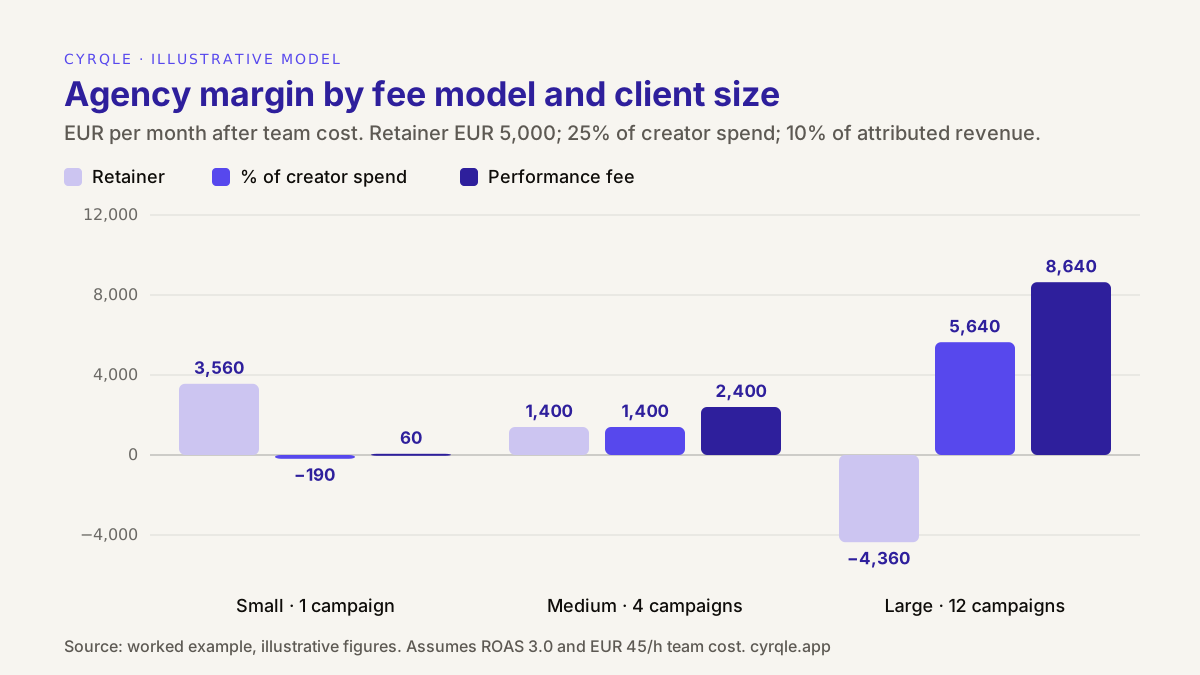
Three readings matter:
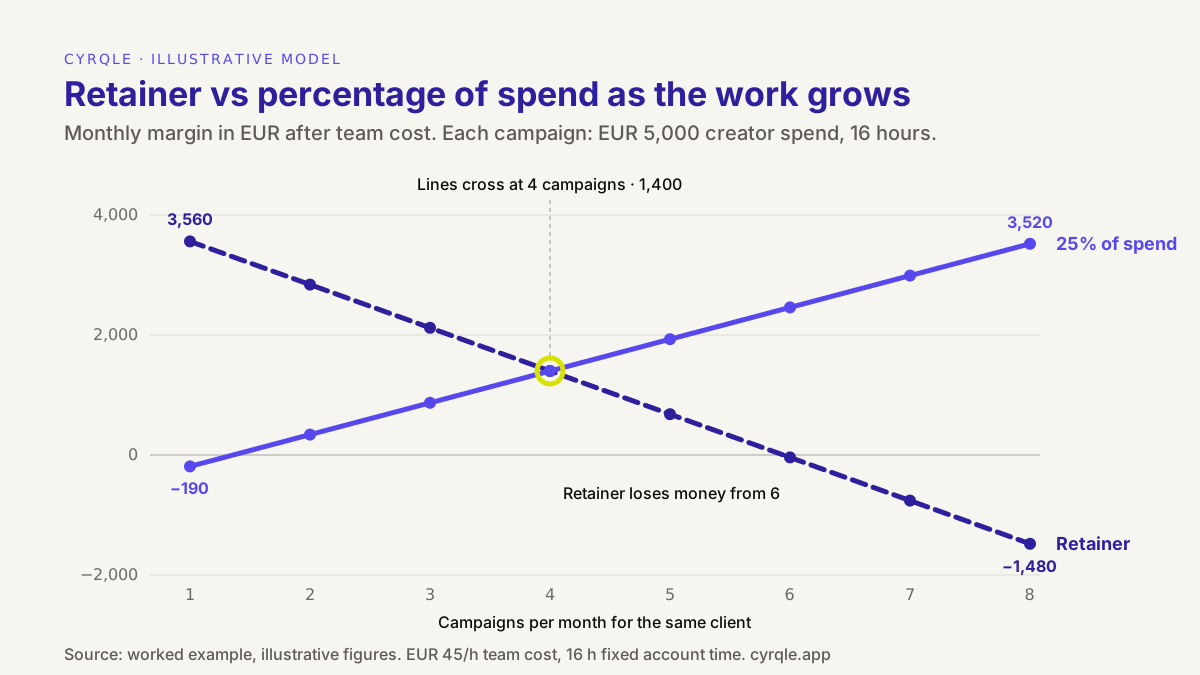
- No model wins at every size. The retainer is best for the small client, the variable models for the large one. At the medium size, retainer and percentage earn exactly the same, because EUR 5,000 is 25% of EUR 20,000.
- The performance fee has the highest ceiling and the thinnest floor. It earns 48% on the large client, but only if the attributed revenue is real and agreed.
- The hybrid is the flattest line. It never earns the most, and it never loses money. That is why many agencies move to it after the first few months with a client.
Where does a retainer break?
A retainer breaks on scope creep: the client adds campaigns, markets or creators, and the fee stays the same. A fixed fee divided by growing hours means a falling hourly rate. In the model, the EUR 5,000 retainer buys 208 hours at the large size. That is about EUR 24 an hour against a cost of EUR 45.
The break-even point is easy to compute:
Campaigns at which a retainer stops paying = (retainer − fixed account cost) ÷ cost per campaign
With our figures: (5,000 − 720) ÷ 720 = 5.9. From the sixth campaign a month, the retainer loses money.
How to protect a retainer:
- Write the scope in units, not words. "Up to 4 campaigns a month, up to 8 creators each, one market, one monthly report." "Ongoing creator management" is not a scope.
- Price the overage. State the fee for each additional campaign or market before the client asks for it.
- Review every quarter. Compare hours logged against hours sold, and reprice at the review if the gap is above an agreed threshold.
Retainers still have real strengths. Cash flow is predictable, the client can budget for them, and they suit work that does not scale with spend: strategy, always-on ambassador programmes and content rights management.
Where does a percentage of creator spend break?
A percentage of creator spend breaks on low-spend clients. The fixed part of the work, the account time, does not shrink when the budget does. In the model, 25% of EUR 5,000 is EUR 1,250, and the client costs EUR 1,440 to serve. The agency loses EUR 190 a month.
The minimum viable volume follows from the same numbers:
Campaigns needed to break even = fixed account cost ÷ (fee per campaign − cost per campaign)
With our figures: 720 ÷ (1,250 − 720) = 1.4, so at least two campaigns a month.
Three other failure points are worth writing into the contract:
- Gifting and product seeding. A programme of gifted product has little or no creator spend, but the work of sourcing, shipping and tracking is the same. A pure percentage pays almost nothing. Agree a fee per creator or a minimum monthly fee for gifted work. Our post on the four creator compensation models explains the fixed-fee, commission, seeding and hybrid structures a creator deal can take, which helps you price each one.
- The definition of "spend". Say whether it includes usage rights, exclusivity, product value, payment fees and any platform take rate. Each one changes the fee base.
- The incentive question. A client may suspect the agency recommends larger budgets because its fee grows with them. A cap, a sliding scale (for example 25% up to EUR 20,000 and 15% above), or a link to an outcome metric answers that suspicion.
Where does a performance fee break?
A performance fee breaks on attribution disputes. The agency is paid on revenue it cannot fully see or control, and the client and agency can disagree about which sales the creators caused. A fee of 10% of attributed revenue is only as strong as the definition of "attributed".
Common sources of dispute:
- Code leakage. Creator discount codes end up on coupon sites. Sales that used the code were not always caused by the creator.
- Overlap with other channels. The same buyer clicked a paid social ad and a creator link. Both teams claim the sale.
- Refunds and returns. In fashion and beauty, returns can take a large share of gross orders. A fee on gross revenue pays for sales that came back.
- Factors outside the agency's control. Price changes, stock-outs and a slow checkout cut conversion, and the agency carries the risk.
The risk is real in the numbers. At a ROAS of 1.5 instead of 3.0, the medium client produces EUR 30,000 of attributed revenue and a EUR 3,000 fee. That is EUR 600 below the agency's cost. The break-even attributed ROAS for this client is 1.8.
Before you sign a performance deal, agree these points in writing:
- Which signals count. Promo code, tracking-link click in the same session, a later visit within a window. Our comparison of discount codes, tracking links and pixels explains how strong each one is.
- The attribution window. For example, 30 days from the click.
- Net or gross. Revenue net of refunds and IVA is the fairest base.
- Who holds the data and when it is final. For example, the client's order data closes on the 10th of the following month.
- A floor and a cap. A minimum monthly fee protects the agency; a cap protects the client from paying a share of a viral outlier.
For a wider view of which numbers to put in front of the client, read our guide to measuring influencer marketing ROI beyond the discount code.
How do you build a hybrid fee that holds up?
A hybrid fee works when the base covers the fixed account time and the variable part tracks the cost driver that moves. In the model, the account time costs EUR 720 a month, so a EUR 1,500 base leaves room for management time and risk. The 20% on creator spend then scales with the campaign work.
A practical sequence:
- Measure your fixed and variable hours. Use your time sheets for three real clients, not an estimate.
- Set the base at about two times fixed account cost. In the model, 2 × EUR 720 ≈ EUR 1,500.
- Choose the variable driver. Creator spend if your work grows with budget; attributed revenue if the client has clean tracking and wants to share risk.
- Set the rate so the medium case earns your target margin. In the model, 20% gives 35% at the medium size.
- Add a performance kicker only on top. For example, 3% of attributed revenue above an agreed ROAS. Never replace the base with it.
One more line belongs in every proposal: the fee excludes IVA. Agency services in Spain are generally taxed at the 21% general rate (IVA: tipos y exenciones, administracion.gob.es). Paying the creators has its own tax rules, which our guide on how to pay influencers in Spain covers. This post is not tax or legal advice: for a specific contract, ask your adviser.
Which fee model should your agency use?
Choose by client, not by agency. Use the table below as a starting point, then run the margin formula with your own hours.
| If the client... | Start with | Watch for |
|---|---|---|
| Has a small, stable budget and needs strategy | Retainer with a written scope | Scope creep; reprice every quarter |
| Runs campaigns that grow with seasons | Percentage of spend with a monthly minimum | Low-spend months and gifted work |
| Sells online with codes, links and order data | Base plus performance kicker | Attribution rules and refunds |
| Is new and unsure of volume | Hybrid: base plus percentage | A base that is too low |
The worst choice is the same model for every client. A single rate card hides the clients that lose money behind the ones that earn it.
How cyrqle helps
cyrqle has an agency workspace built for running many clients at once. The parts that touch pricing are these:
- Per-client commercial terms and fees. Every client brand you manage under Clients carries its own commercial terms and agency fee. A 20% fee for one client and a different arrangement for another do not need a spreadsheet next to the tool.
- The agency fee in the payout split. Every creator payout shows four lines: creator net, cyrqle commission, agency fee and tax withheld, with a statement per payout. That makes a percentage-of-spend fee auditable payout by payout. Creators in Europe and the US are paid through Stripe Connect, in EUR; elsewhere the brand pays by bank transfer and records it. See compensation and contracts.
- An attribution base you can show the client. For performance fees, the campaign Attribution tab shows sales and revenue by confidence tier (Tier 1 — promo code, Tier 2 — same-session, Tier 3 — cookied later), net of refunds, with an audit chain from each sale to the post, code and creator. You can agree with the client which tiers count toward the fee. See creator attribution.
- Client-facing reports with your fee policy. In reports, you can hide creator fees on client reports when your contract uses net pricing, while your internal payout view keeps the full amounts.
Two honest limits. The payout split covers fees tied to creator payments; a fixed retainer or a performance fee is agreed and invoiced under your own contract, so ask in the demo how you want it recorded. And cyrqle's own pricing for agencies is not public: it is a custom monthly base plus usage, so ask for a quote on the pricing page and add it to your margin model. For the wider tool decision, read our guide to influencer software for agencies, workspaces and margin. If you want to see per-client terms and a payout statement on a category close to yours, book a 30-minute demo.
FAQ
What percentage do influencer marketing agencies charge?
There is no standard rate, and published benchmarks are rare, so be careful with any single number. Work backwards instead: compute your cost per campaign and your fixed account cost, then set the percentage so a typical client earns your target margin. In our illustrative model, 25% breaks even at two campaigns a month.
Should creator fees be included in the agency retainer?
Usually not. Keep creator fees as a separate pass-through budget and the agency fee as its own line. If you bundle them, the client cannot see what the creators cost, and a bigger creator budget silently eats your margin.
Is a markup on creator fees legal?
A markup is a commercial choice between you and the client. The question is what your contract says. If it promises cost transparency or audit rights, an undisclosed markup breaches it. Agree net or transparent pricing in writing before the first campaign.
How do agencies charge for gifting campaigns?
A percentage of spend pays almost nothing on gifted product, so most agencies use a fee per creator, a fixed project fee, or a monthly minimum. Price the work, which is sourcing, shipping, follow-up and tracking, not the product value.
How do I move an existing client from a retainer to a hybrid fee?
Show the client the numbers. Bring three months of hours against the scope, propose a lower base plus a variable part, and model the client's cost at their current and planned volume. Clients accept a hybrid more easily when their cost at today's volume does not rise.
Related field notes.
How to manage an influencer ambassador program at scale: clusters, bulk invites by market and language, two follow-ups, your-move buckets and pay on delivery.
An influencer campaign compliance checklist for agencies: the six records to keep for every post, from signed contract to payout, and how to audit them fast.
What influencer marketing software for agencies must do that brand tools skip: client separation, Act-As, per-client fees and white-label reports. Checklist.