
How much to pay for usage rights and exclusivity: a worked calculator
How much to pay for influencer usage rights: price each scope, term, territory and exclusivity window as an uplift on the base fee. Three worked euro examples.
To work out how much to pay for influencer usage rights, start from the creator's base fee for the post and add a percentage for each extra use you buy. As an illustrative guide, website and email use adds 5 to 20% of the base fee, paid ads from your own accounts add 20 to 60%, and ads run from the creator's handle add 30 to 80%, depending on whether you want 30, 90 or 365 days. Territory and exclusivity are separate lines on top.
A sportswear brand in Madrid books a creator for one Reel and one TikTok at EUR 2,000. Then the performance team asks to run the Reel as an ad in Spain and Mexico for the tournament, the ecommerce team wants it on the product page, and the brand manager wants the creator to stay away from rival sportswear for two months. Each of those asks has a price. Nobody wants to discover it after the post goes live.
This post is a calculator in article form. It gives you the formula, an illustrative uplift for every scope and term, a way to price territory and exclusivity, three worked examples in euros, and the reasons paid-ads use has to be explicit. Every percentage here is illustrative, chosen to show the arithmetic, not a market benchmark. It is not legal advice: for a specific contract, ask your lawyer.
How does the usage rights calculator work?
The calculator adds one uplift per right you buy to the creator's base fee. Each uplift is a percentage of the base fee, not of the running total, so the lines stay independent and easy to negotiate one by one.
Total fee = base fee × (1 + scope and term uplift + territory uplift + exclusivity uplift)
You need five inputs:
- Base fee. What the creator charges to make the content and post it on their own account, with no reuse.
- Scope. Where you will use the content: organic reposts, your website and email, paid ads from your accounts, or paid ads from the creator's handle.
- Term. How long each scope runs: 30, 90 or 365 days are the common steps.
- Territory. One country, several markets, or worldwide.
- Exclusivity. Whether the creator must avoid named competitors or a whole category, and for how many days.
Add the uplifts; do not multiply them on top of each other. Compounding a 30% paid-ads uplift on top of a 20% exclusivity uplift inflates the total for no reason and makes the quote harder to check. If you buy two scopes, add both lines.
Step 1: Fix the base fee before you discuss rights
The base fee is the anchor for every other line, so agree it first and agree what it covers. A clean base fee covers production, the agreed posts on the creator's account, and nothing else. If the creator's quote already bundles some reuse, ask them to split it out. Otherwise you cannot tell whether you are paying twice.
The base fee itself depends on reach, format and category. Our guide to influencer fees in Spain by tier and format gives illustrative bands, and the method in pricing creators on median views and effective CPM tells you whether a quote is in line. Only once you trust the base fee does it make sense to put percentages on it.
Step 2: Pick the scope and the term
Scope and term set the largest part of the uplift. The wider the use and the longer it runs, the higher the percentage, and the jump between owned channels and paid ads is the biggest one in the table.
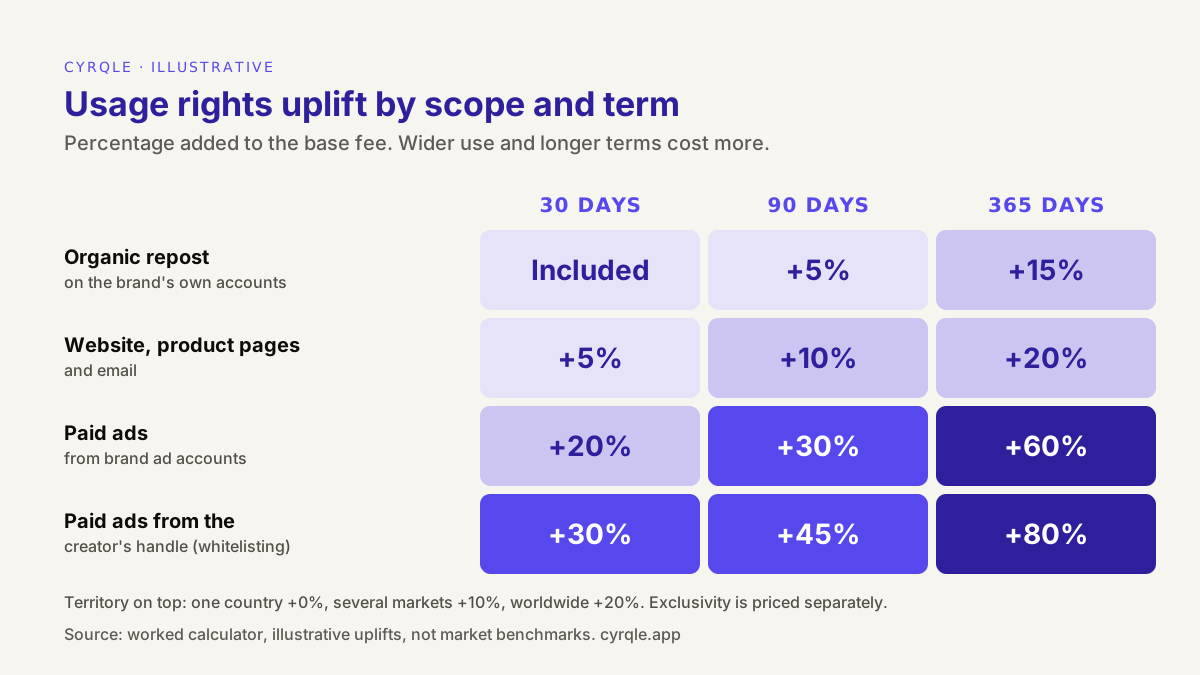
| Scope | 30 days | 90 days | 365 days | Why it costs what it does |
|---|---|---|---|---|
| Organic repost on your own social accounts | Included | +5% | +15% | A small extension of the creator's own post, to an audience that already follows you |
| Website, product pages and email | +5% | +10% | +20% | The content works for you every day on owned media, but no media spend sits behind it |
| Paid ads from your ad accounts | +20% | +30% | +60% | You buy reach the creator never had, often to strangers, with their face on it |
| Paid ads from the creator's handle | +30% | +45% | +80% | Same as paid ads, plus the creator lends their name and account, and must grant access |
All uplifts illustrative. Read the table one row at a time. If you want the post on your product pages for a year and as an ad for 90 days, add the two cells: 20% plus 30% is 50% of the base fee.
Why the term matters as much as the scope
A 365-day paid-ads term costs about twice a 90-day term in this table, because the creator loses control of their image for longer and an old ad can look like a current endorsement. Most paid campaigns run for weeks, not a year. Buy the term your media plan actually needs, and add an option to extend (see step 6).
Never leave the term blank. Under article 43.2 of Spain's copyright law, the Ley de Propiedad Intelectual, a transfer of rights that does not state its duration is limited to five years, and one that does not state its territory is limited to the country where it was granted. Five years is rarely what either side meant.
Step 3: Add territory
Territory is a smaller uplift than scope, but it matters when you advertise across markets. A creator who agreed to Spain did not agree to Mexico or Germany.
| Territory | Illustrative uplift on the base fee | Notes |
|---|---|---|
| One country | +0% | The default for a local campaign |
| Several named markets | +10% | For example Spain and Mexico for a Spanish-language campaign |
| Worldwide | +20% | Ask why you need it. Paid ads usually target named markets anyway |
Illustrative. Territory mostly bites on paid ads. Organic reposts and your website are visible everywhere, so many contracts state territory only for the ads line. Write the markets by name: "Spain and Mexico" is clearer than "Spanish-speaking markets".
Step 4: Price exclusivity as its own line
Exclusivity is not a usage right. It is a promise by the creator not to promote your competitors for a set time, and it costs the creator real income, so it is priced separately from scope.
| Exclusivity | 30 days | 60 days | 90 days |
|---|---|---|---|
| Named competitors (2 to 5 brands) | +5% | +10% | +15% |
| Whole category (for example "sportswear") | +10% | +20% | +30% |
| Longer than 90 days | Negotiate | Negotiate | Negotiate |
Illustrative. The narrower the list, the cheaper the line. "No content for Brand X, Brand Y or Brand Z for 60 days" is cheaper and easier to check than "no sportswear". For a creator who earns most of their income in one category, a long category block can cost more than the base fee, and many will refuse.
Do not confuse an exclusivity window with an exclusive licence. Under article 48 of the copyright law, an exclusive licence must be granted expressly and stops even the creator from exploiting the content within its scope. Most brands do not need that. A non-exclusive licence plus a short competitor window usually covers the real risk.
Step 5: Why must paid-ads use be explicit?
Paid-ads use must be written into the contract by name because it is a separate use, at a separate price, and the law reads a licence narrowly. Assuming that "we can use the content" includes ads is the most expensive mistake in this whole calculation.
Three reasons, in order of how often they cause trouble:
- The licence covers only the uses it names. Article 43.1 of the Ley de Propiedad Intelectual limits a transfer to the modes of exploitation expressly provided for. Article 43.2 adds that if the modes are not stated specifically, the transfer is limited to what is necessary for the purpose of the contract. A contract for a creator to post on their own account does not obviously need ads to fulfil it.
- The creator's image needs express consent. Spain's Ley Orgánica 1/1982 treats using a person's name, voice or image for advertising purposes as an intrusion (article 7.6) unless the person gave express consent (article 2.2). A paid ad with the creator's face on it is the textbook case.
- Ads change the relationship. An organic post reaches the creator's audience once. An ad reaches people who never chose to follow them, as often as the budget allows. Creators know this and price it, so a contract that is silent on ads leads to a dispute, not a free extra.
Ads from the creator's own handle, often called running ads through the creator's account, need even more: the creator has to grant access or a partnership code inside the platform, and the contract should state when that access ends. The clause-by-clause influencer contract template has copyable wording for paid ads, whitelisting and exclusivity, with a term in days for each line.
For organic customer posts rather than paid collaborations, the same logic applies. Our guide to what a usable content licence must state in the EU covers copyright, image rights and GDPR consent in more depth.
Three worked examples (illustrative)
All three examples use the uplifts above. The figures are illustrative, chosen to show the arithmetic, and all amounts are before IVA.
Example 1: a fashion brand that only needs its product pages
A fashion brand in Valencia books a micro creator for one Reel at EUR 500. The brand wants the Reel on two product pages and in its newsletter for a year. No ads, no exclusivity.
| Line | Basis | Amount |
|---|---|---|
| Base fee | 1 Reel, creator's account | EUR 500 |
| Website and email | 365 days, +20% | EUR 100 |
| Territory | Spain, +0% | EUR 0 |
| Exclusivity | None | EUR 0 |
| Total | +20% on base | EUR 600 |
The rights cost EUR 100. That is the cheapest case, and it is also the most common one for ecommerce brands that mainly want creator content on their own pages.
Example 2: a sportswear brand running tournament ads
The sportswear brand from the introduction books a mid-tier creator for one Reel and one TikTok at EUR 2,000. It wants the content on its site and as paid ads from its own accounts in Spain and Mexico for 90 days, with category exclusivity for 60 days.
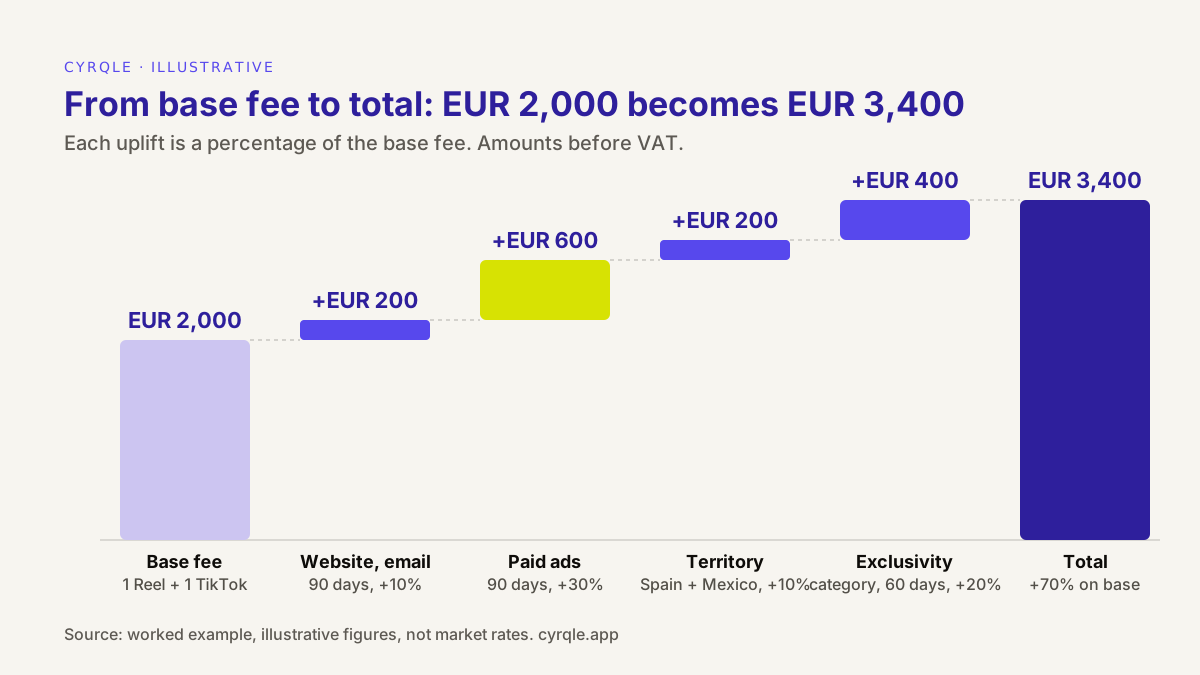
| Line | Basis | Amount |
|---|---|---|
| Base fee | 1 Reel + 1 TikTok, creator's accounts | EUR 2,000 |
| Website and email | 90 days, +10% | EUR 200 |
| Paid ads from brand accounts | 90 days, +30% | EUR 600 |
| Territory | Spain and Mexico, +10% | EUR 200 |
| Exclusivity | Sportswear category, 60 days, +20% | EUR 400 |
| Total | +70% on base | EUR 3,400 |
The paid-ads line is the biggest single uplift, which is normal. The exclusivity line is the easiest to cut: naming five competitors instead of the whole category drops it from EUR 400 to EUR 200.
Example 3: a food delivery brand that wants a year of creator-handle ads
A food delivery brand in Barcelona books a creator at EUR 1,500. The first draft of the brief asks for everything: ads from the creator's handle for a year, the video on the website for a year, and a 90-day category block.
| Line | First draft | Restructured |
|---|---|---|
| Base fee | EUR 1,500 | EUR 1,500 |
| Ads from the creator's handle | 365 days, +80%: EUR 1,200 | 90 days, +45%: EUR 675 |
| Website and email | 365 days, +20%: EUR 300 | 365 days, +20%: EUR 300 |
| Exclusivity | Category, 90 days, +30%: EUR 450 | 3 named competitors, 90 days, +15%: EUR 225 |
| Total | EUR 3,450 (+130%) | EUR 2,700 (+80%) |
| Option | None | Another 90 days of handle ads at +45% (EUR 675), exercisable before day 90 |
The restructured deal saves EUR 750 up front. If the ad performs, the brand exercises the option and pays EUR 675 for another quarter. If it does not, the brand has not prepaid a year of ads for a creative that stopped working after six weeks.
Step 6: What do you do when the rights cost more than the post?
When the uplifts add up to more than 100% of the base fee, stop and restructure the deal rather than pay the total. A total above double the base fee usually means you are buying more term or territory than your media plan uses.
Four levers bring it back down:
- Shorten the term and add an option. Price a renewal now ("another 90 days at EUR X") so you only pay for it if the content works.
- Narrow the exclusivity. Name competitors instead of a category, and match the window to your campaign dates.
- Name the markets. Drop "worldwide" unless you advertise worldwide.
- Separate the creative from the ads. If you mainly want ad creative, a UGC-style brief, where the creator makes content for your accounts and does not post it, can cost less than a full collaboration plus a year of paid rights.
A note on the money you actually pay out: these totals are fees before tax. In Spain the creator's invoice usually adds IVA, and a brand often withholds IRPF from a self-employed creator. Our guide to invoices, IRPF withholding and IVA for influencer payments covers that step. This is general information, not tax advice.
The calculator on one page
Use this as a checklist when you write the brief or the offer.
| Input | Your choice | Illustrative uplift |
|---|---|---|
| Base fee | Content plus posts on the creator's account | Anchor, 100% |
| Organic repost | 30 / 90 / 365 days | Included / +5% / +15% |
| Website, product pages, email | 30 / 90 / 365 days | +5% / +10% / +20% |
| Paid ads from your accounts | 30 / 90 / 365 days | +20% / +30% / +60% |
| Paid ads from the creator's handle | 30 / 90 / 365 days | +30% / +45% / +80% |
| Territory | One country / several markets / worldwide | +0% / +10% / +20% |
| Exclusivity, named competitors | 30 / 60 / 90 days | +5% / +10% / +15% |
| Exclusivity, whole category | 30 / 60 / 90 days | +10% / +20% / +30% |
| Renewal option | Price per extra term, agreed now | Same as the term's uplift |
All uplifts illustrative. Replace them with your own numbers as you collect real quotes. After a few campaigns, your own history is a better guide than any published table.
How cyrqle helps
cyrqle does not set the price of rights for you. It makes sure the rights you pay for are the rights written into the signed contract.
- Rights live on the offer. When you invite a creator from Campaigns, the offer carries the fee, the deliverables and a rights package, with presets such as "Organic only · 90 days". You can set default usage rights for the whole campaign and change them per creator during negotiation.
- Paid ads are a separate tick box. Content-wall and campaign use are always granted on a signed contract. Paid-ads use is granted only when you tick it on the offer, and the agreed terms show paid ads as "allowed" or "not allowed". That is the step 5 rule built into the workflow: no tick, no ads.
- Exclusivity is negotiated in the thread. A counter offer can set exclusivity to none, category exclusive or brand exclusive, with a window in days and a note naming the competitors.
- The terms are frozen at signing. The Creator Collaboration Agreement is signed by both sides, the deal terms are frozen into it, and the signed version sits on the Agreements page with a PDF. Later edits to the campaign do not change what was signed.
- Owned use is ready on day one. Because content-wall use is part of every signed agreement, delivered posts can go straight onto your site through content walls, without a second rights request.
Payment runs through compensation and contracts: you fund the campaign, cyrqle schedules each payout when the creator delivers, and a person on your side triggers settlement. To see the offer and contract flow on one of your own campaigns, book a 30-minute walkthrough.
FAQ
What percentage of the fee should usage rights cost?
There is no fixed percentage. As an illustrative starting point, owned channels such as your website add 5 to 20% of the base fee and paid ads add 20 to 80%, depending on the term and whether ads run from your account or the creator's. Use your own past deals to refine the numbers.
Are usage rights included in an influencer's fee?
Usually not. A standard fee covers the content and the posts on the creator's own account. Reposts, website use and paid ads are extra uses that you list and price in the contract. Some creators bundle a short organic repost into the fee; confirm it in writing.
How long should a usage rights term be?
As long as your plan needs and no longer. 30 or 90 days suits most paid campaigns; 365 days suits product pages. Always state the term in days. In Spain, a licence with no stated term is limited to five years by law, which rarely matches what either side intended.
Is whitelisting more expensive than running the ad from my own account?
Usually, yes. Ads from the creator's handle carry their name and account, so the creator lends more than the content and has to grant platform access. In the illustrative table it costs about 10 to 20 points more than the same term from your own ad account.
Can I buy paid-ads rights after the post is live?
Yes, but you negotiate from a weaker position and the creator can say no. If there is any chance you will advertise the content, agree an option before publication: the term, the markets and the price, exercisable within a set number of days.
Related field notes.
Influencer marketing budget planning for 2027, built bottom-up: objectives, tier mix, pricing model, seasonal peaks in Spain and Mexico and a worked euro model.
Influencer CPM vs CPA, CPE and flat fee: one campaign priced four ways, who carries the risk under each, and a decision tree matching the model to your goal.
An influencer whitelisting contract needs seven terms: permission scope, term, spend cap, creative approval, revocation, running ads at the end, data.