
Spain's influencer law (Real Decreto 444/2024) explained for brands
Spain's influencer law, Real Decreto 444/2024, explained for brands: who is a usuario de especial relevancia, the BOE thresholds, the registry and your duties.
Real Decreto 444/2024 is the Spanish decree that says which creators count as "usuarios de especial relevancia" (users of special relevance), the legal name for large influencers. A creator qualifies when, in the previous calendar year, they earned EUR 300,000 or more in gross income from video-platform activity, reached 1 million followers on one platform or 2 million in total, and published 24 or more videos. Those creators must register with the state and follow audiovisual advertising rules.
Does it affect your campaign? Only partly. The decree puts duties on the creator, not on you. Your own duty, to make sure every paid or gifted post is clearly identified as advertising, comes from other laws and applies to every creator you hire, from a nano-influencer in Murcia to a streamer in Madrid with three million followers. What changes when you work with a large creator is the set of rules their sponsored videos must follow, the regulator who can sanction them, and what your contract should say.
This post reads the decree from the BOE text, article by article, for an advertiser. It covers the thresholds, the exclusions, the registry, the duties, a worked example and the contract lines to add. For the full brand-side legal map, read our legal checklist for influencer marketing in Spain. It is not legal advice: for a specific campaign, ask your lawyer.
Last verified against the consolidated BOE texts of RD 444/2024, Ley 13/2022 and RD 1138/2023 on 3 November 2026. At that date the BOE showed no amendment to RD 444/2024 since publication.
What is Real Decreto 444/2024?
Real Decreto 444/2024, of 30 April, is a four-article regulation that fills in two numbers Ley 13/2022 left open. It was published in the BOE on 1 May 2024 and came into force on 2 May 2024. Without it, article 94 of the audiovisual law could not apply, because the law itself made article 94 wait for a regulation that defined "significant income" and "significant audience".
The decree sits in a chain of four texts. Each one does a different job:
| Text | What it does | Where to read it |
|---|---|---|
| Directive (EU) 2018/1808 | Updates the EU audiovisual directive and brings video-sharing platforms into scope. It does not regulate influencers directly and leaves that choice to member states | EUR-Lex |
| Ley 13/2022, General de Comunicación Audiovisual, art. 94 | Creates the "usuario de especial relevancia", lists five conditions, and applies audiovisual duties to those users | BOE-A-2022-11311 |
| Real Decreto 444/2024 | Sets the income and audience numbers for two of the five conditions (articles 3 and 4) and the registration deadline | BOE-A-2024-8716 |
| Real Decreto 1138/2023 | Organises the state registry, including a section for these users and the data they file | BOE-A-2023-25886 |
The press often calls RD 444/2024 "the influencer law". Strictly, the law is article 94 of Ley 13/2022. The decree is the switch that turned it on.
Who counts as a usuario de especial relevancia?
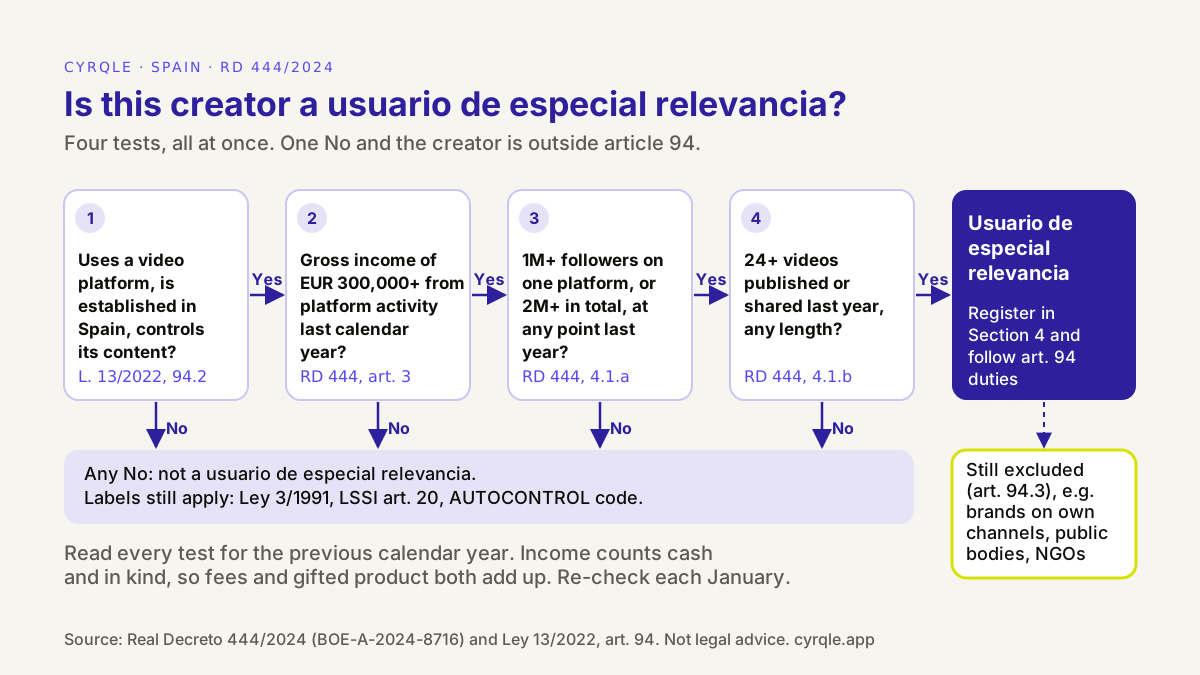
A usuario de especial relevancia is a person or company that uses a video-sharing platform and meets all five conditions of article 94.2 of Ley 13/2022 at the same time. Three conditions are qualitative and come from the law. Two are numeric and come from the decree.
| Condition | Source | What it means in practice |
|---|---|---|
| Economic activity with significant income | Art. 94.2.a + RD art. 3 | EUR 300,000 or more gross income in the previous calendar year, from activity on video-sharing platforms |
| Editorial responsibility | Art. 94.2.b | The creator decides what goes on the channel |
| Significant audience | Art. 94.2.c + RD art. 4 | 1,000,000+ followers on one platform at any point in the previous year, or 2,000,000+ across all platforms, and 24+ videos published or shared that year, any length |
| Function is to inform, entertain or educate | Art. 94.2.d | The main purpose is distributing audiovisual content |
| Offered over electronic networks and established in Spain | Art. 94.2.e | A creator established elsewhere falls under that country's rules, not these |
What counts toward the EUR 300,000?
Article 3 of the decree counts gross income accrued in the previous calendar year, "derived exclusively" from the user's activity across all the video-sharing platforms they use. It lists five types of income:
- Payment, in cash or in kind, for selling or organising the commercial communications in the creator's content. This is your fee, and also your gifted product, hotel nights and travel.
- Payments from the platforms themselves, such as creator funds and revenue shares.
- Subscriptions and payments from the audience.
- Public grants or aid linked to the activity.
- Any other income from the activity on the platforms.
Two consequences for brands. First, gifting is not invisible: a creator who receives a lot of product and trips can cross the threshold without a large cash income. Second, the test is about platform activity. Income from, for example, a creator's own clothing line or a TV contract does not obviously fall under "derived exclusively" from platform activity. The decree does not say more, so ask your lawyer on edge cases.
How are followers and videos counted?
Article 4 sets two tests that must both be met. The audience test is met if the account reached 1,000,000 followers on a single platform "at some point" in the previous calendar year, or 2,000,000 in aggregate across all the platforms the creator uses. The volume test is 24 or more videos published or shared across all platforms in that year, "regardless of their duration".
The decree does not say how followers are verified, whether accounts on platforms where the creator posts no video count toward the aggregate, or what counts as a "video" beyond that duration does not matter. Treat these as open questions, not as loopholes.
Who is excluded even above the thresholds?
Article 94.3 of Ley 13/2022 lists five groups that never fall under these duties, whatever their numbers:
- educational and scientific bodies, within their remit or for outreach;
- museums, theatres and other cultural bodies presenting their programme;
- public administrations and political parties, to inform about their functions;
- companies and self-employed people promoting the goods and services they produce or distribute;
- associations and NGOs promoting their own activities.
The fourth point matters to brands. Your own brand channel, with your own products, is not a usuario de especial relevancia, even with 2 million followers. A creator who sells their own merchandise is a different case, because their channel is not mainly a promotion tool for their own goods.
Article 2 of the decree adds one more exclusion: audiovisual media providers already in Section 1 of the registry (for example, TV broadcasters) for the programmes they upload to platforms.
What does a usuario de especial relevancia have to do?
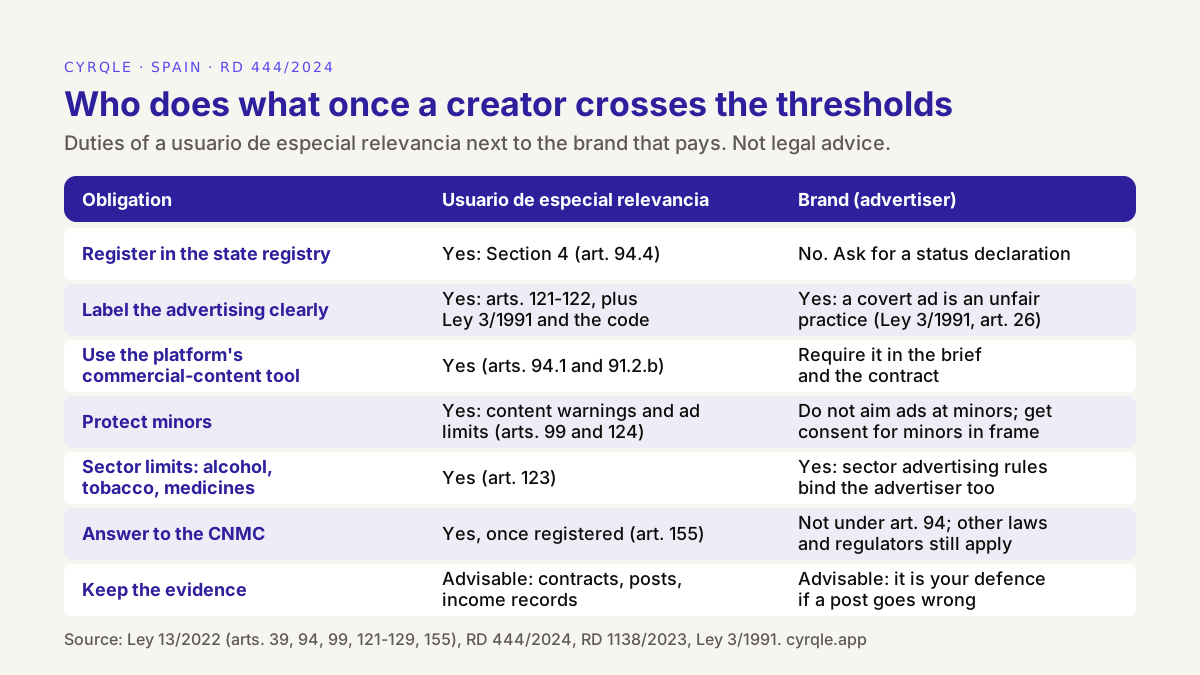
A registered creator is treated as an audiovisual media provider for a limited set of rules. Article 94.1 of Ley 13/2022 lists them. These are the creator's duties, but they shape what your sponsored content can look like:
| Duty | Article of Ley 13/2022 | What it means for a sponsored video |
|---|---|---|
| General principles | Art. 86 (which points to arts. 4, 6, 7.1, 10, 12, 14 and 15) | Human dignity, gender equality and the rights of people with disabilities, among others |
| Protect minors from harmful content | Art. 99.1 and 99.4 | Describe or warn about content that may harm minors |
| Commercial communications must be clearly distinguishable | Art. 121.3 | Advertising must be clearly separated from editorial content by visual, audio or spatial means |
| No covert, subliminal or discriminatory advertising | Art. 122 | A sponsored video that hides its purpose and may mislead viewers is banned |
| Health-related limits | Art. 123 | Tobacco and e-cigarette communications are banned; medicines, health claims and alcohol are restricted |
| Protect minors in advertising | Art. 124 | For example, no direct appeals to minors to buy or to pester parents, and no promotion of body-image pressure through slimming or cosmetic surgery ads |
| Rules by ad type | Arts. 126 to 134 | Definitions and conditions for ads, sponsorship, product placement and other formats |
| Use the platform's tools | Art. 94.1, citing art. 91.2.b | Use the platform feature to declare that a video contains commercial communications |
| Register | Art. 94.4 | Apply to Section 4 of the state registry |
The last-but-one row is the most practical one for brands. Article 91.2.b obliges platforms to offer a feature where uploaders declare that a video contains commercial communications. Article 94.1 tells large creators to use it. So for a usuario de especial relevancia, the paid-partnership or commercial-content toggle is not just good practice from a self-regulation code: the law points to it.
What happens if a creator breaks these rules?
The CNMC supervises the providers registered in the state registry, which includes these users once registered, and can sanction them (article 155.2 of Ley 13/2022). Under article 158.31, breaching the article 94 duties for an uninterrupted month is a serious infringement. Other breaches of article 94 are minor infringements under article 159.9. Article 160 sets the fines, which scale with the income of the service.
For a brand, the risk is indirect but real. A sanction against the creator lands on a campaign with your product in it, and the same facts can also support a complaint against you under Ley 3/1991.
How does the registry work?
The registry is the "Registro estatal de prestadores del servicio de comunicación audiovisual", created by article 39 of Ley 13/2022 and run electronically by the ministry for digital transformation. RD 1138/2023 divides it into four sections. Section 4 is for usuarios de especial relevancia.
- What a creator files. Applicant details, provider details, service details and the video-sharing platform they use (RD 1138/2023, article 13.4 and annex).
- Deadlines. Creators who already met the thresholds when the decree came into force had two months, until 2 July 2024 (single additional provision of RD 444/2024). For new providers, RD 1138/2023 sets a maximum of one month from the start of the activity.
- Is it public? Yes. Under article 40 of Ley 13/2022, registry entries are public and free to consult, within the limits of transparency and data protection law. Under RD 1138/2023, anyone with a legitimate interest can ask for a certificate of an entry.
- Who registers? The creator. The duty is in article 94.4 and it sits with the user, not with the advertiser or the agency.
Because the thresholds are measured on the previous calendar year, status can change every January. A creator who was below the line in 2025 can be above it in 2026 after a good year of brand deals.
What changes for the advertiser, and what does not?
For the brand, Real Decreto 444/2024 changes the counterparty, not the core duty. Your obligation to make advertising identifiable comes from article 26 of Ley 3/1991 on unfair competition and article 20 of the LSSI, and it applies to every creator you pay or gift. The AUTOCONTROL code gives the detail on labels and placement. See our definition of disclosure for the basics.
| Creator below the thresholds | Usuario de especial relevancia | |
|---|---|---|
| Brand must make the ad identifiable | Yes (Ley 3/1991 art. 26, LSSI art. 20) | Yes, same laws |
| AUTOCONTROL label rules as reference | Yes | Yes |
| Audiovisual advertising rules (arts. 121-134) | No | Yes, for the creator |
| Platform commercial-content tool | Recommended by the code | Required by art. 94.1 |
| Registered with the state | No | Yes, Section 4 |
| Regulator that can sanction the creator | None under art. 94 | CNMC |
| Sector rules (alcohol, gambling, health) | Yes, sector laws | Yes, plus art. 123 |
What does not change:
- You still label every paid or gifted post, at the start, in Spanish for a Spanish post. Follow the AUTOCONTROL code for the exact wording and placement.
- Small and mid-size creators are not "unregulated". Covert advertising is an unfair practice for any business that pays for it.
- Image rights, minors' consent and data protection apply as before. Our guide to UGC rights in the EU covers them.
What does change with a large creator:
- Their sponsored videos must follow the audiovisual rules on commercial communications. A product placement brief that asks the creator to "not make it look like an ad" is a problem twice over.
- Category rules bite harder. If you sell alcohol, supplements with health claims or anything aimed at teenagers, give your lawyer the brief before the creator sees it.
- The creator has a regulator. Expect larger creators and their agencies to be stricter about labels, wording and approval rounds, and to ask for contract protection.
For the cross-market view (France, the UK, Brazil, Mexico), see our creator disclosure snapshot by country and the EU and Latin America disclosure guide. Rules there differ in detail, and France in particular has its own influencer law.
Worked example: five creators checked against the thresholds
An illustrative beauty brand in Barcelona plans a summer launch and screens five creators. All figures are illustrative and refer to the previous calendar year.
| Creator | Followers | Videos | Gross platform income (cash + in kind) | Result |
|---|---|---|---|---|
| A, TikTok | 1.3M on TikTok | 52 | EUR 180,000 brand fees + 40,000 platform payouts + 25,000 audience + 70,000 in kind = EUR 315,000 | Qualifies |
| B, TikTok, Instagram and YouTube | 0.95M + 0.6M + 0.5M = 2.05M in total | 30 | EUR 420,000 | Qualifies through the aggregate route |
| C, Instagram | 1.1M | 140 | EUR 260,000 cash, little in kind | Does not qualify: income below the line |
| D, YouTube and Instagram | 0.6M + 0.9M = 1.5M | 60 | EUR 350,000 | Does not qualify: no platform at 1M, total under 2M |
| E, the brand's own TikTok | 1.5M | 90 | Not relevant | Excluded: a company promoting its own goods (art. 94.3.d) |
Three lessons from the table:
- In kind can decide it. Creator A has EUR 245,000 in cash. The EUR 70,000 in product and trips takes A over EUR 300,000. Creator C would also qualify with EUR 40,000 more in gifted product.
- The aggregate route matters. Creator B has no single platform at 1M, but the 2M total test catches B.
- Every creator in the table needs a label. C and D are outside article 94, and their posts still need "Publicidad" or the platform's paid-partnership tool at the start.
You cannot see a creator's income. You can see followers and posting volume. So the practical workflow is: screen on public numbers, then ask every creator above 1 million followers on one platform, or 2 million in total, for a written status declaration.
What should the brief and the contract say?
The brief tells the creator what to do; the contract makes it binding and gives you a record. For any creator near or above the thresholds, add these lines. Our influencer contract template for Spain has the full clause set.
In the brief:
- The content is advertising and must be labelled at the start, plus the platform's commercial-content or paid-partnership tool.
- The claims the creator may and may not make, and any sector rules (alcohol, health, financial products, gambling).
- Whether minors may appear, and that the content must not target minors.
In the contract:
- Status declaration. Whether the creator is registered as a usuario de especial relevancia, with the registry number if so.
- Change notice. A duty to tell you if the status changes during the term, especially across a January.
- Compliance with article 94. For registered creators, a commitment to follow the audiovisual rules on commercial communications and to use the platform's declaration tool.
- Corrections. A short deadline (for example 24 hours) to fix a label or remove a post when you ask.
- Cooperation. A duty to tell you about any CNMC request linked to your campaign content.
- Consideration in full. Fee, product, travel and commission written down. It is honest, and it matches how article 3 counts income. The tax side (invoices, IRPF withholding, IVA) is in our guide on how to pay influencers in Spain.
How cyrqle helps
cyrqle does not tell you whether a creator is a usuario de especial relevancia. That depends on their income, which no platform can see, and on the registry. What cyrqle does is keep the brief, the contract, the drafts and the live posts for each creator in one place, so the checks above leave a record.
- Screen on public numbers. In Find creators, a creator profile shows engagement and posting cadence, which helps you spot who is near the follower and volume tests before you ask for a declaration.
- Brief and draft checks. In Campaigns, you set the required hashtags and the brand handle in the brief. With draft sign-off on, cyrqle flags a draft caption that misses them. The check confirms the text is present; it does not judge position or whether the platform toggle is on, so a reviewer still confirms those once the post is live on Instagram or TikTok. Stories are not tracked automatically.
- Frozen contract terms. Each creator signs the Creator Collaboration Agreement with two-sided e-signature, and cyrqle stores a snapshot of the terms with IP address, device and timestamp. You can link your own brand terms, which is where a status declaration and the article 94 clause can live.
- Consideration on record. Fee, commission and product are set per creator in Compensation and contracts, so the full consideration is written down, not implied.
For the end-to-end flow, read how to run a creator campaign end to end, or book a 30-minute walkthrough to see it on your category.
FAQ
Does Real Decreto 444/2024 apply to brands?
Not directly. The decree defines which creators are usuarios de especial relevancia, and article 94 of Ley 13/2022 puts the duties on those creators. Brands keep their own duty to make advertising identifiable under Ley 3/1991 and the LSSI, for every creator they work with.
What are the thresholds in Real Decreto 444/2024?
All of these, measured on the previous calendar year: gross income of EUR 300,000 or more from activity on video-sharing platforms, in cash or in kind; 1,000,000 followers on one platform at any point, or 2,000,000 across all platforms; and 24 or more videos published or shared. The creator must also be established in Spain and have editorial control.
Does gifted product count toward the EUR 300,000?
Yes. Article 3.2.a of the decree counts payment in cash or in kind for the commercial communications in the creator's content. Free product, trips and services given in exchange for content add to the total.
Can I check if a creator is registered?
The registry is public by law (article 40 of Ley 13/2022), and anyone with a legitimate interest can request a certificate of an entry under RD 1138/2023. The simplest route is to ask the creator for their registry number and a written declaration in the contract.
If a creator is below the thresholds, do I still need a label?
Yes. The disclosure duty does not depend on RD 444/2024. Covert advertising is an unfair practice under article 26 of Ley 3/1991 for any business that pays for a promotion, and the AUTOCONTROL code applies the same label rules to creators of every size.
Does the decree cover Instagram, or only YouTube and TikTok?
It covers "video-sharing platform services". The decree's preamble says social media services fall in scope when sharing video is an essential function. The decree does not list platforms by name, so read it by function, not brand.
Sources
- Real Decreto 444/2024, de 30 de abril (BOE-A-2024-8716), arts. 1 to 4 and single additional provision: https://www.boe.es/eli/es/rd/2024/04/30/444
- Ley 13/2022, de 7 de julio, General de Comunicación Audiovisual, arts. 39, 40, 86, 91, 94, 99, 121 to 134, 155, 158, 159 and 160: https://www.boe.es/buscar/act.php?id=BOE-A-2022-11311
- Real Decreto 1138/2023, de 19 de diciembre, on the state audiovisual registry: https://www.boe.es/buscar/act.php?id=BOE-A-2023-25886
- Ley 3/1991, de 10 de enero, de Competencia Desleal, art. 26: https://www.boe.es/buscar/act.php?id=BOE-A-1991-628
- Ley 34/2002 (LSSI), art. 20: https://www.boe.es/buscar/act.php?id=BOE-A-2002-13758
- Directive (EU) 2018/1808: https://eur-lex.europa.eu/eli/dir/2018/1808/oj
Related field notes.
What the AUTOCONTROL influencer code of conduct (October 2025) asks of brands: accepted labels, placement by format, the #ad question and a brand checklist.
Influencer marketing law in Spain for brands: disclosure labels, RD 444/2024, the AUTOCONTROL code, Ley 3/1991, image rights and minors in a 10-point checklist.
Influencer regulation in Latin America: what PROFECO, SIC, CONARP and SERNAC expect, the label each market wants and one caption that fits all four.