
CPM, CPE, CPA or flat fee: which creator pricing model fits your goal
Influencer CPM vs CPA, CPE and flat fee: one campaign priced four ways, who carries the risk under each, and a decision tree matching the model to your goal.
Influencer CPM vs CPA comes down to who carries the risk. Under CPM you pay per thousand views, so the creator carries the risk that the post is not seen and you carry the risk that it does not sell. Under CPA you pay only for attributed orders, so the creator carries nearly all the risk. A flat fee puts all of it on you. CPE sits between CPM and CPA.
Picture a sneaker brand in Valencia planning a spring drop with five creators in Spain. The finance team wants a cost per order. The creators want a fixed fee they can invoice. The marketing lead wants reach before launch day. All three are asking for a different pricing model, and each one would make a different party carry the downside if the posts disappoint.
This post prices one illustrative campaign four ways, at low and high performance. Then it shows who carries each risk, gives a decision tree by objective, and maps the models to the deal types you can set up in cyrqle. Every number in the worked example is illustrative.
What are CPM, CPE, CPA and a flat fee in creator marketing?
They are four ways to set what a creator is paid. Three tie the payment to a measured result. One does not.
- Cost per thousand views (CPM) pays a rate for each 1,000 views of the post. On Instagram the unit is now views: Meta added a
viewsinsights metric in January 2025 and deprecatedimpressionsandplayson organic media insights from 21 April 2025, on every API version (Instagram Platform changelog). A creator CPM deal should name that metric. - Cost per engagement (CPE) pays a rate for each like, comment, share or save. The contract has to say which of those count.
- Cost per acquisition (CPA) pays a rate for each attributed order, sign-up or booking. A commission, also called revenue share, is the same idea expressed as a percentage of the sale instead of a fixed amount per order.
- Flat fee pays a fixed amount for agreed deliverables, for example two Reels and three Stories, whatever they achieve.
CPM and CPE are common as planning units even when the creator is paid a flat fee. You compute the effective CPM after the campaign to compare creators with each other and with paid social. Divide the fee by the views the post earned, per thousand, and you have the effective CPM. This post is about the other use: CPM, CPE or CPA as the actual payment terms.
What does one campaign cost under CPM, CPE, CPA and a flat fee?
Here is the campaign. All figures are illustrative.
- Scope: five creators, two Reels each, ten posts in total, Spain, a sneaker launch with an average order value of EUR 80.
- Expected outcome: 200,000 views, 8,000 engagements (4% of views) and 200 attributed orders.
- Rates: set so that every model costs the same EUR 4,000 in the expected case. CPM EUR 20 per 1,000 views. CPE EUR 0.50 per engagement. CPA EUR 20 per attributed order, which is 25% of the EUR 80 basket. Flat fee EUR 4,000 for the ten posts.
Now let the campaign go two other ways. In the low case the posts reach half the expected views, engagement falls to 3% and only 50 orders are attributed. In the high case one Reel takes off: 400,000 views, a 5% engagement rate and 500 orders.
| Low performance | Expected | High performance | |
|---|---|---|---|
| Views | 100,000 | 200,000 | 400,000 |
| Engagements | 3,000 | 8,000 | 20,000 |
| Attributed orders | 50 | 200 | 500 |
| Attributed revenue (EUR 80 per order) | EUR 4,000 | EUR 16,000 | EUR 40,000 |
| Cost under CPM (EUR 20) | EUR 2,000 | EUR 4,000 | EUR 8,000 |
| Cost under CPE (EUR 0.50) | EUR 1,500 | EUR 4,000 | EUR 10,000 |
| Cost under CPA (EUR 20) | EUR 1,000 | EUR 4,000 | EUR 10,000 |
| Cost under flat fee | EUR 4,000 | EUR 4,000 | EUR 4,000 |
Illustrative figures. Costs are creator payments only, before IVA, withholding, product cost and platform fees.
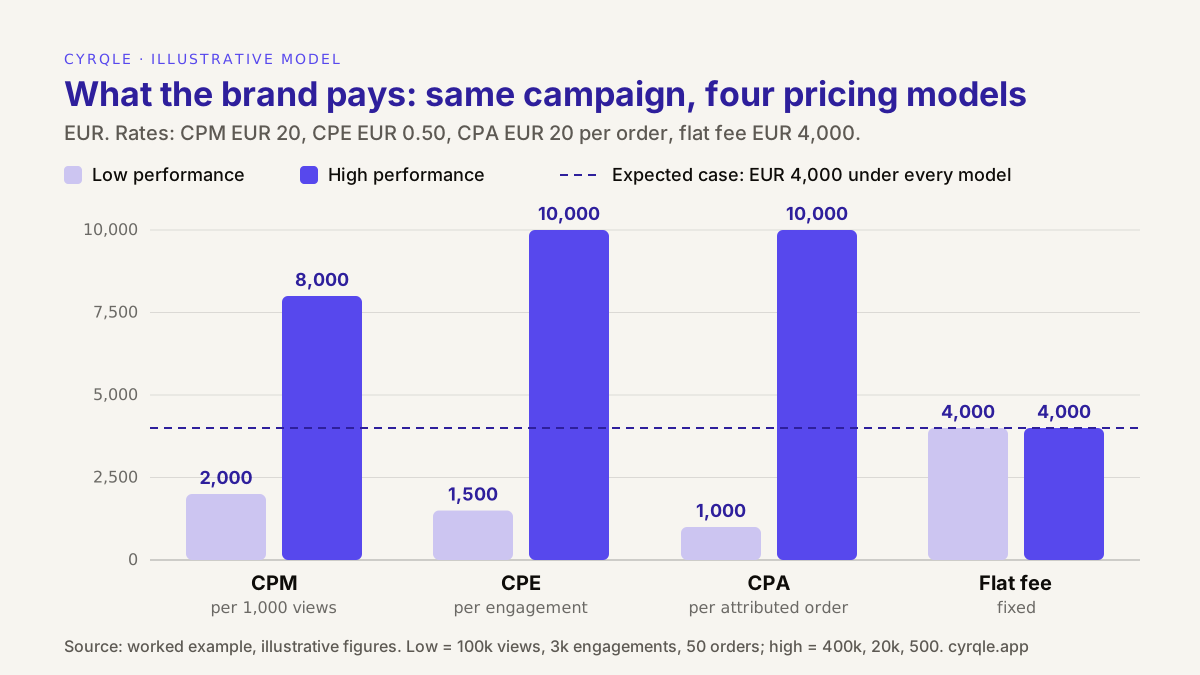
Three readings matter.
- The flat fee is the cheapest model when the campaign over-delivers and the most expensive when it under-delivers. You pay EUR 4,000 either way. In the low case that is EUR 80 per order; in the high case it is EUR 8.
- CPE and CPA swing more than CPM. In the high case the viral Reel lifts views, the engagement rate and conversions together, so a per-engagement or per-order rate compounds. That is why performance deals need a cap.
- Only CPA fixes your cost per order. It is EUR 20 in every scenario, because that is the rate. Your return on spend before product cost stays at 4.0. Under the flat fee the same number runs from 1.0 to 10.0.
Cost per attributed order makes the trade visible:
| Cost per attributed order | Low | Expected | High |
|---|---|---|---|
| CPM | EUR 40 | EUR 20 | EUR 16 |
| CPE | EUR 30 | EUR 20 | EUR 20 |
| CPA | EUR 20 | EUR 20 | EUR 20 |
| Flat fee | EUR 80 | EUR 20 | EUR 8 |
Illustrative figures.
The full cost of a collaboration is more than the creator line. The true cost of a creator collaboration adds IVA, IRPF withholding, product and platform fees on top of these numbers.
Who carries the risk under each model?
Every creator campaign carries four risks: the post is not seen, it is seen but ignored, it is liked but does not sell, and a sale happens but is not tracked. The pricing model decides who absorbs each one.
| Flat fee | CPM | CPE | CPA / commission | |
|---|---|---|---|---|
| Post is seen by fewer people than expected (reach risk) | Brand | Creator | Creator | Creator |
| Post is seen but nobody interacts (engagement risk) | Brand | Brand | Creator | Creator |
| People interact but do not buy (conversion risk) | Brand | Brand | Brand | Creator |
| A sale happens but is not attributed (tracking risk) | Nobody: payment does not depend on it | Nobody | Nobody | Creator |
| Who keeps the upside of a viral post | Brand | Shared | Mostly creator | Mostly creator |
| What you must be able to verify | Posts went live as briefed | Views per post | Engagements, by type | Orders, net of refunds |
| Main failure mode | Paying full price for a post nobody saw | Paying for cheap, off-target views | Paying for giveaway comments and engagement pods | Disputes over attribution; strong creators decline |
Two points are easy to miss.
CPA moves risks the creator cannot control. Conversion depends on your price, stock, delivery times and checkout. If your site is slow on launch day, a CPA creator loses money for your mistake. Creators know this, so good ones either refuse pure CPA or ask for a rate high enough to cover it.
Tracking risk is real money under CPA. If a buyer sees the Reel, opens Safari later and types your URL, a code or link may miss the sale. Under a flat fee that does not matter. Under CPA the creator is not paid for it. Write the rules down: which signals count (code, link, pixel), the attribution window, and whether refunds are netted out. Our comparison of discount codes, tracking links and the pixel covers which signal catches which sale.
Why do creators price risk into their rate?
A creator who carries risk wants to be paid for it. Look at the example from the creator's side: under the flat fee the five creators earn EUR 4,000 in every case. Under CPA they earn between EUR 1,000 and EUR 10,000. Both have the same expected value in this model, but a creator who has to pay rent prefers the certain EUR 4,000.
That has three practical effects:
- Pure CPA attracts the creators who need you least or the creators who sell least. Established affiliate creators with proven conversion can accept it. Creators without sales history often decline, or accept and then put little effort into the post.
- A fair CPA rate is above the "expected" rate. If you want an established creator on pure performance terms, expect to pay a premium per order compared with a hybrid.
- Rate cards are usually quoted as a flat fee. Market rates in Spain are discussed in our guide to what influencers charge in Spain in 2026. Use the flat rate as your anchor and convert it into CPM or CPA terms to see what you are really buying.
The hybrid: a base fee plus commission
Many sales campaigns end up with a hybrid. In our example, a base fee of EUR 2,000 plus EUR 10 per attributed order (12.5% of the basket) gives:
| Low | Expected | High | |
|---|---|---|---|
| Creator earnings, hybrid | EUR 2,500 | EUR 4,000 | EUR 7,000 |
| Brand cost per order | EUR 50 | EUR 20 | EUR 14 |
Illustrative figures.
The creator has a floor that covers the work. You have a cost that rises with sales, but more slowly than under pure CPA. The upside is shared. The four compensation models covers fixed fee, revenue share, seeding and hybrid deals by vertical.
Which pricing model fits your objective?
Choose the model from the one objective the campaign is judged on. If you judge a campaign on sales but pay for views, the creator is rewarded for something you do not value. Our guide to influencer marketing KPIs by objective sets out which metric belongs to which goal.
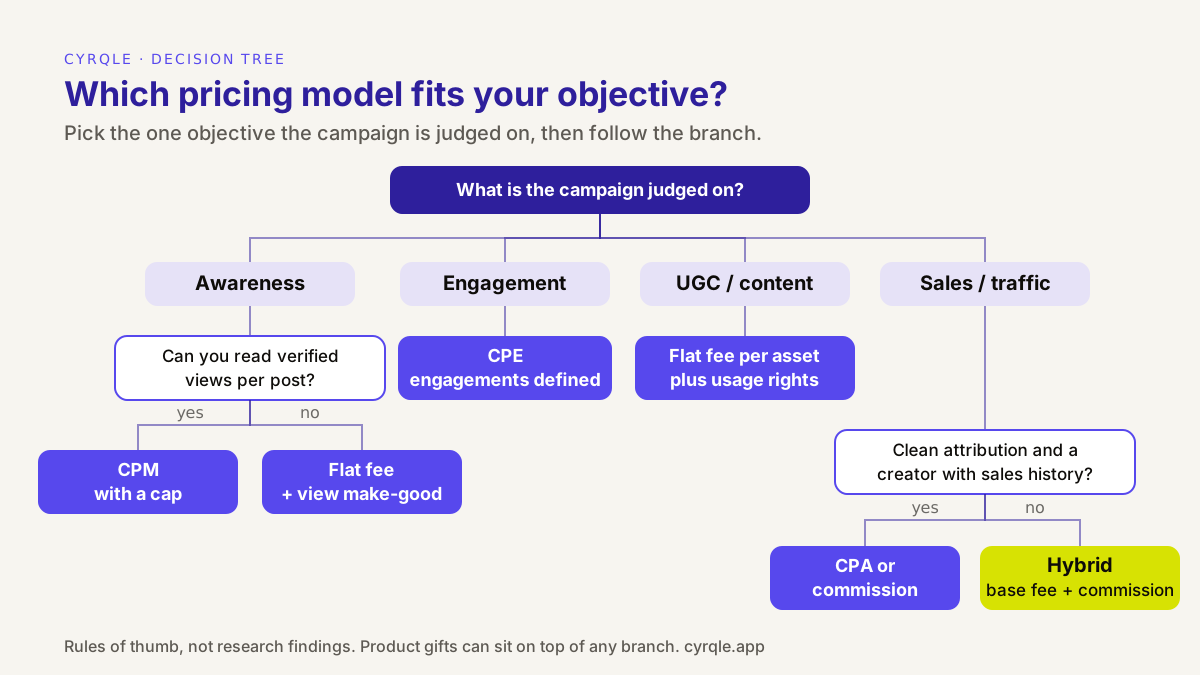
- Awareness. CPM, if you can read verified views for every post, for example from the creator's insights or a connected account. Add a cap so a viral post does not blow the budget. If you cannot verify views, pay a flat fee and add a make-good clause: an extra post if views land below an agreed floor.
- Engagement. CPE, but only with a definition. Say whether likes count, or only comments, shares and saves. Exclude comments generated by a giveaway unless the giveaway is the point.
- UGC and content. A flat fee per asset. You are buying the video, not its reach, so a per-view rate makes no sense. Price the usage rights and any paid-ads use as separate lines.
- Sales or traffic. CPA or commission when your tracking is clean and the creator has a sales history. Otherwise a hybrid. For traffic goals the same logic applies with a cost per click, which is CPA with the click as the action.
Caps, floors and windows to write into any performance deal
Whatever model you pick, put these five terms in the contract:
- The metric and its source. "Views as shown in Instagram insights, screenshot within 7 days of posting" or "orders attributed through the creator's code or link".
- The measurement window. For example 30 days from the post date for views, and a fixed attribution window for orders.
- A cap. The maximum the brand pays, so a viral post does not exceed the budget.
- A floor, if any. A minimum fee, or a make-good post, so the creator is not paid nothing for work delivered as briefed.
- Refunds and fraud. Orders refunded within the return period are deducted; engagement from bought likes or pods is excluded.
How CPM, CPE and CPA map to deal types in cyrqle
cyrqle sets up a deal as one of three building blocks or a combination: Cash payment, Commission on every sale and Product gift, plus the combos Cash & commission, Cash & product, Commission & product and Cash, commission & product. In the brief these appear as Fixed fee, Affiliate / commission and Free product.
| Pricing model | cyrqle deal type | How you use it |
|---|---|---|
| Flat fee | Cash payment | Agree a fixed amount for the deliverables. Product can be added with Cash & product |
| CPM or CPE | Cash payment | Use the rate to set the cash amount from expected views or engagements. cyrqle does not pay per view or per engagement automatically |
| CPA or commission | Commission on every sale | Set a commission percentage. Commission owed is calculated from attributed sales and shown in reports |
| Hybrid | Cash & commission | A fixed fee plus a commission percentage |
| Seeding | Product gift | Product only, or combined with cash or commission |
The honest limit: cyrqle has no per-view or per-engagement payout. If you agree a CPM or CPE deal, you convert it into a cash amount, or you agree a bonus and add it yourself after you check the numbers.
How cyrqle helps
In Compensation, you choose the deal type on the offer before you invite anyone; invites stay blocked until compensation is complete. The creator signs a Creator Collaboration Agreement with the terms frozen at signature, so the compensation terms are on record. Write the cap, metric and window into the contract terms or brand terms you attach.
For the fixed part, you fund the campaign wallet and cyrqle schedules each payout when the creator delivers. A person triggers settlement. Creators in Europe and the US are paid to their bank through Stripe Connect, in EUR.
For the commission part, Attribution gives each creator a promo code and a tracking link, and a tag under 2KB on your store, the Shopify custom pixel and signed order webhooks tie orders back to the creator. Every sale gets a confidence tier and revenue is net of refunds. The commission owed appears in reports as Affiliate / rev-share owed. cyrqle calculates it; paying it is a separate step that you trigger. Paying commission to creators every month walks through that routine.
For CPM checks, the campaign's Posts tab in Campaigns shows views, engagement and an effective cost per thousand views against a paid-ads benchmark for each published Instagram and TikTok post. You can see whether a flat-fee deal turned out cheap or expensive in CPM terms, and use that when you set the next rate. Stories are not tracked automatically, so ask for insight screenshots if they are part of the deal.
To see how a hybrid offer is set up on a campaign in your category, book a 30-minute demo.
FAQ
What is the difference between influencer CPM and CPA?
CPM pays a rate for every 1,000 views of a creator's post. CPA pays a rate for every attributed order or sign-up. Under CPM the creator carries the reach risk and the brand carries the conversion risk. Under CPA the creator carries both, plus the risk that a sale is not tracked, so creators usually ask for a higher rate or a base fee.
Which creator pricing model is cheapest?
None in every case. In our illustrative campaign all four cost EUR 4,000 in the expected case. A flat fee is cheapest when the posts over-deliver; CPA is cheapest when they under-deliver. Pick the model whose risk you can carry, not the one that looks cheapest on paper.
Is CPE a good model for creator campaigns?
It works when engagement is the objective and the contract defines what counts. Exclude giveaway comments and engagement pods, and cap the total. For sales goals, CPE pays for a signal that does not reliably turn into orders.
Should I pay creators per view?
Only if you can verify views for every post and awareness is the goal. Name the metric and its source, set a measurement window and add a cap. If you cannot verify views, pay a flat fee with a make-good clause instead.
How do I combine a flat fee and commission?
Set a base fee that covers the creator's work, then add a commission per attributed sale. In our example, EUR 2,000 plus EUR 10 per order pays the creator EUR 2,500 to EUR 7,000 across the low and high cases. Write the attribution signals, window and refund rule into the contract.
Sources
- Meta, Instagram Platform changelog, entry of 21 January 2025 (views metric added; impressions and plays deprecated on all versions from 21 April 2025): https://developers.facebook.com/docs/instagram-platform/changelog
Related field notes.
How much do influencers charge in Spain? Illustrative 2026 fee bands by tier and format, the levers that move price, and how to compare quotes by effective CPM.
Influencer marketing budget planning for 2027, built bottom-up: objectives, tier mix, pricing model, seasonal peaks in Spain and Mexico and a worked euro model.
Followers tell you how many people once pressed a button. Views tell you how many people see a post today. How to compare creators on median views, effective CPM and consistency, with a worked example.