
The true cost of a creator collaboration: fee, commission, withholding, IVA and fees
The cost of an influencer collaboration in Spain, worked in euros: fee, commission, product, IRPF withholding, IVA, and payment, platform and agency fees.
The cost of an influencer collaboration is not the fee on the offer. It is the fee, plus commission on the sales the creator drives, plus the product you send, plus payment, platform and agency fees. Two other lines move cash without adding cost when handled correctly: IRPF withholding, which you pay to the tax authority instead of the creator, and IVA, which a fully deductible business recovers.
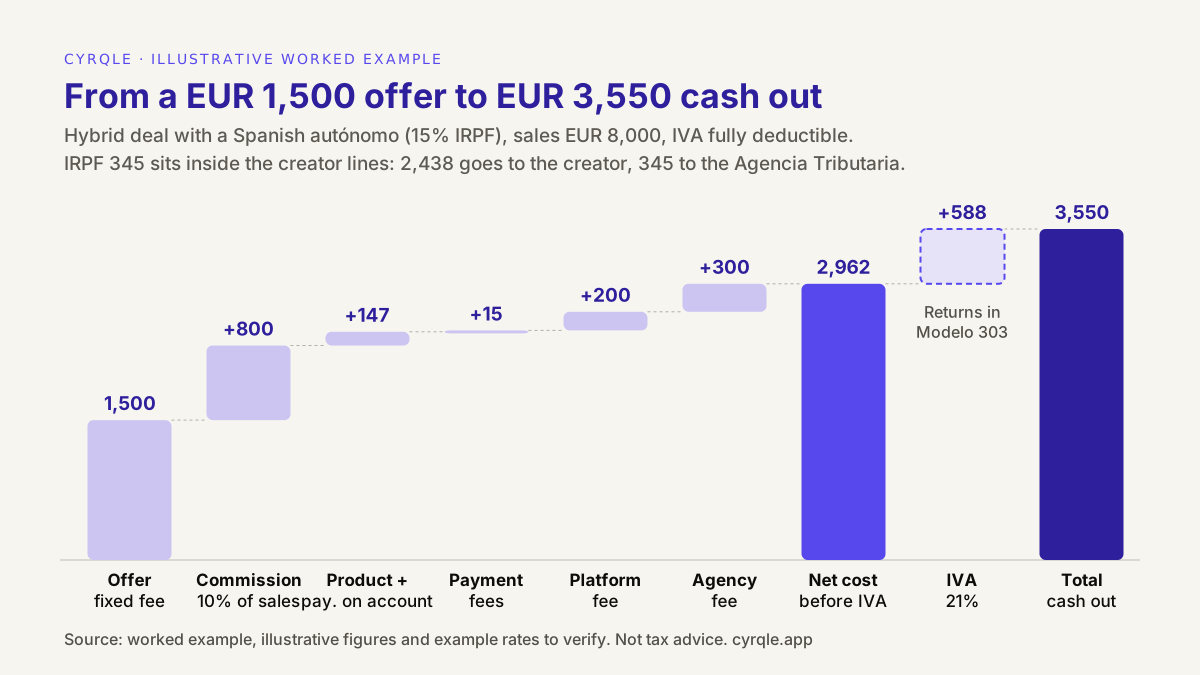
Picture a skincare brand in Valencia that offers a micro creator in Madrid EUR 1,500 for a reel and three stories, plus 10% of the sales her code drives. Marketing budgets EUR 1,500. Finance later sees EUR 3,550 leave the bank, and the controller asks what happened. Nothing went wrong. The budget just counted one line out of nine.
This post is a calculator in article form. It walks one deal from offer to cash out, line by line, separates true cost from cash flow, and then compares a fixed, a commission and a hybrid deal. Every rate here is an example to verify: tax rates are the ones in force when we checked the sources listed at the end, and the fee rates are illustrative. It is not tax advice; your gestor or tax advisor should confirm the treatment for your company.
What are the lines in a creator collaboration's cost?
A creator collaboration in Spain has up to nine cost lines. Seven are economic costs (the first two always, the product and its payment on account whenever you send stock, the last three depending on how you run the programme), and two are taxes that pass through your account. Sort them before you add them up, because only some of them belong in the budget.
| Line | What it is | True cost or cash flow? |
|---|---|---|
| Fixed fee | The agreed fee for the deliverables, before tax | Cost |
| Commission | A percentage of attributed sales, paid after the sales settle | Cost |
| Product | What the product you send costs you (not its retail price) | Cost |
| Payment on account on product | Withholding on the market value of product given to a professional creator | Cost, unless the contract passes it to the creator |
| Payment fees | What the bank or payout provider charges per transfer | Cost |
| Platform fee | The software share of the collaboration, or a take rate on payments | Cost |
| Agency fee | The agency's fee for running the creator, if you use one | Cost |
| IRPF withholding | 15% (or 7%) kept back from a Spanish professional's fee and paid to the tax authority | Cash flow: part of the fee, not on top |
| IVA | 21% on Spanish invoices, or self-assessed under the reverse charge | Cash flow if fully deductible; partly cost if not |
Rates checked against the BOE consolidated texts listed under Sources. The fee lines carry no fixed rate: they depend on your providers.
Before you start, two inputs come from other work. The fee itself depends on the creator, format and market; our guide to influencer rates in Spain in 2026 covers how to set it. The tax treatment depends on who invoices you; how to pay influencers in Spain sets out the IRPF and IVA rules scenario by scenario. This post uses the most common case: a Spanish autónomo registered in a professional activity, who invoices 21% IVA and gets 15% IRPF withheld.
The worked example: one hybrid deal, from offer to cash out
The deal: a micro creator, a Spanish autónomo in a professional activity, posts one reel and three stories for a skincare launch. The brand pays a fixed fee plus revenue share on the sales her code and link drive, and sends two products to feature. The brand is a Spanish company that can deduct IVA in full. All figures are illustrative.
Step 1: the fee and the commission
| Line | Basis (example rates) | Amount |
|---|---|---|
| Fixed fee | Agreed in the brief | EUR 1,500 |
| Attributed sales | Net of IVA and returns, after the return window | EUR 8,000 |
| Commission | 10% of attributed sales | EUR 800 |
| Creator taxable base | Fee + commission | EUR 2,300 |
Write the commission base into the contract: net of IVA, after returns, inside a stated attribution window. "10% of sales" without a base invites a dispute over EUR 168 when the creator reads 10% of gross sales with IVA. How you count those sales matters too; our comparison of discount codes, tracking links and the pixel explains what each method catches and misses.
Step 2: the product and its payment on account
The brand sends two products with a retail value of EUR 180 and a cost of EUR 120. For a professional creator, product given in exchange for content is income in kind, and the payer makes a payment on account on its market value (Article 104 of the IRPF regulation). At 15%, that is EUR 27, paid to the Agencia Tributaria.
| Line | Basis | Amount |
|---|---|---|
| Product cost | Two units at cost price | EUR 120 |
| Payment on account | 15% of EUR 180 market value | EUR 27 |
| Product line | EUR 147 |
The EUR 27 is a cost unless the contract says the creator bears it. The barter can also carry IVA on both sides; we leave it out of the numbers because the treatment depends on the case, so ask your gestor how to document it.
Step 3: fees around the payment
| Line | Basis (illustrative) | Amount |
|---|---|---|
| Payment fees | Two payouts: fee at delivery, commission after the return window | EUR 15 |
| Platform fee | Share of the software cost allocated to this collaboration | EUR 200 |
| Agency fee | Agency's fee for this creator | EUR 300 |
| Fees | EUR 515 |
Payment fees depend on the provider and on who carries them. As one public reference, Stripe's Connect pricing for Spain lists 0.25% + EUR 0.10 per payout and EUR 2 per monthly active account when the platform sets its own pricing. A platform may pass these through, absorb them or add a margin, so ask. Our breakdown of influencer platform pricing and its hidden lines covers take rates and pass-through fees in detail.
Step 4: from net cost to cash out
Add the cost lines: EUR 2,300 + 147 + 515 = EUR 2,962 net cost. That is the number for the budget and for ROAS.
Now the taxes that pass through. The creator's invoice adds 21% IVA on EUR 2,300 (EUR 483). The platform and agency invoices, if they are Spanish, add 21% on EUR 500 (EUR 105). Total IVA: EUR 588. Cash out: EUR 3,550.
The IRPF does not add a line. It splits one. Of the EUR 2,300 the creator earns, you withhold 15% (EUR 345) and pay it to the Agencia Tributaria in your Modelo 111. The rest goes to the creator.
Where does each euro go, and when?
The table below follows the EUR 3,550 to each recipient. It is the view finance needs to schedule transfers.
| Recipient | Calculation | Amount | When |
|---|---|---|---|
| Creator, payout 1 | 1,500 + 315 IVA - 225 IRPF | EUR 1,590 | On delivery |
| Creator, payout 2 | 800 + 168 IVA - 120 IRPF | EUR 848 | After the return window |
| Agencia Tributaria (Modelo 111) | 345 IRPF + 27 payment on account | EUR 372 | Quarterly return after the payment |
| Platform | 200 + 42 IVA | EUR 242 | Per its invoice |
| Agency | 300 + 63 IVA | EUR 363 | Per its invoice |
| Payment provider | Payout fees | EUR 15 | With each payout |
| Product | Stock at cost | EUR 120 | When shipped |
| Total cash out | EUR 3,550 | ||
| IVA recovered (Modelo 303) | -EUR 588 | Quarterly return | |
| Net cost | EUR 2,962 |
Two timing points matter. Withholding is your debt as payer, not the creator's: if you transfer EUR 2,783 (fee plus IVA, no withholding) and forget the Modelo 111, the tax authority can still claim the EUR 345 from you, and that turns cash flow into cost. And IVA recovery lags: you pay the IVA when you pay the invoices and offset it in the next quarterly Modelo 303. Large companies file monthly.
The invoices behind each line need the right fields, or the IVA is not deductible at all. Run the creator's invoice through the influencer invoice checklist for Spanish brands before you release payout 1.
When is IVA a real cost?
IVA is a real cost when your company cannot deduct it in full. A business whose sales are all subject to IVA, like most retailers and consumer brands, deducts the IVA on creator, platform and agency invoices in its Modelo 303, so it costs nothing beyond the cash-flow delay. A business with IVA-exempt activities, such as banks, insurers, private healthcare or education providers (exemptions in Article 20 of Ley 37/1992), deducts only a share, set by the pro-rata rules in Articles 102 to 106.
| Brand's IVA position | IVA recovered | Net cost of the example |
|---|---|---|
| Fully deductible (most retail and consumer brands) | EUR 588 | EUR 2,962 |
| Partly deductible, 40% pro-rata (example rate) | EUR 235.20 | EUR 3,314.80 |
| No deduction right (fully exempt activity) | EUR 0 | EUR 3,550 |
For a partly exempt brand, budget the non-recoverable IVA as cost. Your finance team knows the pro-rata percentage for the current year.
Creators and vendors established outside Spain do not charge Spanish IVA. You self-assess it under the reverse charge and, if fully deductible, deduct it in the same return, so cash out falls by the IVA amount and the net cost stays the same. Non-resident creators also change the withholding: non-resident income tax at a default 19% (EU and EEA) or 24% (elsewhere), unless a tax treaty and a residence certificate remove it. Our guide to paying creators in the EU, the UK and Latin America works through those cases.
Fixed, commission or hybrid: which deal costs less?
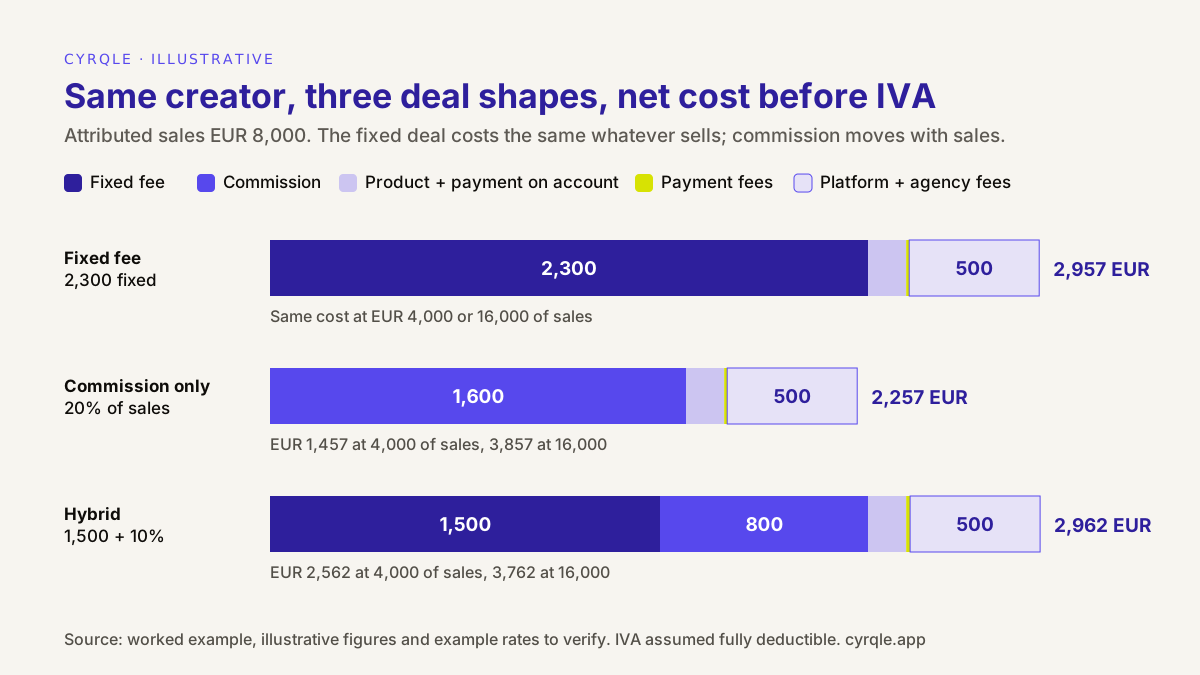
No deal shape is cheapest in general; it depends on how much the creator sells. A fixed fee costs the same whatever happens. Commission only is cheap when sales are low and expensive when they are high. A hybrid sits between. The figure compares three deals with the same creator at EUR 8,000 of attributed sales, with the same product and fee lines.
| Net cost before IVA (illustrative) | Sales EUR 4,000 | Sales EUR 8,000 | Sales EUR 16,000 |
|---|---|---|---|
| Fixed fee EUR 2,300 | EUR 2,957 | EUR 2,957 | EUR 2,957 |
| Commission only, 20% | EUR 1,457 | EUR 2,257 | EUR 3,857 |
| Hybrid, EUR 1,500 + 10% | EUR 2,562 | EUR 2,962 | EUR 3,762 |
| Cost per euro of sales, hybrid | 0.64 | 0.37 | 0.24 |
Each row adds the same EUR 147 product line and EUR 500 of platform and agency fees; the fixed and commission-only deals have one payout (EUR 10 in fees), the hybrid two (EUR 15).
Read the table as a risk map. The fixed fee puts all the sales risk on you: at EUR 4,000 of sales you pay EUR 2,957 for them. Commission only puts it on the creator, which is why established creators may refuse it or ask for a higher percentage. The hybrid shares it: the fixed part pays for the work, the commission rewards the result. Whatever you choose, the cost per euro of sales falls as sales rise, because the fixed lines spread over more revenue.
Two costs this model leaves out on purpose. First, the discount itself: if the creator's code gives 15% off, that discount is margin you give up on every attributed order, and on EUR 8,000 of sales it can exceed the commission. Second, extras such as paid usage rights, exclusivity and rush fees, which can add a large share to the base fee. Add both when they apply.
The calculator in one table
Copy this into a spreadsheet, one row per line. Replace the example rates with yours and with the rates your gestor confirms.
| Line | Formula | Example |
|---|---|---|
| A. Fixed fee | Agreed fee | 1,500 |
| B. Commission | Commission rate x attributed net sales | 10% x 8,000 = 800 |
| C. Product | Units x unit cost | 2 x 60 = 120 |
| D. Payment on account | IRPF rate x product market value (professional creators) | 15% x 180 = 27 |
| E. Payment fees | Provider's fee per payout x payouts | 15 |
| F. Platform fee | Allocated licence share, or take rate x (A + B) | 200 |
| G. Agency fee | Retainer share, or agency rate x (A + B) | 300 |
| Net cost | A + B + C + D + E + F + G | 2,962 |
| H. IRPF withheld | 15% (or 7%) x (A + B) | 345, cash flow only |
| I. IVA | 21% x (A + B + F + G) on Spanish invoices | 588 |
| Cash out | Net cost + I | 3,550 |
| J. Non-recoverable IVA | I x (1 - deductible share) | 0 if fully deductible |
| True cost | Net cost + J | 2,962 |
Then divide true cost by attributed sales for cost per euro of sales, or invert it for ROAS: EUR 8,000 / 2,962 is about 2.7 on this illustrative deal.
How cyrqle helps
cyrqle keeps the deal terms, the payout split and the attributed sales for each collaboration in one workspace, so the lines above come from records, not a reconstructed spreadsheet. It does not decide your tax treatment, collect tax forms or file returns. That stays with your finance team and your gestor.
- Deal terms in the brief. In compensation and contracts, you set the deal type: Cash payment, Commission on every sale, Product gift, or a combination such as Cash & commission. Invites stay blocked until compensation is complete, so every creator receives terms before they say yes.
- A split per payout. Each payout records the creator net, the cyrqle commission, any agency fee and any tax withheld, with a statement or invoice per payout. Finance can match it to the creator's invoice and to the Modelo 111.
- Commission from attributed sales. Each creator gets a promo code and a tracking link, and the attribution view ties orders back to them. Commission owed appears in reports as "Affiliate / rev-share owed". It is calculated and shown, not paid automatically: paying it is a separate step a person takes.
- Payouts in euros. You fund the campaign wallet, cyrqle schedules a payout when a creator delivers, and a person on your side releases it. Creators in Europe and the US get paid to their bank through Stripe Connect; for creators elsewhere, you pay by bank transfer and record it.
Platform plans are quoted after a short call; the pricing page explains how they are structured. If you want to see the payout split on your own deal shapes, book a 30-minute demo.
FAQ
How much does an influencer collaboration really cost?
More than the fee. Add commission on attributed sales, product at cost, any payment on account on that product, and payment, platform and agency fees. In our illustrative hybrid deal, a EUR 1,500 offer becomes a EUR 2,962 net cost. IVA adds to the cash you send out but comes back if your company deducts it in full.
Is IRPF withholding an extra cost for the brand?
No, as long as you withhold it. The 15% (or 7%) comes out of the creator's fee: you pay it to the Agencia Tributaria instead of the creator. It becomes a cost only if you pay the creator the full amount and then have to pay the withholding yourself. Payments on account on gifted product are different: they are a cost unless the contract passes them to the creator.
Should the IVA be in my creator budget?
Only the part you cannot recover. Most consumer brands deduct IVA in full, so the budget should use net amounts and finance should plan the cash for the IVA until the next Modelo 303. Banks, insurers and other partly exempt businesses should budget the non-recoverable share as cost.
Is commission cheaper than a fixed fee?
It depends on sales. In our illustrative comparison, 20% commission costs EUR 1,457 at EUR 4,000 of sales and EUR 3,857 at EUR 16,000, while a EUR 2,300 fixed fee costs EUR 2,957 either way. Model your deal at low, expected and high sales before you pick a shape.
Should commission be calculated on sales with or without IVA?
Agree it in the contract. We suggest calculating commission on sales net of IVA and returns, after a stated return window, because that is the revenue the brand keeps. Without a written base, a 10% commission can differ by over a fifth depending on who reads it.
Sources
- Real Decreto 439/2007, Reglamento del IRPF (Articles 95 and 104, withholding rates and payments on account): BOE-A-2007-6820
- Ley 37/1992, del IVA (Article 20 exemptions, Article 84 reverse charge, Article 90 rate, Articles 102 to 106 pro-rata): BOE-A-1992-28740
- Real Decreto Legislativo 5/2004, Ley del IRNR (Article 25, non-resident rates): BOE-A-2004-4527
- Agencia Tributaria, Modelo 111
- Stripe, Connect pricing (Spain), per-payout and monthly active account fees, checked 3 November 2026: stripe.com/es/connect/pricing
This article is not tax advice. Tax rates and rules change; check every rate with your gestor or tax advisor before you budget.
Related field notes.
An agency paying influencers on behalf of a client must settle who funds, who invoices, who withholds IRPF and how its fee shows. Worked EUR 1,000 payout split.
How to pay international influencers from Spain: invoice and withholding by creator country, payment rails and bank fees, who pays FX, and where Stripe works.
How to pay influencers in Spain as a brand: what the invoice must show, when you withhold IRPF, how IVA works for EU and non-EU creators, and gifted products.