
How much should you pay a micro-influencer? A negotiation guide for brands
How much to pay micro influencers: price on median views and on-topic reach, set an opening offer and a walk-away point, and compare gifting, fee and hybrid.
Pay a micro-influencer for the views your post will actually get from the people you want to reach, not for their follower count. Take the median views of their recent posts, keep only the share that matches your market and category, and multiply each thousand of those on-topic views by a target CPM. As an illustrative guide for Spain, that lands most micro creators between EUR 150 and EUR 800 per Reel, and some below the point where a cash fee makes sense at all.
Follower count is where most quotes start, and it is a poor guide. A skincare creator in Sevilla with 22,000 followers can get more views per Reel than a lifestyle account in Madrid with 82,000. If you pay both on followers, you pay the bigger account nearly four times more for a fifth of the views.
This guide is for brand and agency teams buying micro creators in Spain, the EU and Latin America. It shows how to price a creator on median views and on-topic reach, when gifting, a fixed fee or a hybrid deal is cheaper, how to set an opening offer and a walk-away point, and what to trade instead of cash. It ends with a worked example for a cluster of 20 micro creators. Every number in the example is illustrative.
What counts as a micro-influencer, and why does the price vary so much?
A micro creator is usually defined as an account with roughly 10,000 to 100,000 followers. Some price guides stop the band at 50,000, so check which definition a quote or a benchmark uses before you compare them.
Inside that band, follower count predicts price badly because it predicts reach badly. Recommendation feeds on Instagram and TikTok show posts to people who do not follow the account, and hide them from many who do. The result is a band where two creators with the same following can deliver a tenfold difference in views.
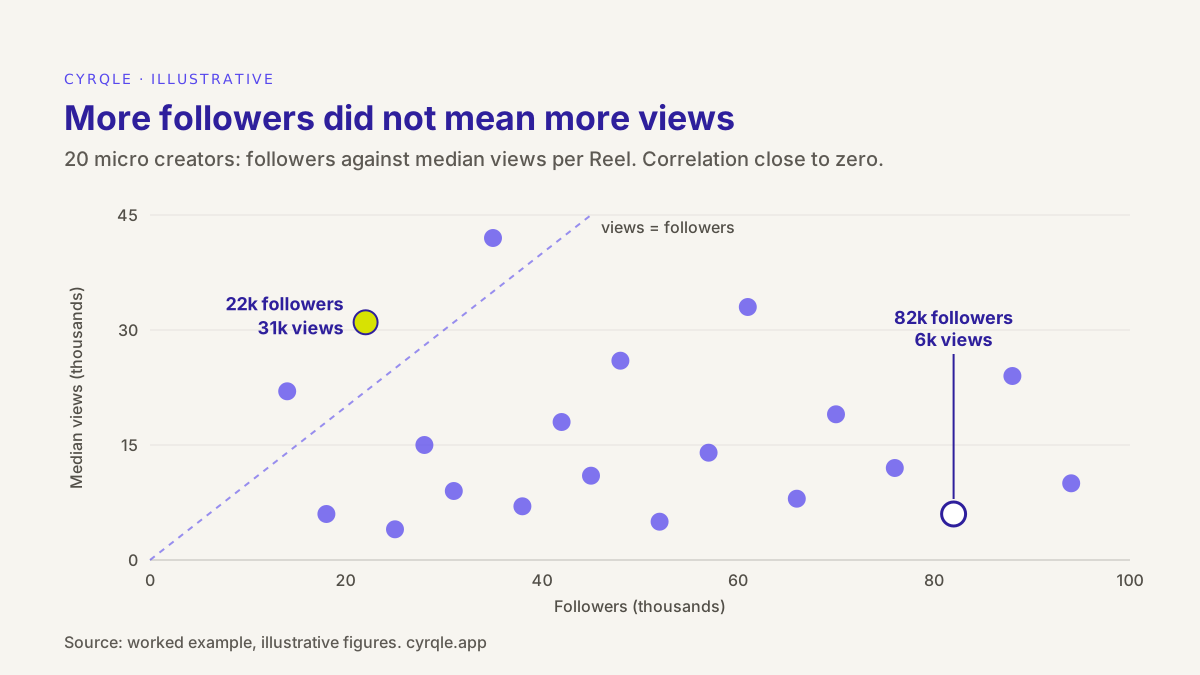
In this illustrative sample of 20 creators, the correlation between followers and median views is close to zero. That is an exaggeration chosen to make the point visible, but the pattern is common enough that our case for audience signal over follower count makes it the first rule of creator selection. Published price guides for Spain are still organised by follower bands; our overview of what influencers charge in Spain in 2026 compares them and shows how far they disagree.
How do you price a micro creator on views instead of followers?
Price a micro creator in four steps: find their median views, estimate the on-topic share, apply a target CPM, and check the result against a floor and a ceiling. The output is a fee you can defend line by line.
Fee = median views × on-topic share ÷ 1,000 × target CPM
Step 1: Median views of recent posts
Take the last 10 to 20 posts of the format you are buying, or the last 60 to 90 days. Sort the views and take the middle value. Use the median, not the average, because one viral Reel can double the average and will probably not repeat. Our guide to choosing creators by median views and effective CPM explains the method in more detail.
Step 2: The on-topic share
On-topic reach is the part of a creator's views that comes from the people you sell to: the right market, the right language and an interest in your category. A Valencia-based running creator whose audience is mostly in Spain and who posts about running in most of their content has a high on-topic share for a running brand. The same creator has a low share for a skincare brand.
You can estimate the share from three sources:
- Content mix. What share of recent posts are about your category? A creator who posts about skincare one time in ten is a weaker buy than one who does every week.
- Audience location. Ask the creator for a screenshot of the top countries and cities in their insights. It takes them a minute and it is the most honest check you have.
- Comments. Read 50 comments on recent posts. Language, location hints and questions about products tell you who is watching.
Step 3: A target CPM
The target CPM is what you are willing to pay for each thousand on-topic views. Set it against your own paid social cost for the same audience, then add a premium for what a creator gives you that an ad does not: content you can reuse, a trusted voice and comments from real people. In this guide we use an illustrative target of EUR 20 per 1,000 on-topic views. Your number depends on your category, market and margins.
Step 4: A floor and a ceiling
A floor is the minimum cash fee that is worth a contract, an invoice and a payout. Below it, the admin costs more than the post. We use EUR 150 in the example, which matches the bottom of the illustrative micro band in Spain. A ceiling is the CPM above which you would rather buy ads or another creator. We use EUR 30.
Gifting, fixed fee or hybrid: which is cheaper for micro creators?
Gifting is cheapest per view, a fixed fee is the most predictable, and a hybrid deal sits between them. Which one wins depends on how likely a gifted creator is to post, how much the fee is, and how much the creator can sell.
| Gifting only | Fixed fee | Hybrid (fee + product + commission) | |
|---|---|---|---|
| What you pay | Product cost and shipping | Agreed fee per deliverable, plus product | Smaller fee, product, commission on attributed sales |
| Post guaranteed | No | Yes, with format and date | Yes, for the fee part |
| Brief and draft control | Little or none | Full, as contracted | Full, as contracted |
| Usage rights | None unless agreed in writing | As written in the contract | As written in the contract |
| Creator incentive to sell | Low | Low after posting | High: commission on each sale |
| Best for | Launches, sampling, building relationships | Fixed dates, awareness, content you will reuse | Sales objectives with a code or tracking link |
Break-even: gifting versus a fee
The real cost of gifting is the cost per post, not the cost per box. If you send a product that costs you EUR 28 landed (product cost plus shipping and packing) and three in ten creators post, each post costs you about EUR 93.
Gifting cost per post = landed cost per box ÷ post rate
Break-even post rate = landed cost per box ÷ fee you would otherwise pay
Against a EUR 150 fee, gifting is cheaper per post as long as more than about 19% of gifted creators post (28 ÷ 150). Against a EUR 500 fee, the break-even falls to under 6%. So gifting looks cheap on paper almost every time. What it does not buy is a date, a format, a brief, rights to reuse the content or a guaranteed post. The economics of seeding versus hybrid programs covers where that trade still makes sense.
Gifted posts are not exempt from disclosure. Spain's e-commerce law requires electronic commercial communications to be "claramente identificables como tales" (LSSI, article 20). The extra duties in Real Decreto 444/2024 apply only to creators with at least EUR 300,000 in income from the activity and at least 1,000,000 followers on one platform or 2,000,000 combined (BOE-A-2024-8716, articles 3 and 4), so they rarely cover micro creators. Our explainer on Real Decreto 444/2024 for brands has the detail. This is not legal advice: for a specific campaign, ask your lawyer.
Break-even: hybrid versus a fixed fee
A hybrid deal swaps part of the fee for commission. It costs more than the fixed fee only when the creator sells enough to earn back the difference, and then you are paying out of revenue you would not otherwise have.
Hybrid break-even sales = fee reduction ÷ commission rate
If a creator would accept EUR 620 fixed, or EUR 500 plus 10% commission, the hybrid costs more only after EUR 1,200 of attributed sales (120 ÷ 0.10). For most micro creators that is a good bet for both sides: the creator keeps an upside, and you only pay more when the post has already paid for itself.
How do you set an opening offer and a walk-away point?
Set both numbers before the first message, from the same formula. The opening offer is the fee at your target CPM. The walk-away point is the fee at your ceiling CPM. Everything between them is room to negotiate, and you should know in advance what you will trade to move through it.
Opening offer = on-topic views ÷ 1,000 × target CPM (but never below your floor)
Walk-away point = on-topic views ÷ 1,000 × ceiling CPM
If a creator's walk-away point is below your floor, do not offer cash at all. Offer product and commission, or move on. The creator is not worse for it; they are simply a better fit for a gifting or affiliate deal than for a paid post.
Here is the method on four creators from the illustrative cluster, at a EUR 20 target CPM, a EUR 30 ceiling and a EUR 150 floor. Fees are rounded to the nearest EUR 10.
| Creator | Followers | Median views | On-topic share | On-topic views | Follower-based fee (EUR 8 per 1,000) | Opening offer | Walk-away point |
|---|---|---|---|---|---|---|---|
| 3 | 22,000 | 31,000 | 80% | 24,800 | EUR 176 | EUR 500 | EUR 740 |
| 7 | 35,000 | 42,000 | 60% | 25,200 | EUR 280 | EUR 500 | EUR 760 |
| 13 | 57,000 | 14,000 | 75% | 10,500 | EUR 456 | EUR 210 | EUR 320 |
| 18 | 82,000 | 6,000 | 70% | 4,200 | EUR 656 | No cash: product and commission | EUR 130, below the floor |
All figures illustrative. Creator 3 would be underpaid on followers and could fairly ask for more; creator 18 would be paid five times what their views justify. A view-based offer is not just a way to pay less. It moves money from accounts that look big to accounts that are actually seen.
How the conversation usually goes
- Lead with the reason, not the number. "We price on recent median views in Spain. Your last 15 Reels have a median of 31,000, and most of your audience is here." A creator can argue with a number; it is harder to argue with their own insights.
- Make the opening offer and the package clear. One Reel, three stories, organic use, draft review, publish window, payment terms.
- Let the creator counter, then trade, do not split. If the counter is above your opening offer, move by adding something from the trade list below, not by halving the gap.
- Stop at the walk-away point. If the creator's price is above it, thank them and say why. A creator who prices above your ceiling is not wrong; they are for a brand with a higher ceiling.
Creators are often working from the same arithmetic. Our guide for creators on how much to charge for a sponsored post teaches the same view-based method from their side, which makes these conversations shorter.
What can you trade instead of cash?
Trade things that cost you less than they are worth to the creator, and charge separately for things that cost the creator more than they cost you. That is the whole skill of a good negotiation with a micro creator.
| Trade | Cost to you | Value to the creator | Direction |
|---|---|---|---|
| Product bundle (several products, not one) | Your landed cost | The retail price, which is usually well above your cost | Cheap way to close a gap |
| Flexible publish window (two weeks, not a fixed day) | Little | Fits around other work | Lowers the price; avoids a rush fee |
| Fewer revision rounds, more creative freedom | Some brand risk | Less unpaid time | Lowers the price |
| Repeat booking (three posts over three months) | A commitment | Predictable income | Lower fee per post |
| Commission on attributed sales | Paid only from sales | Upside without a cap | Replaces part of the fee |
| Fast payment terms (for example 15 days, not 60) | Earlier cash out | Real value for a self-employed creator | Lowers the price at no cost |
| Longer usage-rights term | Nothing in cash today | The creator's image used for longer | Raises the price |
| Paid-ads use or exclusivity | Nothing in cash today | Lost income and control | Raises the price; price as its own line |
Directions are general. The size of each effect is negotiated case by case.
The last two rows are where brands overspend without noticing. A 90-day website and email licence might add about 10% to the base fee; a year of paid ads can add 60% or more. Our usage rights and exclusivity calculator gives an illustrative uplift for every scope and term. Buy the rights you will use, for the term your media plan needs.
Worked example: a 20-creator micro cluster
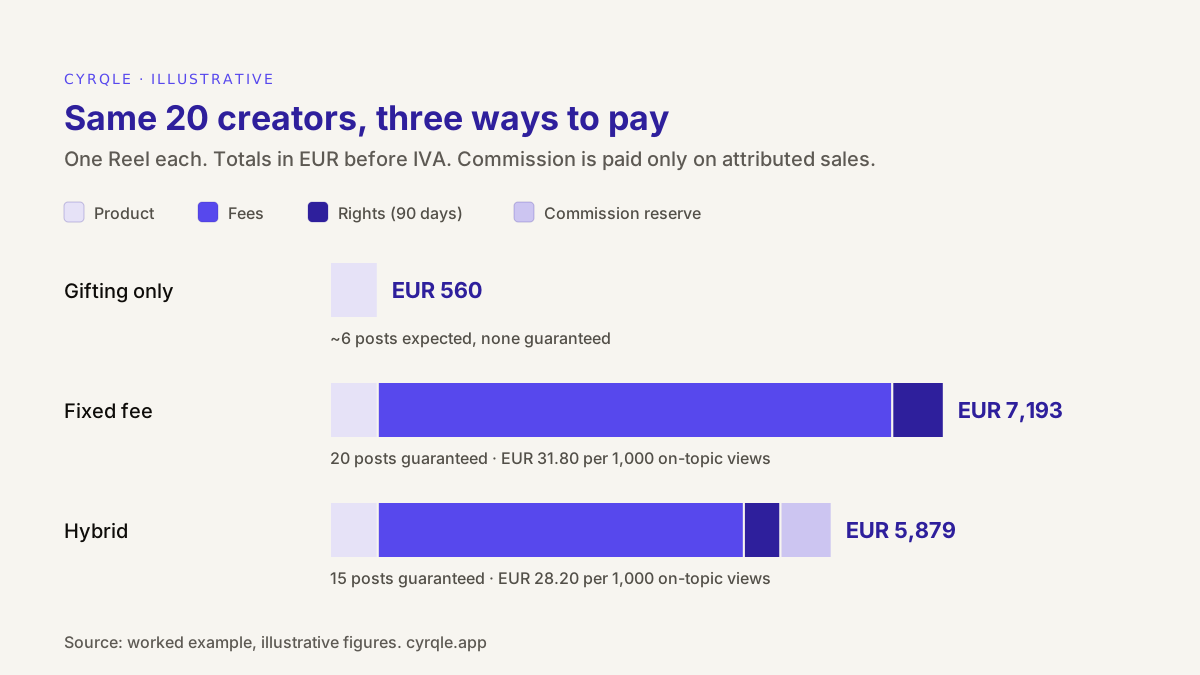
A skincare brand wants 20 micro creators in Spain for a serum launch: one Reel each. The 20 creators have between 14,000 and 94,000 followers, 992,000 followers in total, and 322,000 median views per Reel in total. After the on-topic share for each creator, the cluster delivers an illustrative 226,300 on-topic views. The brand compares three ways to pay the same 20 creators.
Shared assumptions (illustrative): product landed cost EUR 28 per creator; 30% of gifted creators post; fixed fees agreed halfway between the opening offer and the walk-away point, with the EUR 150 floor; a 90-day website and email licence at 10% of fees; commission at 10% of attributed sales, with a forecast of EUR 6,000 in sales for the cluster.
| Gifting only | Fixed fee | Hybrid | |
|---|---|---|---|
| Product | EUR 560 | EUR 560 | EUR 560 |
| Fees | EUR 0 | EUR 6,030 | EUR 4,290 (15 creators at their opening offer) |
| Rights (90 days, website and email) | None | EUR 603 | EUR 429 |
| Commission reserve | None | None | EUR 600 (paid only on sales) |
| Total | EUR 560 | EUR 7,193 | EUR 5,879 |
| Posts guaranteed | 0 (about 6 expected) | 20 | 15 (the other 5 on product and commission) |
| On-topic views counted on | About 67,900 expected | 226,300 | 208,700 guaranteed |
| Cost per 1,000 on-topic views | About EUR 8.25, if they post | EUR 31.80 | EUR 28.20 |
All figures illustrative, before IVA. Three things stand out:
- Follower pricing would cost the most. At an illustrative EUR 8 per 1,000 followers, the same 20 fixed fees total EUR 7,936. With product and rights, the cluster costs about EUR 9,290, or EUR 41 per 1,000 on-topic views, and most of the extra money goes to the creators with the fewest views.
- Hybrid keeps most of the reach for less. The five creators whose walk-away point sits below the floor move to product and commission. They may still post; you just do not pay cash for a post that is not worth it. The other 15 accept their opening offer because commission gives them an upside.
- Gifting is a different product. It is the cheapest cost per view only if creators post, and you cannot plan a launch date on a 30% post rate. Use it to find the creators worth paying next time.
The fees above are not yet the cash you pay out. In Spain the invoice adds IVA and, for self-employed creators, you usually withhold IRPF. Our guide to paying influencers in Spain walks through invoices, withholding and IVA.
How cyrqle helps
In Find creators, each recommended creator carries estimates you can sort on: estimated reach, on-topic reach, a cost estimate, estimated media value and an estimated return. Use the best value and hidden gems lenses to bring efficient creators to the top, then check each one against the median views on their profile. Every "est." figure is an estimate built from public post data, for comparing creators with each other, not a quote.
In Clusters, the planner gives a live reach and cost estimate as you add or remove creators, so you can try budget what-ifs before you send an offer. Save two versions of the shortlist, for example an all-paid cluster and one that drops the low-view creators, and compare them side by side (up to four). Then add the cluster you choose to a campaign.
In the campaign, you choose the deal type: Cash payment, Commission on every sale, Product gift, or a combination such as Cash, commission & product. Invites stay blocked until compensation is complete, so no offer goes out without terms. Paid-ads use is granted only if you tick it on the offer, which keeps the rights line explicit. Each creator gets a promo code and a tracking link, commission owed is calculated and shown in reports, and fees are paid in EUR through Stripe Connect to creators in Europe and the US (elsewhere you pay by bank transfer and record it). See compensation and contracts for the detail, or book a 30-minute walkthrough on your own category.
FAQ
How much should I pay a micro-influencer for one Instagram Reel?
As an illustrative guide for Spain, most micro creators land between EUR 150 and EUR 800 per Reel before IVA and before rights. Within that range, price on median views and on-topic reach: on-topic views divided by 1,000, times your target CPM. Some micro creators will fall below the point where a cash fee makes sense.
Is it fine to pay micro-influencers in product only?
Yes, when the creator agrees and you accept that a post is not guaranteed. Product-only deals suit launches and relationship building. If you need a date, a format, a brief or reuse rights, pay a fee or a hybrid, and put the terms in writing. A gifted post still needs an advertising label.
What commission rate should I offer a micro creator?
There is no standard rate. It depends on your margin and average order value. Work back from what you can afford per order, then check the hybrid break-even: fee reduction divided by commission rate. The examples here use 10% for illustration only.
Should I pay more for a creator with high engagement but low views?
Not by default. Engagement shows attention, but you are buying people who see the post. Use engagement to choose between creators with similar on-topic views, and as a reason to accept a price near your walk-away point rather than above it.
How do I compare a micro creator with a macro creator?
Put both on the same scale: fee divided by on-topic views, times 1,000. A cluster of micro creators often delivers the same on-topic reach for less money, with more varied content, but it takes more coordination. Our guide to creator compensation models covers which deal structure fits each tier.
Related field notes.
How much do influencers charge in Spain? Illustrative 2026 fee bands by tier and format, the levers that move price, and how to compare quotes by effective CPM.
Influencer marketing budget planning for 2027, built bottom-up: objectives, tier mix, pricing model, seasonal peaks in Spain and Mexico and a worked euro model.
Followers tell you how many people once pressed a button. Views tell you how many people see a post today. How to compare creators on median views, effective CPM and consistency, with a worked example.