
Product gifting agreement template (short form, ES and EN)
Influencer gifting agreement template on one page: product and value, content expected or not, disclosure, usage rights, returns and the no-post outcome.
An influencer gifting agreement template is a one-page document you send with a product seeding parcel. It states the product and its market value, whether the creator is expected to post or is free not to, how any post is labelled as advertising, what the brand may do with the content, whether the product must be returned, and what happens if no content appears. Below is the short form, ready to copy, with a note on each clause and on the Spanish rules behind it.
Use it for product seeding: a box of serums to 40 creators in Madrid and Valencia, a pair of trainers to a runner in Seville, a loaned watch for a shoot in Barcelona. When the deal includes a cash fee, a commission or paid ads, use the full clause-by-clause influencer contract template instead. This guide is not legal or tax advice: have your lawyer review the text before you send it, and check that the rules have not changed since publication.
When is a gifting agreement enough?
A short gifting agreement is enough when the only thing the creator receives is product, and the only thing you might receive is an optional post on the creator's own account. It stops being enough as soon as money changes hands, you want to run the content as an ad, or you need exclusivity. At that point you need a full contract.
| Note in the box | Short gifting agreement | Full influencer contract | |
|---|---|---|---|
| Product and value in writing | Rarely | Yes | Yes |
| Content expected or not, stated | Implied, often unclear | Yes, one of two options | Yes, with deliverables and dates |
| Disclosure rule | Missing | Stated | Stated |
| Usage rights for the brand | None | None, or a narrow licence | Full scope: term, territory, media, paid ads |
| Return and no-post outcome | Missing | Stated | Stated, with cancellation terms |
| Fee, invoice and withholding | Not applicable | Not applicable (product only) | Stated |
| Effort per creator | Lowest | Low | Higher |
If you are still deciding whether to offer product or cash at all, read when a gifted product makes sense and when a paid collaboration does. It looks at the decision from the creator's side, which is how your offer will be judged.
Gift with no strings, or gift for content?
This is the decision that shapes every other clause. Make it before you write anything.
Option A: a no-strings gift. You send the product because you think the creator will like it. They owe you nothing: no post, no review, no tag. If they post, it is their choice and their words. This is the classic seeding model and the one most creators prefer.
Option B: a gift in exchange for content. You send the product and the creator agrees to publish something: one Reel, three Stories, a TikTok, within a window. The product is the payment. Some brands in Spain call this a canje (an exchange).
The legal consequences differ. Under the AUTOCONTROL, AEA and IAB Spain influencer code that came into force on 1 October 2025, content is advertising when it promotes a product and is published within a collaboration or reciprocal commitment in return for a payment or other consideration. The code lists "the free delivery of a product" as consideration (norms 4 and 5). Option B fits that definition directly. Option A can still be read as advertising if there are signs of control: the code lists examples such as the brand asking for a positive review, asking for a specific number of posts, or asking the creator to show or mention the product. So a "no obligation" gift with a note saying "tag us in your Reel" is not really Option A.
The practical rule: in Option A, ask for nothing and still ask the creator to label any post that results; in Option B, write the deliverable down and require the label. For the wider picture, see our summary of the AUTOCONTROL influencer code and what brands must do.
| Option A: no-strings gift | Option B: gift for content | |
|---|---|---|
| Creator must post | No | Yes, as listed in the agreement |
| Brand may ask for a review, tags or a post count | No, or it becomes Option B | Yes, within the agreement |
| Is a resulting post advertising? | Often yes in practice; label it | Yes; label it |
| If nothing is posted | Nothing happens | The creator returns the product or pays its value, if the agreement says so |
| Typical use | Launch seeding, relationship building | Small creators, low-value products, UGC volume |
The annotated one-page agreement
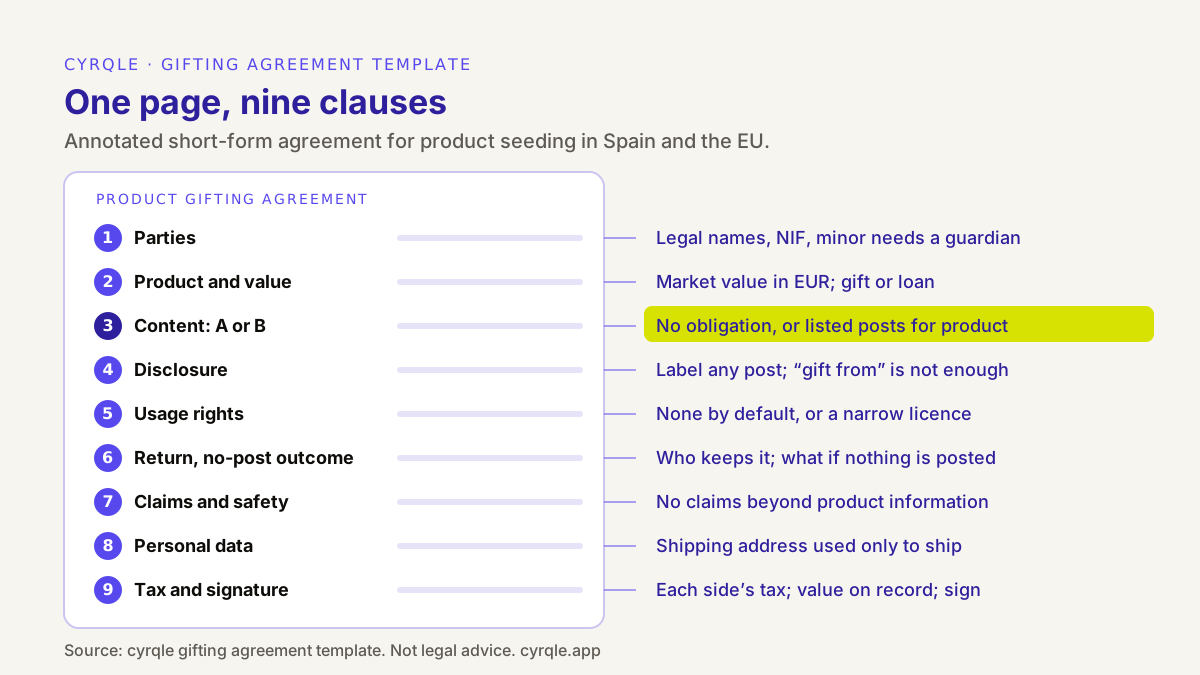
Nine clauses, one page:
- Parties. Who gives the product and who receives it.
- Product and value. What ships, how many, the market value, and whether it is a gift or a loan.
- Content. Option A (none expected) or Option B (listed deliverables and a window).
- Disclosure. How any resulting post is labelled.
- Usage rights. None by default, or a narrow licence.
- Return and no-post outcome. Whether the product comes back and what happens if nothing is posted.
- Product claims and safety. What the creator should not say about the product.
- Personal data. The shipping address and contact details the brand holds.
- Tax and signature. Each side's tax position, and how both sides accept.
The template (short form, English)
Copy the text into your own document, replace everything in square brackets, and delete the option you do not use. The Spanish version of this page carries the same template in Spanish, for creators who prefer to sign in Spanish.
PRODUCT GIFTING AGREEMENT

1. PARTIES
[Brand legal name], NIF [number], [address] ("the Brand"), and
[Creator full legal name], NIF/NIE [number], [address], who
publishes as @[handle] ("the Creator").
If the Creator is under 18, a parent or legal guardian also signs
and consents to this agreement.

2. PRODUCT
2.1 The Brand will send: [product, variant, quantity].
2.2 Market value: EUR [amount] (the Brand's public retail price
    on [date]).
2.3 The product is [a GIFT: the Creator keeps it]
    OR [a LOAN: the Creator returns it under clause 6].

3. CONTENT  (choose one option and delete the other)
OPTION A - NO OBLIGATION
3.1 The Creator is not required to publish anything, review the
    product or mention the Brand. Any content is the Creator's
    free choice, in the Creator's own words.
OPTION B - CONTENT IN EXCHANGE FOR THE PRODUCT
3.1 In exchange for the product, the Creator will publish:
    [1 Instagram Reel / 3 Stories / 1 TikTok video] on @[handle]
    between [date] and [date].
3.2 The Brand [will / will not] review a draft before publication.
    One round of changes at most, answered within [2] working days.
3.3 Each post stays live for at least [30] days.

4. DISCLOSURE
4.1 Any post about the product will be labelled as advertising
    at the start, clearly and visibly, using the platform's paid
    partnership tool where available and a label such as
    "publicidad" or "publi".
4.2 "Gift from [Brand]", "thanks to [Brand]", "colab" or a brand
    hashtag on their own are not enough.

5. USAGE RIGHTS
5.1 The Creator keeps all rights to their content.
5.2 The Brand may share the post inside the platform with its
    native share or repost tools.
5.3 [DEFAULT] Any other use (website, email, product pages,
    in-store screens, paid ads) needs the Creator's separate
    written permission.
    OR [OPTIONAL] The Creator grants the Brand a non-exclusive
    licence to show the post on the Brand's website and own
    social accounts in [Spain / the EU] for [90] days.
    Paid advertising is not included.

6. RETURN AND NO-POST OUTCOME
6.1 Gift: the Creator keeps the product whether or not they post.
6.2 Loan: the Creator returns the product in the same condition
    by [date], using the prepaid label the Brand provides.
6.3 Option B only: if no content is published by [date] and the
    Brand did not cause the delay, the Creator will [return the
    product at the Brand's cost / pay its market value / nothing
    further]. No other penalty applies.

7. PRODUCT CLAIMS AND SAFETY
7.1 The Creator will not make health, medical or performance
    claims beyond those in the product information attached.
7.2 The Creator will use the product as instructed.

8. PERSONAL DATA
8.1 The Brand uses the Creator's name, address and contact
    details only to ship the product and run this agreement, and
    keeps them only as long as needed. Contact: [email].

9. TAX AND SIGNATURE
9.1 Each party is responsible for its own tax obligations. The
    market value in 2.2 is the value of the product for that
    purpose.
9.2 Spanish law applies. The parties accept this agreement by
    signature [or electronic signature] on the dates below.

The Brand: [name, date]          The Creator: [name, date]
What each clause protects
Clauses 1 and 2: who and what
The creator's legal name and tax number are not paperwork for its own sake. If the gift later turns into a paid job, or the tax adviser on either side asks what was exchanged, the agreement shows who received what. The market value in clause 2.2 matters more than it looks: it is the number both sides use for tax, and it is the number a regulator or a creator's audience would use to judge the relationship. Use your public retail price, not your cost.
Say whether the product is a gift or a loan. High-value items (watches, cameras, designer bags, furniture for a shoot) are often loaned, and a creator who believes it was a gift will not return it. Clause 2.3 removes the ambiguity.
Clause 3: the choice that drives the rest
Option A only works if you really ask for nothing. Remove "please tag us", "we'd love a Reel" and "share your honest review" from the cover note, because those requests are exactly the signs of editorial control the influencer code lists. You can still include a discount code or a tracking link for the creator's audience, but in Option A that is an offer, not an obligation.
Option B is a small paid collaboration with product as the fee. Keep the deliverable short, give a realistic window, and limit approvals to one round. Asking for a draft review, three revisions and a 90-day stay-live clause for a EUR 40 product is a fast way to get a no.
Clause 4: disclosure, in both options
Spanish unfair competition law treats undisclosed advertising as a misleading practice (Ley 3/1991, article 26). The 2025 influencer code says the label must be at the start of the message, easy to see, and not hidden among other hashtags or behind "more". It recommends the platform's own tools and labels such as "publicidad", "publi", "en colaboración con" or "patrocinado por". It names "Regalo de [marca]" (gift from brand) and "Gracias a [marca]" (thanks to brand) as unclear labels that should not be used on their own, which is why clause 4.2 spells them out.
Why include a disclosure clause in Option A, where nothing is required? Because the code also lets a brand show that a breach was an isolated departure from its instructions (norm 12). A written instruction to label is that evidence. For the full set of rules, see our legal checklist for influencer marketing in Spain.
Clause 5: usage rights are not part of a gift
This is the clause brands most often get wrong. Sending product buys you no right to download the creator's Reel and put it on a product page. Spanish copyright law requires a transfer of exploitation rights to be in writing (Ley de Propiedad Intelectual, article 45) and limits it to the uses named (article 43). The creator's image is protected separately by Ley Orgánica 1/1982. A public post lets you share it inside the platform; anything else needs permission.
You have two clean options. The default in the template grants nothing and lets you ask later, post by post, once you see what was published. The optional line grants a narrow licence up front: website and own social accounts, one territory, a fixed term, no paid ads. Paid ads are always a separate conversation with a separate price; our usage rights and exclusivity calculator shows how to price them. For the EU background on consent and withdrawal, read why a public post is not a licence.
Clause 6: returns and the no-post outcome
Decide before shipping what happens when nothing is posted. In Option A the answer is nothing: the creator keeps the product, and you learn something about fit. In Option B you can ask for the product back or its value, but keep it proportionate. A creator who falls ill or whose account is restricted should not owe a penalty. Most brands that seed at scale simply accept the loss and stop sending to creators who never post, which is cheaper than chasing returns.
For loans, give a date, pay the return shipping and say what "same condition" means for items that are used on camera.
Clauses 7 to 9: claims, data and tax
Clause 7 matters in regulated categories: food supplements, cosmetics with active ingredients, anything that touches health. The creator should not invent claims the product cannot legally make. Attach the approved product information.
Clause 8 covers the creator's home address, which is personal data under the GDPR. You need it to ship; you do not need to keep it forever.
Clause 9 keeps tax honest without pretending to settle it. Gifted product is not automatically tax-free for the creator. In a binding ruling of 10 July 2025 on products received free in exchange for reviews (consulta vinculante V1285-25), Spain's Dirección General de Tributos treated the products as income in kind valued at normal market value. A creator who already works as a self-employed professional will usually include gifts received for their work in their activity income, and a gift-for-content exchange can also raise IVA questions for both sides. The details depend on how each party is registered, so ask your tax adviser and keep the value on record.
How seeding moves from shipment to reusable content
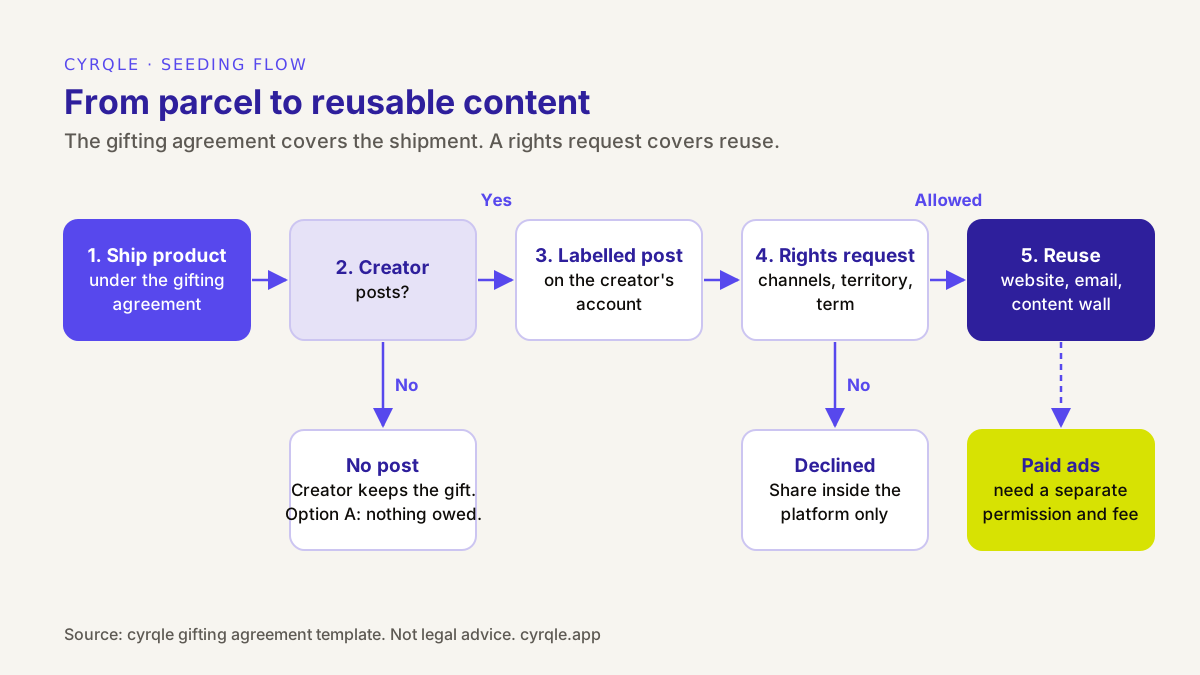
The agreement covers the shipment. What happens after depends on the creator. If they do not post, the flow ends: in Option A, nothing is owed. If they post, the post is labelled under clause 4, and then you decide whether the content is worth reusing. If it is, and clause 5 granted nothing, you send a rights request for that specific post, stating the channels, territory and term. The creator allows or declines. Only an allowed licence lets you put the post on your website, in email or on a shoppable wall. Paid ads still need their own permission.
This two-step structure keeps the gifting agreement light. You do not ask 40 creators to sign a broad licence for content that may never exist. You ask the 10 who posted, for the posts you actually want.
Worked example (illustrative)
A skincare brand in Valencia seeds a new serum to 40 micro-creators in Spain. All figures are illustrative, chosen to show the arithmetic, not market benchmarks.
| Line | Amount |
|---|---|
| Product cost per kit (illustrative) | EUR 18 |
| Shipping and packaging per kit (illustrative) | EUR 7 |
| Cost per creator | EUR 25 |
| Total for 40 creators | EUR 1,000 |
| Creators who post (illustrative 25%) | 10 |
| Cost per resulting post | EUR 100 |
| Rights requests sent for the best posts | 8 |
| Licences allowed (illustrative 6 of 8) | 6 |
| Cost per reusable, licensed asset | about EUR 167 |
The market value on each agreement is the retail price, EUR 49 in this example, not the EUR 18 cost. That is the figure the creators may need for their own tax records.
The useful comparison is not "EUR 100 per post is cheap". It is whether those 10 posts and 6 licensed assets would have cost more as paid collaborations, and whether any of them drove sales. That is the argument in the economics of seeding-only versus hybrid programmes: seeding is cheap per creator but hard to measure unless each creator has a code or a tracking link.
Five mistakes that turn a gift into a dispute
- "No obligation" with strings attached. A cover note asking for a tag and a Reel makes it Option B without the clarity of Option B.
- No value on the paper. Nobody can tell later what was exchanged.
- Reusing the post because "we sent the product". A gift is not a licence. Ask first.
- Leaving disclosure to the creator. Write the label rule down, even when you ask for nothing.
- Loans treated like gifts. If you want it back, say so, with a date and a prepaid label.
How cyrqle helps
In cyrqle, product is a deal type, not a side spreadsheet. When you build a campaign in Campaigns, the brief has a Free product section, and the offer to each creator can be a Product gift on its own or combined with cash or commission (Cash & product, Commission & product, Cash, commission & product). Invites stay blocked until the compensation is complete, so no creator receives an offer without the product and terms filled in. cyrqle does not ship the parcel; your warehouse or logistics partner still does that.
When a creator accepts a gift-for-content offer (Option B), cyrqle produces a Creator Collaboration Agreement with a two-sided e-signature and a frozen terms snapshot: the product, deliverables and rights on the offer are locked into the signed version, which sits on the Agreements page with a PDF. The creator can sign from a link without an account, and cyrqle records the IP address, device and timestamp. Be aware of one difference from the default in the template above: a signed cyrqle agreement always grants content-wall and campaign use, and grants paid-ads use only if you ticked it on the offer. Tell creators that up front. See Compensation and contracts for the deal types and the signing flow.
For no-strings seeding (Option A), keep the short agreement outside the campaign flow and give each creator a promo code or tracking link from Attribution, so any sales the seeding drives are measured. When a seeded creator posts, find the post with a UGC collector, then request rights from the post card: cyrqle emails the creator, or gives you a link to send by DM, with your rights terms in their language. The step-by-step version is in our guide to requesting content rights from a creator. Licensed posts can then go on a content wall, which only shows a post while its licence is active.
cyrqle does not replace your lawyer or tax adviser. To see a product-gift offer and the agreement on your own campaign, book a walkthrough.
FAQ
Do I need a written agreement to gift a product to an influencer?
No law requires one for a pure gift, but it is the cheapest protection you have. One page settles whether content is expected, how a post is labelled, whether you can reuse it and whether the product comes back. Without it, each of those becomes a negotiation after the parcel has arrived.
Is a gifted post advertising in Spain?
When the product is given in exchange for a post, yes: the 2025 influencer code counts free product as consideration, and the post must be labelled. A truly unconditional gift can fall outside that definition, but signs such as asking for a review or a mention can bring it back in. The safe practice is to ask creators to label any post about a gifted product.
Can I use a gifted creator's post on my website or in ads?
Not without their written permission. Spanish copyright law requires rights to be granted in writing and limits them to the uses named. Ask for a licence that states the channels, territory and term, and ask for paid ads separately.
What if the creator does not post?
In a no-strings gift, nothing happens: they keep the product. In a gift-for-content agreement, the agreement can require the product back or its value if nothing is published by the deadline, but keep the remedy proportionate and do not apply it when the delay was outside the creator's control.
Does the creator pay tax on a gifted product in Spain?
Possibly. Spain's tax authority has treated products received in exchange for reviews as income in kind at market value, and professional creators usually count such products in their activity income. Write the market value on the agreement and ask a tax adviser for the specific case.
When should I use the full influencer contract instead?
As soon as there is a cash fee, a commission, paid ads, whitelisting or exclusivity. Those need deliverables, payment terms, invoice data and a full usage-rights clause, which the full influencer contract template for Spain covers.
Sources
- Código de Conducta de Publicidad a través de Influencers (in force 1 October 2025), AUTOCONTROL, AEA and IAB Spain, norms 4, 5, 6, 8 and 12: autocontrol.es
- Ley 3/1991 de Competencia Desleal, article 26: BOE-A-1991-628
- Ley de Propiedad Intelectual (Real Decreto Legislativo 1/1996), articles 43 and 45: BOE-A-1996-8930
- Ley Orgánica 1/1982, protection of honour, privacy and image: BOE-A-1982-11196
- Dirección General de Tributos, consulta vinculante V1285-25 of 10 July 2025 (products received in exchange for reviews), as published by fiscal-impuestos.com; official database: petete.tributos.hacienda.gob.es
- General Data Protection Regulation (EU) 2016/679: EUR-Lex
Related material.
Influencer platform comparison template: a weighted scorecard for brands and agencies, with score definitions, demo evidence and a TCO line for Q4 renewals.
Justify your influencer marketing budget on one page: spend, attributed revenue as a range, MER, payback, holdout result and risks, with a worked euro example.
Free influencer brief template in nine sections, from objective to approval, with a filled Black Friday 2026 example, disclosure wording and usage rights.