
Creator brief template (ES and EN) with a filled example
Free influencer brief template in nine sections, from objective to approval, with a filled Black Friday 2026 example, disclosure wording and usage rights.
An influencer brief template is a short document that tells a creator what the campaign must achieve and what is fixed, while leaving the creative idea to them. The version below has nine sections: objective, audience, key message, deliverables and dates, disclosure, do and don't, usage rights, compensation, and approval. Copy the blank template, then compare it with the filled Black Friday 2026 example further down.
Picture a skincare brand in Valencia that sends eight creators a two-line message in October: "Black Friday, our serum, 30% off, post that week." Five creators post on different days, two forget the code, one tags the label at the end of twenty hashtags, and nobody knows if the brand may reuse the videos on its product page. Every one of those problems is a missing brief section.
This guide is for brand and agency teams in Spain, the EU and Latin America. It sits next to our clause-by-clause influencer contract template: the brief explains the job, the contract makes it binding. Parts of it touch Spanish law; it is not legal advice, so have your lawyer check the rights and disclosure wording for your campaign.
What goes in a creator brief?
A creator brief needs nine sections, and each one answers a question the creator would otherwise ask you in a DM. The first three set the goal, the middle three set the rules, and the last three set the deal. Our earlier note on the shape of a working brief argued for more structure than a paragraph and a deck; this template is that structure, ready to use.
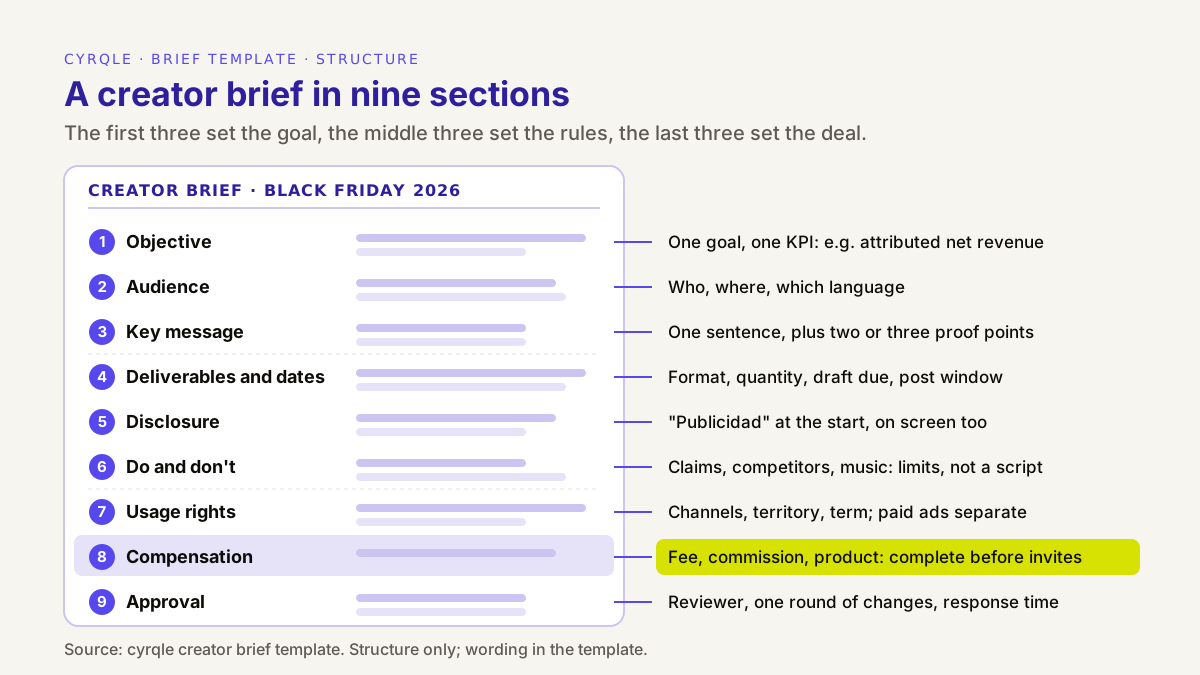
| # | Section | The question it answers for the creator | Typical length |
|---|---|---|---|
| 1 | Objective | What does success look like, and how will you measure it? | 2 to 3 lines |
| 2 | Audience | Who should watch and buy, where, in which language? | 3 lines |
| 3 | Key message | What is the one thing a viewer should remember? | 1 sentence + 2 proof points |
| 4 | Deliverables and dates | What do I post, where, how many, and by when? | A small table |
| 5 | Disclosure | Which label, where in the post? | 3 to 4 lines |
| 6 | Do and don't | What must I avoid saying or showing? | 5 to 8 bullets |
| 7 | Usage rights | What can the brand do with my content afterwards? | 4 to 6 lines |
| 8 | Compensation | What do I get, and when? | 4 to 5 lines |
| 9 | Approval | Who reviews my draft, how many rounds, how fast? | 3 to 4 lines |
A good brief fits on two pages. If yours runs to ten, the creative direction is probably too tight. Creators know their audience better than you do, and a campaign brief that scripts every line produces content that looks like an ad and performs like one.
The blank template (English)
Copy the text into your own document, replace everything in square brackets, and delete what does not apply. The Spanish version of this page carries the same template in Spanish, for creators who prefer to work in Spanish.
CREATOR BRIEF
Campaign: [name]                     Brand: [brand]
Version: [v1, date]                  Brand contact: [name, email]
Reply to this brief by: [date]

1. OBJECTIVE
Goal: [one only: sales / traffic / lead gen / sign-ups /
       awareness / engagement / UGC]
Main KPI: [e.g. attributed net revenue, clicks, sign-ups, views]
Why now: [one sentence: launch, season, offer]

2. AUDIENCE
Who: [age range, life stage, interests]
Where: [countries or cities]        Language: [es-ES / en / ...]
What they think today: [one sentence: the doubt to overcome]

3. KEY MESSAGE
In one sentence: [what the viewer must remember]
Proof points (use one or two): [fact] [fact] [fact]
Call to action: [what the viewer does next, with code or link]
Your idea, your words: we do not script the content.

4. DELIVERABLES AND DATES
Format       Platform    Qty  Draft due   Post window    Live for
[Reel]       [Instagram] [1]  [date]      [date - date]  [days]
[Stories]    [Instagram] [3]  [no draft]  [date]         [24 h]
[Video]      [TikTok]    [1]  [date]      [date - date]  [days]
Required in every piece: [@brand handle] [#campaign hashtag]
                         [your code: ______] [your link: ______]
Product ships: [date]           Contract signed by: [date]

5. DISCLOSURE
Label: "Publicidad" or "Publi" at the start of the caption and
on screen in the first seconds of every video and on every Story.
Also switch on the platform's paid-partnership tool.
Not enough on its own: "#ad", "colab", "gracias a [brand]",
"regalo de [brand]", the brand hashtag, a label hidden behind
"more" or among other hashtags.
Reposts keep the label. AI-generated or AI-altered content
must not mislead.

6. DO AND DON'T
Do: [show the product in use] [say the code out loud] [...]
Don't: [health or medical claims beyond the claims sheet]
       [mention or show competitor products] [copyrighted music
       outside the platform library] [prices other than the offer]

7. USAGE RIGHTS
Channels: [brand website, product pages, own social accounts,
          email, in-store screens]
Territory: [Spain / EU / named countries]
Term: [months] from first publication
Paid ads (whitelisting, partnership ads): [not included /
          included for [term], fee EUR [amount]]
Exclusivity: [none / no [category] brands from [date] to [date]]
Raw files: [not required / delivered by [date]]

8. COMPENSATION
Fixed fee: EUR [amount], [plus IVA / withholding as per contract]
Commission: [x]% of net revenue from your code and link,
            orders [date] to [date], net of returns
Product: [items], retail value EUR [amount]
When paid: [fee after the last deliverable is live; commission
           after the returns window closes]
Invoice to: [legal name, tax number, address]

9. APPROVAL
Draft review: [yes / no]          Reviewer: [name]
Rounds: [1] round of changes      We answer within: [2] working days
We may ask you to change: facts, claims, disclosure, brand and
product names. We will not rewrite your voice or your idea.
Each section in the template has a matching clause in the contract. Sections 4, 7 and 8 must say exactly the same thing in both documents, so draft the brief first and copy those three sections into the contract.
A filled example: Black Friday 2026 (illustrative)
Below is the same template, filled in for an illustrative Black Friday campaign. The brand, the creator and every number are made up to show the level of detail, not to set market rates. The dates follow our 12-week Black Friday creator timeline: Black Friday falls on Friday 27 November 2026 and Cyber Monday on 30 November.
CREATOR BRIEF
Campaign: Black Friday 2026, Vitamin C serum
Brand: Lumen Skin (fictional brand, Valencia)
Version: v2, 18 September 2026      Brand contact: Marta, marta@[...]
Reply to this brief by: 28 September 2026

1. OBJECTIVE
Goal: sales
Main KPI: attributed net revenue from your code and link
Why now: our only sitewide offer of the year, 16 to 30 November.

2. AUDIENCE
Who: women and men 25 to 40 who already use a basic routine
     (cleanser, moisturiser, SPF) and want one extra step.
Where: Spain, mainly Madrid, Valencia, Barcelona, Seville
Language: Spanish (es-ES)
What they think today: "vitamin C serums oxidise and irritate."

3. KEY MESSAGE
In one sentence: one serum, morning only, visible glow in four
weeks, and Black Friday is the cheapest it will be this year.
Proof points (use one or two): airless bottle that limits
oxidation; fragrance-free; 30 ml lasts about two months.
Call to action: 25% off with your code, 16 to 30 November.
Your idea, your words: we do not script the content.

4. DELIVERABLES AND DATES
Format       Platform    Qty  Draft due  Post window       Live for
Reel         Instagram   1    30 Oct     16 - 20 Nov       60 days
Stories      Instagram   3    no draft   27 Nov            24 h
Video        TikTok      1    30 Oct     27 or 30 Nov      60 days
Required in every piece: @lumenskin  #LumenBlackFriday
                         code ANA25 (25% off)  link: lumen.[...]/ana
Product ships: 12 October       Contract signed by: 9 October

5. DISCLOSURE
Label: "Publicidad" at the start of the caption and on screen in
the first 3 seconds of the Reel and the TikTok, and on each of the
3 Stories. Switch on "Paid partnership" (Instagram) and
"Paid partnership" / promotional content (TikTok).
Not enough on its own: "#ad", "colab", "gracias a @lumenskin",
"regalo de Lumen", or #LumenBlackFriday alone.

6. DO AND DON'T
Do: apply the serum on camera; show the bottle and the code on
screen; say the code out loud; say when the offer ends.
Don't: claim it treats acne, melasma or any medical condition;
show or name other skincare brands; use before/after photos
edited with filters; use music outside the platform library.

7. USAGE RIGHTS
Channels: Lumen website and product pages, Lumen Instagram and
          TikTok accounts, Lumen newsletter
Territory: Spain
Term: 6 months from first publication
Paid ads: not included. Any boost needs a separate offer and fee.
Exclusivity: no other skincare brand posts from 9 Nov to 7 Dec
Raw files: not required

8. COMPENSATION
Fixed fee: EUR 500 plus IVA, withholding as per your contract
Commission: 10% of net revenue from code ANA25 and your link,
            orders 16 Nov to 7 Dec, net of returns
Product: serum + SPF kit, retail value EUR 78 (yours to keep)
When paid: fee within 15 days of the last deliverable going live;
           commission after the returns window, by 15 January 2027
Invoice to: Lumen Skin S.L. (fictional), NIF [...], Valencia

9. APPROVAL
Draft review: yes (Reel and TikTok; Stories are not reviewed)
Reviewer: Marta          Rounds: 1     We answer within: 2 working days
Final approval by: 6 November
We may ask you to change: facts, claims, disclosure, brand and
product names. We will not rewrite your voice or your idea.
Three choices in this example are worth copying. The objective is one word, so the creator knows a sales post needs a code, a reason to buy now and an end date. The exclusivity window is short and named, which keeps it cheap. And the commission period ends after Cyber Monday but is paid only after returns, which is when net revenue is known.
How to write each section
1. Objective: one goal, one number
Pick one objective and the KPI that proves it. A sales campaign is judged on attributed revenue and orders, an awareness campaign on views and reach, a UGC campaign on usable assets. Our guide to influencer KPIs by objective lists the right measure for each. Tell the creator the KPI. Creators who know you count code sales will say the code more than once.
2. Audience: who, where, which language
Name the age range, the market and the language. "Spain, Spanish-speaking, 25 to 40" changes the content more than any mood board. Add one sentence on what the audience believes today, because that is the objection the creator has to answer.
3. Key message: one sentence and a few facts
Write the single idea the viewer must remember, then give two or three facts the creator can choose from. Do not write a script. The idea is yours; the words are theirs.
4. Deliverables and dates: the table that prevents disputes
Every deliverable in a creator campaign needs a format, a platform, a quantity, a draft date, a post window and a minimum time live. Put them in a table. Add the codes, links, handles and hashtags that must appear in every piece. If you measure with a promo code and a tracking link together, our comparison of discount codes, tracking links and the pixel explains why. Work the dates backwards from the post window: product delivered two weeks before drafts, drafts one week before final approval, final approval before your store's change freeze.
5. Disclosure: write the label, word for word
Do not write "please disclose the partnership". Write the label and its position. The AUTOCONTROL, aea and IAB Spain code that came into force on 1 October 2025 recommends the platforms' own paid-partnership tools first (norm 6.a), accepts clear words such as "publicidad", "publi", "en colaboración con" or "patrocinado por" (6.b), and rejects vague ones such as "Colab", "Sponso", "Gracias a [marca]", "Regalo de [marca]", or "Ad" in a post written in Spanish (6.c). The brand hashtag on its own is not enough. Norm 6.d puts the label at the start of the message, easy to see, not mixed in with other hashtags and not behind "more". Norm 6.e says the label stays when the content is reposted, which matters when you reuse it.
The brief also protects the brand. Norm 12 says liability can reach everyone involved in the commercial communication, and a subject can escape it only by showing that the breach was a one-off departure from the instructions given to the creator. A written disclosure section is that instruction. The code's norm 11 adds that content generated or substantially changed with AI must not mislead. Our summary of the AUTOCONTROL influencer code and what brands must do has the full list of labels and positions by platform.
6. Do and don't: limits, not a script
List what the creator must not say or show: claims your product cannot legally make, competitor products, music they do not have the rights to, prices other than the offer. Attach a claims sheet in regulated categories (cosmetics with actives, food supplements). Keep the "do" list short and practical: show the product in use, say the code out loud, say when the offer ends.
7. Usage rights: channels, territory, term
The brief must say what you will do with the content after it is posted, because creators price that. Spanish copyright law requires a transfer of exploitation rights to be made in writing (Ley de Propiedad Intelectual, article 45) and limits it to the uses expressly stated and to the term and territory agreed. If the term is not mentioned, article 43 limits the transfer to five years; if the territory is not mentioned, to the country where the transfer is made. Name the channels, the territory and the term, and treat paid ads as a separate line with a separate price. If you plan to run the content as ads from the creator's account, read the contract terms for whitelisting and partnership ads before you write this section.
8. Compensation: complete before you invite
State the fixed fee, any commission and its base (gross or net, which orders, which dates), the product and its retail value, when each part is paid, and who the invoice goes to. Creators decide on this section first. A brief that says "fee to be discussed" doubles the negotiation, and the creators you most want will skip it.
9. Approval: one round, a fixed response time
Say whether drafts are reviewed, by whom, how many rounds of changes are included and how fast you answer. One round with a two-working-day answer is a fair default. Say what you will ask to change (facts, claims, disclosure, names) and what you will not (the creator's voice and idea). A review is also your chance to check the label position before the post goes live.
Brief or contract: what goes where?
The brief and the contract overlap, and creators read both. The brief explains the job in plain language; the contract makes the commercial terms binding.
| Creator brief | Creator contract | |
|---|---|---|
| Purpose | Explain the job and the creative limits | Make the commercial terms binding |
| Tone | Plain, friendly, two pages | Precise, clause by clause |
| Objective, audience, key message | Yes, in full | No, or a one-line reference |
| Deliverables and dates | Yes, as a table | Yes, the same table, binding |
| Disclosure | Exact label and position | Obligation to label, and what happens if not |
| Do and don't | Yes, practical list | Claims, morality and termination clauses |
| Usage rights | Summary: channels, territory, term, paid ads | Full licence wording |
| Compensation | Amounts and timing | Amounts, invoicing, tax, late or missed delivery |
| Approval | Rounds and response time | Same, plus what happens if approval stalls |
| Who signs | Nobody; it is sent with the offer | Both parties |
The rule that saves the most trouble: sections 4, 7 and 8 of the brief must match the contract word for word. If you change a date or a fee during negotiation, change both. Our influencer contract template for Spain and the EU has the matching clauses.
How does a brief move from invite to post?
A brief does work at every stage of the campaign, not only on day one. The creator reads it to decide, re-reads it to make the draft, and you use it to approve and to check the live post.
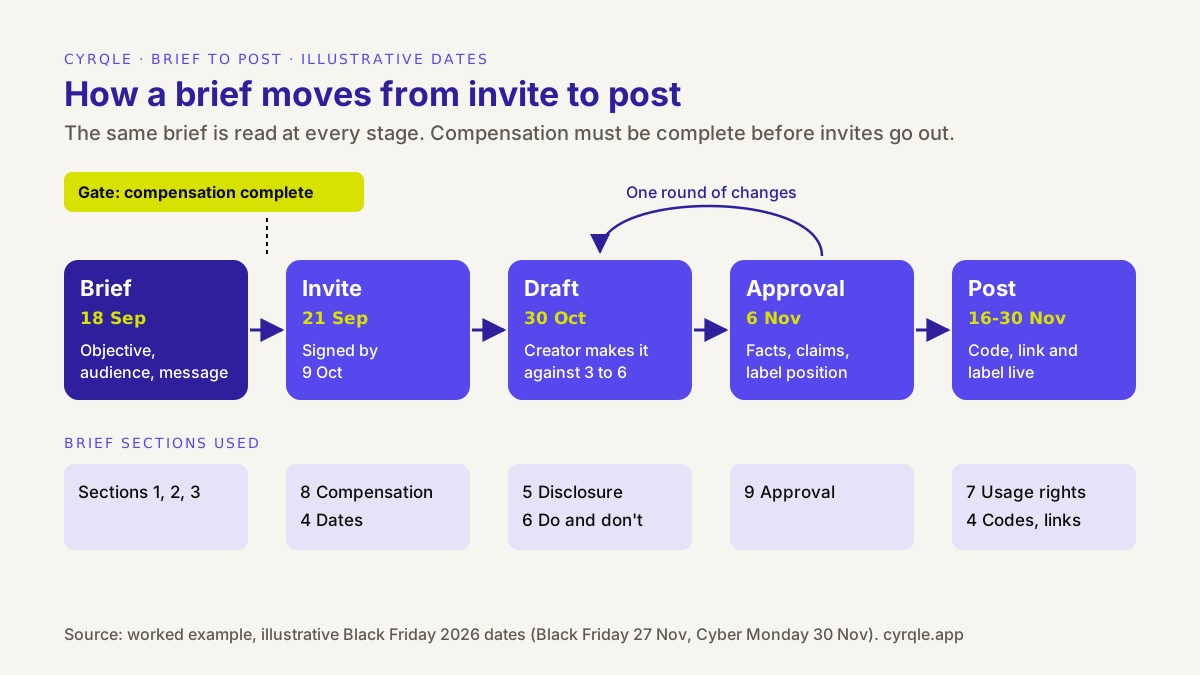
- Brief. You write it, with the objective, audience and message settled. Illustrative date: 18 September.
- Invite. The brief goes out with the offer. Compensation and dates must be complete at this point. Invites on 21 September, contracts signed by 9 October.
- Draft. The creator makes the content against sections 3 to 6. Drafts due 30 October.
- Approval. You check facts, claims and the disclosure label, and send one round of changes if needed. Final approval by 6 November, before the store's change freeze.
- Post. The content goes live in its window with the code, link and label. Usage rights start from first publication. Posts from 16 to 30 November.
For the whole lifecycle, including payouts and reporting, see our walkthrough of running a creator campaign end to end.
Worked example: what the filled brief costs (illustrative)
The Black Friday brief above goes to eight creators. Every figure here is illustrative, chosen to show the arithmetic, not a benchmark.
| Line | Calculation | Amount |
|---|---|---|
| Fixed fees | 8 creators x EUR 500 | EUR 4,000 |
| Product kits at cost | 8 x EUR 20 (retail value EUR 78 each) | EUR 160 |
| Orders from codes and links, net of returns | illustrative | 260 orders |
| Net revenue | 260 x EUR 62 average order | EUR 16,120 |
| Commission | 10% x EUR 16,120 | EUR 1,612 |
| Total creator cost | 4,000 + 160 + 1,612 | EUR 5,772 |
| Return on creator spend | 16,120 / 5,772 | about 2.8 |
| Cost per order | 5,772 / 260 | about EUR 22 |
Two things in the brief made this calculation possible. Section 4 put a code and a link in every piece, so each order can be traced to a creator. Section 8 defined commission on net revenue for a fixed order window, so the commission figure is known once returns close, not argued about in January. Fees exclude IVA, and any withholding depends on each creator's tax status.
Seven brief mistakes that cost you later
- Three objectives. "Awareness, sales and UGC" gets content that does none of them well.
- "Please disclose." Write the label and the position, or expect "#colab" at the end of twenty hashtags.
- No draft date. Without one, the first draft arrives the day before the post window.
- "Usage: social media." No channels, territory or term means a fight when you want the video on a product page.
- "Fee to be discussed." The creators you want most will not reply.
- A script instead of a message. Scripted creator content looks like an ad and performs like one.
- Brief and contract out of sync. A date changed in a DM but not in the contract becomes a missed deliverable.
How cyrqle helps
In Campaigns, you start a brief from one sentence or prompt, such as "Black Friday push for our vitamin C serum, Spain, 25 to 40, sales", and cyrqle drafts the brief. You then edit every part on the Brief tab and choose the objective from Sales, Lead gen, Traffic, Free trial, Booking, UGC, Awareness or Engagement. The AI gives you a first draft; the disclosure wording, claims and rights terms are still yours to check.
- No invite without the money. The brief has Fixed fee, Affiliate / commission and Free product sections, and invites stay blocked until compensation is complete. Tracking links need a destination link or a connected store.
- Ranked against the brief, invited by you. The discovery drawer ranks creators against the brief. You choose who to invite, one by one or in bulk, in Spanish or English by market, with two automatic follow-ups.
- The terms are frozen when signed. When a creator accepts, both sides sign a Creator Collaboration Agreement with a frozen terms snapshot. Content-wall and campaign use are always granted; paid-ads use only if you tick it on the offer. Write section 7 of your brief to match. Deal types, signing and payouts are covered in compensation and contracts.
- Drafts are checked against the brief. With draft sign-off switched on, you approve or request changes, and cyrqle checks each draft for the required hashtags and handles. Check the label position yourself: an automated check cannot judge whether "Publicidad" sits at the start.
- Posts are tracked. Published Instagram and TikTok posts are tracked with views, engagement and effective CPM. Instagram Stories are not tracked automatically, so ask for screenshots in the brief.
Commission owed on code and link sales is calculated and shown; paying it is a separate step that a person triggers. For the button-by-button version, read how to launch your first creator campaign, or book a 30-minute walkthrough to see a brief built on your own category.
FAQ
What is the difference between a creator brief and an influencer contract?
The brief explains the job: objective, audience, message, deliverables, disclosure, limits, rights, pay and approval, in plain language. The contract makes the deliverables, rights and payment binding and covers what happens if something goes wrong. Send both, and keep the dates, rights and fees identical in each.
How long should an influencer brief be?
One to two pages is enough for most campaigns. The nine sections above fit on two pages when the key message is one sentence and the deliverables are a table. Longer briefs usually over-script the content, which creators push back on and audiences scroll past.
Should I send the brief before or after the creator agrees?
Before. The brief is how the creator decides whether to say yes, so it goes out with the invite, with compensation and dates already filled in. Negotiation can change details, but then both the brief and the contract must be updated.
Do I need a brief for a gifting campaign?
Yes, but a short one. If you expect nothing in return, say so, and still ask the creator to label any post. If you expect content in exchange for the product, the product is the payment and the post is advertising under the Spanish influencer code, so the full disclosure section applies.
Can I reuse the content a creator makes from my brief?
Only within the usage rights you agreed in writing. In Spain, a rights transfer covers only the uses, term and territory stated, so name the channels, the territory and the term, and agree paid ads separately. Without that, ask the creator before you put the content on your website or in an ad.
Sources
- AUTOCONTROL, aea and IAB Spain, Código de Conducta de Publicidad a través de Influencers, in force 1 October 2025, norms 4 to 6, 11 and 12: https://www.autocontrol.es/app/uploads/codigo-de-conducta-de-publicidad-a-traves-de-influencers-2025.pdf
- Real Decreto Legislativo 1/1996, texto refundido de la Ley de Propiedad Intelectual, articles 43 and 45: https://www.boe.es/buscar/act.php?id=BOE-A-1996-8930
- Ley 3/1991, de 10 de enero, de Competencia Desleal, article 26 (covert commercial practices): https://www.boe.es/buscar/act.php?id=BOE-A-1991-628
Related material.
A practical checklist for your first campaign in cyrqle: drafting the brief, setting compensation and the destination link, choosing deliverables, finding and inviting creators, signing agreements, tracking posts and paying creators.
Influencer platform comparison template: a weighted scorecard for brands and agencies, with score definitions, demo evidence and a TCO line for Q4 renewals.
Justify your influencer marketing budget on one page: spend, attributed revenue as a range, MER, payback, holdout result and risks, with a worked euro example.