
15 questions to ask any influencer software vendor in a demo
15 questions to ask an influencer marketing platform in a demo: data, attribution, payouts, rights, security and exit, with red-flag answers and good ones.
The questions to ask an influencer marketing platform in a demo are the ones that expose how it works when nobody is presenting: where creator data comes from and how fresh it is, how a sale is tied to a creator, which countries and currencies it can pay in, where content rights are recorded, what exports exist, what its security status is in exact words, and what the exit terms are. Below are 15 questions in five risk areas, each with a good answer and a red flag.
A demo is a performance. The vendor chooses the account, the creators and the order of the screens, and the first stretch often goes to discovery filters and a dashboard. The weak spots sit elsewhere: in the payout run for a creator in Mexico, in the refund that should have reduced a commission, in the licence nobody can find when a creator asks you to take a video down. This script is written for agencies and brand teams in Spain, the EU and Latin America who want to see those parts before they sign. It works as the live-demo half of our 12-point buyer's checklist for choosing an influencer platform.
How should you run an influencer platform demo?
Run the demo on your material, not the vendor's. Send a real brief, five creators you already know and your markets two days before the call, and ask the vendor to use them. Known creators let you check the data against what you see in the app yourself.
Three rules keep the demo honest:
- Show, do not tell. For every question, ask to see the screen. "Yes, we do that" without a screen scores the same as "no".
- Ask for the boring path. A refund, a licence withdrawal, a payout to a creator outside the EU, an export. Happy paths are rehearsed; edge cases are not.
- Write it down while it is fresh. Score each answer 0 (red flag or no answer), 1 (answered but not shown, or partly) or 2 (shown live and complete). Fifteen questions give a maximum of 30.
Agencies should bring one more thing: a second client brand. Ask the vendor to switch between the two during the call, so you see how client data, creator fees and reports stay separate.
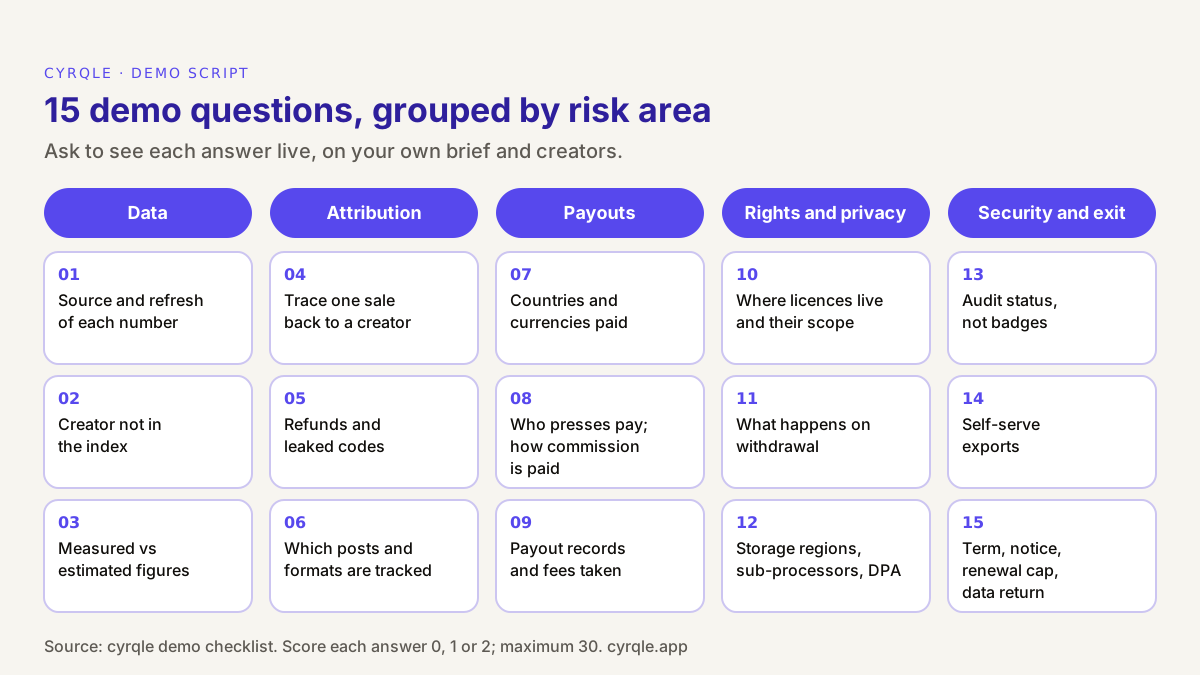
Data: where do the numbers in the demo come from?
Discovery data decides who ends up on your shortlist. If the source is unclear, every reach and cost figure built on it is unclear too.
1. Where does this creator's data come from, and when was it last updated?
Pick one of your five known creators and ask for the source of each number on the profile: public posts, data the creator shared by connecting an account, a third-party supplier or a model.
- Good answer: the vendor names the sources per field and shows how recent the posts behind the numbers are.
- Red flag: a headline database size ("millions of creators") with no answer on source or refresh.
2. What happens when the creator I need is not in your index?
Every index has gaps, especially for small creators in Spain and Latin America. What matters is the recovery path.
- Good answer: you type a handle or paste a link, and the profile is fetched and analysed while you watch, or the vendor tells you exactly how long it takes.
- Red flag: "send us a list and our team will add them."
3. Which numbers on this screen are measured, and which are estimated?
Views and engagement on public posts can be measured. Reach, audience demographics, cost and media value are usually estimated. Both are useful; mixing them up is not.
- Good answer: estimates are labelled as estimates on screen, and the vendor can explain what each one is built from.
- Red flag: audience percentages shown to one decimal place with no word on how they were derived.
Ranking on recent views, rather than followers, is covered in our guide on comparing creators on real views and effective CPM.
Attribution: how is a sale tied to a creator?
Attribution is the area where a polished dashboard hides the most. Ask what the revenue number is made of, not how it looks.
4. Can you trace one sale back to the creator, step by step?
Ask the vendor to open a single order and walk it back: the order, the code or click, the post, the creator, and who or what recorded it.
- Good answer: a named signal for each sale (promo code, tracking link and on-site tag, store pixel, order webhook, in-store redemption) and a confidence level per order.
- Red flag: one "influenced revenue" or "earned media value" figure that cannot be broken down to an order.
5. What happens to a sale that is refunded, or to a code that leaks to a coupon site?
Refunds and leaked codes are where commission disputes start. If the platform counts gross orders, you pay commission on returned goods.
- Good answer: revenue is shown net of refunds, and code sales are separated from click-based sales so a leak is visible.
- Red flag: "the store handles returns" with no adjustment in the platform's numbers.
For a full comparison of the signals, read discount code, tracking link or pixel: which attribution method to use.
6. Which posts are tracked automatically, on which networks and in which formats?
Discovery and tracking are often different lists. A tool can find YouTube creators but not track their videos, and stories are often not tracked at all.
- Good answer: a written list of networks and formats tracked without manual input, and what you do for the rest.
- Red flag: tracking claimed for a network the vendor cannot show in the demo.
Payouts: who can the platform pay, in what currency, and who presses the button?
Payout coverage is the most under-checked area in platform selection. It fails slowly, as weeks of manual bank transfers.
7. Which countries and currencies can you pay creators in today?
Get the list in writing. Payment rails often cover the EU and the US but not every Latin American market, and settlement may be in one currency only.
- Good answer: a country list, the settlement currency or currencies, who carries any FX cost, and what you do for creators outside the list.
- Red flag: "we support global payments" with no list.
8. Who triggers a payout, and how is commission paid?
Fixed fees are easy. Commission is the hard case: the platform has to calculate it from attributed sales, net of refunds, and then turn it into a payment.
- Good answer: the vendor shows who approves and releases each payout, and walks one commission from calculation to payment, including the manual steps.
- Red flag: "commission is automatic" without a screen that shows how refunds and disputes are handled.
9. What does each payout produce, and what fees are taken from it?
Finance needs one record per payout to reconcile. Fees on payouts are also a pricing line many quotes leave out.
- Good answer: a statement or invoice per payout showing the creator's net amount, platform fee, any agency fee and any tax withheld.
- Red flag: fees that only appear in the contract's small print. Our breakdown of what influencer platforms charge and where the hidden costs sit shows how to model them.
If you pay creators outside the EU, the guide on paying creators in the EU, the UK and Latin America lists what to check per country.
Rights and privacy: what is on record?
A public post is not a licence. If you reuse creator or customer content, you need a record of who agreed to what, and it has to survive a dispute.
10. Where is a content licence stored, and what scope does it record?
Ask to see one licence. It should name the post, the channels, the markets, the duration and whether paid ads are included.
- Good answer: each licence is a record with its scope, status and a PDF you can download, and paid-ads use is a separate permission.
- Red flag: "rights are covered by a clause in your contract with the creator."
11. What happens when a creator withdraws permission?
Under the GDPR, consent can be withdrawn as easily as it was given. The question is whether the platform acts on it.
- Good answer: the withdrawal is recorded with a date, and content stops showing on your site or wall without anyone editing it by hand.
- Red flag: "you would remove it manually."
How to request content rights from a creator shows what a usable record looks like step by step.
12. Where is the data stored, who are your sub-processors, and will you sign a DPA?
Under Article 28 of the GDPR, a processor works under a written contract that covers, among other things, what happens to personal data at the end of the service. Ask for the regions, the sub-processor list and the data processing agreement (DPA) before the commercial call.
- Good answer: named storage regions, a public sub-processor list and a DPA you can read before you sign.
- Red flag: "our infrastructure is GDPR compliant", with no regions or list.
Security and exit: what happens if it goes wrong, or when you leave?
These questions feel like procurement paperwork, which is why they are skipped in demos. They are cheap to ask before the contract and expensive after it.
13. What is your security status, in exact words?
Ask for the audit status, not badges. A logo on a footer does not tell you which audit, by whom, covering which period, or whether it is finished.
- Good answer: a precise sentence such as "SOC 2 Type II audit in progress" or "SOC 2 Type II report covering these dates, available under NDA", plus a security questionnaire.
- Red flag: "we are SOC 2" or "enterprise-grade security" with no report, no dates and no auditor.
"In progress" is an honest answer. "Compliant" with nothing behind it is not.
14. What can I export without asking support, and in what format?
Your creator lists, contracts, licences, codes and sales history are the asset you build in the tool. Ask the vendor to export some of each during the demo.
- Good answer: CSV for data and PDF for documents, with exports you can run yourself. For agencies: white-label client reports that can hide creator fees. Our white-label reporting checklist for agencies covers what those reports should contain.
- Red flag: "exports are available on request."
15. What are the exit terms?
Ask for the minimum term, the notice period, the cap on renewal increases, and what happens to your data on the last day: returned, deleted, or both, and in what format.
- Good answer: the terms in the contract draft, and a DPA clause on returning or deleting personal data at your choice. In the EU, the Data Act (Regulation (EU) 2023/2854) adds switching rules for some data processing services; whether a given tool is in scope is a question for your lawyer. This is not legal advice.
- Red flag: auto-renewal with no cap, and no written answer on data return.
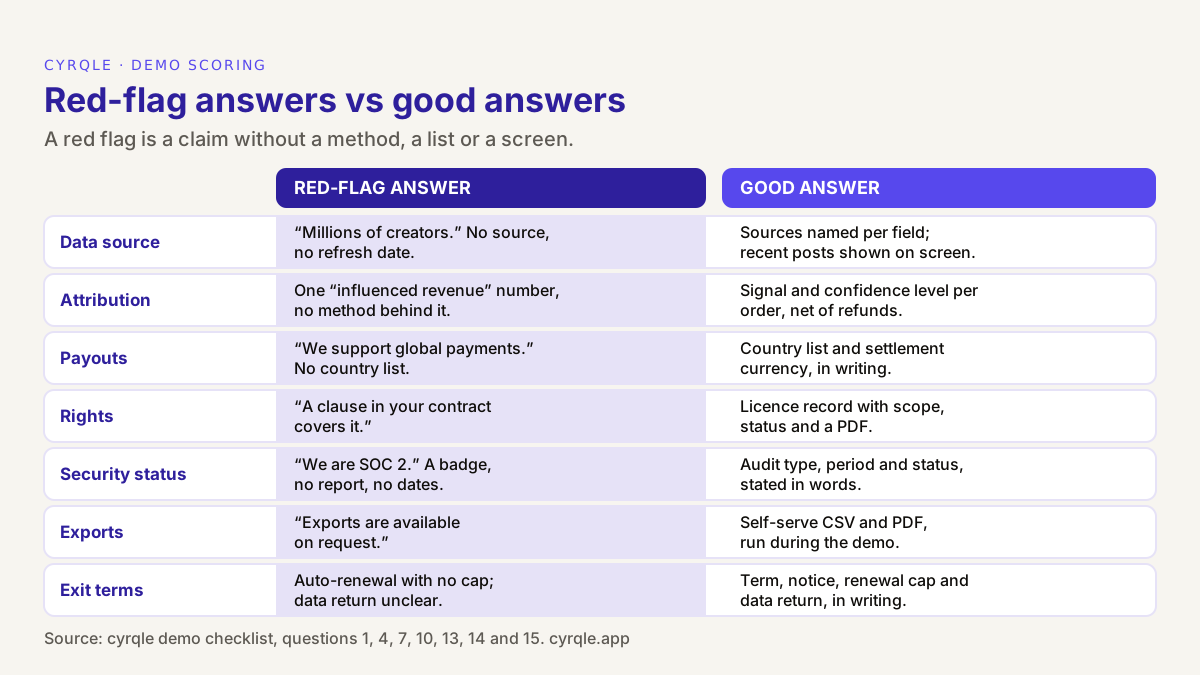
Red-flag answers vs good answers
The pattern behind every red flag is the same: a claim without a method, a list or a screen. The table below is the text version of the scoring sheet for all 15 questions.
| Risk area | Good answer | Red flag | |
|---|---|---|---|
| 1. Data source and refresh | Data | Sources named per field; recent posts shown | Database size with no source |
| 2. Creator not indexed | Data | Fetched on demand during the call | 'Send us a list' |
| 3. Measured vs estimated | Data | Estimates labelled and explained | Precise audience splits with no method |
| 4. Trace one sale | Attribution | Signal and confidence per order | One 'influenced revenue' figure |
| 5. Refunds and leaked codes | Attribution | Revenue net of refunds; code sales split out | 'The store handles returns' |
| 6. Post tracking | Attribution | Written list of networks and formats | Tracking claimed but not shown |
| 7. Countries and currencies | Payouts | Country list and settlement currency in writing | 'Global payments' |
| 8. Who triggers payouts | Payouts | Approval and commission path shown | 'Commission is automatic' |
| 9. Payout records and fees | Payouts | Statement per payout with the split | Fees only in small print |
| 10. Licence record | Rights and privacy | Scope, status and PDF per licence | 'A clause in the contract' |
| 11. Withdrawal | Rights and privacy | Recorded and enforced on display | 'Remove it manually' |
| 12. Residency and DPA | Rights and privacy | Regions, sub-processor list, DPA | 'GDPR compliant infrastructure' |
| 13. Security status | Security and exit | Audit type, period and status in words | Badges, no report or dates |
| 14. Exports | Security and exit | Self-serve CSV and PDF | 'On request' |
| 15. Exit terms | Security and exit | Term, notice, cap and data return in writing | Uncapped auto-renewal |
Worked example: scoring two demos
An agency in Madrid runs creator programmes for a fashion client selling in Spain and Mexico, with about 30 creators a quarter on a fixed fee plus commission. It demos two vendors, called A and B here. All scores are illustrative.
| Risk area | Max | Vendor A | Vendor B |
|---|---|---|---|
| Data (Q1-3) | 6 | 6 | 4 |
| Attribution (Q4-6) | 6 | 2 | 5 |
| Payouts (Q7-9) | 6 | 3 | 4 |
| Rights and privacy (Q10-12) | 6 | 3 | 5 |
| Security and exit (Q13-15) | 6 | 4 | 4 |
| Total | 30 | 18 | 22 |
Vendor A gave the best discovery demo of the two and would win a search bake-off. It scored 0 on question 5: it counts gross orders, so the client would pay commission on returned clothes, and returns are a real cost in fashion. For a commission programme, that is a knockout, not a two-point gap. Vendor B scored 1 on question 7: it pays creators in Spain directly and the agency would pay Mexican creators by bank transfer. That is a known, plannable cost, so B stays on the list.
The lesson: decide your knockouts before the first demo. A total hides the one answer that makes a tool unusable for your programme.
What changes when an agency runs the demo?
The 15 questions stay the same; three of them get sharper. On question 1, check that a client cannot see another client's creators or lists. On question 9, ask whether the agency fee appears as its own line on each payout statement, separate from the creator fee. On question 14, ask to see a client report with your logo, with creator fees hidden, exported as PDF. Our guide to influencer software for agencies covers the multi-client workspace in more depth.
How cyrqle answers the 15 questions
We should be able to pass our own test, so here are our answers, including the ones that are "no" or "partly". Ask us to show each one live in a 30-minute demo on your own category.
| # | cyrqle's answer today |
|---|---|
| 1 | Find creators runs on a proprietary creator index built from public Instagram and TikTok posts. We do not publish a refresh guarantee; ask us how recent the data is for the creators you bring. |
| 2 | Lookup resolves a handle, link, keyword or hashtag, and a creator who is not indexed yet can be fetched on demand. |
| 3 | Reach, on-topic reach, cost, media value and return are shown as estimates. We do not offer audience-country filtering. |
| 4 | Attribution uses per-creator promo codes, tracking links, a tag under 2KB on your store, the Shopify pixel, signed order webhooks from Shopify, WooCommerce and Magento, and cashier redemption in store. Each sale carries a tier: Tier 1 — promo code, Tier 2 — same-session, Tier 3 — cookied later. An audit chain links sale, code, post and creator. |
| 5 | Revenue is net of refunds, and code sales sit in their own tier. We do not run incrementality or lift tests for you. |
| 6 | Published Instagram and TikTok posts are tracked with views and engagement. Stories are not tracked automatically, and YouTube, X, LinkedIn and Facebook are not tracked. |
| 7 | Settlement is in EUR. Creators in Europe and the US are paid through Stripe Connect. Elsewhere, you pay by bank transfer and record it in cyrqle. No multi-currency payouts. |
| 8 | You fund the campaign, a payout is scheduled when the creator delivers, and a person on your team triggers settlement. Commission owed is calculated and shown in reports; paying it is a separate step. |
| 9 | Each payout has a statement or invoice with the split: creator net, cyrqle commission, agency fee and tax withheld. Our rates are not public; ask on the call. See compensation and contracts. |
| 10 | Every contract and content licence sits on the Agreements page with status, origin and a PDF. Paid-ads use is granted only if it is ticked on the offer. |
| 11 | Creators can withdraw a licence, and a content wall shows a post only while an active, unexpired licence exists. |
| 12 | Data is stored in the EU. The sub-processor list is public, and our DPA is published on the site. |
| 13 | We build to SOC 2 controls, and our SOC 2 Type II audit is in progress. We are not SOC 2 certified. Details are on the security page. |
| 14 | Five reports (brand, campaign, creator media kit, creator list, cluster) export as PDF and CSV; codes export in bulk; agreements download as PDF. Agencies get white-label reports that can hide creator fees. Ask us in writing for anything beyond that. |
| 15 | Our DPA states that on termination we delete or return personal data at your choice, subject to legal retention. Term and notice are set in your contract; pricing is a custom monthly base plus usage. |
Where we are not the right fit, we will say so on the call: if most of your sales close in TikTok Shop, if YouTube is central to your plan, or if you pay many creators in local Latin American currencies.
FAQ
How many questions should I ask in an influencer platform demo?
Fifteen fit in a 45-minute demo if you send them in advance and ask to see the screen for each. If time is short, ask questions 4, 7 and 14 first: attribution, payout coverage and exports cause the most expensive surprises.
Should I send the demo questions to the vendor before the call?
Yes. Sending them in advance does not let the vendor hide weak spots; it removes the excuse that a screen "is not set up in this account". Send your brief and five known creators with them.
What does "SOC 2 in progress" mean?
It means the vendor has started a SOC 2 audit but does not yet have the final report. It is an honest status. Ask which type, which period it covers and when the report is expected, and ask for a security questionnaire in the meantime.
Is a free trial better than a demo?
A trial shows you the product without a presenter, but most trials skip the hard parts: real payouts, signed contracts and attributed orders. Use the demo to see those, then use a trial or pilot on real creators.
What is the biggest red flag in an influencer software demo?
A number with no method behind it. It can be a database size, an "influenced revenue" figure or a security badge. If the vendor cannot show where a number comes from, assume nobody knows.
Sources
- Regulation (EU) 2016/679 (GDPR), Articles 7 and 28, EUR-Lex: https://eur-lex.europa.eu/eli/reg/2016/679/oj
- Regulation (EU) 2023/2854 (Data Act), EUR-Lex: https://eur-lex.europa.eu/eli/reg/2023/2854/oj
Related field notes.
How to prove influencer marketing ROI to a client in 30 days: one objective, a small creator cluster, per-creator codes, an agreed holdout region, a fixed bar.
CreatorIQ alternatives for European mid-market teams and agencies: when an enterprise suite is right, when it is overkill, and four honest options by fit.
The best influencer marketing platforms in Spain for 2026, compared by use case: databases, suites, marketplaces and commerce loop, with criteria and verdicts.