
Paying creators in other countries: EU, UK and Latin America
How to pay international influencers from Spain: invoice and withholding by creator country, payment rails and bank fees, who pays FX, and where Stripe works.
To pay an international influencer from Spain, you need the creator's invoice with no Spanish IVA on it, a decision on Spanish non-resident income tax, and a payment rail that the creator can receive. The tax side depends on where the creator lives and whether you hold a tax residence certificate. The rail depends on the country too: euro transfers inside Europe are cheap and simple, while wires to Latin America carry bank fees and currency conversion that someone has to pay.
This guide is for the people who pay: brand finance, marketing operations and agency teams paying creators for clients. It starts where the guide to paying influencers in Spain stops, with creators in other EU countries, the UK, the US and Latin America. It assumes the paying company is established in mainland Spain or the Balearic Islands. It is not tax or legal advice: treaties have their own wording, rulings answer specific cases, and your gestor or tax adviser should confirm each scenario before you pay.
What changes when the creator lives outside Spain?
Three things change when a creator lives outside Spain: the invoice carries no Spanish IVA, a different income tax applies, and the money crosses a border. The rest stays the same. You still need a signed contract, a valid invoice and proof that the content was delivered before you release the payment.
- IVA moves to you. When a creator established outside Spain supplies a service to your Spanish business, the place of supply is Spain (Ley 37/1992, Article 69), but you account for the IVA yourself under the reverse charge (Article 84.Uno.2º). The creator's invoice shows no Spanish IVA. You declare and, if your activity allows it, deduct the same amount in your Modelo 303.
- Withholding becomes non-resident tax (IRNR). Spanish IRPF withholding does not apply to a non-resident. Spanish law can still treat a service used in Spain as Spanish-source income (Real Decreto Legislativo 5/2004, Article 13.1.b). The default rate is 19% for residents of the EU or the EEA with effective tax information exchange, and 24% for everyone else (Article 25). The paying company withholds it (Article 31) and files it in Modelo 216 and the annual Modelo 296.
- A treaty can remove the withholding. Under most double tax treaties, the business profits of a creator with no permanent establishment in Spain are taxed only where the creator lives. To apply the treaty you need the creator's tax residence certificate issued by their own tax authority. Without it, the default rate applies.
Treaties also have a separate article for artists and entertainers, and advisers do not always agree when content creation falls under it. That is the main reason to agree the treatment of each creator with your adviser instead of applying one rule to the whole roster.
Which countries have a tax treaty with Spain?
Spain has a double tax treaty in force with most countries a creator campaign is likely to touch. The Spanish Ministry of Finance publishes the official list of tax treaties in force. When we checked it for this article, it included:
- Europe: the United Kingdom, Portugal, France, Italy, Germany, Ireland, the Netherlands, Belgium, Poland, Sweden, Switzerland and most other European states. Denmark is the exception to remember: its treaty with Spain was denounced with effect from 1 January 2009.
- North America: the United States and Canada.
- Latin America: Mexico, Colombia, Argentina, Chile, Brazil, Uruguay, Ecuador, Costa Rica, Panama, the Dominican Republic, El Salvador, Bolivia, Paraguay, Venezuela and Cuba.
Peru did not appear on the list. For a Peruvian creator, or any creator in a country without a treaty, expect the default 24% non-resident withholding unless your adviser finds another route. Check the list again before each tax year, because treaties are signed, renegotiated and denounced.
Collect the certificate early. The Spanish administration's guidance on non-resident tax says a certificate of residence issued by another state's tax authority is valid for one year (administracion.gob.es). Ask for it at contract stage, keep it with the contract, and ask for a new one when it expires. For a creator who works with you every month, that is one reminder a year, not one per payment.
Country by country: invoice, withholding and documents
The table below maps the most common creator countries for a Spanish brand. The withholding column shows the Spanish default rate and what a treaty can change. It does not cover the tax the creator owes in their own country, which is the creator's responsibility.
| IVA on the creator's invoice | Spanish withholding by default | With a treaty and a valid certificate | Documents to collect | |
|---|---|---|---|---|
| Portugal, France, Italy, Germany and most EU states | None; you self-assess (reverse charge) | IRNR 19% | Usually 0% on business profits | EU VAT number (check in VIES); tax residence certificate |
| Denmark | None; you self-assess (reverse charge) | IRNR 19% | No treaty in force since 2009 | EU VAT number; ask your adviser about relief |
| United Kingdom | None; you self-assess (reverse charge) | IRNR 24% (the UK is no longer in the EU) | Usually 0% on business profits | Tax residence certificate from HMRC |
| United States | None; you self-assess (reverse charge) | IRNR 24% | Usually 0% on business profits | US residency certificate (IRS Form 6166) |
| Mexico, Colombia, Argentina, Chile, Brazil | None; you self-assess (reverse charge) | IRNR 24% | Treaty in force; relief depends on its wording | Tax residence certificate; invoice valid in the creator's country |
| Peru | None; you self-assess (reverse charge) | IRNR 24% | No treaty in force on the Ministry list | Invoice; ask your adviser |
Checked against the BOE consolidated texts and the Ministry of Finance treaty list linked in this article. "Usually 0%" describes the standard business-profits article for a creator with no permanent establishment in Spain; the artists article, image-rights fees or royalties for usage rights can change the answer.
Three points from the table are worth stating on their own:
- The UK moved from 19% to 24%. Since Brexit, a UK-resident creator does not get the EU and EEA default rate. With a valid HMRC certificate the Spain-UK treaty usually removes the withholding entirely, so the certificate matters more than it used to.
- The invoice does not need to be in euros. Spain's invoicing regulation lets invoice amounts be in any currency, as long as any tax charged is shown in euros (Real Decreto 1619/2012, Article 12). A Mexican creator can invoice in pesos. You then convert the taxable base to euros for your own IVA and withholding returns, and your books need the exchange rate you used.
- Usage rights can be a royalty. If the contract pays separately for a licence to use the content in ads, part of the fee may be treated as a royalty, which has its own treaty article and often a different rate. Price and describe usage rights as a separate line, and ask your adviser how to treat it. The usage rights pricing calculator shows how to split that line.
Which payment rail should you use for each region?
Use a euro transfer or a regulated payout provider for creators in Europe, and an international bank transfer for creators in Latin America. The rail does not change the tax: a Stripe payout, a SEPA transfer and a SWIFT wire all need the same invoice and the same withholding decision.
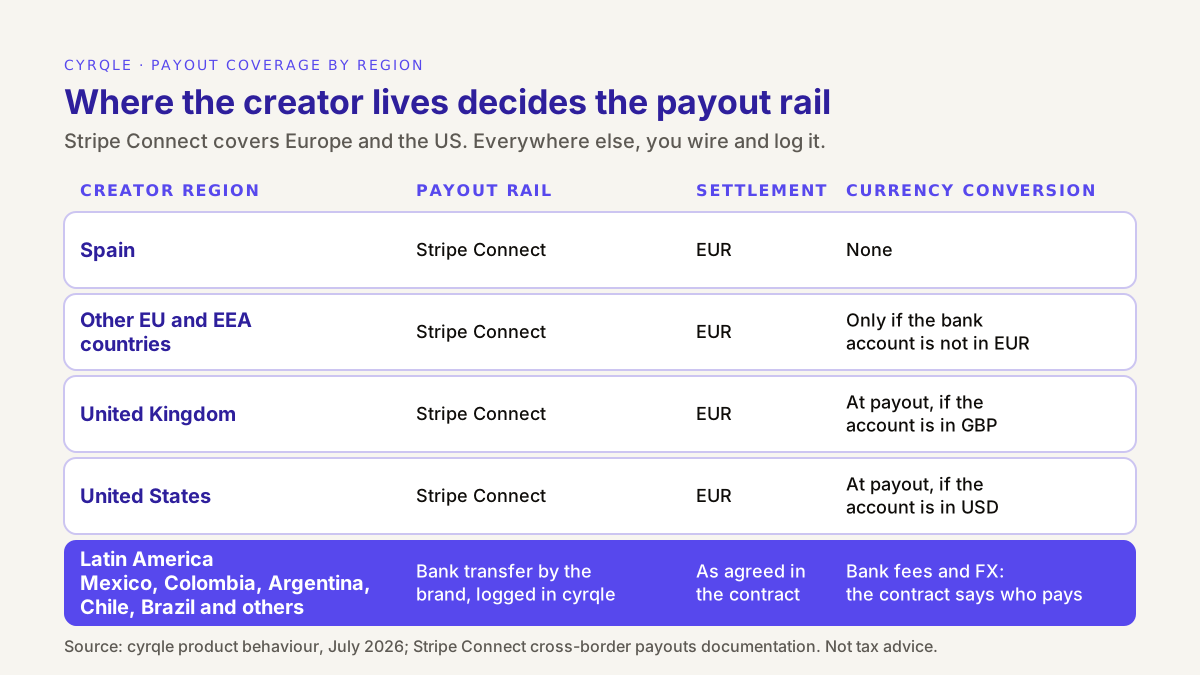
SEPA credit transfer (EU, EEA, UK, Switzerland and a few others). The SEPA schemes run by the European Payments Council cover the 27 EU states plus the UK, Iceland, Norway, Liechtenstein, Switzerland, Monaco, San Marino, Andorra, Vatican City and several Balkan states. For euro payments inside the EU, Regulation (EU) 2021/1230 requires a bank to charge the same for a cross-border euro transfer as for the matching domestic one. That rule is about parity with domestic prices, not a promise that transfers are free.
International wire (SWIFT) for Latin America and the rest of the world. A wire from a Spanish bank to Mexico, Colombia or Argentina passes through the sending bank, sometimes one or more correspondent banks, and the receiving bank. Each can charge. The sender picks a fee option when ordering the wire:
| Option | Who pays the fees | What the creator receives |
|---|---|---|
| OUR | You pay your bank's fees and the fees of the banks downstream | The full amount, unless a correspondent still deducts something |
| SHA | You pay your bank; the creator pays their bank and any correspondents | Less than you sent |
| BEN | The creator pays all fees, deducted from the amount | Less than you sent, sometimes noticeably less |
Inside the EU you do not get to choose. Spain's payment services law says that when both banks are in the EU, each side pays its own provider's charges (Real Decreto-ley 19/2018, Article 35.2). That is the SHA model, and it is why SEPA transfers always run on shared charges.
Regulated payout providers. A payout platform such as Stripe Connect handles identity checks on the creator, the bank details and a record of every transfer. Stripe documents that platforms in the EEA can make cross-border payouts to connected accounts in the US, the UK, the EEA, Canada and Switzerland, and that self-serve cross-border payouts do not extend beyond those regions (Stripe docs). For Latin American creators, a bank wire is the realistic default.
Whatever rail you use, avoid cash and personal payment apps for creator fees. They leave a weak audit trail, and Spain's Ley 7/2012, Article 7 bans cash payments of 1,000 euros or more when one party is acting as a business or professional.
Who pays the currency conversion?
Whoever receives money in a currency other than the one sent pays the conversion, unless the contract says otherwise. If you pay a Mexican creator 1,000 euros, their bank converts it to pesos at its own rate and margin. If you agree to pay 20,000 pesos, your bank converts euros to pesos and you carry the cost and the rate risk.
Put four lines in the contract so nobody argues about it after the post goes live. The influencer contract template for Spain and the EU has a payment clause you can extend with them:
- Fee currency. "The fee is 1,000 EUR" or "The fee is 20,000 MXN". Pick one.
- Fee option for wires. OUR if the creator must receive the full amount, SHA if each side pays its own bank.
- Conversion. Who carries the bank's conversion margin, and which date's rate applies if the fee is in the creator's currency.
- Withholding. That the fee is gross, and that you will withhold Spanish non-resident tax unless the creator sends a valid tax residence certificate before payment.
Most Spanish brands pay in euros and let the creator's bank convert. It keeps your books simple and the cost predictable. A creator with a big following in Mexico and an agency behind them may push back and ask for pesos. If you agree, treat the conversion as part of the fee when you compare creators.
Worked example: one 1,500-euro fee, four countries
A Spanish brand books four creators for the same deliverable at 1,500 euros each. The brand pays in euros and can deduct IVA in full. All bank fees and conversion margins are illustrative; your bank's tariff and the day's rate decide the real numbers.
| Portugal, certificate on file | United Kingdom, no certificate | Mexico, certificate on file | Peru, no treaty | |
|---|---|---|---|---|
| Fee on the invoice | 1,500 EUR | 1,500 EUR | 1,500 EUR | 1,500 EUR |
| Spanish IVA | Reverse charge, self-assessed | Reverse charge, self-assessed | Reverse charge, self-assessed | Reverse charge, self-assessed |
| IRNR withheld | 0 | 24%: 360 EUR | 0 | 24%: 360 EUR |
| Amount sent | 1,500 EUR | 1,140 EUR | 1,500 EUR | 1,140 EUR |
| Rail | Stripe Connect or SEPA | Stripe Connect | SWIFT wire, OUR | SWIFT wire, SHA |
| Your bank fee (illustrative) | 0 | 0 | 30 EUR | 30 EUR |
| Creator side: fees and conversion (illustrative) | 0 | Conversion at payout if the account is in GBP | Conversion margin of about 2% on pesos | Correspondent fees plus conversion |
| Paid to the tax office | 0 | 360 EUR (Modelo 216) | 0 | 360 EUR (Modelo 216) |
The lesson is in the second and fourth columns. The same fee leaves the UK and Peruvian creators 360 euros short of what they may have expected, and only one of the two can fix it. The UK creator can send an HMRC certificate, after which the treaty usually removes the withholding, and your adviser can tell you whether a correction or refund is possible for a payment already made. The Peruvian creator cannot, because there is no treaty to apply. Tell creators in the second group at contract stage, before they price their fee, not when the payment lands.
Withholding is your company's debt, not the creator's. If you pay the gross amount and forget to withhold, the Agencia Tributaria can still claim the 360 euros from you.
A payer's checklist for creators abroad
- Contract stage: collect the creator's legal name, address, country of tax residence, tax ID or EU VAT number, and the tax residence certificate. Agree the fee currency, the wire fee option and who carries the conversion.
- Before the first payment: check the EU VAT number in VIES, check the certificate's date and the treaty list, and decide the withholding rate with your adviser.
- Invoice check: no Spanish IVA, a reverse-charge note, the fee in the agreed currency, and a description of the deliverables and any usage rights as a separate line. The influencer invoice checklist for brands covers every field.
- Payment: pay the net amount by the rail the creator can receive, and keep the transfer reference.
- After payment: self-assess the IVA in Modelo 303, file any withholding in Modelo 216, include the creator in Modelo 296, and keep the certificate, contract, invoice, post and transfer together.
If you also run campaigns for the Mexican market, the Hot Sale Mexico creator playbook covers the calendar and campaign side; this checklist covers the payment side.
How cyrqle helps
cyrqle runs the payment side of a creator campaign, from the deal terms in the brief to the payout record. It does not decide your tax treatment, collect tax residence certificates or file returns for you. That stays with your finance team and your adviser.
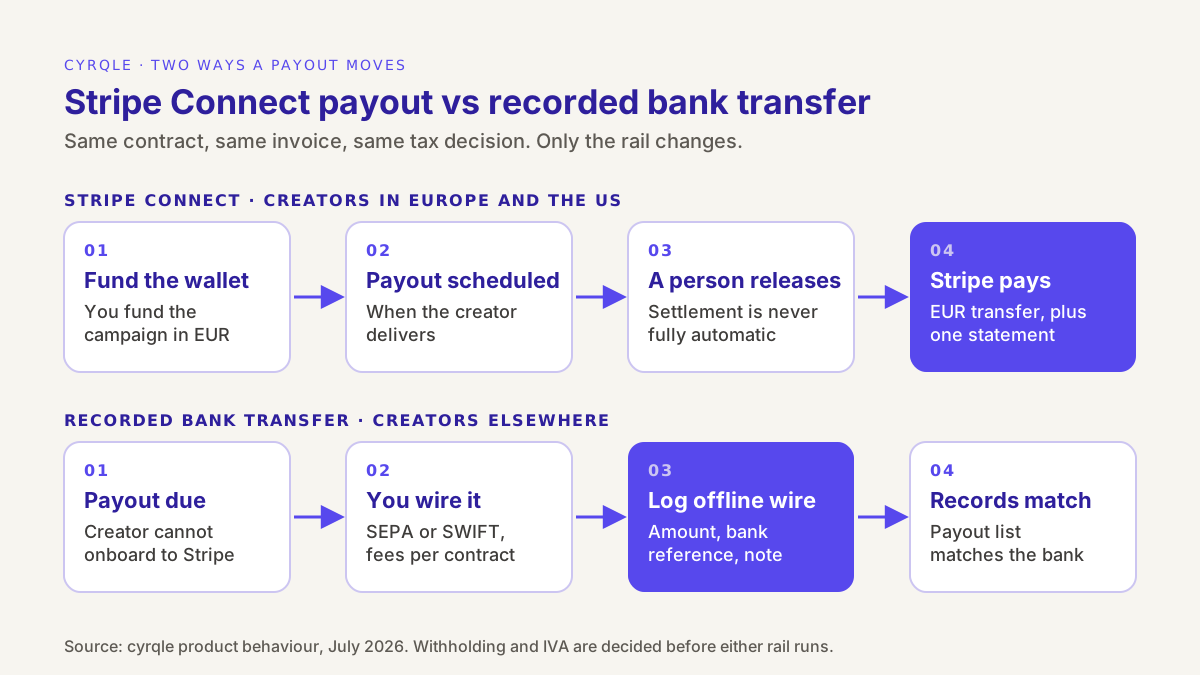
- Stripe Connect for Europe and the US. In compensation and contracts, you fund the campaign wallet in euros. When a creator delivers, cyrqle schedules the payout, and a person on your side releases it. Creators in Europe and the US onboard to Stripe Connect and get paid to their bank; settlement is in euros. The Stripe integration page explains onboarding, and why marketplaces use Stripe Connect for creator payouts covers the background.
- A country check before onboarding. Before cyrqle opens a payout account, it asks Stripe whether a payment to the creator's country is possible. If it is not, the creator is told they will be paid by bank transfer instead, so nobody completes identity checks for an account that cannot receive money.
- Logged wires for everyone else. For creators in Latin America and other regions, you send the wire from your own bank and use Log offline wire on the campaign. You record the amount, the bank reference (for example the SWIFT MT103 reference) and an audit note. The payout appears in the campaign's payouts list with your user stamp, so the campaign record matches the bank.
- One statement per payout. Each payout shows the split: creator net, cyrqle commission, any agency fee and any amount withheld. Finance can match it to the creator's invoice and your Modelo 216.
- What cyrqle does not do. It settles in euros only. It does not convert currencies, pay creators in pesos or reales, or pay Latin American creators through Stripe. Commission owed on sales is calculated in reports; paying it is a separate step.
If you run a brand team, cyrqle for brands shows the rest of the workflow, and you can book a demo to see the payout and wire-logging screens on a real campaign.
FAQ
Do I withhold tax when I pay a foreign influencer from Spain?
Usually yes, unless a treaty removes it. A Spanish company paying a non-resident creator for a service used in Spain withholds non-resident income tax: 19% for EU and EEA residents, 24% for others, including the UK. With a valid tax residence certificate, most treaties remove the withholding on business profits. Confirm each case with your adviser.
Does a creator in another country charge me Spanish IVA?
No. A creator established outside Spain invoices your Spanish business without Spanish IVA, and you self-assess it under the reverse charge in your Modelo 303. If your company can deduct IVA in full, the charge and the deduction cancel out in the same return. Creators in the Canary Islands, Ceuta and Melilla follow different indirect-tax rules.
Can I pay a creator in Mexico or Argentina through Stripe Connect in cyrqle?
No. In cyrqle, Stripe Connect payouts cover creators in Europe and the US. For creators in Mexico, Argentina and the rest of Latin America, you pay by bank transfer from your own bank and log the wire in cyrqle with the amount, bank reference and an audit note, so the campaign's payout records stay complete.
Who pays the bank fees on an international transfer?
It depends on the fee option. With OUR you pay all fees and the creator should receive the full amount; with SHA each side pays its own bank; with BEN the creator pays everything. Inside the EU, Spanish law requires the shared model. For wires outside the EU, write the option into the contract.
Should I pay foreign creators in euros or in their local currency?
Paying in euros keeps your books simple and puts the conversion cost on the creator's side. Paying in local currency makes the creator's income predictable but moves the rate risk and conversion margin to you. Either works if the contract says which currency, which rate date and who carries the bank's margin.
Sources
- Ministry of Finance, list of double tax treaties in force: hacienda.gob.es
- Real Decreto Legislativo 5/2004, Ley del IRNR (Articles 13, 25 and 31): BOE-A-2004-4527
- Ley 37/1992, del IVA (Articles 69 and 84): BOE-A-1992-28740
- Real Decreto 1619/2012, invoicing regulation (Article 12, currency and language): BOE-A-2012-14696
- Real Decreto-ley 19/2018, payment services (Article 35.2, shared charges): BOE-A-2018-16036
- Ley 7/2012, cash payment limits (Article 7): BOE-A-2012-13416
- Regulation (EU) 2021/1230 on cross-border payments in the Union: EUR-Lex
- Spanish administration, non-resident income tax and certificates of residence: administracion.gob.es
- Stripe, Connect cross-border payouts: docs.stripe.com
- European Payments Council, SEPA geographical scope: europeanpaymentscouncil.eu
Related field notes.
How to pay influencers in Spain as a brand: what the invoice must show, when you withhold IRPF, how IVA works for EU and non-EU creators, and gifted products.
An agency paying influencers on behalf of a client must settle who funds, who invoices, who withholds IRPF and how its fee shows. Worked EUR 1,000 payout split.
The cost of an influencer collaboration in Spain, worked in euros: fee, commission, product, IRPF withholding, IVA, and payment, platform and agency fees.