
How to choose an influencer marketing platform: a 12-point buyer's checklist
How to choose an influencer marketing platform: 12 criteria for Spain, EU and LatAm teams, from data provenance and attribution to payouts, rights and exit.
To choose an influencer marketing platform, list the jobs you need done from finding creators to paying them, weight them for your programme, and score each vendor against 12 criteria: data provenance, platform coverage, brief-to-contract workflow, Spanish-language support, approvals and tracking, attribution method, reporting, payouts, rights, data residency, exit and pricing. Then ask every vendor to show each one live, on your own category.
Most "how to choose" guides stop at discovery filters and dashboards. Those matter, but they are the easy part to demo. The expensive surprises arrive three months in: the platform cannot tell you which creator sold, cannot pay a creator in Mexico, or has no record of who agreed to let you reuse a video. This guide is written for brand and agency teams in Spain, the EU and Latin America, and it covers those gaps first-hand.
What types of influencer marketing platform are there?
Influencer marketing platforms fall into four broad types: creator databases, campaign managers, marketplaces and creator commerce platforms. The type matters more than the feature list, because it decides what the tool was built to prove. Two questions separate them: can it show which creator drove a sale, and can it pay that creator?
- Creator database. Search, vet and export lists of creators. Outreach, contracts, payments and sales tracking happen in other tools or spreadsheets.
- Campaign manager. Briefs, outreach, draft approval and reporting in one place. Sales usually come from discount codes or a link report; payments often run outside.
- Marketplace. Creators apply to briefs you publish, and the platform often holds and releases payment. You get less control over who you pick and usually little sales data.
- Creator commerce platform (sometimes called a Creator Commerce OS). Discovery, contracts, attribution and payouts share one record, so the creator who signed the deal is the same creator the sale and the payout are tied to.
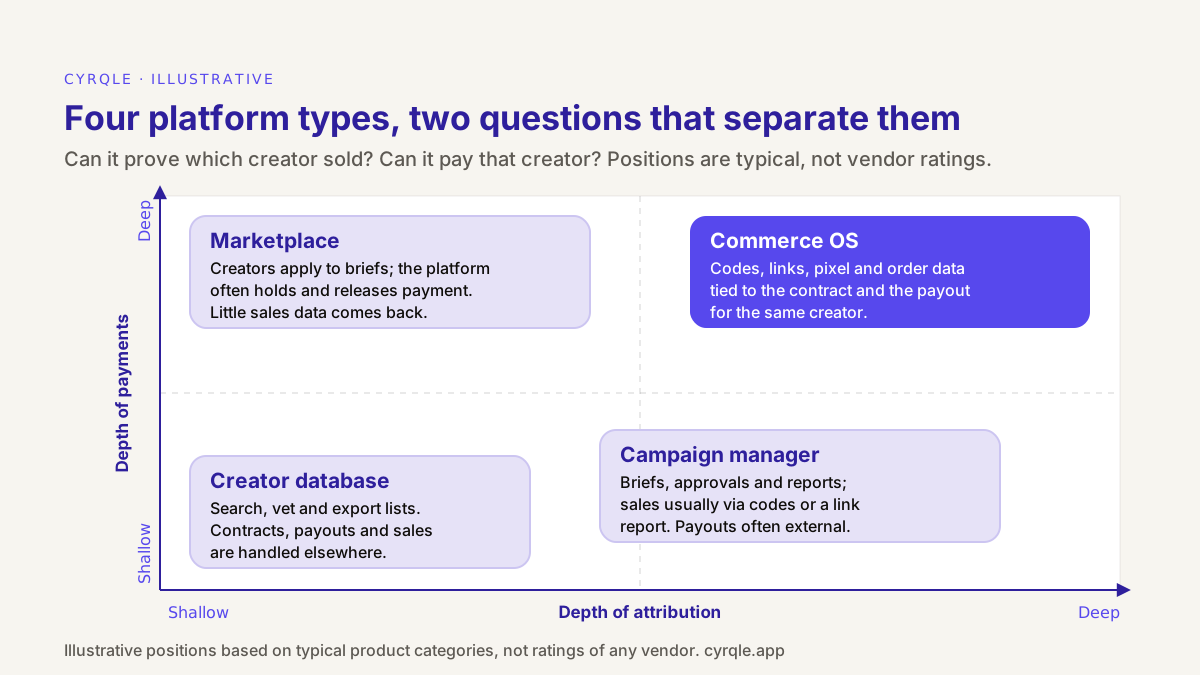
None of these types is wrong. A PR-led awareness programme with ten creators a year can live happily on a database plus a spreadsheet. A D2C brand paying 40 creators a mix of fee and commission every month cannot. Decide which type you need before you compare vendors inside it, and use the independent roundup of creator commerce software to see who sits where.
The 12-point checklist at a glance
The checklist maps 12 criteria to the six stages of the creator loop; three of them (residency, exit and pricing) apply across every stage. Use the table as your scorecard. The "Red flag" column is what a weak answer sounds like in a demo.
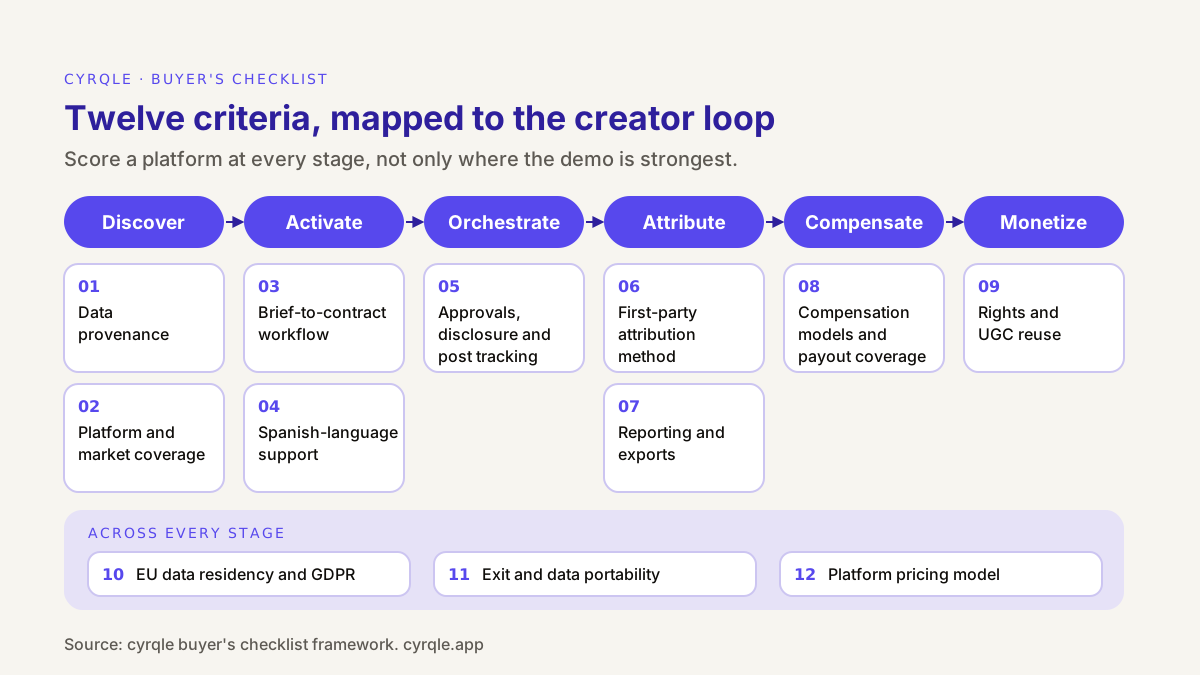
| Stage | Ask the vendor | Red flag | |
|---|---|---|---|
| 1. Data provenance | Discover | Where does creator data come from, and how is a missing creator added? | A headline database size with no answer on source or refresh |
| 2. Platform and market coverage | Discover | Which networks are searched and tracked, and does search work in Spanish? | Tracking claimed for a network you cannot see in the demo |
| 3. Brief-to-contract workflow | Activate | Show me a brief becoming invites and a signed contract. | Contracts are 'attached as a PDF' outside the platform |
| 4. Spanish-language support | Activate | Can the interface, invites and contracts run in Spanish? | Only the marketing site is translated |
| 5. Approvals, disclosure and tracking | Orchestrate | How are drafts approved and ad labels checked? Which posts are tracked automatically? | Manual screenshots as the only proof a post went live |
| 6. Attribution method | Attribute | Which signals tie a sale to a creator, and how confident is each one? | One 'influenced revenue' number with no method behind it |
| 7. Reporting and exports | Attribute | Which reports exist, in which formats, and can agencies white-label them? | Reports only as screenshots or a live login |
| 8. Compensation and payouts | Compensate | Which deal models, which countries, which currencies, and who presses 'pay'? | 'We support payments' with no list of countries |
| 9. Rights and UGC reuse | Monetize | Where is the licence stored, what scope does it record, and what happens on withdrawal? | Rights handled by 'a clause in your contract' |
| 10. EU data residency and GDPR | Across | Where is data stored, who are the sub-processors, and is there a DPA? | No sub-processor list |
| 11. Exit and portability | Across | What can I export on the way out, in what format? | Export 'on request' only |
| 12. Pricing model | Across | What is fixed, what scales with usage, and is there a fee on creator payments? | Price only after you sign an NDA, with no structure |
The rest of this guide explains each criterion: why it matters and what a good answer looks like.
Discover: where does the creator data come from?
1. Discovery data provenance
Data provenance is the answer to "where did this number come from?". Discovery tools build their indexes from public posts, from creators who connect their accounts, from third-party data suppliers, or a mix. Each source has a different accuracy and a different legal basis, and the difference shows up in your shortlist.
Ask four things: which sources feed the index, how a creator who is not yet indexed gets added, which fields are measured and which are estimated, and whether audience demographics are observed or modelled. A good vendor separates measured views from estimated reach on screen. Treat any database size quoted without a method as marketing, not data.
Provenance also decides how you should rank creators. Recent views and engagement measured from public posts are more useful than follower counts, as our guide to comparing creators on real views and effective CPM explains.
2. Platform and market coverage
Coverage means the networks the platform can search and the networks it can track after a post goes live. Those are often different lists. A tool can find YouTube creators but not track their videos, which leaves you checking deliverables by hand.
Check three things against your actual plan: the networks your creators post on, the markets you buy in (Spain, Mexico, Colombia, Argentina, Chile), and whether search understands Spanish captions and regional slang. Search by meaning, not just by keyword, matters more in Spanish because the same idea is written differently in Madrid and Monterrey.
Activate: can you go from brief to signed contract in one place?
3. Brief-to-contract workflow
The activation workflow is the path from a written brief to creators who have accepted terms and signed. Every step that leaves the platform, such as a contract emailed as a PDF or deal terms agreed in a DM, is a step where terms drift and records go missing.
Ask the vendor to run it live: write a brief, rank creators against it, send invites, negotiate a fee, and send a contract that the creator signs without creating an account. Look for a frozen snapshot of the agreed terms, so that what the creator signed is exactly what you pay against later.
4. Spanish-language support
Spanish-language support means the product, not the website, works in Spanish: the interface for your team, invites and follow-ups to creators, contract and rights templates, and the support desk. A Mexican creator who receives an English invite and an English contract is less likely to answer and more likely to misread the terms.
Ask to see a Spanish invite and a Spanish contract in the demo. If you work in both Spain and Latin America, ask whether invites can be sent by market in Spanish or English from the same campaign.
Orchestrate: how are drafts approved and posts tracked?
5. Approvals, disclosure and post tracking
Orchestration covers what happens between signature and payout: draft review, disclosure checks and proof that the post went live. In Spain, advertising by creators must be identifiable as advertising. Royal Decree 444/2024 sets obligations for high-reach creators (BOE-A-2024-8716), and the industry code run by AUTOCONTROL covers how to label commercial content. A platform cannot make you compliant, but it can make the check routine.
Look for an optional draft sign-off step, an automated check for required hashtags and handles, and automatic tracking of published posts with views and engagement. Ask which formats are tracked: feed posts and reels are common, stories are often not. This is not legal advice; for a specific campaign, ask your lawyer.
Attribute: how does the platform know a sale came from a creator?
6. First-party attribution method
The attribution method is the set of signals a platform uses to tie an order to a creator. It is the criterion that decides whether you can defend the budget, and the one rival guides most often reduce to "has ROI reporting". Ask what the number is made of.
The common first-party signals, roughly from strongest to weakest:
| Signal | How it works | Watch out for |
|---|---|---|
| Promo code | The buyer types the creator's code at checkout | Codes leak to coupon sites |
| Tracking link plus on-site tag | The click and the later order share a session or first-party cookie | Ad blockers and cross-device journeys |
| Store pixel and order webhooks | Orders come from your store's own records, net of refunds | Setup on each store platform |
| In-store redemption | A cashier records the code at the till | Staff have to use it |
| Estimated media value | A modelled value of reach, not a sale | Not attribution at all |
A good answer names the signals, shows a confidence level per order, removes refunds, and lets you trace one sale back to the code, the post and the creator. Be wary of a single "influenced revenue" figure with no method. If you need to know what would have happened without creators, that is an incrementality question, answered with a holdout test, not by a dashboard.
See how cyrqle approaches this on the first-party attribution page.
7. Reporting and exports
Reporting is the output the rest of the company sees. Check which reports exist (brand, campaign, creator, list), which formats they export to (PDF for the CMO, CSV for finance), and whether an agency can white-label them and hide creator fees from the client. A report you can only view inside the tool is a report finance will rebuild in a spreadsheet. Agencies should look at white-label reports in detail.
Compensate: who can you pay, in what currency, and who presses the button?
8. Compensation models and payout coverage
Payout coverage is the list of countries and currencies in which a platform can actually move money to creators, and the controls around it. It is the most under-checked criterion in platform selection and the one that turns into weeks of manual bank transfers when it fails.
Ask five questions:
- Which deal models? Fixed fee, commission on sales, gifted product, or a mix. The four common compensation models each need different tracking.
- Which countries? Get the list in writing. Payment rails often cover the EU and the US but not every Latin American market.
- Which currencies? Is settlement in one currency or in the creator's local currency, and who carries the FX cost?
- Who triggers the payment? Automatic on delivery, or released by a person after approval. Both are valid; you need to know which.
- What paperwork comes out? A statement or invoice per payout, with withholding shown, so your finance team can reconcile it.
Commission is the hard case. Calculating what a creator is owed is easy; turning it into a monthly payment, net of refunds, is not. Ask the vendor to show a commission payout end to end. See how cyrqle handles contracts and creator payouts.
Monetize: can you reuse the content legally?
9. Rights and UGC reuse
Rights management is how a platform records permission to reuse creator and customer content outside the original post. A public post is not a licence. In the EU the creator owns the copyright, the people in the picture have image rights, and the content is personal data under the GDPR.
Ask where each licence lives, whether it records scope (channels, markets, duration, paid ads or not), how withdrawal works, and whether content stops showing on your site when a licence ends. Paid-ads use should be a separate tick, not implied. Our walkthrough on requesting content rights from a creator shows what a usable record looks like.
Across the loop: residency, exit and pricing
10. EU data residency and GDPR
Data residency is where your workspace data, creator data and content files are stored and processed. For EU brands, ask for the regions used, the sub-processor list, a data processing agreement under Article 28 of the GDPR, and the vendor's security status in precise words: "audit in progress" and "certified" are different things. The GDPR text on EUR-Lex is the reference for what a processor contract must cover.
11. Exit and data portability
Exit is the criterion nobody asks about in a demo and everybody needs later. Your creator lists, contracts, licences, codes and sales history are the asset you are building. Ask what you can export, in what format, and what happens to your data when the contract ends. GDPR Article 28 requires a processor to delete or return personal data at the end of the service, at your choice; ask how that is done in practice. In the EU, the Data Act (Regulation (EU) 2023/2854) also adds switching rules for some data processing services. Whether a given tool is in scope is a legal question; this is not legal advice.
12. Pricing model
Influencer platforms are priced per seat, as a platform fee plus usage, as a percentage of creator spend, or as a fee on payouts. Many combine two. The structure matters more than the headline, because it decides what happens to your cost when the programme grows. Ask for the fixed part, the usage part, any fee taken on creator payments, the minimum term and what is charged for extra markets or brands. Our sister guide on platform pricing covers hidden costs in depth; see the list at the end.
Worked example: scoring two platforms for a Madrid skincare brand
A D2C skincare brand in Madrid sells on Shopify in Spain and Mexico. It works with about 40 creators a quarter on a fixed fee plus commission, and it wants to reuse the best videos on product pages. It shortlists two platforms, called X and Y here. All weights and scores are illustrative.
The team weights the 12 criteria to total 100, then scores each vendor 1 to 5 after a live demo. Weighted score = sum of (weight x score) / 5.
| Criterion | Weight | Platform X | Platform Y |
|---|---|---|---|
| 1. Data provenance | 8 | 5 | 3 |
| 2. Platform and market coverage | 7 | 5 | 3 |
| 3. Brief-to-contract workflow | 10 | 3 | 4 |
| 4. Spanish-language support | 8 | 2 | 5 |
| 5. Approvals, disclosure and tracking | 7 | 3 | 4 |
| 6. Attribution method | 18 | 2 | 4 |
| 7. Reporting and exports | 6 | 4 | 4 |
| 8. Compensation and payouts | 14 | 1 | 4 |
| 9. Rights and UGC reuse | 8 | 2 | 4 |
| 10. EU residency and GDPR | 5 | 3 | 5 |
| 11. Exit and portability | 4 | 3 | 3 |
| 12. Pricing model | 5 | 4 | 3 |
| Weighted score (out of 100) | 100 | 55.8 | 77.8 |
Three lessons come out of this table:
- Discovery alone misleads. Platform X wins the first two rows and would win a discovery bake-off. It loses overall because attribution and payouts carry 32 of the 100 points for this brand.
- Weights change the answer. On a plain average, X scores 3.1 and Y 3.8: closer than the weighted result. A PR-led brand that never pays commission would move weight from attribution and payouts to discovery (for example 19 and 18 points on criteria 1 and 2, 6 and 4 on criteria 6 and 8), and the gap would shrink from 22 points to about 2: 71.0 for X against 73.4 for Y.
- Knockouts beat totals. X scores 1 on payouts. For a brand paying 40 creators commission every quarter, that alone rules it out, whatever the total.
Set the weights before the first demo, so a strong presentation in one area does not reset your priorities.
Where cyrqle is not the best fit
cyrqle is a creator commerce platform built for Spain, the EU and Latin America. It is the wrong choice in some cases, and you should know them before a demo:
- TikTok Shop. cyrqle has no TikTok Shop integration. If most of your creator sales close inside TikTok Shop, choose a tool built around it.
- YouTube, X, LinkedIn and Facebook. cyrqle discovers and tracks creators on Instagram and TikTok only. YouTube deliverables cannot be verified automatically.
- Multi-currency payouts. Settlement is in EUR. Creators in Europe and the US are paid through Stripe Connect; elsewhere, the brand pays by bank transfer and records it. If you pay many creators in local currencies, a vendor such as CreatorIQ, whose CreatorIQ Pay announced coverage of 80+ markets and 60+ currencies in December 2025, may fit better. Compare the two on our cyrqle vs CreatorIQ comparison.
- YouTube, Twitch and wider network coverage. Kolsquare, founded in Paris in 2018, lists Instagram, TikTok, YouTube, Facebook, Twitch and Snapchat on its about page. If YouTube or Twitch is central to your plan, read how cyrqle and Kolsquare differ first.
- Incrementality and multi-touch models. cyrqle measures first-party attributed sales with confidence tiers. It does not run lift studies, holdouts or multi-touch attribution for you.
How cyrqle helps
cyrqle covers the loop in one workspace, and each part maps to the checklist:
- Discover (1, 2). In Find creators you search a proprietary creator index by meaning across captions and visuals, in Spanish or English, and fetch a creator on demand if they are not indexed yet. Reach, cost and return figures are labelled as estimates.
- Activate and orchestrate (3, 4, 5). Campaigns turn a brief into ranked creators and invites in Spanish or English by market. The Creator Collaboration Agreement is signed by both sides, with a frozen terms snapshot and a signing link that needs no creator account. Optional draft sign-off checks required hashtags and handles, and published Instagram and TikTok posts are tracked with views and engagement. The app runs in Spanish and English.
- Attribute (6, 7). Attribution combines per-creator promo codes, tracking links, a tag under 2KB on your store, the Shopify pixel and signed order webhooks from Shopify, WooCommerce and Magento. Each sale gets a confidence tier, revenue is net of refunds, and an audit chain links sale, code, post and creator. Reports export as PDF and CSV, with white-label options for agencies.
- Compensate (8). Compensation supports cash, commission, product and combinations. You fund the campaign, a payout is scheduled when the creator delivers, and a person triggers settlement. Commission owed is calculated and shown; paying it is a separate step.
- Monetize (9). Rights requests go to the creator by email or DM link, every licence sits on the Agreements page with status and a PDF, and a content wall only shows a post while its licence is active.
- Across (10, 12). Data is stored in the EU, and our SOC 2 Type II audit is in progress (see security). Pricing is a custom monthly base plus usage for brands and agencies.
The fastest way to score cyrqle against this checklist is to book a 30-minute demo on your own category and markets, and ask us to show each of the 12 points live.
More in this series
This pillar is the hub of our platform-selection series. Each guide goes deeper on one decision:
- Best influencer marketing platforms in Spain: an honest comparison, including us.
- Influencer platform pricing: what you pay and what is hidden.
- CreatorIQ alternatives in Europe for mid-market teams and agencies.
- Platform, agency or in-house: a cost model and break-even.
- Questions to ask in a vendor demo, criterion by criterion.
- Platform evaluation scorecard template with the weights from the worked example.
FAQ
What is the most important criterion when choosing an influencer platform?
It depends on your objective. For sales-led programmes, the attribution method and payout coverage matter most, because they decide whether you can prove and pay for results. For awareness programmes, discovery data quality and post tracking matter more. Set weights before the first demo.
Should I choose a platform with the biggest creator database?
Not on size alone. A large index is only useful if its data is recent, its source is clear and it covers your markets and networks. A smaller index with measured recent views in Spain and Mexico can beat a global one built on follower counts.
How long does it take to evaluate influencer marketing platforms?
Plan for three to six weeks: one week to agree weights and must-haves, two to three weeks for demos and a trial on real creators, and one week for security, DPA and contract review. Score each vendor straight after its demo, while the details are fresh.
Do I need a platform that pays creators, or can I pay them myself?
You can pay them yourself; many teams do with fewer than ten creators. Past that, manual transfers, invoices and commission sums take hours each month and create errors. If you pay commission, a platform that calculates it per creator, net of refunds, saves the most time.
Is an influencer platform GDPR compliant by default?
No tool is compliant by default; compliance depends on how you use it. Check that the vendor signs a data processing agreement, publishes its sub-processors and stores data in the EU, and that it keeps a record of creator consent for content reuse.
Sources
- Royal Decree 444/2024, Boletín Oficial del Estado: https://www.boe.es/buscar/act.php?id=BOE-A-2024-8716
- Regulation (EU) 2016/679 (GDPR), EUR-Lex: https://eur-lex.europa.eu/eli/reg/2016/679/oj
- Regulation (EU) 2023/2854 (Data Act), EUR-Lex: https://eur-lex.europa.eu/eli/reg/2023/2854/oj
- CreatorIQ press release on CreatorIQ Pay, 4 December 2025: https://www.creatoriq.com/press/releases/creatoriq-expands-benchmarkiq-creatoriq-pay
- Kolsquare, About page (checked 3 November 2026): https://www.kolsquare.com/en/about
Related field notes.
The best influencer marketing platforms in Spain for 2026, compared by use case: databases, suites, marketplaces and commerce loop, with criteria and verdicts.
15 questions to ask an influencer marketing platform in a demo: data, attribution, payouts, rights, security and exit, with red-flag answers and good ones.
How to pay influencer commission every month: count attributed orders net of refunds, hold for returns, send a statement, pay against an invoice, reconcile.