
Influencer marketing platform pricing: what you pay and what is hidden
Influencer marketing platform pricing explained: licence, seats, usage, payout fees, take rates and internal hours, with a TCO worksheet.
Influencer marketing platform pricing is rarely a single number. Most vendors charge a licence or base fee, then add costs that scale with users, usage, creator spend or creator payouts. To compare quotes fairly, add up six lines for one year: licence, seats, usage or credits, payment and payout fees, any agency fee, and the internal hours the tool does not remove. Then run the same sum at twice your volume.
Many vendors do not publish prices, and the ones that do change them often. So this guide does not list competitor prices. Where you need a figure, verify it on the vendor's own site or in a written quote. What this guide gives you is the structure behind the price, the costs that do not appear on the first quote, and a worksheet you can fill in for any vendor. It is written for brand and agency teams buying in Spain, the EU and Latin America, and it pairs with our 12-point checklist for choosing an influencer marketing platform, where pricing is criterion 12.
What does an influencer marketing platform cost?
An influencer marketing platform costs a fixed part plus a variable part. The fixed part is a licence or monthly base fee. The variable part grows with one of four things: the number of users, how much you use the tool, how much you spend on creators, or how much you pay out through it. The same programme can cost very different amounts under two quotes with similar headline prices, because the variable part is where the money goes as you grow.
Six lines make up the full cost:
- Licence or base fee. Monthly or annual, often with a minimum term.
- Seats. A price per user, sometimes with a number included.
- Usage or credits. Searches, creator profiles unlocked, content collectors, reports or campaigns.
- Payment and payout fees. Card or bank fees to fund campaigns, fees per payout to creators, and any take rate the platform keeps on creator payments.
- Agency fee. If an agency runs the programme, its retainer or percentage sits on top of the software.
- Internal hours. The time your team still spends on outreach, contracts, invoices, commission sums and reports.
The first three lines are on the quote. The last three usually are not, and they are the ones that grow fastest.
The six pricing models, and when each one penalises growth
Influencer platforms use six pricing structures. Each one is fair for some programmes and expensive for others. The question to ask is not "which is cheapest?" but "which line grows when my programme doubles, and does the work grow with it?"
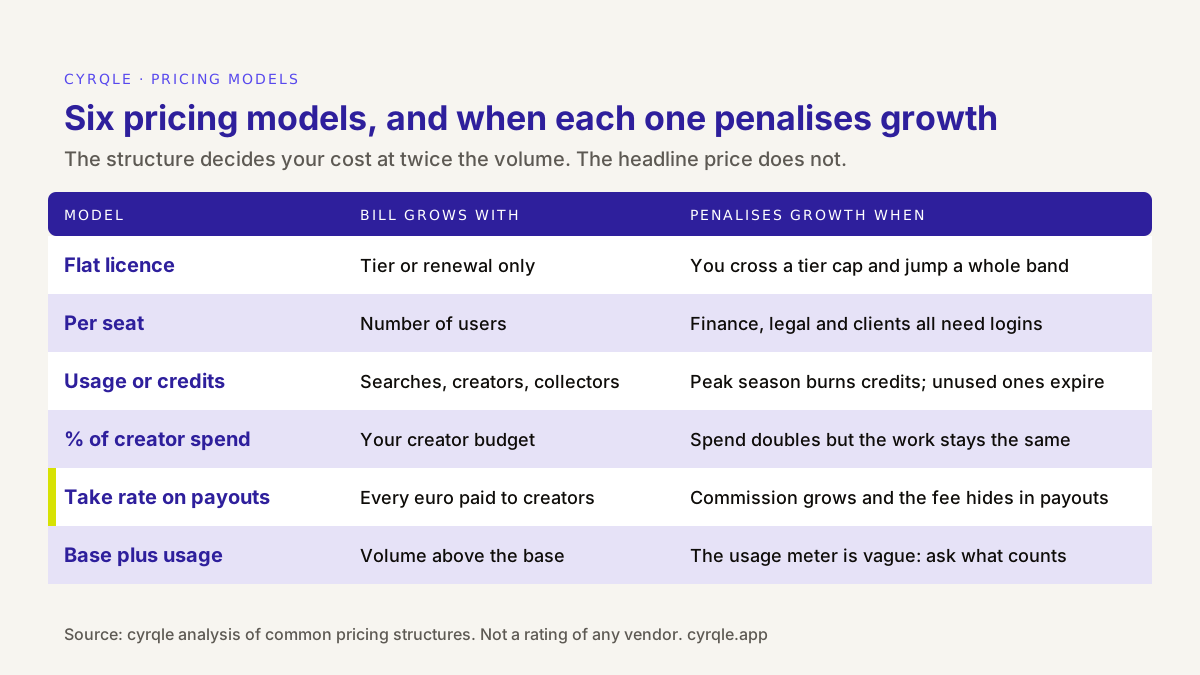
| How it is charged | Fits best when | Penalises growth when | |
|---|---|---|---|
| Flat licence | A fixed annual or monthly fee, often in tiers by brands, markets or creators | Your volume is stable and you can predict next year | You cross a tier limit and pay for the whole next band |
| Per seat | A price per named user per month | A small, fixed team uses the tool every day | Finance, legal, regional teams or clients need logins, so people share accounts |
| Usage or credits | Credits for searches, unlocked profiles, collectors or reports | Usage is light or seasonal and you want to pay only for what you use | Peak season burns credits, or unused credits expire at the end of the term |
| Percentage of creator spend | A share of the creator budget run through the platform | Spend is small and you want cost to follow budget | Spend doubles while the work does not, so the fee grows for no extra service |
| Take rate on payouts | A percentage kept on each payment to a creator, charged to you or deducted from the creator | You run few payments and want no fixed fee | Commission and affiliate programmes grow, and the cost hides inside payment lines |
| Base plus usage | A monthly base fee plus a variable part tied to volume | You want a predictable floor and cost that tracks real activity | The usage meter is vague, so ask exactly which unit is counted and at what price |
Two of these models are tied to money you send to creators, not to work the platform does. A percentage of spend and a take rate both grow when you raise creator fees, even if the platform does nothing more. That is not wrong, but it means a programme that pays commission every month gets more expensive in exact proportion to its success. Read the revenue share and commission terms in your creator contracts next to the platform's fee terms, so you know who pays what on each sale.
A take rate also has a second-order effect. If the platform deducts it from the creator, experienced creators raise their rates to cover it. Our guide to what influencers charge in Spain in 2026 shows how sensitive rates already are to format and usage rights; a fee taken from the creator's side ends up in your budget one way or another.
The costs that do not appear on the first quote
Hidden costs in influencer platform pricing are the lines that sit outside the licence: payment processing, payout fees, take rates, onboarding, add-ons, minimum terms, internal hours and exit. None of them is hidden on purpose in most cases. They are simply on a different page of the contract, or not in the contract at all.
Payment and payout fees
Moving money costs money, and someone pays it. When a platform pays creators, its payment provider charges fees for funding and for each payout, and the platform either passes them through, absorbs them or adds a margin. As one public reference point, Stripe's Spanish pricing pages list 1.5% + EUR 0.25 for standard EEA cards and EUR 0.35 for SEPA Direct Debit, and, for Connect platforms that set their own user pricing, EUR 2 per monthly active account plus 0.25% + EUR 0.10 per payout (Stripe pricing, Stripe Connect pricing, checked 3 November 2026). Your vendor may use a different provider or a different arrangement, so ask for its own payout fees in writing.
How you pay creators also brings tax paperwork: invoices, IRPF withholding and IVA. That is not a platform fee, but it decides how many hours your finance team spends per payout. Our guide on paying influencers in Spain, with invoices, IRPF and IVA covers the rules.
Take rate on creator payments
A take rate is a percentage the platform keeps from each creator payment. It may be called a service fee, a transaction fee or a marketplace fee. Ask three questions: what percentage, on which payments (fees, commission, product value), and who carries it (you on top, or the creator out of their fee). An 8% take rate on EUR 150,000 of creator payments is EUR 12,000 a year, which can be more than the licence.
Onboarding, add-ons and minimum terms
Look for one-off setup or onboarding fees, paid add-ons (extra brands, extra markets, extra languages, white-label reports, API access), minimum contract length, auto-renewal and notice periods, and the price increase cap at renewal. An annual contract paid upfront with a 90-day notice period is a different commitment from a monthly one, even at the same monthly price.
Internal hours
Internal hours are the cost of the work the platform does not do. If contracts, payouts or commission calculations happen outside the tool, someone builds them in a spreadsheet each month. Price those hours at a loaded hourly cost, not at salary, and count them as part of the platform's cost. A cheaper tool that leaves 20 hours a month of reconciliation is not cheaper.
Agency fee
If an agency runs your programme, its fee sits on top of the software: a retainer, a percentage of creator spend, or a performance fee. Agencies that run their own platform may bundle it; others pass the software cost through. Ask for both lines separately. Agencies evaluating software for themselves should read our guide to influencer software for agencies and margin, which models the hours side in detail.
Exit and IVA
Exit costs are the fees or effort needed to leave: data export "on request", migration help billed by the hour, or a contract that ends with your creator history locked in. Ask what you can export, in which format, at no charge.
Platform quotes are usually net of IVA. For a Spanish company buying from a vendor established in another EU country, IVA on the service is normally self-assessed by the buyer under the reverse-charge rule of the Spanish VAT Act (Ley 37/1992, BOE). It is rarely an extra cost for a VAT-registered business, but it changes how finance books the invoice. This is not tax advice; check your case with your adviser.
TCO worksheet: fill this in for every quote
Total cost of ownership (TCO) is the full annual cost of running your creator programme on a platform: what you pay the vendor, what you pay to move money, and what your team spends in hours. Fill in one column per vendor, at your current volume. Then copy the column and double the volume inputs.
| Line | How to calculate it | Ask the vendor |
|---|---|---|
| Licence or base fee | Monthly fee x 12, plus any one-off setup | Minimum term, notice period, renewal increase cap |
| Seats | Paid users x price per seat x 12 | How many seats are included, and are view-only users free? |
| Usage or credits | Expected units x unit price, plus overage | Which unit is counted, and do unused credits roll over? |
| Payment and funding fees | Creator spend x funding fee percentage + fixed fees | Who pays card or bank fees to fund campaigns? |
| Payout fees | Number of payouts x per-payout fee + monthly account fees | Are provider fees passed through at cost or marked up? |
| Take rate | Creator payments x take rate percentage | On which payments, and is it charged to you or the creator? |
| Agency fee | Retainer x 12, or creator spend x agency percentage | Is software bundled in the agency fee or billed separately? |
| Internal hours | Hours per month x 12 x loaded hourly cost | Which tasks still happen outside the tool? |
| Exit | Export and migration cost at the end of the term | What can I export, in what format, at no charge? |
| Total | Sum of all lines | Compare at 1x and 2x volume |
Leave creator fees themselves out of the TCO. You pay them whichever platform you choose. Include them only when a model is calculated on them, such as a percentage of spend or a take rate.
Worked example: two quotes for the same programme
A fashion D2C brand in Valencia sells in Spain and Portugal. It spends EUR 150,000 a year on creators, makes about 360 creator payouts a year (30 a month, a mix of fixed fees and monthly commission) and has four people on the team. It has two quotes. All prices, rates and hours below are illustrative. They are not the prices of any real vendor.
- Quote A: EUR 800 a month licence, EUR 100 per seat per month, and an 8% take rate on creator payouts. The tool pays creators but does not calculate commission or produce a statement per payout, so finance reconciles by hand: about 20 hours a month.
- Quote B: EUR 1,500 a month base with seats included, usage at EUR 8 per creator payout, and payout fees passed through at Stripe's listed Connect rates. Commission is calculated in the tool and each payout has a statement: about 6 hours a month of checking.
- Internal cost: EUR 40 per hour, loaded.
| Line | Quote A | Quote B |
|---|---|---|
| Licence or base fee | EUR 9,600 | EUR 18,000 |
| Seats (4 users) | EUR 4,800 | Included |
| Usage (360 payouts x EUR 8) | None | EUR 2,880 |
| Payout fees and take rate | EUR 12,000 (8% of 150,000) | EUR 1,130 (provider fees at cost) |
| Internal hours | EUR 9,600 (20 h x 12 x 40) | EUR 2,880 (6 h x 12 x 40) |
| Annual TCO | EUR 36,000 | EUR 24,890 |
Quote B's payout fees: 0.25% of EUR 150,000 is EUR 375, plus 360 x EUR 0.10 is EUR 36, plus 360 active-account months x EUR 2 is EUR 720, for EUR 1,131, rounded to EUR 1,130.
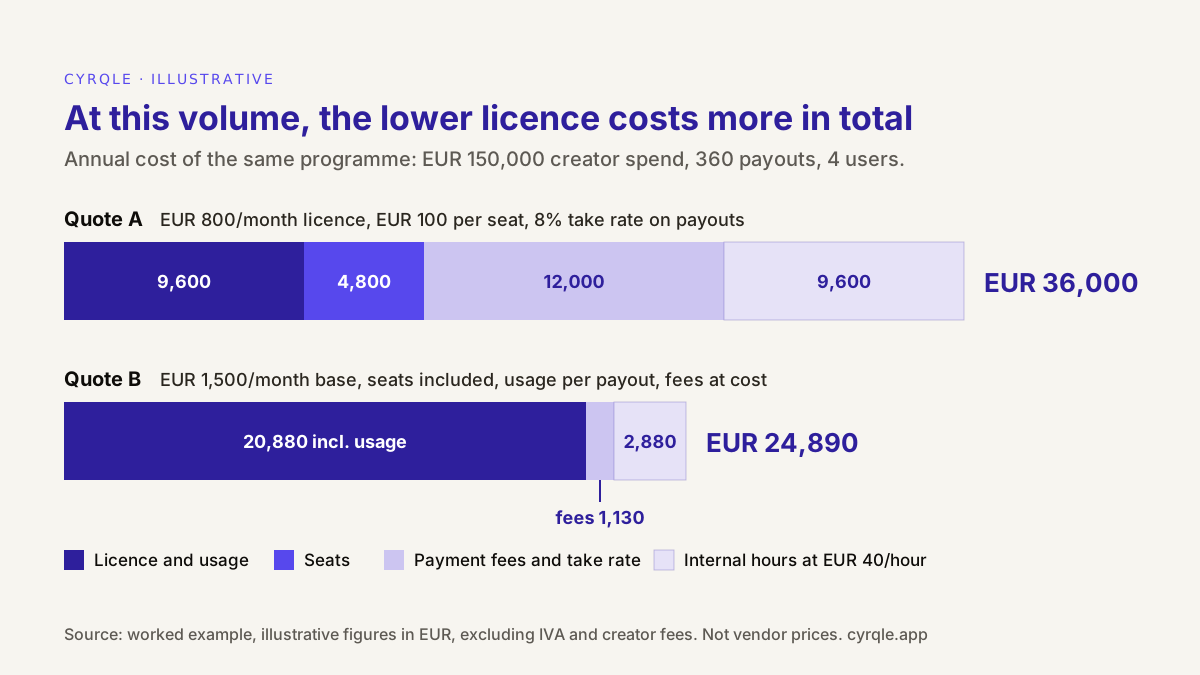
Quote A has the lower licence by EUR 8,400 a year. It is still EUR 11,110 more expensive in total, because the take rate and the manual hours together cost EUR 21,600.
What happens at one fifth and at twice the volume
The ranking is not fixed. Run the same assumptions at a smaller and a larger programme. Illustrative.
| Programme | Creator spend | Payouts a year | Users | Quote A | Quote B |
|---|---|---|---|---|---|
| Small | EUR 30,000 | 60 | 2 | EUR 16,800 | EUR 20,120 |
| Current | EUR 150,000 | 360 | 4 | EUR 36,000 | EUR 24,890 |
| Double | EUR 300,000 | 720 | 6 | EUR 60,000 | EUR 30,820 |
At small volume, Quote A wins by EUR 3,320, because its low licence matters most when there is little to pay out. At double volume, Quote A grows by EUR 24,000 and Quote B by EUR 5,930. The take rate and the manual hours both scale with payouts; the base fee does not. A brand that expects to stay small should take Quote A. A brand that expects to grow commission payouts should not.
Assumptions for the other rows: Quote A hours of 5 a month (small) and 40 (double); Quote B hours of 3 and 10; Quote B payout fees of about EUR 200 and EUR 2,260.
Questions to ask before you sign
Ask every vendor the same questions, in writing, and put the answers into the worksheet:
- What is fixed, what is variable, and which unit drives the variable part?
- Is there a fee on creator payments, on which payments, and who carries it?
- Which payment and payout fees are passed through, and at what rate?
- How many seats are included, and do view-only users for finance, legal or clients cost extra?
- What does the contract cost at twice our volume, in the same currency?
- What is the minimum term, the notice period and the cap on renewal increases?
- Which add-ons are paid: extra brands, markets, languages, white-label reports, API?
- What can we export when we leave, in which format, at no charge?
If a vendor will not answer the second or fifth question before you sign, treat that as the answer. Measuring what the programme returns is the other half of the decision; our guide to measuring influencer marketing ROI beyond the discount code covers the revenue side of the same sum.
How cyrqle is priced
cyrqle publishes its pricing model on the cyrqle pricing page, and it is stated here exactly as that page states it. Creators use cyrqle free, and cyrqle never charges creators. Brands and agencies pay a custom monthly base plus usage that scales with campaign volume and creator pool. There are no flat public tiers. Enterprise pricing is bespoke. For a figure, talk to us: we size it on the call.
Two points from the worksheet, answered for cyrqle:
- Fees on payouts. Every payout in cyrqle comes with a statement that shows the split: the creator's net amount, the cyrqle commission, any agency fee and any tax withheld. The rates are not published; ask for them on the call and put them in your worksheet.
- Usage. Usage can include items such as credits for collectors. Ask which units apply to your plan.
How cyrqle helps reduce the hidden lines
cyrqle is built to shrink the two lines that grow fastest in the worksheet: payout handling and internal hours.
- Payouts in one place. In compensation and contracts, you structure deals as fixed fee, commission, product or a mix, fund the campaign, and cyrqle schedules each payout when the creator delivers. A person on your team triggers settlement. Creators in Europe and the US are paid to their bank through Stripe Connect, in EUR. Elsewhere, you pay by bank transfer and record it in cyrqle.
- A statement per payout. Each payout has a statement or invoice with the split shown, so finance reconciles from one record instead of a spreadsheet.
- Commission calculated, not guessed. Commission owed is calculated from attributed sales and shown in reports. Paying it is a separate step that you control, not an automatic transfer.
- Contracts in the same record. The Creator Collaboration Agreement is signed by both sides with a frozen terms snapshot, so the fee you pay matches the fee that was signed.
- Exports for finance. Reports export as PDF and CSV. Agencies can white-label them and hide creator fees from client reports; see cyrqle for agencies.
cyrqle does not do everything on this list for every market. Settlement is in EUR only, and Stripe Connect payouts cover Europe and the US. If you pay many creators in local Latin American currencies, factor in the bank-transfer hours for those creators.
The fastest way to fill in the worksheet for cyrqle is to book a 30-minute demo with your volume, your markets and your deal mix, and ask us to price it on the call.
FAQ
How much does an influencer marketing platform cost per month?
There is no single market price, and many vendors do not publish one. Expect a fixed licence or base fee plus a variable part tied to users, usage, creator spend or payouts. Verify current prices on each vendor's own site or in a written quote, and compare annual totals, not monthly headlines.
What is a take rate in influencer marketing?
A take rate is the percentage a platform keeps from each payment made to a creator through it. It may be charged to the brand on top of the creator's fee or deducted from what the creator receives. Either way it scales with your creator payments, so model it at twice your current volume.
Is a percentage-of-spend model a bad deal?
Not always. For a small or irregular programme it keeps cost in line with budget and avoids a fixed fee. It becomes expensive when spend grows faster than the work, for example when commission payouts double but the platform does no extra work to process them.
Should creator fees be part of the platform's total cost of ownership?
No. You pay creators whichever platform you choose, so leave their fees out of the comparison. Include creator payments only where a pricing line is calculated on them, such as a percentage of spend, a take rate or a per-payout fee.
Do influencer platforms charge creators?
Some do, through a fee deducted from payouts or a paid creator plan; others do not. Ask each vendor. A fee taken from creators tends to come back to you as higher rates. cyrqle does not charge creators.
Sources
- Stripe, Pricing (Spain), standard EEA cards and SEPA Direct Debit, checked 3 November 2026: https://stripe.com/es/pricing
- Stripe, Connect pricing (Spain), monthly active account and per-payout fees, checked 3 November 2026: https://stripe.com/es/connect/pricing
- Ley 37/1992, del Impuesto sobre el Valor Añadido, Boletín Oficial del Estado: https://www.boe.es/buscar/act.php?id=BOE-A-1992-28740
Related field notes.
Influencer marketing budget planning for 2027, built bottom-up: objectives, tier mix, pricing model, seasonal peaks in Spain and Mexico and a worked euro model.
Influencer CPM vs CPA, CPE and flat fee: one campaign priced four ways, who carries the risk under each, and a decision tree matching the model to your goal.
The cost of an influencer collaboration in Spain, worked in euros: fee, commission, product, IRPF withholding, IVA, and payment, platform and agency fees.