
Influencer platform vs agency vs in-house: cost model and break-even
Influencer agency vs platform vs in-house: an illustrative cost model, break-even by campaigns per year, the hybrid option and when an agency is better.
Whether an influencer agency or a platform is cheaper depends on how many campaigns you run a year. An agency charges per campaign, so it is cheaper at low volume. An in-house team on a platform carries a fixed cost, so it gets cheaper per campaign as volume grows. In our illustrative model, the lines cross between 12 and 20 campaigns a year.
Picture a cosmetics brand in Valencia that sells online in Spain and Portugal. Last year it ran six creator campaigns through an agency. This year the plan is a launch every month, plus summer sales and Black Friday. The marketing director has three options on the table: keep the agency, bring the work in-house on a platform, or split it, with the agency on ideas and the brand on operations. Each option sounds sensible. Each one costs a different amount depending on the volume.
This post builds that decision as a calculator. It defines the three models, sets out an illustrative cost per model, finds the break-even points, and gives you a formula to run with your own numbers. It also says plainly when an agency is the better choice. If you are still at the stage of comparing tools, start with our 12-point checklist for choosing an influencer marketing platform.
What do agency, in-house and hybrid models include?
The three models differ in who does the work and which costs are fixed. The creator fees themselves are the same in all three: you pay the creators whoever books them. What changes is the cost of running the programme around those fees.
- Agency (full service). The agency writes the strategy, finds and negotiates with creators, manages contracts and approvals, pays creators, and reports results. You pay a management fee, often a percentage of creator spend, plus fees for strategy, creative and reporting. Your team only briefs and approves. Many agencies use their own software, and its cost sits inside their fee.
- In-house on a platform. Your team runs everything with software: discovery, briefs, invites, contracts, draft approval, post tracking, payouts and attribution. You pay a platform licence and the hours of at least one person who owns the programme.
- Hybrid. Your team runs operations on the platform. A smaller agency or freelance strategist adds the creative concept and talent introductions, per campaign or on a light retainer. You pay the platform, a smaller agency fee and fewer internal hours than fully in-house.
There is a fourth, informal model that many brands start with: in-house without a platform. The team runs creators from spreadsheets, DMs and email, and pays creators by bank transfer one by one. We include it in the calculator below, because it is often the real alternative to an agency.
Agencies price their own work in several ways. Our guide to how agencies price influencer services explains the retainer, the percentage of spend and the performance fee from the agency's side.
How much does each model cost per year?
The annual cost of each model is a fixed part plus a cost per campaign times the number of campaigns. The model below uses one set of illustrative assumptions. All figures are illustrative. They are not the prices of any real agency or vendor, and they are not cyrqle's prices.
Common assumptions:
- Creator spend of EUR 12,500 per campaign. Left out of the totals, because it is the same in every model.
- A loaded internal cost of EUR 50 per hour. For reference, Spain's average labour cost per effective hour worked was EUR 24.88 in the first quarter of 2026, across the whole economy (INE, Encuesta Trimestral de Coste Laboral). A specialist marketing role plus overhead, tools and management time sits above that average. Use your own figure.
- A platform licence of EUR 18,000 a year (EUR 1,500 a month). Platform prices vary widely by vendor, structure and volume. Our breakdown of influencer platform pricing and its hidden costs shows how to build the full figure for a real quote.
| Cost line | Agency | In-house on a platform | Hybrid |
|---|---|---|---|
| Platform licence (fixed) | Inside the agency fee | EUR 18,000 | EUR 18,000 |
| Programme owner (fixed) | None | 320 h × EUR 50 = EUR 16,000 | 120 h × EUR 50 = EUR 6,000 |
| Fixed cost per year | EUR 0 | EUR 34,000 | EUR 24,000 |
| Agency fee per campaign | 20% of EUR 12,500 + EUR 1,000 strategy and reporting = EUR 3,500 | None | EUR 1,000 concept and talent shortlist |
| Internal hours per campaign | 10 h × EUR 50 = EUR 500 | 30 h × EUR 50 = EUR 1,500 | 20 h × EUR 50 = EUR 1,000 |
| Cost per campaign | EUR 4,000 | EUR 1,500 | EUR 2,000 |
The fixed hours cover the work that exists even in a quiet month: owning the creator relationships, keeping contracts and rights in order, reporting to management and learning what works. The per-campaign hours cover the brief, invites, negotiation, approvals, payouts and the campaign report. With a platform, much of that per-campaign work moves out of spreadsheets and email, which is why the in-house cost per campaign is low.
Where is the break-even point?
The break-even point is the number of campaigns a year at which two models cost the same. Below it, the model with the lower fixed cost is cheaper. Above it, the model with the lower cost per campaign is cheaper.
Break-even campaigns = (fixed cost of model A − fixed cost of model B) ÷ (cost per campaign of model B − cost per campaign of model A)
With the illustrative numbers:
- Agency vs hybrid: (EUR 24,000 − EUR 0) ÷ (EUR 4,000 − EUR 2,000) = 12 campaigns a year.
- Hybrid vs in-house: (EUR 34,000 − EUR 24,000) ÷ (EUR 2,000 − EUR 1,500) = 20 campaigns a year.
- Agency vs in-house: EUR 34,000 ÷ (EUR 4,000 − EUR 1,500) = 13.6 campaigns a year.
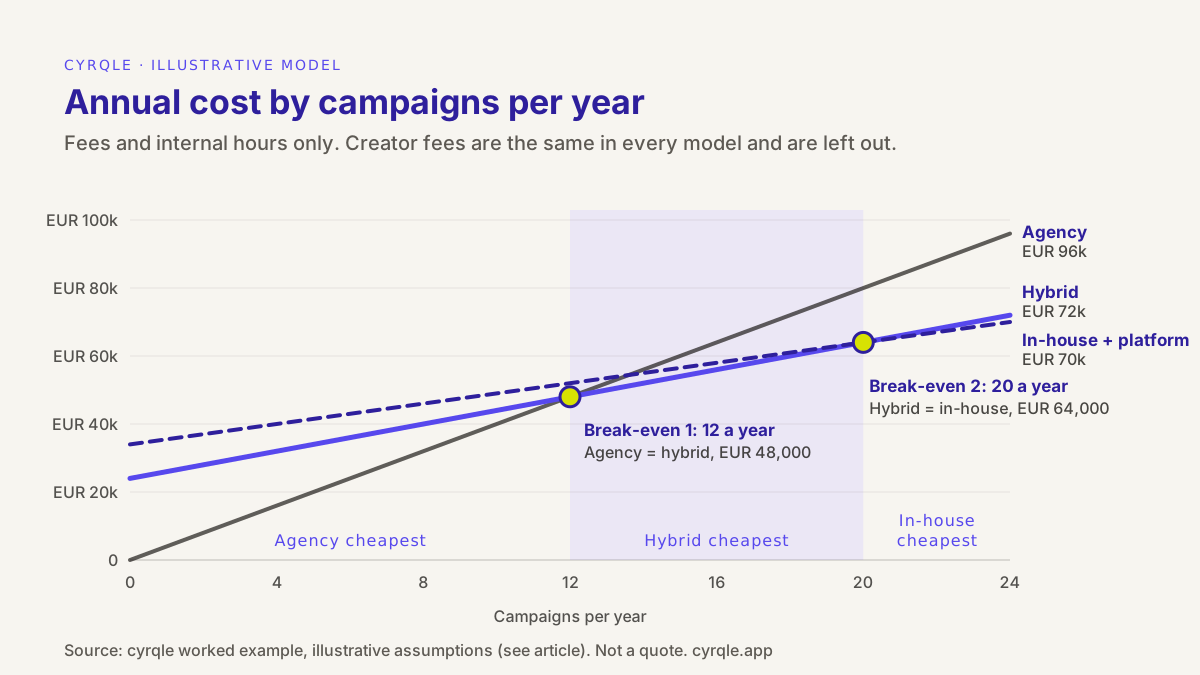
| Campaigns per year | Agency | In-house on a platform | Hybrid | Cheapest |
|---|---|---|---|---|
| 4 | EUR 16,000 | EUR 40,000 | EUR 32,000 | Agency |
| 8 | EUR 32,000 | EUR 46,000 | EUR 40,000 | Agency |
| 12 | EUR 48,000 | EUR 52,000 | EUR 48,000 | Agency = hybrid |
| 16 | EUR 64,000 | EUR 58,000 | EUR 56,000 | Hybrid |
| 20 | EUR 80,000 | EUR 64,000 | EUR 64,000 | Hybrid = in-house |
| 24 | EUR 96,000 | EUR 70,000 | EUR 72,000 | In-house |
Illustrative figures, excluding creator fees and IVA.
Three things stand out.
- At low volume, the fixed cost dominates. With four campaigns a year, the in-house team costs EUR 10,000 per campaign and the agency EUR 4,000. Software and an owner are hard to justify for a programme that runs once a quarter.
- The hybrid is the cheapest model across the middle. Between 12 and 20 campaigns a year, which is roughly one to two a month, it combines a modest fixed cost with a modest cost per campaign.
- At high volume, every extra campaign is cheap in-house. At 24 campaigns, the in-house cost per campaign falls to about EUR 2,900, against EUR 4,000 with the agency. The gap grows with each campaign you add.
The exact crossover points depend on your assumptions. A higher agency percentage or bigger creator budgets move break-even down. A pricier platform or a full-time hire moves it up. The shape does not change: the fixed-cost model always wins at some volume, and the question is whether you will reach it.
Calculator: work out your own break-even
You can run this decision in a spreadsheet in about fifteen minutes. Fill in one column per model, then apply the formula.
| Input | Where to get it | Your figure |
|---|---|---|
| Campaigns per year | Your plan for the next 12 months, including tentpoles | |
| Creator spend per campaign | Average of last year, or your budget ÷ campaigns | |
| Agency fee per campaign | Agency quote: percentage of spend × spend + fixed fees | |
| Platform cost per year | Vendor quote, including seats, usage and payout fees | |
| Fixed internal hours per year | Time to own the programme even with no live campaign | |
| Internal hours per campaign | Time per campaign for each model; ask a team that runs one | |
| Loaded hourly cost | Salary plus social security and overhead, ÷ hours worked |
Then calculate, for each model:
Annual cost = fixed cost + (cost per campaign × campaigns per year)
And between any two models, the break-even formula above. Two checks make the result more reliable.
- Run it at your planned volume and at half of it. Plans slip. If the in-house option only wins at the full plan, a quiet year turns it into the most expensive one.
- Check capacity, not only cost. Hours have a ceiling. If your owner has 320 hours a year for the programme and each campaign needs 30 more, 24 campaigns means 1,040 hours: roughly two-thirds of one full-time role.
What about in-house without a platform?
Running creators from spreadsheets looks cheap because there is no licence. In the same illustrative model, say the fixed cost is EUR 16,000 of owner time plus EUR 1,000 of basic tools, and each campaign takes 60 hours of manual outreach, contract chasing, payment and reporting (EUR 3,000). The annual cost is EUR 17,000 + EUR 3,000 per campaign.
That model beats the agency below 17 campaigns a year, and the platform below about 11. But two costs do not show up in the sum. First, capacity: 24 campaigns at 60 hours each is 1,440 hours on top of the fixed time, which is a full-time role on its own. Second, risk: unsigned terms, rights you cannot prove, payments without a statement and sales nobody can attribute. Spreadsheets are a reasonable start for a handful of creators. They stop being cheap at the volume where the platform starts to pay off.
When is an agency the better choice?
An agency is the better choice when the value you need is judgement, relationships or speed, not throughput. Cost per campaign is one input. These situations often outweigh it:
- You run fewer than about one campaign a month. At low volume, the agency's lack of fixed cost wins on price, and you avoid paying for software that sits idle.
- You need creative strategy you do not have. A strong concept is worth more than a cheaper process. Good agencies bring ideas tested across many brands.
- You need talent relationships. Top creators and their managers often work through agencies they know. If your plan depends on a few large names, access matters more than tooling.
- You are entering a new market. An agency with a local team knows the creators, the rates and the disclosure rules there. You can bring the work in-house once you know the market.
- You cannot hire, or cannot hire fast. If headcount is frozen or the launch is in six weeks, an agency is the only way to start on time.
- You need surge capacity. A tentpole moment such as a World Cup or Black Friday can need more hands than your team has for a few weeks.
The risk with an agency is not usually the fee. It is that the creator history, the contracts and the performance data leave with the agency when the contract ends. Ask for them in the contract: who owns the data, in what format you get it, and whether contracts with creators are signed in your name. If you are the agency reading this, the same argument works in reverse: being the partner that runs the hybrid well is a durable position. Our 30-day pilot plan for proving creator ROI to a client shows one way to earn it.
What each model does well and badly
No model wins on every line. The trade-off is between flexibility and cost per campaign, and between outside expertise and owned knowledge.
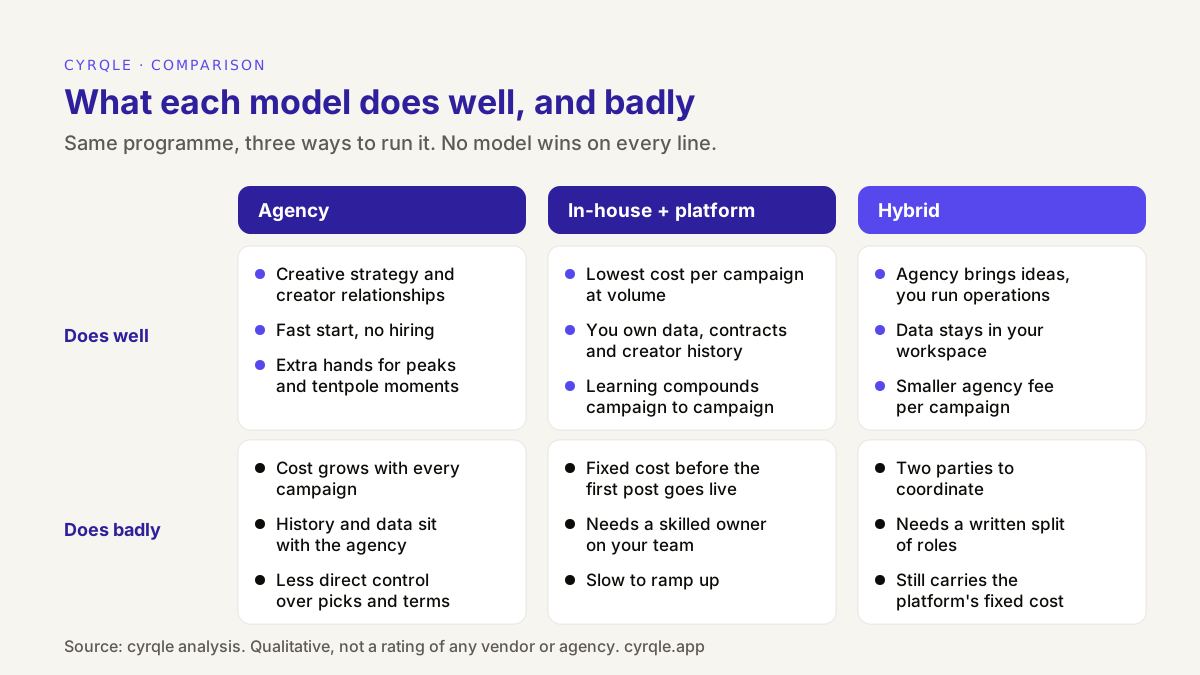
| Agency | In-house on a platform | Hybrid | |
|---|---|---|---|
| Cost structure | Mostly variable: fee per campaign or percentage of spend | Mostly fixed: licence plus an owner's time | Medium fixed cost, medium cost per campaign |
| Cheapest when (illustrative) | Under about 12 campaigns a year | Over about 20 campaigns a year | Between about 12 and 20 campaigns a year |
| Time to first campaign | Fastest: weeks | Slowest: you set up the tool and the team | Medium: the agency covers the gaps while you learn |
| Creative strategy | Strong, if you pick the right agency | Depends on your team's skills | Agency supplies it per campaign |
| Creator relationships | Held by the agency | Built and held by you | Introduced by the agency, kept by you |
| Data and contracts | Often in the agency's tools; negotiate access | In your workspace | In your workspace |
| Scales to many campaigns | Cost scales in proportion | Cost per campaign falls with volume | Cost per campaign falls, but more slowly |
| Main risk | Knowledge leaves with the agency | Paying fixed cost for a programme that stays small | Unclear split of roles between agency and team |
Comparison of operating models, not of named vendors or agencies. Checked 3 August 2026.
The verdict: pick by volume first, then by skills. If you are below one campaign a month and have no specialist in-house, use an agency and make sure you keep the data. If you are at one to two a month, the hybrid usually gives you most of the savings with less risk. If you run creators every week, own the operation.
How to move from agency to hybrid to in-house
Most brands do not switch in one step. A staged move lowers the risk.
- Keep the agency for the next campaign, but run it in your own workspace. The agency works inside your tool, so contracts, posts and results are recorded in your account from day one.
- Take over one operational task at a time. Payouts and reporting are good first steps: they are repetitive and easy to check. Invites and negotiation come next.
- Narrow the agency's scope to what it does best. Concepts, talent introductions and tentpole moments. Renegotiate the fee to match the smaller scope.
- Measure the same way throughout. Use the same attribution method before and after the change, so you compare like with like. Otherwise a drop in reported sales may only be a change in how you count them.
- Review the break-even each quarter. If the volume does not arrive, the hybrid stays cheaper than a full in-house team. That is a fine place to stay.
How cyrqle helps
cyrqle is a platform, so it fits the in-house and hybrid models. It does not replace a creative agency, and it does not suit a brand that runs two campaigns a year.
- One workspace for the operation. In Campaigns, you write the brief (the AI brief builder can draft it from one sentence), rank creators against it, invite them, sign the Creator Collaboration Agreement with two-sided e-signature, approve drafts with automated checks for required hashtags and handles, and track published Instagram and TikTok posts. That is the per-campaign work that drives the hours in the model above.
- Payouts and contracts in one place. Deals can be cash, commission, product or a mix. You fund the campaign, and cyrqle schedules a payout when the creator delivers; a person on your team triggers settlement. Creators in Europe and the US are paid in euros to their bank through Stripe Connect, with a statement for each payout. Commission owed is calculated and shown in reports; paying it is a separate step. See compensation and contracts.
- Built for the hybrid. In the agency console, an agency can link to a client brand, request access, act as the client with per-member permissions, and produce white-label reports. That lets the agency work inside your account, so the history stays with you. See cyrqle for agencies.
- Attribution you can compare across models. Per-creator promo codes, tracking links and a tag under 2KB on your store give each sale a confidence tier, shown on the campaign's Attribution tab.
cyrqle does not publish prices: brand and agency plans are a custom monthly base plus usage. See how cyrqle pricing works, then put the quote into the calculator above. To see the workflow on your own category, book a 30-minute demo.
FAQ
Is an influencer agency or a platform cheaper?
It depends on volume. An agency has almost no fixed cost, so it is cheaper for a few campaigns a year. A platform plus an internal owner has a fixed cost but a lower cost per campaign. In our illustrative model, the agency is cheapest below 12 campaigns a year. An in-house team on a platform beats the agency above about 14, but the hybrid is cheaper than both until about 20.
How many campaigns a year justify bringing influencer marketing in-house?
In our illustrative model, about 20 campaigns a year, or one every two to three weeks, before a fully in-house team beats a hybrid. Your number depends on your agency fee, platform price and internal hourly cost. Run the break-even formula with your own quotes, and check the result at half your planned volume too.
Can I use an agency and a platform at the same time?
Yes. That is the hybrid model. Your team runs briefs, contracts, payouts and tracking on the platform, and the agency adds concepts and talent introductions per campaign. Agree in writing who does what, and make sure the agency works inside your workspace so the data stays with you.
Do I need a full-time person to run influencer marketing in-house?
Not at first. The model assumes about 320 fixed hours a year plus around 30 hours per campaign. At 12 campaigns that is roughly 680 hours, well under one full-time role. Above about 40 campaigns a year (320 fixed hours plus 30 per campaign fills a 1,600-hour role), or with many always-on creators, you will need at least one dedicated person.
What should I ask an agency about data ownership?
Ask who owns the creator list, contracts, content licences and performance data, in what format you receive them, and when. Ask whether contracts with creators are signed in your name or the agency's. Get the answers in the agency contract before the first campaign, not at the end.
Sources
- Instituto Nacional de Estadística (INE), Encuesta Trimestral de Coste Laboral, first quarter 2026, released 16 June 2026: https://www.ine.es/dyngs/Prensa/ETCL1T26.htm
- All other figures in this article are illustrative assumptions for a worked example. They are not market benchmarks or vendor prices.
Related field notes.
CreatorIQ alternatives for European mid-market teams and agencies: when an enterprise suite is right, when it is overkill, and four honest options by fit.
Influencer marketing platform pricing explained: licence, seats, usage, payout fees, take rates and internal hours, with a TCO worksheet.
The best influencer marketing platforms in Spain for 2026, compared by use case: databases, suites, marketplaces and commerce loop, with criteria and verdicts.