
Discovery tool or full platform? The four jobs of influencer software and who does each
Influencer discovery tool vs influencer marketing platform: the four jobs (find, run, pay, prove) and when a search tool is enough.
An influencer discovery tool finds creators. An influencer marketing platform also runs the campaign, pays the creators and proves which ones drove sales. Those are four separate jobs: find, run, pay and prove. A search tool is enough when you work with fewer than about 10 creators a month, in one market, on gifting or one-off fees. Past that, the three jobs it skips move into spreadsheets, and the spreadsheet becomes the real cost.
This is why buyers get confused. A low-cost search subscription and a custom-priced platform quote look like two prices for one product. They are prices for a different number of jobs. A marketing lead in Madrid comparing the two is really deciding which of contracts, payouts and attribution she is willing to keep doing by hand, and for how many creators.
This guide defines the four jobs, shows which type of tool usually covers each, lists what lands in a spreadsheet when a job is skipped, and gives decision rules for when search is enough. It is written for brand and agency teams in Spain, the EU and Latin America. For the full vendor evaluation once you know what you need, use our 12-point checklist for choosing an influencer platform.
What is the difference between an influencer discovery tool and an influencer marketing platform?
An influencer discovery tool is a searchable database of creator profiles. You filter by topic, country, follower range and engagement, open a profile with audience and content analytics, and export a shortlist. Its job ends when you have the list.
An influencer marketing platform includes discovery, then keeps the same creator record through the rest of the work: the brief and contract, the payout, and the sales or other results the creator drove. One common definition, from Later's 2026 buyer guide, calls a platform "software that helps brands find creators, manage campaigns, automate outreach, and track ROI". That definition lists more than one job, and that is the point.
The labels are used loosely. Some vendor pages call a search database a "platform", and some roundups treat "discovery tool" and "platform" as the same thing. A comparison page from Yoloco puts the real difference well: "Every tool here can find creators. The difference is what happens next." So ignore the label and ask which jobs the product does.
What are the four jobs of influencer software?
Every creator programme, from a 5-creator gifting push to a 200-creator affiliate programme, does the same four jobs. The tool you choose decides which of them happen in software and which happen in email, a bank portal and a shared sheet.
Find: search, vet and shortlist
The find job turns a brief into a shortlist. Inputs are the brief, the markets and the budget. Outputs are a list of creators with the numbers you need to choose between them: recent views, engagement, content mix, past brand collaborations and signs of fake followers.
What good looks like: search by what creators actually post, not only by bio keywords; Spanish-language content handled natively; brand-collaboration history so you can see who already works with your competitors. This is the job every discovery tool does, and where the best of them are very good.
Run: brief, contract, drafts and live posts
The run job covers everything between "yes, let's work together" and "the post is live". That means outreach and follow-ups, agreed terms, a signed contract, content drafts and approval, a disclosure check, and proof the post went up.
In Spain, running a campaign also means keeping a record of disclosure. The advertising code for influencers from Autocontrol, in force in its second version since 1 October 2025, asks for a clear advertising label, and Real Decreto 444/2024 adds duties for the largest video creators. A search tool records none of this. Whoever runs the campaign has to keep the signed terms and check each label.
Pay: fee, commission, product and the payout itself
The pay job turns agreed terms into money in the creator's account. It includes the creator's invoice, tax lines, the payment itself and a record that ties the payment to the deliverable.
In Spain, a professional creator's invoice may carry IRPF withholding of 15%, or 7% for a new professional who tells you in writing, under Article 95 of the IRPF regulation. Other creators invoice through a company and carry no withholding line. Your gestor decides each case; our guide to paying influencers in Spain covers the scenarios. The point for tool choice is simple: whatever pays creators must handle a withholding line, or finance will rebuild every payout by hand.
Geography matters too. "Pays creators" can mean "pays creators in Spain but not in Mexico". Stripe, for example, says platforms in the US, UK, EEA, Canada or Switzerland can make self-serve cross-border payouts to connected accounts in any of those regions, and that it "doesn't support self-serve cross-border payouts to countries outside the listed regions". A tool built on that rail needs another route for Colombia or Argentina.
Prove: which creator drove which sale
The prove job connects a result to a creator. For sales, the usual methods are a per-creator promo code, a tracking link, an on-site tag or pixel, and order data from the store, with refunds taken off. For awareness, it is views, reach and effective CPM per post.
Each method sees different buyers: codes catch people who never clicked, links catch people who did, and both miss some. Our comparison of discount codes, tracking links and pixels explains the overlap. Without software, prove becomes a weekly store export, a manual code-to-creator lookup and a sum in a spreadsheet.
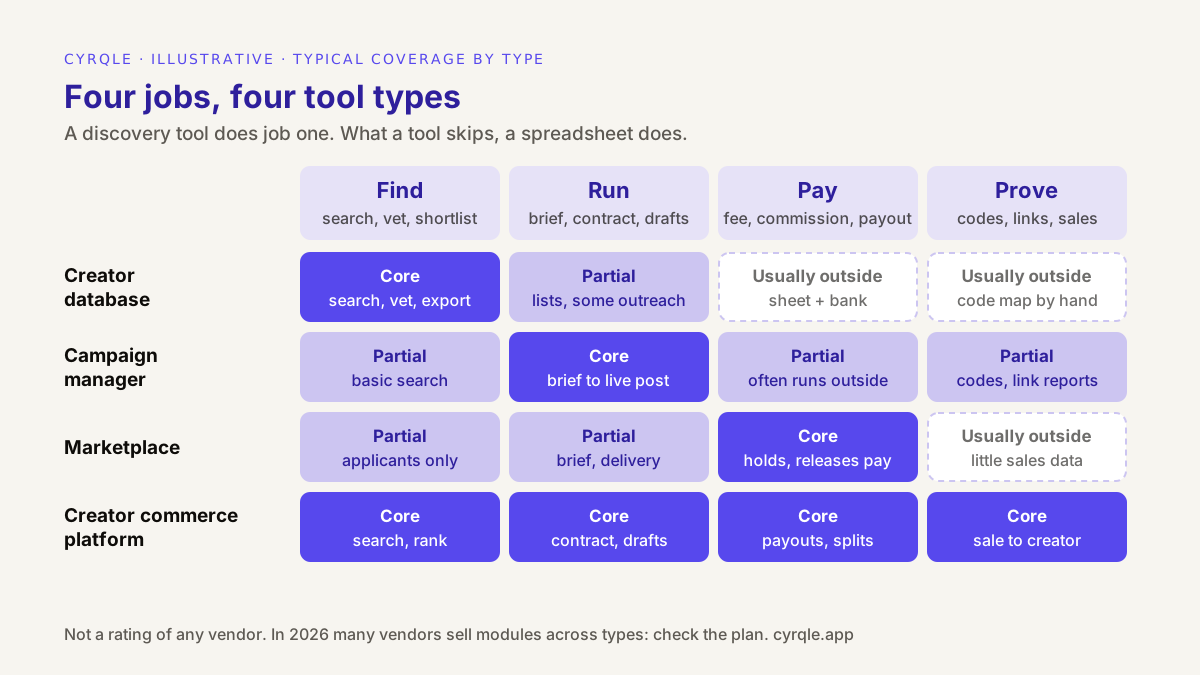
Which types of tool cover which jobs?
Influencer tools fall into four broad types, the same four used in our buyer's guide to influencer platforms: creator databases, campaign managers, marketplaces and creator commerce platforms. Each type was built around one job and reaches into the others to a different depth.
| Find | Run | Pay | Prove | |
|---|---|---|---|---|
| Creator database | Core: search, analytics, export | Partial: lists, sometimes outreach | Usually outside: bank and spreadsheet | Usually outside: codes mapped by hand |
| Campaign manager | Partial: basic search or imported lists | Core: brief to live post | Partial: often runs outside | Partial: code or link reports |
| Marketplace | Partial: creators who apply to your brief | Partial: brief and delivery | Core: holds and releases payment | Usually outside: little sales data |
| Creator commerce platform | Core: search and ranking against the brief | Core: contract, drafts, posts | Core: payouts and splits | Core: sale tied to creator |
None of these types is wrong. Each one is the right buy for a programme whose hard job matches its core. To see where named products sit, use the independent roundup of creator commerce software.
The lines moved in 2026
The table describes types, not vendors, because several vendors now sell across types. Modash, which many buyers know as a search database, says on its payments page that it "collects invoices, pays creators in their currency, and handles all tax and regulatory compliance". Influencity's help centre says brands can send payments to influencers inside the platform. Kolsquare's own blog describes a payment feature "powered by GigaPay" that lets managers authorise creator payments.
So the honest question is not "is this vendor a database?" It is "which of the four jobs does the plan in front of me do, in my countries, for my payment types?" Those modules often sit on higher tiers or come as add-ons, and coverage differs by creator country. Ask for each job, the plan that includes it and the countries it covers, in writing.
What does each job leave in a spreadsheet if your tool skips it?
Every skipped job still gets done. It moves to a spreadsheet, an inbox and someone's afternoon. The table shows what lands there and what tends to break first.
| What lands in the spreadsheet | Who keeps it | What breaks first | |
|---|---|---|---|
| Find skipped | Handles copied from in-app search, follower counts typed by hand | Junior marketer | Stale numbers; no brand-collaboration history; fake followers missed |
| Run skipped | Contract PDFs in email, a status column (invited, signed, draft, live), labels checked by eye | Campaign owner | Nobody knows which terms a creator signed; a missing #publi label |
| Pay skipped | Payout list with fee, commission, product value, IRPF line, IBAN and paid date | Marketing and finance | Duplicate or late payments; commission summed by hand; creators abroad paid outside the process |
| Prove skipped | Promo-code-to-creator map, weekly store export, refunds taken off by hand | Analyst or e-commerce lead | Codes leak to coupon sites; refunds not netted; nobody can say which creator sold |
The last row is the one that surprises teams. Promo code leakage to coupon sites credits sales to creators who did not drive them, and a sheet has no way to tell.
The hidden cost is hours
Spreadsheet work has a price, it just does not arrive on an invoice. Our guide to influencer platform pricing and hidden costs lists internal hours as one of the six cost lines in any total-cost comparison. Use the calculator to put a number on yours.
Hours spent each month on the jobs your tool skips, and what they cost.
Illustrative defaults. Time your own last campaign and replace them. Compare the yearly figure with the price difference between the two quotes you have.
Worked example, with the illustrative defaults: 12 creators a month at 20 + 15 + 25 = 60 minutes each is 12 hours a month. At 35 euros an hour that is 420 euros a month, or 5,040 euros a year. At 4 creators a month the same rates give 4 hours and 1,680 euros a year, which is why a search tool plus a sheet is often the right call for small programmes. At 40 creators it is 40 hours a month, a week of someone's time, before you count the errors.
When is a search tool enough?
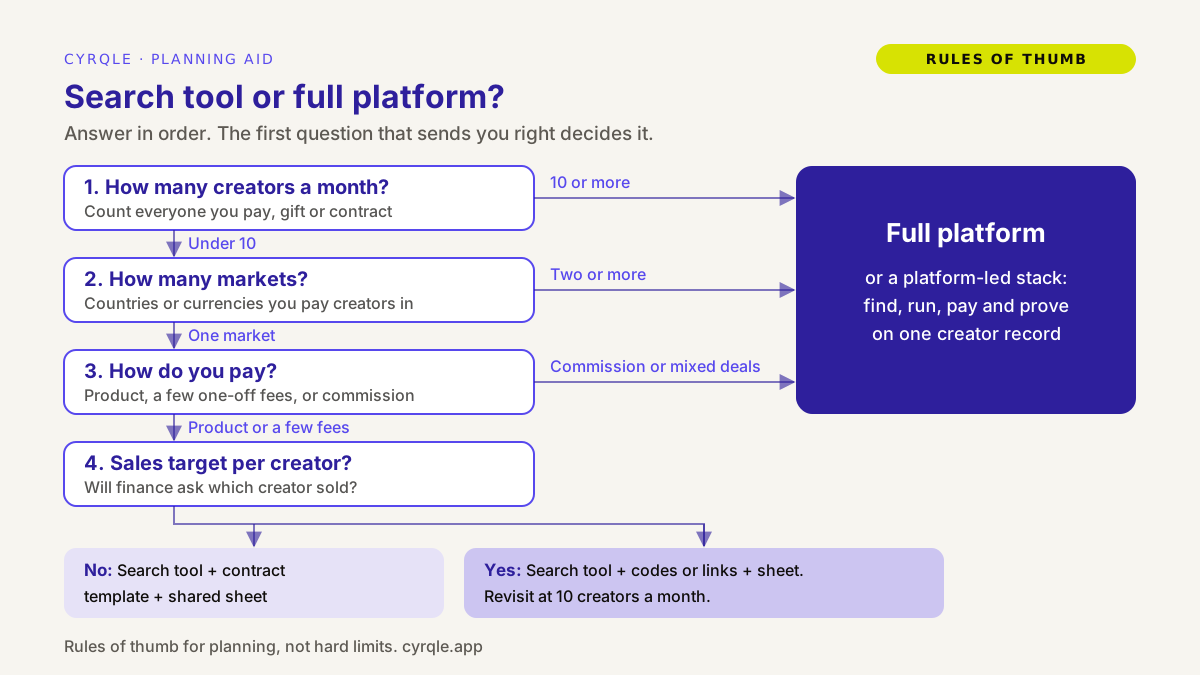
A search tool, a contract template and a shared sheet are enough when every one of these is true. Treat them as rules of thumb, not hard limits.
- Under about 10 creators a month. Below that, the run, pay and prove work fits in a few hours.
- One market and one currency. All creators invoice in euros from Spain, for example.
- Product or a few one-off fees. Gifting or seeding, or a handful of fixed fees that go through your normal accounts-payable process.
- No sales target per creator. The goal is awareness or content, and nobody in finance will ask which creator sold.
- A one-off push, not a programme. A launch seeding or a single event, not monthly ambassadors.
The setup that works: the search tool for find; a standard contract template stored in one shared folder; and one sheet with a tab per job (status, payouts, codes). When you start to outgrow it, our influencer platform evaluation scorecard helps you compare the options you will need.
When do you need a system?
You need a system that covers more than find when any one of these is true:
- 10 or more creators a month, or several campaigns running at once.
- Two or more markets, for example Spain and Mexico, or two languages in outreach.
- Commission or mixed deals: fee plus commission, or commission only. Commission needs sales per creator, net of refunds, every month.
- A sales target per creator, or a finance team that asks "which creator sold?"
- Content reuse in ads or on your site, which needs recorded rights.
- An agency with several clients, where each client's creators, fees and reports must stay apart.
Partial stacks: search tool plus affiliate tool plus payments
Some teams join three tools instead of buying one: a search database, an affiliate or code-tracking app, and a payments provider. That can work well in one market, on one store, for a commission-led programme with a stable roster.
The joins are where it breaks. The same creator has three identities, one in each tool, and nobody owns the reconciliation. When a creator disputes a commission, you need the signed rate from one tool, the sales from another and the payout from a third. If you go this way, pick one tool as the master record and export the others into it every month.
How do you compare a search tool quote with a platform quote?
Compare the total cost of getting all four jobs done, not the two licence prices. Five steps:
- List the jobs you need now and in 12 months. If you plan to add commission or a second market next year, count it now.
- For each job, decide tool or spreadsheet. Be honest about which spreadsheets you will keep.
- Price the spreadsheet hours with the calculator above and add them to the cheaper quote.
- Ask each vendor to show each job live, on your own creators and your own countries. A payout demo to a Spanish creator says nothing about a Mexican one.
- Compare total cost: licence, usage, payout fees, internal hours and the cost of leaving. The platform pricing worksheet lays out each line.
For the full demo script, see our 15 questions to ask any influencer software vendor.
How cyrqle helps
cyrqle is a creator commerce platform: it covers the four jobs on one creator record, for Instagram and TikTok. The limits are part of the answer, so they are listed below.
- Find. In Find creators, you search a proprietary creator index by meaning across captions and visuals, filter by country, sector and engagement in Explore, or look up a handle in Lookup. Each profile shows engagement, posting cadence, content mix and brand-collaboration history. cyrqle ranks creators against your brief (brief match, objective fit); you choose who to invite. Reach and cost figures are estimates.
- Run. In Campaigns, invites stay blocked until compensation is complete. Both sides e-sign the Creator Collaboration Agreement, with the terms frozen at signature. Drafts get an automated check for required hashtags and handles, and live posts on Instagram and TikTok are tracked.
- Pay. In compensation and contracts, deals are Cash payment, Commission on every sale, Product gift or a mix. You fund a campaign wallet; a payout is scheduled when the creator delivers, and a person on your side releases it. Creators in Europe and the US get paid through Stripe Connect, settled in euros. Each payout shows creator net, cyrqle commission, any agency fee and any tax withheld. cyrqle does not decide or file your tax.
- Prove. Attribution gives each creator a promo code and a tracking link, with a tag under 2KB on your store and signed order webhooks from Shopify, WooCommerce and Magento. Every sale gets a confidence tier, revenue is net of refunds, and ROAS sits on the campaign Attribution tab. Commission owed is calculated and shown; paying it is a separate step.
Where cyrqle is not the fit: a one-off gifting push with a handful of creators, where a search tool and a sheet cost less; a YouTube-led programme, because cyrqle does not track YouTube posts; and programmes that need local-currency payouts across Latin America, because settlement is in euros and outside Europe and the US you pay by bank transfer and record it. To see it on your own category, book a 30-minute demo.
More in this series
- How to choose an influencer marketing platform: the 12 criteria, once you know which jobs you need.
- The weighted platform scorecard, ready to fill in after each demo.
- Influencer marketing platforms in Spain compared, by type and use case.
- Vendor-by-vendor reads of Influencity, Modash, Kolsquare and Primetag, GRIN and the Latin American options are added here as they publish.
FAQ
What is an influencer discovery tool?
An influencer discovery tool is a searchable database of creator profiles with filters, audience and content analytics, and list export. It does the find job: it turns a brief into a shortlist. Contracts, payouts and sales tracking happen elsewhere unless the vendor sells those modules separately.
Do I need an influencer marketing platform for a small brand?
Usually not at first. If you work with fewer than about 10 creators a month, in one market, paid in product or a few fixed fees, and you have no sales target per creator, a search tool, a contract template and a shared sheet are enough. Revisit the decision when you add commission or a second country.
Can I run influencer marketing from a spreadsheet?
Yes, at low volume. Keep one sheet with three tabs: creator status (invited, signed, draft, live), payouts (fee, product value, withholding, paid date) and codes (code, creator, sales, refunds). It stops scaling when the weekly reconciliation takes longer than the campaign work.
What is the difference between an influencer CRM and an influencer platform?
An influencer CRM, also called creator relationship management, keeps the relationship record: contacts, conversations, status and history. That is most of the run job. A platform may add search, payouts and sales attribution on the same record.
Can an influencer platform pay creators in other countries?
It depends on the payment provider and the creator's country. Stripe's self-serve Connect payouts cover the US, UK, EEA, Canada and Switzerland; other countries need a different route. Ask each vendor to show a payout to a creator in each country you use, and check which currency the creator receives.
Should I buy a discovery tool and a separate affiliate tool instead of one platform?
It can work in one market with one store and a commission-led roster. The risk is reconciliation: the same creator exists in three tools, and a commission dispute needs data from all three. If you choose the stack, name one tool as the master record.
Sources
- Later, "Best influencer marketing platforms to drive measurable results" (2026), definition of a platform: https://later.com/blog/best-influencer-marketing-platforms-to-drive-measurable-results/
- Yoloco, "Best influencer marketing platforms" comparison: https://yoloco.io/compare/best-influencer-marketing-platforms
- Stripe documentation, Connect cross-border payouts (read November 2026): https://docs.stripe.com/connect/cross-border-payouts
- Modash, influencer payments page: https://www.modash.io/influencer-payments
- Influencity knowledge base, influencer payments: https://knowledge.influencity.com/payments/influencer-payments
- Kolsquare blog, pricing plans 2026 (payments powered by GigaPay): https://www.kolsquare.com/en/blog/how-much-does-kolsquare-cost-pricing-plans-2026
- Real Decreto 439/2007, Reglamento del IRPF, Article 95: BOE-A-2007-6820
- Real Decreto 444/2024, usuarios de especial relevancia: BOE-A-2024-8716
- AUTOCONTROL, aea and IAB Spain, Código de Conducta de Publicidad a través de Influencers (2025): https://www.autocontrol.es/app/uploads/codigo-de-conducta-de-publicidad-a-traves-de-influencers-2025.pdf
Related field notes.
Influencer agency vs platform vs in-house: an illustrative cost model, break-even by campaigns per year, the hybrid option and when an agency is better.
CreatorIQ alternatives for European mid-market teams and agencies: when an enterprise suite is right, when it is overkill, and four honest options by fit.
The best influencer marketing platforms in Spain for 2026, compared by use case: databases, suites, marketplaces and commerce loop, with criteria and verdicts.