
Instagram, TikTok or YouTube? What each platform needs from a creator campaign in Spain
Influencer marketing by platform: Instagram, TikTok and YouTube compared for Spain on ad reuse, rights, delivery proof, pricing basis and disclosure labels.
Instagram, TikTok and YouTube differ less in what the creator makes than in the paperwork around it. Each platform has its own ad format for reusing a creator's post, its own in-app permission, its own way for the brand to prove the post went live, its own usual pricing unit and its own disclosure tool. In Spain the written licence and the "Publi" label are the same on all three.
Picture a skincare brand in Madrid that books one creator for a Reel, a TikTok and a YouTube integration in the same month. It is one creator and one product, but the brand needs three different permissions to put the content into ads and three different kinds of proof for the report. The label rule is the same on all three, and none of the three platform tools covers it alone.
This guide puts the three platforms side by side for a Spanish or Latin American brief. It covers the reuse format, the rights clause, delivery proof, pricing basis and disclosure, with the primary source for each point. It is written for brand and agency teams.
Instagram, TikTok or YouTube: the short answer
Instagram suits polished visual formats and has the most mature ad-reuse format, Meta partnership ads. TikTok suits fast, native short-form video, where views swing more from post to post and Spark Ads reuse the post through a time-limited code. YouTube suits long-form integrations that keep getting views for months, and its partnership ads need the creator to link the video to the brand's Google Ads account.
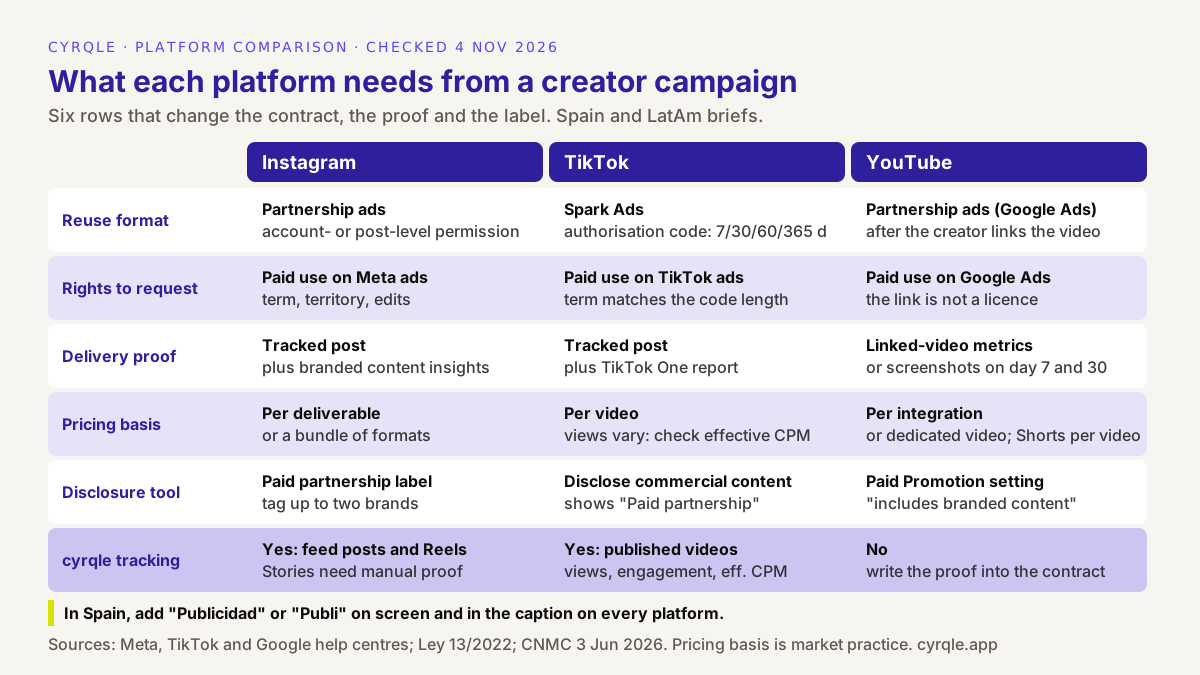
The same table in text:
| TikTok | YouTube | ||
|---|---|---|---|
| Format that reuses the creator's post | Partnership ads (account-level or post-level permission) | Spark Ads (authorisation code of 7, 30, 60 or 365 days) | Partnership ads in Google Ads, after the creator links the video |
| Rights to request in writing | Paid use on Meta ads, term, territory, edits | Paid use on TikTok ads, term that matches the code | Paid use on Google Ads, term, territory. Google says the link is not a licence |
| How the brand proves delivery | Live post plus branded content insights | Live post plus TikTok One reporting | Linked-video metrics, or screenshots on dated checkpoints |
| Usual pricing basis | Per deliverable, often a bundle | Per video, checked on effective CPM | Per integration or dedicated video; Shorts per video |
| Platform disclosure tool | Paid partnership label | "Disclose commercial content" toggle | "Paid Promotion" setting |
| Tracked automatically in cyrqle | Feed posts and Reels (not Stories) | Published videos | No |
Checked on 4 November 2026. Platform settings change, so check the help pages again before you sign.
How to read the table for a Spanish or LatAm brief
Choose the platform for the audience and the objective first. Then read across the row for that platform and copy each cell into the brief and the contract. If the brief covers Mexico, Colombia or Argentina as well as Spain, check two things per country. First, whether the platform tool works there (YouTube's brand-deal programme does not cover every Latin American market, see the disclosure section). Second, whether the local disclosure rule is stricter than the platform label. Our overview of influencer rules across Latin America covers the second check.
Which ad format reuses the creator's post on each platform?
Each platform has one native format that turns a creator's organic post into a paid ad under the creator's name: Meta partnership ads, TikTok Spark Ads and YouTube partnership ads in Google Ads. All three need a technical permission from the creator inside the platform. None of them replaces a written licence.
Instagram and Facebook: partnership ads
Partnership ads run from the brand's ad account and show both the creator's handle and the brand. Meta's partnership ads documentation describes two permission routes:
- Account-level permission. The creator lets the brand run partnership ads without approving each post.
- Post-level permission. It applies "when an account-level permission does not exist". The creator shares a partnership ad code for a post, or approves the boost of an organic branded content post.
If the brand publishes a partnership ad without the permission, Meta "publishes the ad in a pending delivery state" until the creator approves. So the platform will not let you skip the creator, but it also will not check your contract. Help-centre copies of Meta's guidance say either side can remove the permission at any time. Write down what happens if they do.
TikTok: Spark Ads and the authorisation code
Spark Ads promote an existing organic TikTok post from the creator's account. In TikTok's Spark Ads help article, the creator turns on the "Ad authorization" toggle, agrees to TikTok's advertising content terms, and selects "the authorization duration (7, 30, 60, or 365 days)". The brand pastes the code into TikTok Ads Manager.
The duration is the detail that matters. When the authorisation ends before the ad flight does, the ad stops delivering, and TikTok's fix is to ask the creator to extend it. Some third-party guides list a 90-day option. TikTok's own list does not, so a 90-day licence needs a 60-day code plus a renewal, or a 365-day code with a contract clause that limits use to 90 days.
YouTube: partnership ads through Google Ads
YouTube's equivalent is called "Creator partnerships" in Google Ads. Google's partnership ads help page says: "Before launching your ad campaign, connect your brand's creator videos to your Google Ads account". The creator can start the link from YouTube Studio, and those links are "automatically accepted after the creator initiates the link". After the link, the brand can run the video as an ad and gets "access to organic view metrics for linked videos".
All three formats are what the industry calls whitelisting. Our guide to the seven contract terms for whitelisting and partnership ads has sample wording for each clause.
What rights must the brand ask for on each platform?
On every platform, the brand needs a written licence that names the paid media (Meta ads, TikTok ads or Google Ads), the term, the territory and the edits allowed. The creator's consent to use their image and voice in ads must also be in writing. The in-app permission must match the licence, not replace it.
The platform switch is not the licence
Google says this directly on the partnership ads page: "you're responsible for securing sufficient rights to use the video as an ad", which "may require you to have a separate agreement with the creator or other rights holders". Meta and TikTok work the same way in practice. The code or link only proves the creator pressed a button.
Spanish copyright law fills in what a vague agreement covers. Under article 43 of the Ley de Propiedad Intelectual, a transfer of rights is limited to the modes of exploitation "expresamente previstas" and to the time and territory stated. If the term is missing, the transfer lasts five years. If the territory is missing, it covers only the country where it was granted. Article 45 adds that every transfer "deberá formalizarse por escrito". So a WhatsApp "yes, use it" plus a Spark code is a weak position. List each medium by name.
Match the code length to the licence term
The most common gap is a date mismatch. Two examples, both illustrative:
| Contract says | Platform permission | What happens |
|---|---|---|
| Paid use on TikTok for 90 days | 30-day Spark code | The ad stops on day 30. You lose 60 days you paid for unless the creator renews the code |
| Paid use on TikTok for 30 days | 365-day Spark code | The ad can keep running for 11 months after your licence ends. Nothing in Ads Manager stops you |
| Paid use on Meta for 60 days | Account-level permission, no end date | Same risk as above. Put an end date in the contract and in your ad flight |
The fix is one line in the contract: the platform permission is set to the shortest available length that covers the licence term, and the brand ends the ad flight on the last day of the licence.
Image and voice: why consent must be written
The creator's face and voice are a second right, separate from copyright. Under Ley Orgánica 1/1982, using a person's image or voice for advertising without express consent is an unlawful intrusion (article 7.6). Article 2.3 says that consent can be revoked at any time, with compensation for damages. Write down the notice period and how fast running ads stop if the creator withdraws.
Paid use costs more than organic use, and ads from the creator's own handle usually cost more than ads from yours. Our usage rights pricing calculator prices each step.
How do you prove the post went live?
Delivery proof differs most between platforms. On Instagram and TikTok, the brand can check the live post and read platform reports for branded content. On YouTube, the brand sees metrics only if the creator links the video, so the contract must say which screenshots or YouTube Studio data the creator sends, and on which dates.
When the creator uses the paid partnership label and tags the brand, the brand can see branded content insights for that post in Meta's tools, including reach and engagement. Stories are the weak point: they disappear after 24 hours, so ask for a screenshot of each Story frame and its insights before it expires.
TikTok
TikTok One campaign reporting shows metrics such as average view time, 2-second and 6-second views and view sources. TikTok's reporting help page says it covers "projects and videos within your current region", so a campaign run from Spain with Mexican creators may need creator screenshots for the Mexican posts.
YouTube
YouTube gives the brand metrics in two ways. If the video is linked in Google Ads, the brand gets organic view metrics. If the creator accepts a share request in YouTube Creator Partnerships, "the advertiser can view the content's organic performance metrics in Google Ads", according to YouTube's help page. Otherwise, the brand depends on what the creator shares. Long-form views build over weeks, so pick fixed checkpoints, for example day 7 and day 30 after publication, and write them into the contract.
What do you pay for on each platform?
Instagram creators usually price per deliverable, often as a bundle of formats. TikTok creators price per video, but views vary more, so check each quote on effective CPM. YouTube creators price per integration (a mention inside a longer video) or per dedicated video, and Shorts are priced like TikTok videos. None of this is a platform rule. It is market practice.
Per post, per video, per integration
The unit decides what you compare. An Instagram bundle (one Reel, one carousel, three Story frames) has no single view count. A TikTok video has one view count, but it can be ten times higher or lower than the creator's median. A YouTube integration keeps collecting views for months, so the number on day 7 is not the number on day 90. For fee ranges in Spain, see influencer rates in Spain for 2026.
Compare quotes on effective CPM
Effective CPM is the fee divided by the views you expect, times 1,000. It puts all three platforms on one scale. Use the creator's median views on recent posts of the same format, not their best post. Our guide to choosing creators by views and CPM explains how to pick the median.
Worked example (illustrative): an Instagram Reel for EUR 900 with 25,000 expected views, a TikTok video for EUR 700 with 40,000 views, and a YouTube integration for EUR 2,500 with 60,000 views at day 30.
| Platform | Fee | Expected views | Effective CPM |
|---|---|---|---|
| Instagram Reel | EUR 900 | 25,000 | EUR 36.00 |
| TikTok video | EUR 700 | 40,000 | EUR 17.50 |
| YouTube integration | EUR 2,500 | 60,000 (day 30) | EUR 41.67 |
Illustrative figures. The YouTube line costs the most per thousand views here, but it also gets a longer watch time and keeps building after day 30. Effective CPM is a tool for finding quotes that are out of line, not the only decision rule.
Fee divided by expected views, times 1,000, for one deliverable per platform.
Illustrative defaults. Change any input.
Add the paid-use uplift
The fee above covers the organic post. A Spark code, a partnership ad permission or a YouTube link for ads is paid use and is priced on top, by medium, term and territory. Agree the uplift before the creator publishes, not after the post does well.
Which disclosure tool does each platform offer, and is it enough in Spain?
Each platform has a built-in disclosure tool: Instagram's paid partnership label, TikTok's commercial content toggle and YouTube's Paid Promotion setting. Spanish law requires platforms to offer these tools and requires large creators to use them. For large creators, the CNMC also wants "publicidad" or "publi" visible inside the video. Use the tool and the written label together.
The three platform tools
- Instagram. The paid partnership label, under Instagram's branded content policy. It works on feed posts, Stories, Reels and Live, and the creator can tag up to two brands.
- TikTok. The "Commercial Content Disclosure setting". The creator turns on "Disclose commercial content" and picks "Your brand" or "Branded content". The post then shows a "Paid partnership" label for third-party branded content, according to TikTok's disclosure help page (updated January 2026).
- YouTube. The "Paid Promotion" setting, with the option "Yes, my video includes branded content". It "adds a disclosure label that appears at the beginning of your video", per YouTube's help page. YouTube adds that creators and brands are "responsible for understanding and complying with all applicable legal requirements".
What Spanish law adds
Ley 13/2022, the audiovisual law, makes video platforms offer a way to declare commercial content (article 91.2.b). Article 94 makes users of special relevance follow the commercial communication rules and use that tool. Article 122.3 bans covert audiovisual advertising. Real Decreto 444/2024 sets who counts: income of at least EUR 300,000 a year from the activity, at least 1,000,000 followers on one platform or 2,000,000 combined, and at least 24 videos in the previous year. Our explainer on Real Decreto 444/2024 for brands covers the registry.
On 3 June 2026 the CNMC announced requirements sent to five such creators. It said "publicidad" or "publi" must appear visibly inside the video, and that "ad", "embajadora", a "#publi" outside the video, or the platform tool alone were not enough.
Smaller creators fall under the general rules: the LSSI, the unfair competition law and the AUTOCONTROL code. The code also asks for a clear label at the start, in the language of the post. Our guide to the AUTOCONTROL influencer code lists the labels it accepts.
The practical rule for every platform: "Publicidad" or "Publi" at the start of the caption, on screen in any video, plus the platform tool.
A note for Latin America
The platform tools vary by country. YouTube Creator Partnerships lists Spain and Mexico as available countries, but not Colombia, Argentina or Chile (checked on 4 November 2026). For creators in those markets, plan on creator-shared analytics for YouTube proof, and check the local disclosure rule.
A platform-by-platform workflow from brief to report
The workflow is the same five steps on every platform. Only the rights clause and the proof step change. Instagram and TikTok posts can be tracked automatically once they are live. YouTube goes to a manual proof step with dated checkpoints.
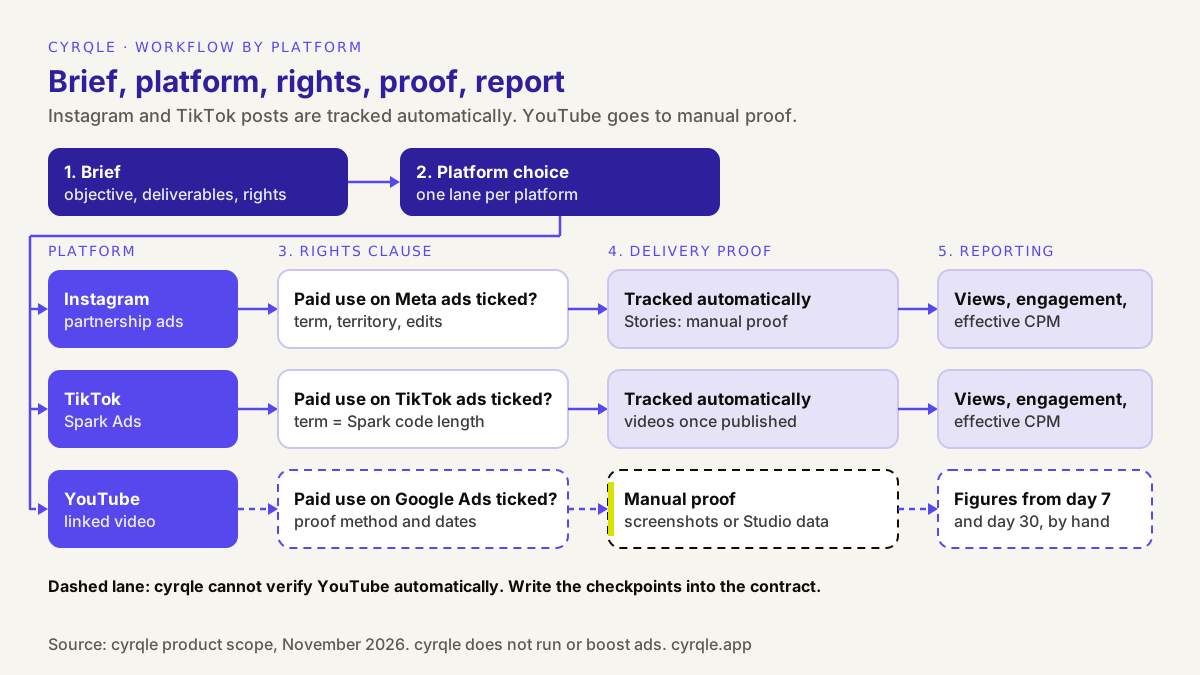
- Brief. State the objective, the platform per deliverable, the label rule and the rights you want. What a creator brief should include lists the six parts.
- Platform choice. One lane per platform, even for the same creator.
- Rights clause. Is paid use ticked? Which media, term and territory? Does the code length match?
- Delivery proof. Tracked post on Instagram and TikTok; screenshots or linked-video metrics on YouTube; screenshots for Instagram Stories.
- Reporting. Views, engagement and effective CPM per post, with the YouTube figures added from the agreed checkpoints.
Where TikTok Shop fits
TikTok Shop is a commerce choice, not a content format. If you sell through it, the creator links the product inside TikTok, and the sale stays in TikTok's own reporting. If you sell on your own store, use promo codes and tracking links. Our comparison of TikTok Shop and your own store covers the trade-offs.
Short-form and long-form
Reels, TikToks and YouTube Shorts are short-form: priced per video, views peak in days, and effective CPM is a fair comparison. A long-form YouTube integration is a different product. Views build over months, and the integration sits inside the creator's own content, so price it per integration and measure it at a fixed day.
How cyrqle helps
In Campaigns, the brief, invites, contract, drafts and live posts sit in one workspace. The Creator Collaboration Agreement is signed by both sides and keeps a frozen snapshot of the terms. Content-wall and campaign use are always included, and paid-ads use is included only if you tick it on the offer, so the paid-use term is on record before anyone spends on ads. The draft step can check for required hashtags and handles, which helps with the "Publi" rule.
Once posts are live, the Posts tab tracks published Instagram feed posts, Reels and TikTok videos with views, engagement and effective CPM against a paid-ads benchmark. YouTube deliverables and Instagram Stories cannot be verified automatically, so write the proof into the contract. Promo codes and tracking links in attribution work for any platform, YouTube included, because they sit on your own store. cyrqle does not run or boost ads; you set up partnership ads and Spark Ads in the platforms' ad managers yourself. To see the workflow on your own category, book a demo.
More in this series
FAQ
Which platform is best for influencer marketing in Spain?
There is no single best platform. Instagram is the safest default for visual products and has the most mature ad-reuse format. TikTok often gives a lower effective CPM for short video. YouTube suits products that need a longer explanation. Choose by audience and objective, then plan the rights and proof for that platform.
What is the difference between Spark Ads and Instagram partnership ads?
Both turn a creator's post into a paid ad under the creator's name. Spark Ads use a code the creator generates for one TikTok post, valid for 7, 30, 60 or 365 days. Meta partnership ads use either an account-level permission or a post-level code. In both cases you still need a written licence.
Can a brand run a creator's YouTube video as an ad?
Yes. The creator links the video to the brand's Google Ads account, and the brand can then run it as a partnership ad and see its organic view metrics. Google says the link does not give you the rights, so you need a separate written agreement that covers paid use, term and territory.
Is the paid partnership label enough in Spain?
Not for large creators. The CNMC said in June 2026 that the platform tool alone is not enough for users of special relevance, and that "publicidad" or "publi" must be visible inside the video. Use the platform tool plus "Publicidad" or "Publi" on screen and in the caption.
How do I verify a sponsored YouTube video's views?
Ask the creator to link the video in Google Ads or accept a brand partner share request, which gives you organic metrics. If that is not possible, write screenshots or YouTube Studio exports into the contract, with fixed dates such as day 7 and day 30 after publication.
Do I need a written contract to reuse a creator's post in ads?
Yes. Spanish copyright law requires the transfer of rights in writing, and it covers only the uses it names. If the term is missing, it lasts five years; if the territory is missing, it covers only Spain. Image and voice consent must also be express. Put both in the contract.
Sources
- Meta for Developers, Partnership ads: ads creation
- TikTok Ads Manager, How to create Spark Ads and About TikTok One campaign reporting
- TikTok, How to turn on the commercial content disclosure setting
- Google Ads Help, About partnership ads
- YouTube Help, YouTube Creator Partnerships and Add paid product placements, sponsorships and endorsements
- Ley 13/2022, General de Comunicación Audiovisual: BOE-A-2022-11311
- Real Decreto 444/2024: BOE-A-2024-8716
- CNMC, press release of 3 June 2026
- Real Decreto Legislativo 1/1996, Ley de Propiedad Intelectual (articles 43 and 45): BOE-A-1996-8930
- Ley Orgánica 1/1982 (articles 2 and 7): BOE-A-1982-11196
Related field notes.
TikTok influencer marketing in Spain, step by step: brief a sound-on video, shortlist on views per follower, sign Spark codes, add Publi, check effective CPM.
The full lifecycle of a creator campaign, step by step, and the decisions at each stage that decide whether you can measure it and pay for it cleanly. Written for brand and agency teams in Spain, the EU and Latin America.
How to manage an influencer ambassador program at scale: clusters, bulk invites by market and language, two follow-ups, your-move buckets and pay on delivery.