
Whitelisting and partnership ads: the contract terms brands need
An influencer whitelisting contract needs seven terms: permission scope, term, spend cap, creative approval, revocation, running ads at the end, data.
An influencer whitelisting contract is the part of the creator agreement that lets a brand run paid ads from the creator's own handle. It needs seven terms: which handle, posts and platforms the permission covers, how long it lasts, the maximum media spend, who approves the ad creative, how either side can stop the ads, what happens to ads still running at the end, and who sees the data. Leave any of them out and you find out during the campaign.
Picture a sportswear brand in Madrid. A creator's Reel about a new running shoe does well organically, so the performance team wants to put EUR 6,000 behind it as a partnership ad on Instagram and as a Spark Ad on TikTok. The creator agrees by message. Three months later the ad is still running, the creator has signed with a rival, and nobody can say whether the brand was allowed to keep spending. Every term in this guide exists to stop that conversation.
This guide covers the formats, the seven clauses with sample wording, a timeline, a worked example in euros, and how cyrqle fits in. It is not legal advice: for a specific contract, ask your lawyer.
What are whitelisting, partnership ads and Spark Ads?
Whitelisting is when a brand runs paid ads through a creator's own account, with the creator's permission, so the ad shows the creator's name while the brand controls targeting and budget. It is also called allowlisting. Partnership ads (Meta) and Spark Ads (TikTok) are the platform formats that make it work. All three need a usage licence in the contract and a technical permission inside the platform.
The two permissions do different jobs. The contract decides what you are allowed to do. The platform permission decides what you are able to do. If the platform permission is wider or longer than the contract, nothing in the ad tool will stop you from breaching it.
| Ads from your own account | Meta partnership ads | TikTok Spark Ads | |
|---|---|---|---|
| Whose name is on the ad | Your brand only | The creator, with your brand as partner | The creator's account |
| Platform permission from the creator | None. You upload the file | Account-level permission, post-level permission, or a partnership ad code | An authorisation code the creator generates for a post |
| Where the permission length is set | Only in the contract | In the permission settings; check the current options when the creator grants it | The creator picks 7, 30, 60 or 365 days in the app |
| Contract lines needed | Paid-ads use, term, territory, edits | All seven clauses in this guide | All seven clauses in this guide |
| Typical price | Lower uplift on the base fee | Higher uplift: the creator lends name and account | Higher uplift: the creator lends name and account |
Sources: Meta's partnership ads creation documentation describes account-level and post-level permissions and partnership ad codes, and notes that an ad published without the permission sits in a pending delivery state. TikTok's Spark Ads help article lists the authorisation durations of 7, 30, 60 or 365 days. Checked on 21 August 2026; platform settings change, so check again before you sign.
Notice the mismatch in the last two rows. TikTok has no 90-day option in that list, so a 90-day licence and a 60-day code leave a gap, and a 365-day code outlives the licence by nine months. Clause 2 below deals with it.
Why is a separate whitelisting clause needed?
A general "the brand may use the content" line does not cover ads from the creator's handle. Spanish copyright law limits a licence to the uses it names: article 43 of the Ley de Propiedad Intelectual says a transfer covers only the modes of exploitation expressly provided for, and caps it at five years and the country of grant when term and territory are missing.
Image rights add a second layer. Under article 7.6 of Ley Orgánica 1/1982, using a person's name, voice or image for advertising is an unlawful intrusion unless they gave express consent (article 2.2). Article 2.3 then says that consent can be revoked at any time, with compensation for the damage caused, including justified expectations. That one sentence is why clause 5 exists.
The fee logic is the same as for any paid use, only stronger. The creator lends their name and account, not just a video. Our worked calculator for usage rights and exclusivity prices ads from the creator's handle as a separate, higher uplift than ads from your own account. If you start from a blank page, the influencer contract template for Spain has a whitelisting line in its usage-rights clause; the seven clauses below are what to attach to it.
The seven clauses, with sample wording
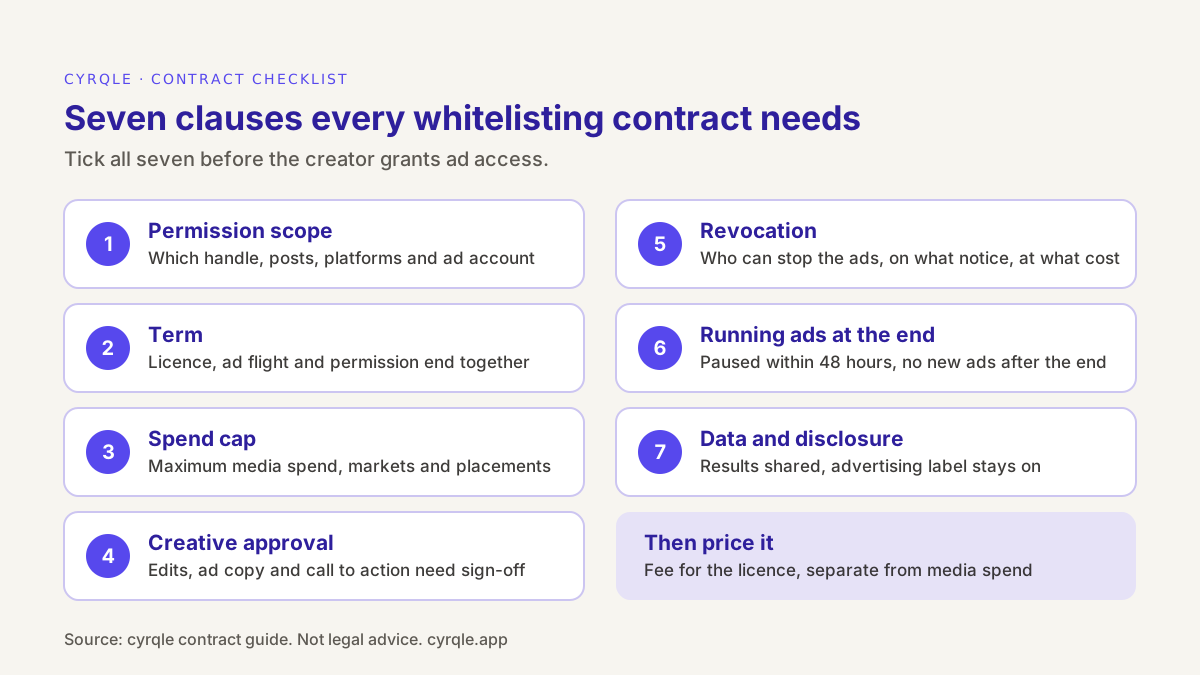
Write each clause in plain words, with numbers and dates rather than "reasonable" and "promptly". The sample wording is a starting point to adapt with your lawyer.
1. Permission scope: which handle, which posts, which ad account
Scope says exactly what the brand may do with the creator's identity. Name the handle on each platform, the posts that may be used (by link), whether the brand may also create new ads under the handle with content the creator did not post, and which brand ad account and Business Manager will hold the permission.
"The Creator authorises the Brand to run paid ads from the Creator's handles @handle (Instagram) and @handle (TikTok), using only the posts listed in Annex 2, from the Brand's ad account [ID]. The Brand will not publish new posts, send messages or reply to comments as the Creator."
Prefer post-level permission over account-level permission when the deal covers a few posts. Account-level access is convenient, but it lets the brand build ads from any post, which is more than most creators intend to give.
2. Term: one end date for everything
The term is the window in which ads may run. State it in days from a fixed start, and require the platform permission to end no later than the licence. Where the platform options do not match, pick the shorter one and renew it, or have the creator revoke the code on the end date.
"Ads may run from [date] to [date] (the Ad Term). The Creator will set any platform permission to expire on or before the last day of the Ad Term. If the platform does not offer a matching duration, the Creator will revoke the permission on the last day, and the Brand will stop delivery first."
Add an option if you think the ad may work: "The Brand may extend the Ad Term by 90 days by written notice before day 80, for a fee of EUR [amount]." Pricing the extension now is cheaper than negotiating it when the creator knows the ad is a hit.
3. Spend cap, markets and placements
The spend cap is the maximum media budget the brand may put behind the creator's identity during the term. It matters to creators because spend decides how many times strangers see their face with a brand next to it. It also protects your budget from an automated campaign that scales a winner overnight.
"Total media spend on ads under the Creator's handle will not exceed EUR [amount] during the Ad Term, in [Spain], on [Instagram feed, Stories and Reels; TikTok For You feed]. Raising the cap requires the Creator's written approval and the fee in Annex 3."
State whether the cap is gross or net of platform fees, which markets are in, and whether audience targeting has limits (no targeting of minors, for example). The creator should be able to see delivered spend, which links to clause 7.
4. Creative approval: what you may change
Whitelisted ads are rarely the organic post as it was. Brands trim the video, add subtitles, write the ad copy and choose the call to action. Each of those puts words next to the creator's name, so agree what needs approval and how fast.
"The Brand may cut, subtitle and resize the content. Ad copy, headlines, calls to action and any new edit will be sent to the Creator for approval, who will answer within [2] working days. Silence after that period counts as approval. The Brand will not add product claims the Creator did not make."
Keep claims consistent with what the creator actually said, especially in regulated categories such as supplements, cosmetics and finance. Also agree who moderates comments on the ad, since they appear under the creator's name.
5. Revocation: who can stop the ads, and at what cost
Revocation is the clause most templates skip. In Spain the creator's consent to commercial use of their image can be revoked at any time under Ley Orgánica 1/1982, so the contract cannot remove that right. It can set the notice, the process and the money.
"Either party may suspend the ads with [48] hours' written notice if the other breaches this agreement, if the content becomes harmful to its reputation, or by the Creator under Article 2.3 of LO 1/1982. On revocation without breach by the Brand, the Creator refunds the unused share of the whitelisting fee pro rata to the days left in the Ad Term, as the agreed compensation."
List the reputational triggers for both sides: the brand faces a public scandal, the creator does, or a product recall makes the claims untrue. A clear trigger list prevents a fight about what "harmful" means.
6. What happens to running ads at the end
When the term ends, the spend cap is hit or the permission is revoked, ads may still be in delivery, sitting in a queue or scheduled for later. Say what happens to each.
"At the end of the Ad Term, on reaching the spend cap, or on revocation, the Brand will pause all ads under the Creator's handle within [48] hours and will not create new ones. The Brand may keep ad reporting data. The Brand will not run the same content from its own account unless Clause [X] grants that use separately."
The last sentence closes a common loophole: switching a whitelisted ad to the brand's own account when the creator's permission ends. Running the same video from your account is a different use, and it needs its own licence line.
7. Data, account access and disclosure
The brand sees ad results the creator cannot see, and the creator's account is exposed while access lasts. Agree three things. First, the brand shares a delivery report with spend, impressions and markets at the end of the term. Second, the brand only uses the access for the ads in scope and removes it on the end date. Third, the ad stays labelled as advertising.
The platform's paid-partnership label does most of the disclosure work, but do not remove or hide it in edits. Spanish rules on influencer advertising expect commercial content to be identified clearly; our guide to the AUTOCONTROL influencer code covers which labels count. Under GDPR, any audience or customer data that passes between the parties needs a lawful basis and a clear purpose.
How the dates fit together
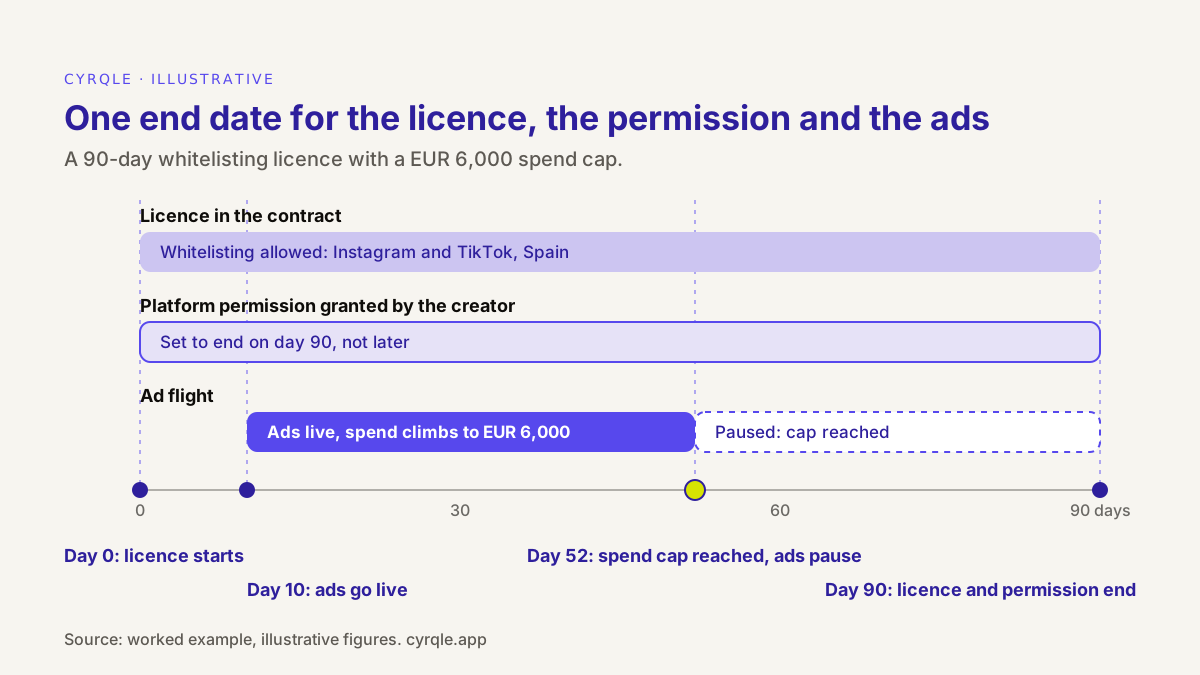
In this illustrative timeline, the licence and the platform permission both start on day 0 and end on day 90. Ads go live on day 10, after the creative is approved. Spend reaches the EUR 6,000 cap on day 52, so the ads pause even though 38 days of licence remain. The brand can use those days only if the creator approves a higher cap. On day 90 the licence and the permission end together, and clause 6 applies to anything left in the account.
Worked example: a 90-day whitelisting deal (illustrative)
The sportswear brand from the introduction books the creator for one Reel and one TikTok at a base fee of EUR 1,800. It wants to run the Reel as a partnership ad and the TikTok as a Spark Ad in Spain for 90 days. All figures are illustrative and before IVA. The uplifts follow the illustrative bands in the usage rights pricing calculator.
| Line | Terms | Amount |
|---|---|---|
| Base fee | 1 Reel + 1 TikTok on the creator's accounts | EUR 1,800 |
| Whitelisting licence | 90 days, Spain, ads from the creator's handle, +45% | EUR 810 |
| Spend cap | EUR 6,000 media spend in total, Instagram and TikTok | Included |
| Cap increase option | Each extra EUR 6,000 of spend, +15% of the base fee | EUR 270 per step |
| Extension option | Another 90 days, notice before day 80, +45% | EUR 810 |
| Fee at signing | EUR 2,610 |
Media spend is paid to the platforms by the brand and does not pass through the creator. Keep it out of the creator's fee line so nobody confuses "EUR 6,000 cap" with "EUR 6,000 owed".
Now the creator revokes on day 30 because they sign with a competitor. Under clause 5, ads pause within 48 hours and the creator refunds the unused share of the licence: 60 of 90 days, so two thirds of EUR 810, which is EUR 540. The base fee stays with the creator, because the organic posts were delivered. Without clause 5, the brand would be arguing about "justified expectations" with no number to point at.
If the ads keep performing and the brand wants more, the two options give it a price in advance: EUR 270 to double the cap, EUR 810 for another quarter. Neither needs a new negotiation.
Common mistakes in whitelisting deals
| Mistake | What goes wrong | Fix |
|---|---|---|
| Consent by DM only | No proof of scope, term or price | Sign the seven clauses as an annex to the agreement |
| Platform code longer than the licence | Ads keep running after the contract ends | Clause 2: permission ends on or before the licence end date |
| No spend cap | A scaled campaign shows the creator far more than they priced | Clause 3: cap per term, with a priced increase |
| Account-level access for a two-post deal | Brand can build ads from any post | Clause 1: post-level permission and a list of posts |
| Moving the ad to the brand's account at the end | A new use with no licence | Clause 6: own-account use needs its own line |
| No revocation terms | Dispute over refunds and damages | Clause 5: notice, triggers and a pro-rata refund |
How cyrqle helps
cyrqle does not run or boost ads today. You set up partnership ads and Spark Ads in Meta Ads Manager or TikTok Ads Manager yourself. What cyrqle does is make sure the paid-ads permission you rely on is agreed, signed and on record before anyone spends money.
- Paid-ads use is licensed on the offer. When you invite a creator from Campaigns, the offer carries the fee, the deliverables and a rights package. Content-wall and campaign use are always granted on a signed contract. Paid-ads use is granted only if you tick it on the offer, and the agreed terms show paid ads as allowed or not allowed.
- Your whitelisting terms travel with the contract. The Creator Collaboration Agreement is signed by both sides, and you can link your own brand terms to it. That is where the seven clauses above belong: scope, term, cap, approval, revocation and wind-down.
- The signed version is frozen. Deal terms are frozen into the agreement at signing, and the signed agreement sits on the Agreements page with its status and a PDF. When a creator asks what they agreed to, you open one file.
- Pick the post with evidence. Live posts on Instagram and TikTok are tracked with views, engagement and effective CPM against a paid-ads benchmark, so you can see which organic post earned the right to a budget before you ask for ad access.
- Approve the creative before it goes live. Optional draft sign-off lets you approve or request changes, with an automated check for the required hashtags and handles.
Sales from the creator's tracking link or promo code show up by confidence tier in attribution. cyrqle does not separate organic sales from ad-driven ones, so keep your own ad-platform reporting for the paid side. For the licence side of creator content that is not paid, see UGC licensing rules in the EU. To walk through the offer and contract flow on one of your own campaigns, book a 30-minute demo.
FAQ
Is whitelisting the same as partnership ads?
Not exactly. Whitelisting is the general practice of running ads from a creator's account with their permission. Partnership ads are Meta's format for it, showing both the creator and the brand; Spark Ads are TikTok's. The contract terms are the same for all three, but the platform permission differs.
How long should a whitelisting licence last?
As long as the media plan needs, usually 30 to 90 days for a campaign. State it in days, set the platform permission to end on or before the same date, and add a priced option to extend. Longer terms cost more because an old ad can look like a current endorsement.
Can a creator stop a whitelisted ad before the end of the term?
In Spain, yes. Ley Orgánica 1/1982 lets a person revoke consent to use their image at any time, with compensation for the damage caused. The contract cannot remove that right, but it can set the notice period, how fast ads pause and what is refunded.
Do I need a spend cap if I pay the creator a flat fee?
Yes. A flat fee is priced on an expected level of exposure. Without a cap, the same fee covers EUR 500 or EUR 50,000 of spend behind the creator's face. A cap with a priced increase keeps the deal fair and protects your own budget too.
What happens to the ad's comments and results when the licence ends?
Ads pause and no new ones are created, as clause 6 says. The brand usually keeps its reporting data. Comments remain on the creator's post, so agree in clause 4 who moderates them while the ads run.
Related field notes.
How much to pay for influencer usage rights: price each scope, term, territory and exclusivity window as an uplift on the base fee. Three worked euro examples.
A public post is not a licence. What brands in Spain, the EU and Latin America need before they reuse customer and creator content: copyright, image rights, GDPR, clear usage terms and a record you can prove.
The full lifecycle of a creator campaign, step by step, and the decisions at each stage that decide whether you can measure it and pay for it cleanly. Written for brand and agency teams in Spain, the EU and Latin America.