
Influencer advertising rules in Mexico, Colombia, Argentina and Chile
Influencer regulation in Latin America: what PROFECO, SIC, CONARP and SERNAC expect, the label each market wants and one caption that fits all four.
Influencer advertising in Mexico, Colombia, Argentina and Chile is regulated through consumer-protection law, not a dedicated influencer statute. Each market adds a guide that says how a paid or gifted creator post should be labelled: PROFECO's Guía de publicidad para influencers in Mexico (2023), the SIC's good-practice guide in Colombia (2020), the CONARP self-regulation guide in Argentina (2020) and SERNAC's interpretative circular in Chile (2022). The safe pattern across all four is the same: a clear Spanish label such as "Publicidad", at the start, with the brand named.
Picture a skincare brand in Madrid that plans a launch with creators in Ciudad de México, Bogotá, Buenos Aires and Santiago. The brief says "#publi #ad, as usual". That pair works in Spain, but PROFECO lists both "#Publi" and "#Ad" as ambiguous, and Colombia's SIC wants the brand account next to the label. One brief, four markets, two problems before a single post is live.
This guide gives you a country table with the regulator or code, the label each one expects and the date we last checked it. It then covers who is liable, what counts as advertising, and a worked example you can copy into a brief. It is not legal advice: for a specific campaign, ask a lawyer in the market.
Which rules apply to influencer advertising in each country?
Each country has a general consumer law that bans misleading advertising, and one document that applies it to creators. The documents are guides, not new laws, but regulators read the law through them.
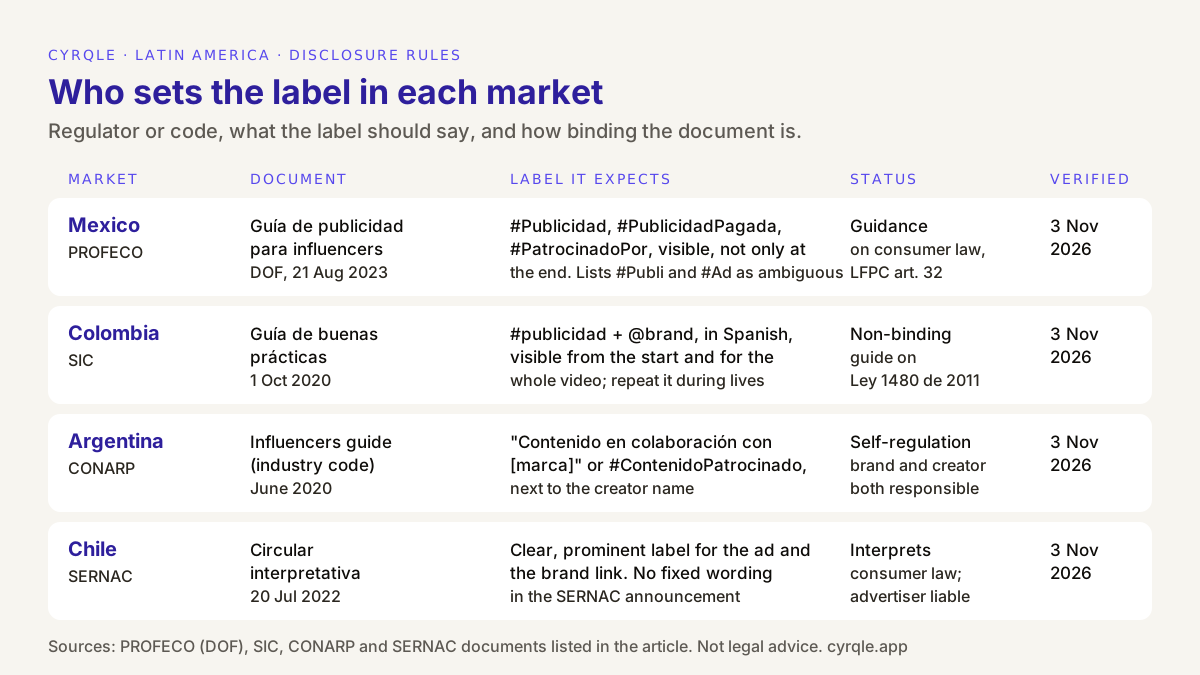
| Market | Body and document | Legal base | What the label should do | Last verified |
|---|---|---|---|---|
| Mexico | PROFECO, Guía de publicidad para influencers, created by an agreement in the DOF on 21 August 2023 | Ley Federal de Protección al Consumidor, art. 32: advertising must be clear, truthful and verifiable | Use #Publicidad, #PublicidadPagada, #PatrocinadoPor or #Patrocinio in a visible place. In video, at the start or inside the content, not only at the end. In audio and live, say it out loud | 3 Nov 2026 |
| Colombia | Superintendencia de Industria y Comercio (SIC), Guía de buenas prácticas en la publicidad a través de influenciadores, 1 October 2020 | Ley 1480 de 2011 (Estatuto del Consumidor). The SIC calls the guide "derecho flexible": guidance, not a new rule | "#publicidad" or "#patrocinadopor" plus the brand's account, in Spanish, visible from the first moment, kept on screen for the whole video and repeated in live streams | 3 Nov 2026 |
| Argentina | CONARP (advertising self-regulation council), Influencers: Guía para la comunicación con fines comerciales, June 2020 | Industry self-regulation under the CONARP code; national consumer law still applies | "Contenido en colaboración con [marca]" or #ContenidoPatrocinado, or similar, in a visible place next to the creator's name or at the start of the post | 3 Nov 2026 |
| Chile | SERNAC, circular interpretativa on native advertising and influencers, 20 July 2022 | Ley del Consumidor. SERNAC's reading puts civil and administrative liability on the advertiser | Identify the content as advertising clearly and prominently, and show the link between brand and creator. SERNAC's announcement does not fix a word | 3 Nov 2026 |
"Last verified" means we read the regulator's own document on that date. Guides change. Check the current version before a campaign, and note the date you checked it in your campaign file.
What counts as advertising: is a gifted product enough?
Yes, in practice. All four documents look at the relationship, not only at cash.
- Mexico. PROFECO's guide says that if you share information or recommend a product on your channels, you are producing advertising. It adds that invitations to events or trips, free products and other non-cash benefits also count when the creator shares the experience.
- Colombia. The SIC defines the commercial relationship as any direct or indirect payment: money, gifts, product loans, incentives, commissions, payment in kind, discounts or coupons. It also looks at control: a script, a required number of posts, a request to show the product, or brand approval of the content.
- Argentina. The CONARP guide applies whenever there is a consideration, "sea en dinero, canje, descuento, o de la índole que fuera" (money, barter, discount or any other kind). Follower count does not matter.
- Chile. SERNAC ties the advertiser's liability to the existence of a commercial link between the brand and the person who posts.
So the test for a brand is short. If you gave the creator anything of value and had any say in the post, label it as advertising. That matches Spain, where the AUTOCONTROL code also treats gifted product as advertising. Our checklist of Spanish influencer law for brands covers the Spanish side.
Which label does each country expect?
The words differ more than the principle. Every guide wants the label to be clear, in the language of the audience, and visible without a click. The details:
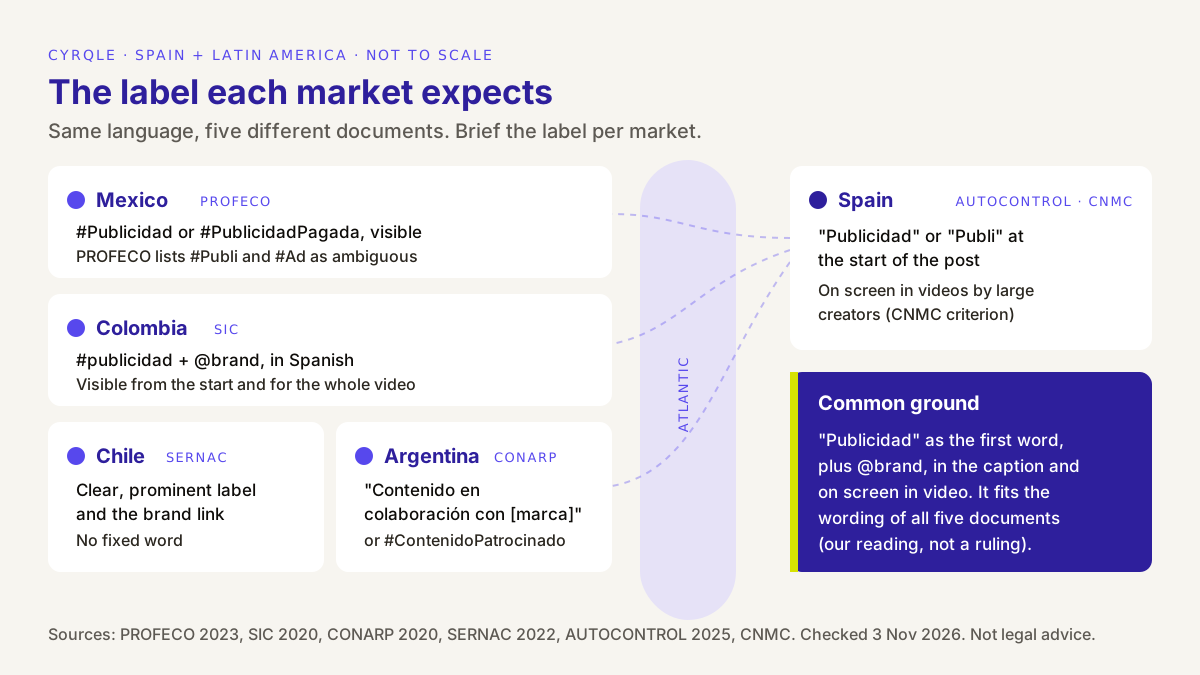
Mexico: #Publicidad, not #Publi
PROFECO suggests #PublicidadPagada, #Publicidad, #OpinionesPersonales and #PatrocinadoPor, and in another list #Patrocinio. Its checklist tells creators to avoid ambiguous references and abbreviations, and names "¡Gracias empresa X!", "Embajador", "Socio", "Empresa X", "#Publi" and "#Ad" as examples. It also warns against hiding the label among many hashtags or putting it only at the end of the post.
Format rules in the guide: for an image, put the information on the image itself. For video, include it at the start or inside the content, not only at the end or in the description. For a live stream, say it is advertising when you mention the product. For audio such as podcasts, say it out loud.
The guide adds a reminder that matters for beauty, food and supplements: products that can affect health have their own advertising rules under COFEPRIS, the health regulator. And the rules apply to child and teenage creators too.
Colombia: #publicidad plus the brand account
The SIC is the most specific about form. The statement must be in Spanish ("en castellano"), simple, as visible as the main message, understandable at a glance, not lost in a block of hashtags or links, visible from the moment the ad appears, present for the whole of a video, repeated periodically in live streams, and legible on every device.
Its examples pair the label with the brand handle: "#publicidad @(marca)", "#Patrocinadopor @(marca)". It says "patrocinio", "en asociación con", "gracias a [marca]", "esto es posible por" or only calling yourself an ambassador are not enough, because they do not make the commercial link clear. Teaser campaigns may hold back the brand name at first, but must still show that the content is advertising.
Argentina: "Contenido en colaboración con [marca]"
CONARP suggests two forms, "Contenido en colaboración con… (marca)" or #ContenidoPatrocinado, "or similar", placed visibly next to the creator's or brand's name or at the start of the post, with no extra action needed from the user, on every device. It also points out that digital content crosses borders, so the brand and creator must check the law of each country where the post is seen.
Chile: clear and prominent, wording open
SERNAC's announcement lists the good practices it expects: identify the advertising content clearly and prominently, show the link between advertiser and creator, describe the product's features clearly, do not promote stereotypes, and do not promote products that can harm health. It also asks for extra care with content aimed at children and teenagers. It does not fix a specific hashtag. A Spanish label such as "Publicidad" at the start meets the "clear and prominent" test better than a hashtag at the end.
Who is liable: the brand or the creator?
The brand is in the frame everywhere. The split differs:
| Market | Brand | Creator |
|---|---|---|
| Mexico | The consumer law's advertising rules apply to whoever advertises; the guide does not split liability | The PROFECO guide is written for creators and treats their recommendations as advertising |
| Colombia | Ley 1480, art. 30: the advertiser is liable for damage caused by misleading advertising | A creator who hides the commercial link may be treated as an advertiser too |
| Argentina | CONARP says brand and creator are both responsible for the content | Same |
| Chile | SERNAC: civil and administrative liability falls on the advertiser where there is a commercial link | Liable as a supplier when selling their own products |
So "the creator forgot the label" is not a defence a brand can rely on. The practical answer is the same in every market: write the label into the brief and the contract, check the draft, and keep the record. For Spain, the same logic applies under the AUTOCONTROL code; see our explainer of the October 2025 AUTOCONTROL influencer code.
Which rules apply when the creator and the audience are in different countries?
Assume both. A creator in Bogotá with a large audience in Mexico publishes one post that Mexican consumers see. CONARP's guide says it plainly: there are no borders in the digital world, so the same content is seen in several jurisdictions. The conservative rule is to label for every market the post targets, using the stricter wording.
For a Spain-based brand this matters twice. Spain also has Real Decreto 444/2024 for large creators, which we explain in Spain's influencer decree for brands. And a label that passes in Spain ("Publi") can fall short in Mexico. Our earlier Q2 2026 snapshot of disclosure rules by country covers other markets; for the four in this guide, use the primary documents above.
Worked example: one launch, four LatAm markets plus Spain
A Madrid skincare brand briefs eight creators for an autumn serum launch: two in Spain, two in Mexico, two in Colombia, one in Argentina and one in Chile. Each creator gets product and a fixed fee; the Mexican creators also get a discount code. The figures are illustrative.
First briefs, before review. The team copies its Spanish brief: "Add #publi #ad at the end."
| Creator | Draft caption ending | Problem |
|---|---|---|
| Spain, 2 creators | "... #skincare #publi #ad" | In Spain "publi" is accepted but belongs at the start; "#ad" is another language |
| Mexico, 2 creators | "... #publi #ad" | PROFECO lists #Publi and #Ad as ambiguous; the label sits at the end |
| Colombia, 2 creators | "gracias a @marca #publi" | The SIC rejects "gracias a"; label should be visible from the start |
| Argentina, 1 creator | "#publi" at the end | Not next to the name or at the start, as CONARP suggests |
| Chile, 1 creator | "#publi" at the end, and only on frame 1 of a 3-story set | Hard to call clear and prominent on frames 2 and 3 |
One rewritten brief. "First line of every caption: 'Publicidad · @marca'. In video and stories: 'Publicidad' on screen from the first second, on every story frame and for the whole video. In live streams: say 'esto es publicidad de @marca' when you show the product and repeat it. Use the platform's paid-partnership tool as well. Do not use #publi, #ad, 'gracias a' or 'colab' as the only label."
That single instruction fits the wording of PROFECO, the SIC, CONARP and SERNAC, and the AUTOCONTROL code in Spain. Add per-market lines where a guide asks for more: health claims checked against COFEPRIS rules in Mexico; for any Spanish creator who may be a "usuario de especial relevancia", the on-screen label the CNMC expects.
Result in this example. Eight drafts reviewed, eight fixed at draft stage, zero live posts to correct. Fixing a caption before publication takes minutes. Fixing it afterwards means a correction request, a reply to keep on file and a post that was non-compliant while it was live.
If the same campaign pays the creators, see paying creators in other countries for the money side, and our Hot Sale Mexico playbook for timing a Mexican launch.
A five-step compliance routine for multi-market campaigns
- Map the markets. For each creator, list where they live and where their audience is. Label for every market the post targets.
- Write the label into the brief. Use the exact words, the position (first line, on screen from the start) and the platform tool. One sentence per format.
- Freeze it in the contract. The creator agrees to the label and to correct a post on request.
- Check every draft. Look for the label, its position and the brand handle before approval. Check stories frame by frame.
- Keep the record. Store the brief, the approved draft, the live link and the date you checked the rules. If a regulator asks, that file is your answer.
How cyrqle helps
In Campaigns, the brief is where you set the brand handle and the required hashtags for each campaign. Put your market's label there, for example #Publicidad, so it is part of what every creator receives. Bulk invites go out in Spanish or English by market.
- Draft approval. With draft sign-off turned on, each draft comes to you before it goes live. cyrqle checks the caption for the required hashtags and handles and flags what is missing, so a draft without your label is caught by name. You still judge placement and on-screen labels yourself.
- Signed terms. The Creator Collaboration Agreement is signed by both sides with a frozen snapshot of the terms, so the disclosure duty you wrote is on record. See Compensation and contracts.
- A record per post. Published Instagram and TikTok posts are tracked against the campaign, next to the approved draft. Story tracking is not automatic, so keep your own screenshots for story sets.
cyrqle does not decide which label a market's law requires. It makes sure the label you chose reaches every creator and every draft. For the broader picture, read our EU and Latin America disclosure guide and the LATAM creator commerce 2026 report, or see the disclosure entry in our glossary.
FAQ
Is there an influencer law in Mexico?
Not a dedicated one. The Ley Federal de Protección al Consumidor (art. 32) requires advertising to be clear, truthful and verifiable, and PROFECO's 2023 guide explains how that applies to creators. Health-related products also fall under COFEPRIS advertising rules.
Is the SIC guide binding in Colombia?
The guide itself is not a new rule; the SIC calls it "derecho flexible". But it explains how the SIC reads Ley 1480 de 2011, which is binding, and the SIC enforces that law against misleading advertising. Treat the guide as the standard the regulator will use.
Can I use #publi in Latin America?
Avoid it as the only label. PROFECO names "#Publi" and "#Ad" as ambiguous, and the SIC wants "#publicidad" with the brand account. "Publicidad" in full, at the start, works in Spain and in all four markets in this guide.
Does gifted product count as advertising in Latin America?
Yes. PROFECO counts gifts, trips and event invitations; the SIC counts gifts, product loans, discounts, coupons and commissions; CONARP counts barter and discounts. If you gave anything of value and shaped the post, label it.
Who is responsible if a creator forgets the label?
Often the brand. In Chile SERNAC places liability on the advertiser where there is a commercial link, in Colombia the advertiser answers for misleading advertising, and in Argentina CONARP says brand and creator share responsibility. Brief the label, check drafts and keep the record.
Sources
Checked on 3 November 2026. Not legal advice: for a specific campaign, ask a lawyer in the market.
- PROFECO, Acuerdo por el que se da a conocer la Guía de publicidad para influencers, Diario Oficial de la Federación, 21 August 2023.
- PROFECO, Guía de publicidad para influencers (PDF).
- Superintendencia de Industria y Comercio, Superindustria expide "Guía de buenas prácticas en la publicidad a través de influenciadores", 1 October 2020.
- CONARP, Código de Ética y Autorregulación Publicitaria and papers, including "Influencers: Guía para la comunicación con fines comerciales" (June 2020) and "Comunicación con fines comerciales: recomendaciones para influencers" (2022).
- SERNAC, El SERNAC dicta circular interpretativa sobre publicidad nativa e influencers, 20 July 2022.
Related field notes.
Spain's influencer law for creators: the BOE thresholds in RD 444/2024, why most creators sit below them, and the label rules that still apply to everyone.
What the AUTOCONTROL influencer code of conduct (October 2025) asks of brands: accepted labels, placement by format, the #ad question and a brand checklist.
Spain's influencer law, Real Decreto 444/2024, explained for brands: who is a usuario de especial relevancia, the BOE thresholds, the registry and your duties.