
TikTok Shop vs your own store: where should creator sales land?
TikTok Shop vs Shopify for creator sales in Spain: in-app conversion against customer data, margin, returns and attribution, with a worked example in euros.
Send creator sales to TikTok Shop if your product sells on impulse, your margin can carry a platform fee, and you care most about the first order. Send them to your own Shopify or WooCommerce store if you need the customer's email, repeat purchases and attribution you can compare with every other channel. Most brands with a real repeat business end up with a hybrid: TikTok Shop for low-price hero products, their own store for everything they want to build a customer relationship around.
Picture one reel from a creator in Valencia showing a EUR 39 serum. One viewer taps the product tag and pays inside TikTok in four taps. Another taps the link in the creator's bio, lands on the brand's store, browses, and buys two products with the creator's code. Same video, two very different sales: different fees, different data, different return flow and a different report.
This post compares the two destinations on the four things that decide the question: customer data, margin per order, returns and attribution. It includes a worked example in euros. The return-on-investment maths behind it is in our guide to measuring influencer marketing ROI.
Is TikTok Shop available in Spain?
Yes. TikTok Shop opened in Spain in December 2024, its first market in continental Europe after the UK. In May 2026 TikTok's newsroom listed Spain among its existing European markets, with France, Germany, Ireland, Italy and the UK, and announced Austria, Belgium, the Netherlands and Poland from 15 June 2026 (TikTok newsroom).
Sellers register through TikTok Shop Seller Center. On the cost side, TikTok told sellers in December 2025 that the standard commission in Spain, Germany, France, Italy and Ireland would go from 5% to 9% per sale from 8 January 2026, with some sub-categories at 7% and a reduced rate for new sellers in their first months, as reported by Ecommerce News Europe. Fees change, so check the current rate for your category in Seller Center before you model anything.
TikTok Shop is a form of social commerce: discovery, product page and checkout all live inside the social app. Your own store is the opposite model: the social app sends traffic, and the sale happens on a site you control.
Two purchase paths from the same creator video
A creator video can end in one of two places. On path A, the viewer taps a product tag and pays in the TikTok checkout. On path B, the viewer taps a link or remembers a code and pays on your own store.
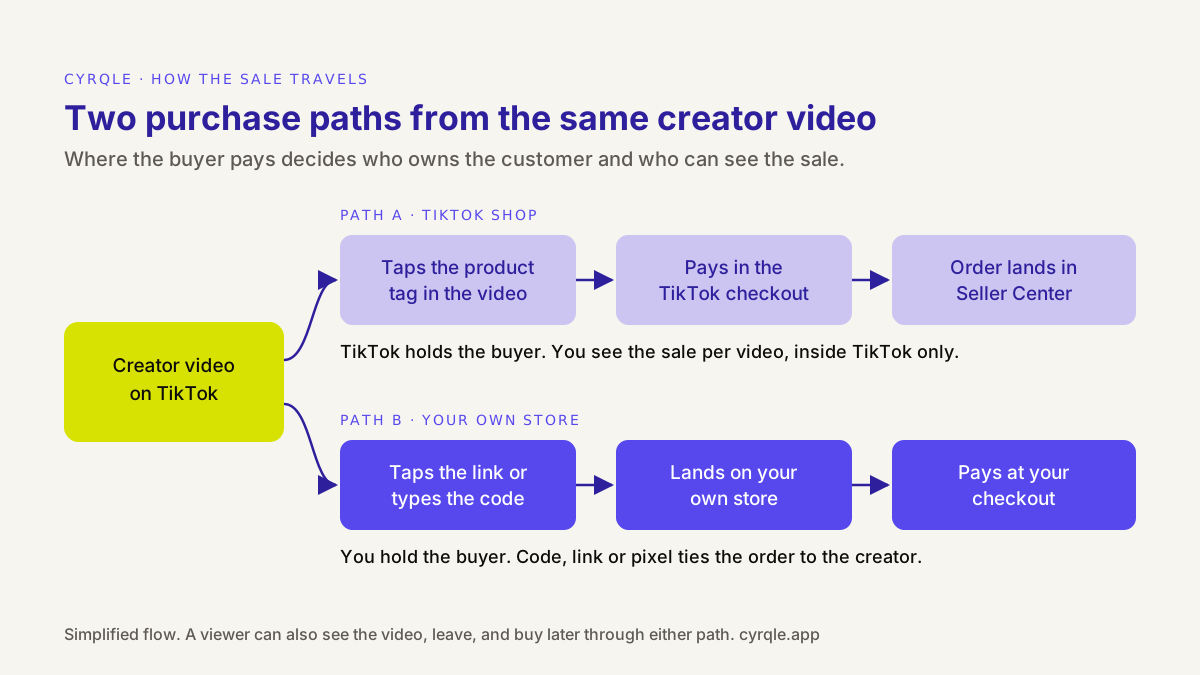
The difference is not only the checkout. On path A, TikTok holds the customer relationship and records the sale against the video. On path B, you hold the customer, and your own tracking has to connect the order back to the creator. The rest of this post follows from that split.
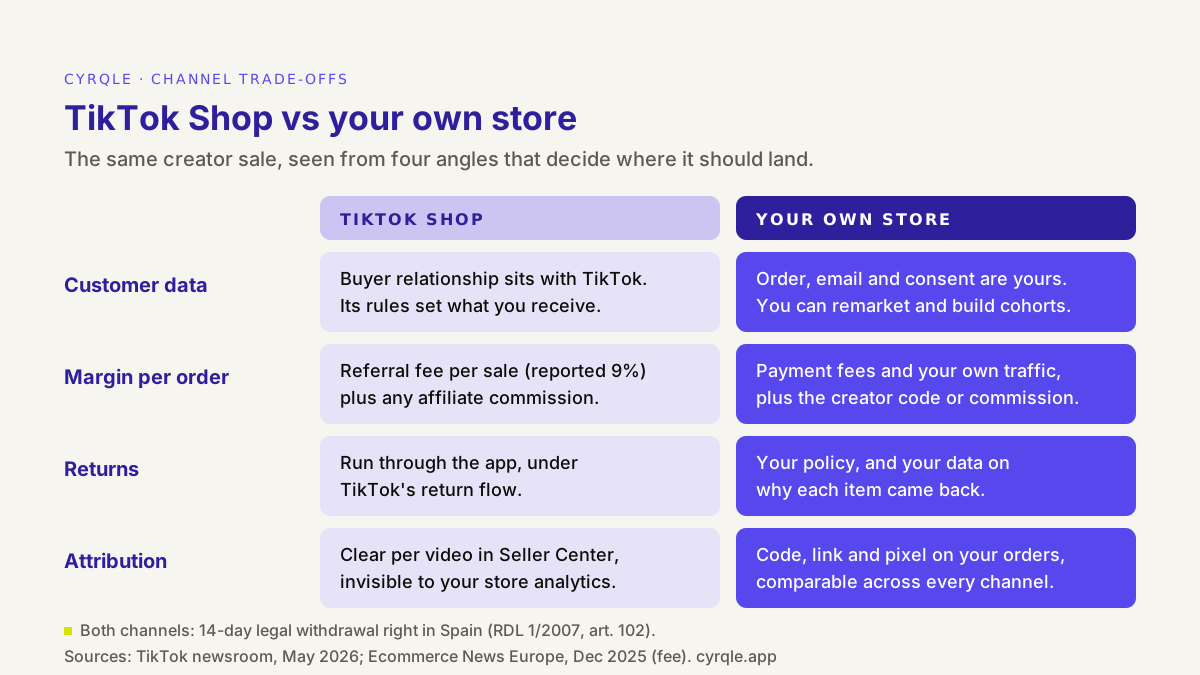
TikTok Shop vs your own store, side by side
| TikTok Shop | Your own store (Shopify, WooCommerce, Magento) | |
|---|---|---|
| Where the buyer pays | Inside the TikTok app | On your site, after leaving the app |
| First-order conversion | Usually higher: no app switch, no new checkout | Usually lower: every extra step loses buyers |
| Customer data | TikTok holds the relationship; its seller rules decide what you receive and how you may use it | Order, email address and marketing consent are yours |
| Platform fee per order | Seller commission, reported at 9% standard in Spain from January 2026 | None from a marketplace; you pay payment fees and your own traffic costs |
| Creator payment | TikTok's affiliate commission set in Seller Center, or a flat fee | Code, link or commission you set and pay yourself |
| Returns | Handled through TikTok's return flow | Your policy, your process, your data on reasons |
| Attribution | Per video and per creator, inside Seller Center | Code, link and pixel on your own orders, comparable to other channels |
| Repeat purchases | Hard to drive yourself | Email, loyalty and cohorts are under your control |
Who owns the customer?
On your own store, the buyer becomes your customer. You get the email address, you can ask for marketing consent at checkout, and the order joins your customer history. That is what lets you send a replenishment reminder after 30 days, build a cohort of everyone who bought through a creator, and judge the creator on the value of the customers they brought, not only on the first basket. We argue for that view in optimising creators on cohort value, not cost per order.
On TikTok Shop, the platform sits between you and the buyer. You receive what you need to fulfil the order, and TikTok's seller policies decide what else you get and what you may do with it. Read those policies before you plan to email TikTok Shop buyers. In practice, a repeat purchase from that buyer usually happens on TikTok again, when another video reaches them, and you pay the platform fee again.
This matters most for products people buy more than once. A EUR 25 moisturiser bought every two months is worth far more as a customer than as an order. A EUR 25 phone case bought once is not.
Which channel leaves more margin per order?
It depends on two numbers you can estimate before you choose: the conversion gap between the channels, and how many buyers come back. The example below uses illustrative figures for a skincare brand in Spain. The 9% TikTok fee is the reported standard rate; every other number is illustrative.
Assume 1,000 viewers tap a product tag or a link from the same set of creator videos. Average order value is EUR 40 excluding VAT. Product cost is 40% of the price. Creators earn 15% commission in both channels.
| Per 1,000 taps (illustrative) | TikTok Shop | Your own store |
|---|---|---|
| Conversion rate | 4.0% | 2.5% |
| Orders | 40 | 25 |
| Revenue | EUR 1,600 | EUR 1,000 |
| Product cost (40%) | EUR 640 | EUR 400 |
| Platform commission (9%) | EUR 144 | EUR 0 |
| Payment fees (about 2%) | not modelled | EUR 20 |
| Creator commission (15%) | EUR 240 | EUR 150 |
| Contribution, first order | EUR 576 | EUR 430 |
| Repeat orders you trigger by email (20% of buyers, no creator commission, illustrative) | not counted | 5 orders x EUR 23.20 = EUR 116 |
| Contribution after six months | EUR 576 | EUR 546 |
The table counts no repeat orders on TikTok Shop because you cannot trigger them yourself; if later videos bring those buyers back, that revenue exists but carries the fee again. On the first order, TikTok Shop wins clearly, because the conversion gap is bigger than the fee. After six months of repeat orders, the gap almost closes. Change two assumptions and the answer flips: if your own store converts at 3%, or if 35% of buyers come back, your own store comes out ahead.
Two lessons from the arithmetic:
- The conversion gap is the swing factor. Do not guess it. Run the same creators to both destinations for two to four weeks and measure it on your own category.
- Fees are only one cost. Discount codes, free shipping thresholds and returns move margin as much as the platform fee does. The true cost of a creator collaboration lists the full stack.
How do returns change the answer?
Returns hit both channels, and the legal floor is the same. In Spain, a consumer who buys at a distance can withdraw from the contract within 14 calendar days without giving a reason (Real Decreto Legislativo 1/2007, article 102). Selling inside TikTok does not remove that right.
What differs is control and visibility:
- On TikTok Shop, the buyer asks for the return inside the app and the platform's flow manages it. You see the returned order in Seller Center, next to the sale.
- On your own store, you set the process above the legal minimum, you can collect a reason code, and you can see which creator's buyers return the most.
For categories with high return rates, such as fashion and footwear, judge every creator on revenue net of refunds, not gross sales. A creator whose buyers return half of what they order is a different investment from one whose buyers keep it. Impulse purchases made in a few taps can also come back more often than considered ones; measure it on your own data before you assume either way.
Which channel shows you the attribution?
Both channels give you attribution. They do not give you the same kind.
TikTok Shop attributes sales inside its own system. Seller Center shows which videos, lives and affiliate creators generated orders. For sales that happen inside TikTok, that view is clear, because the platform sees the whole journey from video to checkout. What you cannot do is compare it like for like with your other channels, because the data stays in TikTok and follows TikTok's own rules.
Your own store needs you to build the link between creator and order. The standard toolkit is a per-creator discount code, a tracking link with a small tag on your site, and a checkout pixel. Each sees a different slice of buyers, as we explain in discount code vs tracking link vs pixel. The result is first-party attribution: your orders, your rules, comparable with email, paid social and every other channel in your store data. For Shopify setup, see how to track creator sales on Shopify.
Running both channels creates one blind spot. A viewer can see a creator's video, ignore the product tag, and search for your brand on Google two days later. Neither TikTok Shop nor a creator link will claim that sale. If you need to know the total effect of the creator programme across all channels, you need a holdout test, not a better tag. Our holdout test guide shows how to run one without a data team.
When should you choose each channel?
| Your situation | Better destination | Why |
|---|---|---|
| Low price, impulse product, one-off purchase | TikTok Shop | Conversion is the main lever and there is little repeat value to lose |
| Consumable with repeat purchase (skincare, supplements, coffee) | Your own store | Repeat orders and the customer's email outweigh the first-order conversion gap |
| Premium or considered product, high AOV | Your own store | Buyers browse and compare; your site tells the story better |
| Launch or test of a new hero product | Both, in parallel | Measure the conversion gap on your own category before you commit |
| Live shopping event | TikTok Shop | In-app checkout fits the format; take the platform's numbers as the record |
| Brand selling mostly through retail partners | Your own store or the retailer | TikTok Shop adds a channel you must stock and serve |
| You need one comparable ROAS across all channels | Your own store | Your store data is the only place every channel meets |
If you run both, decide in the brief which products each creator pushes where, and do not send the same viewer two calls to action in one video. Report TikTok Shop sales from Seller Center and own-store sales from your attribution system as two lines, never as one total.
How cyrqle helps
cyrqle measures creator sales on your own store. It has no TikTok Shop integration and does not read sales from Seller Center. If you sell through TikTok Shop, keep those figures from TikTok and report them next to cyrqle's numbers.
For your own store, Attribution gives each creator a promo code and a tracking link. A tag under 2KB on your store ties link clicks to orders. On Shopify, a custom pixel covers the hosted checkout, and signed order webhooks are the server-side record of each sale; see the Shopify integration for what is set up and how. WooCommerce and Magento send signed order webhooks too.
Every sale gets a confidence tier: Tier 1 — promo code, Tier 2 — same-session and Tier 3 — cookied later, with a 30-day window. Revenue is shown net of refunds, which matters for the returns question above. The Attribution tab shows sales, revenue and clicks by tier, top creators, content and markets, with an audit chain from each sale to the post, the code and the creator.
On the content side, cyrqle tracks published TikTok and Instagram posts in a campaign with views, engagement and effective CPM, so you can see the reach a creator delivered regardless of where the sale landed. To see the attribution tiers on your own category, book a 30-minute demo.
FAQ
Is TikTok Shop better than Shopify for creator sales?
Neither is better in general. TikTok Shop usually converts more first orders because the buyer stays in the app. Shopify, or any store you own, gives you the customer, repeat revenue and attribution you can compare across channels. Choose by product: impulse and one-off favours TikTok Shop; repeat and considered favours your own store.
Can I connect TikTok Shop and Shopify?
Connector apps exist that sync products and orders between a store and TikTok Shop, but support differs by market, so confirm that the app you pick supports TikTok Shop Spain before you rely on it. Syncing the catalogue does not merge the customer relationship: a sale made in the TikTok checkout is still a TikTok Shop sale under TikTok's rules.
How much commission does TikTok Shop charge in Spain?
The standard seller commission was reported at 9% per sale from 8 January 2026, up from 5%, with some sub-categories at 7% and a lower introductory rate for new sellers. Affiliate commission you pay creators is on top. Check Seller Center for the current rate in your category.
Do EU return rules apply to TikTok Shop orders?
Yes. A consumer in Spain who buys at a distance has a 14-day right of withdrawal under the consumer protection law, wherever the checkout runs. The platform manages the return flow, but the seller's legal obligations to the consumer still apply. This is not legal advice; ask your lawyer about your specific setup.
Can I add TikTok Shop sales to my creator ROAS?
Only as a separate line. TikTok Shop and your store attribute sales with different rules, and the same viewer can appear in both. Report each channel from its own system, then add a holdout test if you need the combined effect of the programme.
Sources
- TikTok newsroom, "TikTok Shop Expands Across Europe", 28 May 2026: https://newsroom.tiktok.com/tiktok-shop-expands-across-europe?lang=en-150
- Ecommerce News Europe, "TikTok Shop raises seller fees in Europe", 11 December 2025: https://ecommercenews.eu/tiktok-shop-raises-seller-fees-in-europe/
- Real Decreto Legislativo 1/2007, texto refundido de la Ley General para la Defensa de los Consumidores y Usuarios, articles 102 and 104 (right of withdrawal and its period): https://www.boe.es/buscar/act.php?id=BOE-A-2007-20555
Related field notes.
Influencer discount code vs tracking link vs pixel: what each method sees and misses, how they overlap, and how to combine them into confidence tiers.
How to tell whether the creator content on your site is earning its place. The metrics that matter at each step, from wall impressions to product clicks to attributed orders, and the traps that make the numbers look better or worse than they are.
Returns-adjusted ROAS for fashion creator campaigns: gross vs net ROAS per creator with worked numbers, why commission waits for returns, and who changes rank.