
Influencer vetting and brand-safety checklist (2026): proceed, conditional or drop
Influencer vetting checklist for agencies: 14 checks, the evidence to file for each, a proceed, conditional or drop rule, EU and Spain rules and re-vet dates.
An influencer vetting checklist is a fixed set of checks you run on every creator before you sign, with a written decision at the end. The version in this guide has 14 checks in four groups: audience, content, commercial history and compliance. Each check names what to compute, what evidence to save and what moves the creator to proceed, conditional (with a mitigation the client accepts) or drop.
Picture an agency in Madrid that shortlists 12 creators for a sportswear client launching in Spain and Mexico. The client's legal team asks one question: "Why these 12, and what did you check?" Most agencies answer from memory. That answer is weak in a market where, in the European Commission's 2023 sweep, 97% of the 576 influencers screened posted commercial content and only 20% disclosed it every time. Not checking is the risky default, and the client knows it.
This guide gives you the 14 checks, benchmarks with a stated method, a decision tree, an evidence table you can copy into your vetting file and a re-vet calendar. It is written for agencies and brand teams buying creators in Spain, the EU and Latin America. It is not legal advice: for a specific campaign, ask your lawyer.
Why does an agency need a written vetting file?
Clients now expect proof, not judgement. In a US survey of 117 marketers by EMARKETER and Viral Nation, 96.6% said they want documentation of how influencers were vetted before a campaign, but only 25.6% always see it. Only 21.8% believe their agency partners have a well-defined and transparent vetting process (EMARKETER x Viral Nation, Brand Safety and Influencer Marketing Survey, 2025). It is a vendor co-authored US sample, so read it as a direction, not a European figure.
The European reason is liability. Spain's unfair-competition law treats paid promotion on social networks that is not clearly identified as advertising as a deceptive practice (Ley 3/1991 de Competencia Desleal, article 26). The AUTOCONTROL code asks adhered advertisers to write the code into every creator contract (norm 3). When something goes wrong after launch, the first question is what you knew before you signed. A vetting file answers it. The post-launch side, one record per published post, is covered in the influencer campaign compliance audit.
Before you start
Four decisions make the checklist work. Skip them and every creator ends up "conditional" with no conditions.
- Write the client's red lines. Brand-safety topics the client will not sit next to, the competitor list (including regional accounts), the exclusivity window you plan to buy, and the markets. Red lines turn a vague brand-safety review into a pass or fail.
- Fix the evidence format. One row per creator, one column per check, plus the date, the reviewer and the source of each data point. A spreadsheet works; so does a CRM. The guide to choosing between a spreadsheet and influencer CRM software covers when to switch.
- Name the approver. The agency lead approves proceed and drop. The client signs off every conditional, because the client carries the residual risk.
- Set the depth. A light vet (checks 1, 4, 6 and 12) for one-off gifting to nano creators. The full 14 checks for paid deals, ambassadors and any creator who will appear in ads.
The 14 checks at a glance
Tick each check as you file its evidence. The detail line names what goes in the file.
Audience checks (1 to 4)
1. Is the computed engagement rate in line with the tier?
Compute the engagement rate yourself from public posts. Do not copy it from the media kit. For each of the last 12 feed posts, divide likes plus comments by the current follower count, then take the median. The median ignores one viral post that would inflate an average.
Compare the result with the median of the creator's tier and platform. The benchmarks below come from the cyrqle creator index and use the same formula: per creator, the median over the 12 most recent feed posts since January 2024; per tier, the median creator, with the 25th and 75th percentiles in brackets.
| Tier | Instagram, Spain | Instagram, all countries | TikTok, Spain | TikTok, all countries |
|---|---|---|---|---|
| Nano 1k-10k | small sample, see note | 0.89% (0.26-2.90), n = 6,896 | 0.59% (0.30-1.05), n = 7,608 | 0.58% (0.28-1.13), n = 12,359 |
| Micro 10k-50k | 0.89% (0.47-2.01), n = 946 | 0.89% (0.32-2.37), n = 2,905 | 0.37% (0.18-0.79), n = 17,038 | 0.34% (0.15-0.78), n = 28,699 |
| Mid 50k-500k | 0.85% (0.38-1.79), n = 1,577 | 0.72% (0.24-1.84), n = 4,760 | 0.20% (0.07-0.71), n = 9,868 | 0.17% (0.06-0.61), n = 25,467 |
| Macro 500k-1M | 0.84% (0.34-1.88), n = 210 | 0.70% (0.23-2.10), n = 747 | 0.22% (0.05-0.91), n = 983 | 0.19% (0.05-0.71), n = 4,707 |
| Mega 1M+ | 0.71% (0.32-2.15), n = 176 | 0.86% (0.25-2.72), n = 1,285 | 0.30% (0.08-0.93), n = 1,054 | 0.24% (0.06-0.81), n = 7,061 |
Source: cyrqle analysis of 16,593 public Instagram and 78,293 public TikTok creator profiles (977,000 posts, Jan 2024 to Nov 2026), Nov 2026. Median (p25-p75). The Spain nano Instagram cell has only 133 creators and is out of line with the other tiers, so it is left out.
These figures look lower than many vendor benchmarks. That is expected: they describe the median creator's median post, while most published benchmarks average across posts and accounts, and a few viral posts pull an average up. Use the same formula for your creator and for the benchmark, or the comparison means nothing. For views-based pricing, see how to choose creators by views and effective CPM.
Evidence to file: the 12 post links, likes and comments per post, the follower count with the date, your median, and the benchmark cell with its n.
2. Where does the creator sit inside the tier?
Position inside the tier matters more than the tier itself. On Instagram, a creator at the 75th percentile of a tier has 7x to 11x the engagement rate of a creator at the 25th percentile of the same tier, and the top 10% have 55x to 77x the bottom 10%. Followers and engagement rate are barely related on Instagram (Spearman -0.07, n = 16,593). On TikTok the relation is negative (Spearman -0.26, n = 78,293). Source: cyrqle creator index, Nov 2026.
So place the creator in a quartile. The rule of thumb this guide uses:
- Above the tier p75: good, but look harder at check 4. Very high engagement can come from engagement pods.
- Between p25 and p75: normal. Proceed on this check.
- Below p25: conditional (a test post, or a commission-led deal before a fee) or drop, unless fit is exceptional and the client accepts it.
Engagement rate from your own count, compared with the tier median and quartiles.
Tier defaults: Instagram, Spain, micro tier (cyrqle creator index, Nov 2026, n = 946). The creator inputs are illustrative. Replace the tier values from the table above.
Worked example (illustrative creator): a micro creator in Spain with 30,000 followers and a median of 450 likes plus comments per post has an engagement rate of 1.50%. That is 1.69 times the tier median of 0.89%, 0.75 of the p75 (2.01%) and 3.19 times the p25 (0.47%). The creator sits in the upper half of the tier but not in the top quartile. Check 2 passes.
3. Are there follower spikes nobody can explain?
A spike is a jump in followers that no post, press mention or collaboration explains, followed by flat engagement. Bought followers rarely like or comment, so the engagement rate drops after the jump. A spike with a viral post behind it is normal.
There is no reliable public figure for the share of fake followers on an account. Tools that print a "fake %" are estimating, and their methods differ, so treat any such number as one input. What you can document: dated follower counts (your own snapshots, the creator's native analytics, or a third-party growth chart labelled as such), and the post or event that explains each jump. On Instagram, "About this account" shows the date the account joined and, where shown, the account's country and the number of username changes. Screenshot it.
Evidence to file: dated follower counts, the explaining post for each jump, and the "About this account" screenshot.
4. Do the comments look like a real audience?
Sample 20 comments on each of 5 recent posts, 100 in total. Count the comments that are emoji-only or generic ("great post", "love this"), the accounts that comment first on every post within minutes, and comments in a language the target audience does not speak. One of these alone proves nothing. All three together, combined with high engagement from check 2, point to pods or bought engagement.
Evidence to file: the sample (post links and the 100 comments), your counts and the share of generic or repeated comments.
Content checks (5 to 7)
5. Do the format mix and cadence match the media kit?
Record the share of reels, carousels and photos in the last 12 posts, and the posting cadence. As a reference, the median Instagram creator in Spain posts 7.6 times a month (n = 2,953), rising from about 5 a month for nano creators to about 10 for macro and mega creators. Among Spanish Instagram creators, reels are 52.6% of posts, carousels 36.0% and photos 11.4% (n = 3,042). The median TikTok creator in Spain posts 15.1 times a month (n = 34,435). Source: cyrqle creator index, Nov 2026.
Cadence is a baseline, not a pass mark. Flag a sudden change: a creator whose cadence fell from 8 posts a month to 1 has a different account from the one in the media kit. Flag a mismatch too: if the brief needs reels and the creator posts photos.
6. Does any content conflict with the client's red lines?
Scroll 12 months of posts, captions and bio links, and search the creator's name in news. Compare what you find with the client's written red lines. Spain's audiovisual law sets a floor: among other limits, commercial communication must not encourage discrimination (Ley 13/2022 General de Comunicación Audiovisual, article 122). Regulated categories add their own rules, set out in the regulated products rules matrix for Spain and Latin America.
Log facts, not labels. Write "post of 12 March, link, conflicts with client red line 3 (gambling promotion)", not "creator is religious" or "creator has a health condition". The second kind of note is special-category data under the GDPR (see check 14), and you do not need it to make the decision.
7. Is the audience in the right market?
Check the profile country and the caption language. Then ask the creator for native audience screenshots from Instagram or TikTok analytics (country, city, age), dated within the last 30 days. Third-party audience-country figures are estimates; if you use one, label it as an estimate in the file. A creator who will not share native analytics for a paid deal moves to conditional or drop.
Commercial-history checks (8 to 11)
8. How often does the creator use the paid-partnership label?
Find the creator's commercial posts and note which ones carry the platform label (Instagram "Paid partnership", TikTok commercial content disclosure). A creator who uses the label consistently has the habit you need. A creator with many brand posts and no labels needs a contract clause and a draft check (see the decision rules below).
The EU's Digital Services Act requires platforms to offer this declaration tool to users, which is why the labels exist (Regulation (EU) 2022/2065, article 26(2)).
9. What does the brand-tag history show?
List every brand the creator tagged or mentioned in the last 12 months. A tag is not proof of a paid deal. Norm 4 of the AUTOCONTROL code lists signs that make a post likely to be advertising even without proof of payment: an earlier or later collaboration with the brand, the same hashtags as other creators in the same period, a discount code, a direct call to buy, editorial control by the advertiser and affiliate links.
The gap between tags and labels is large. Among Instagram creators in Spain, 47.0% tagged or mentioned a known brand account in their last 12 posts (n = 3,045), but only 9.8% used a disclosure hashtag in the same posts (n = 3,042). The hashtag list includes "#ad", "#sponsored" and "#partner", which the AUTOCONTROL code does not accept for Spanish-language posts, and placement was not measured, so 9.8% is an upper bound for compliant hashtag use, not a compliance rate. Source: cyrqle creator index, Nov 2026. Read it as a disclosure gap signal, not as proof of breaches.
10. Has the creator worked with a competitor?
Check the last 12 months against the client's competitor list, including regional and sub-brand accounts. Compare each competitor post date with the exclusivity window you plan to buy.
- No competitor posts: proceed.
- Competitor posts outside the window: conditional. Add an exclusivity clause and start your campaign after the last competitor post.
- A competitor deal inside the window, or an active ambassador role: drop.
11. Who is in the creator's collaborator graph?
Look at the accounts the creator co-posts with, tags and is tagged by. Three things matter: a tight ring of accounts that comment on each other's posts within minutes (pods, see check 4), associates the client would not want next to the brand, and a cluster of creators who all work for one competitor. Note what you saw and the links.
Compliance checks (12 to 14)
12. Does the creator disclose correctly?
Score the last 5 to 10 commercial posts against norm 6 of the AUTOCONTROL influencer code, in force since 1 October 2025:
- Label: the platform tool, or an accepted word such as "publicidad", "publi", "en colaboración con", "patrocinado por" or "Embajador de [marca]".
- Not enough: "Colab", "Sponso", "sp", "Gracias a [marca]", "Regalo de [marca]", "Viaje patrocinado", a brand hashtag on its own, or a label in another language than the post, such as "Ad".
- Position: at the start of the message, visible without tapping "more", not mixed into a run of hashtags, and kept on reposts.
Stories disappear after 24 hours, so ask for screenshots of past story sets or check the creator's highlights. The full label and placement rules are in the AUTOCONTROL influencer code explainer, and the cross-market version in the EU and LatAm disclosure guide.
TikTok updated its branded content policy with effect from 30 October 2026. It still requires creators to switch on the commercial content disclosure toggle for paid promotion, and it may remove or restrict content that does not comply (TikTok branded content policy).
13. What is the creator's legal status, and who gets paid?
Three questions:
- Is the creator a "usuario de especial relevancia"? Under Real Decreto 444/2024, a creator is a usuario de especial relevancia when all three conditions are met: gross income of at least EUR 300,000 from the activity in the previous year, at least 1,000,000 followers on one service or 2,000,000 combined, and at least 24 videos in the previous year. These creators must register in the state audiovisual register and follow the audiovisual law's rules on commercial communication and minors (Ley 13/2022, article 94). Check the register entry for any creator near the thresholds. The wider rules are in the guide to influencer marketing law in Spain.
- Who invoices, and are they set up to do it? Confirm the legal name, tax ID and country of the payee, and whether the creator invoices as an individual, through a company or through an agent. The EU sweep found that only 47% of the influencers who carried out a commercial activity were registered as traders.
- Is the creator a minor, or do minors appear in the content? For a creator under 18, the contract needs the consent of a parent or legal guardian. Treat content with children as a brand-safety topic in check 6.
14. Is your vetting file itself compliant?
A vetting file holds personal data about a person you did not collect it from, so the GDPR applies to the agency (Regulation (EU) 2016/679). Four rules keep it clean:
- Minimise (article 5). Keep only the fields the decision needs, the ones in the evidence table below.
- No special-category inferences (article 9). Do not record health, religion, political views, sexual orientation or ethnic origin. Data the creator made public is a narrow exception, and you still need a purpose. Record the conflict with a red line instead.
- Tell the creator (article 14). When you collect data from public profiles, the creator has a right to know. A short notice in the first outreach email or in the contract usually covers it.
- Set a retention period. For example, the contract term plus the limitation period your lawyer sets for disputes. Delete files for creators you dropped once the shortlist closes, unless you have a reason to keep them.
Our GDPR glossary entry has the definitions.
From checks to a decision: proceed, conditional or drop
Every creator ends with one of three decisions. Run the hard red lines first, so you do not spend an hour on a creator the client would never accept.
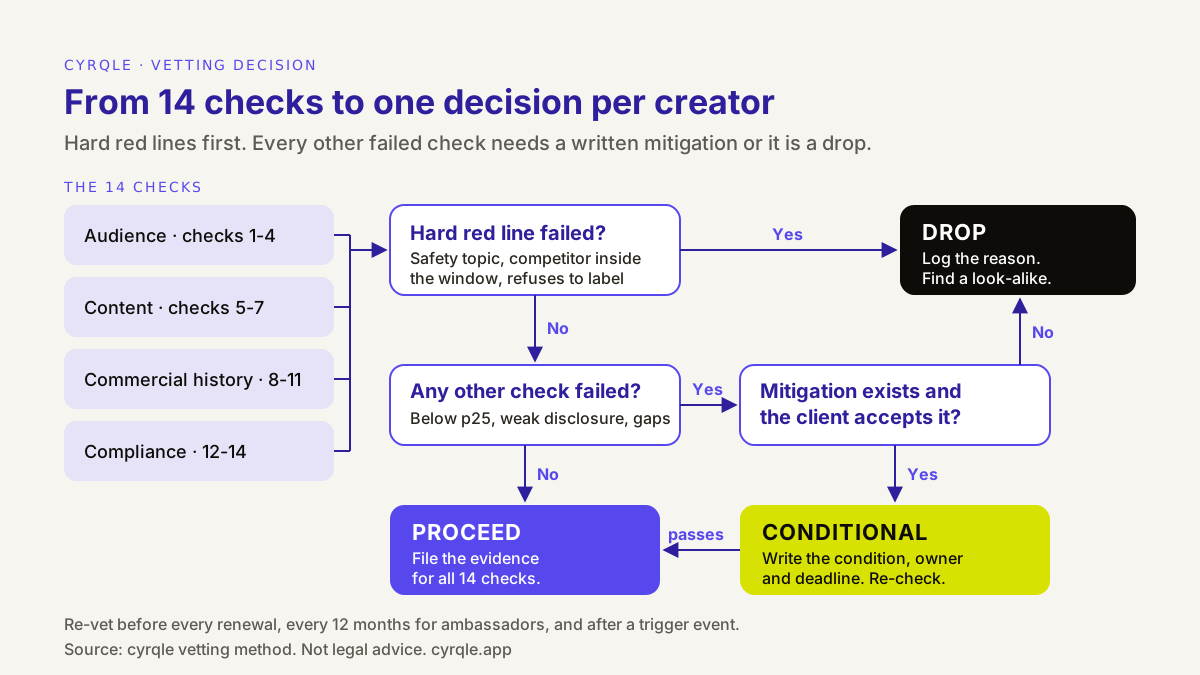
Drop when a hard red line fails: a conflict with a client red line in check 6, a competitor deal inside the exclusivity window (check 10), an unexplained spike together with generic comments (checks 3 and 4), or a creator who refuses to label (check 12). Record the reason. Then look for a replacement with a similar profile.
Conditional when a check fails and a mitigation exists. Typical pairs:
| Failed check | Mitigation |
|---|---|
| Weak disclosure history (12) | AUTOCONTROL clause in the contract (norm 3), the required label named in the brief, draft approval with a check for the label |
| Engagement below the tier p25 (2) | One test post, or a commission-led deal before a fixed fee |
| Competitor posts outside the window (10) | Exclusivity clause; campaign starts after the last competitor post |
| No native audience data (7) | Native screenshots dated within 30 days before signing |
| Thin payee data (13) | Legal name, tax ID and country confirmed before the contract goes out |
Write the condition, the owner and the deadline in the file. A condition you do not write down becomes a pass. Re-check before signing; if the condition is met, the creator moves to proceed.
Proceed when all 14 checks pass. File the evidence anyway: the client's question is "what did you check?", and "everything passed" is not an answer without the file.
What evidence should you save for each check?
Copy this table into your vetting file. One row per check, one file per creator.
| # | Check | Evidence to save | Proceed if | Conditional if (mitigation) | Drop if |
|---|---|---|---|---|---|
| 1 | Engagement vs tier median | 12 post links, likes and comments, follower count with date, benchmark cell and n | Near or above the median | Well below the median: see check 2 | Feeds checks 2 and 3 |
| 2 | Position in the tier | Quartile vs p25 and p75 | Between p25 and p75, or above with clean comments | Below p25: test post or commission first | Below p25 with no mitigation the client accepts |
| 3 | Follower spikes | Dated follower counts, explaining post, "About this account" screenshot | No jump, or every jump explained | Unexplained jump, clean comments: ask for native analytics | Unexplained jump plus generic comments |
| 4 | Comment quality | 100-comment sample with counts | Mostly specific comments from varied accounts | Some generic: re-check after a test post | Mostly generic or the same accounts every time |
| 5 | Format mix and cadence | Format shares, posts per month, media-kit claims | Matches the brief and the media kit | Mismatch: brief the missing format, test first | Account no longer active in the format you need |
| 6 | Brand-safety topics | Links to any conflict, the red line it touches | No conflict | Old, isolated, outside a red line: client decides in writing | Conflict with a written red line |
| 7 | Market and language fit | Profile country, caption language, native screenshots within 30 days | Market matches | Screenshots missing: get them before signing | Wrong market, or refuses analytics for a paid deal |
| 8 | Paid-partnership label use | Links to labelled and unlabelled commercial posts | Uses the label consistently | Rarely: label in the contract and the brief | Feeds check 12 |
| 9 | Brand-tag history | Brands tagged in 12 months, norm 4 signs | Tags match disclosed deals | Undisclosed signs: clause plus draft check | Feeds checks 10 and 12 |
| 10 | Competitor collaborations | Competitor posts with dates | None | Outside the window: exclusivity clause | Inside the window or active ambassador |
| 11 | Collaborator graph | Accounts and links of concern | Nothing of concern | Concern the client accepts in writing | Pod ring or associate on a red line |
| 12 | Disclosure habits | 5 to 10 commercial posts scored against norm 6, story screenshots | Platform label or "publi" at the start every time | Inconsistent: clause, label in the brief, draft check | Refuses to label |
| 13 | Legal status and payee | UER test result, register check, payee name, tax ID, country | Status clear, payee confirmed | Missing data: collect before the contract | Cannot identify the payee |
| 14 | File hygiene | The file, retention date, notice text | Done | Not applicable: fix before you file | Not applicable: fix before you file |
The file is also the cover sheet for the client report. If you send it under your own brand, the white-label influencer reporting checklist covers what to include and what to hide.
When should you re-vet a creator?
Vetting is a snapshot. Accounts change, so set dates and triggers. The cadence below is recommended practice, not a legal rule.
| When | What to run |
|---|---|
| Before every new contract or renewal | All 14 checks, compared with the last file |
| Every 12 months for ambassadors and always-on creators | All 14 checks |
| Every quarter for always-on creators | Light re-check: checks 1, 3, 10 and 12 |
| A follower jump or a drop in engagement | Checks 1 to 4 |
| A public controversy | Check 6, and check 11 if it involves an associate |
| A new competitor deal | Check 10 against the current exclusivity window |
| The creator nears the UER thresholds | Check 13 |
| A platform policy or rule change (TikTok branded content policy from 30 October 2026; the EU Digital Fairness Act once proposed) | Check 12 and your contract clauses |
How cyrqle helps
In Find creators, each creator profile shows computed engagement, posting cadence, content mix, classified bio links, brand-collaboration history (paid partnerships and tagged brands) and the collaborator graph. That covers the raw data for checks 1, 2, 5, 8, 9 and 11. Competitor Explorer and "Creators who worked with these brands" cover check 10, and the Brands catalogue rolls regional accounts up under the brand family, so a competitor's local account is not missed. When a creator is dropped, "similar creators" gives you look-alikes to vet next. cyrqle ranks creators against your brief; you make the decision.
Save the shortlist to Lists and export a Creator list report as PDF or CSV for the client file from Reports. In cyrqle for agencies, you manage each client in its own workspace, set per-member access, and send white-label reports with creator fees hidden. For conditional creators, the Creator Collaboration Agreement in Campaigns can link your brand terms (where the AUTOCONTROL clause lives), and the optional draft sign-off checks for required hashtags and handles before a post goes live. "Invite again" on Campaign renewal is the natural point to re-vet.
The limits are real. cyrqle does not give a fake-follower or audience-authenticity score, does not show audience country, and does not classify brand-safety topics. Checks 3, 4, 6, 7, 12 (for Stories), 13 and 14 stay with your team. After signing, log every post as described in the post-by-post compliance audit.
FAQ
How long does it take to vet one influencer?
Our estimate: a full vet with all 14 checks takes roughly 30 to 60 minutes per creator for a paid deal, most of it on checks 4, 6 and 12. A light vet for one-off gifting (checks 1, 4, 6 and 12) takes less. In the EMARKETER and Viral Nation survey of 117 US marketers, more than half spent 30 minutes or less per influencer.
How can I tell if an influencer has fake followers?
No tool we know of gives a verified fake-follower percentage. Look for a pattern of three signs: an unexplained follower jump, engagement well below the tier's 25th percentile, and generic or repeated comments from the same accounts. If you see two or more, ask for native analytics before you go further.
What is a good engagement rate for an influencer in Spain?
It depends on platform and tier. On Instagram in Spain, the median creator is at 0.84% to 0.89% for the micro, mid and macro tiers (cyrqle creator index, Nov 2026, n = 946, 1,577 and 210). On TikTok in Spain, the median falls from 0.59% for nano to 0.20% for mid-tier creators. Judge the quartile inside the tier, not one number.
Is the brand responsible if the creator does not label the post?
Both sides carry risk. Spain's unfair-competition law treats paid promotion on social networks that is not clearly identified as advertising as a deceptive practice, and the AUTOCONTROL code asks advertisers to put the labelling duty into the contract and check it. It is not legal advice: for a specific campaign, ask your lawyer.
How often should we re-vet a creator we already work with?
Re-vet before every renewal, once a year for ambassadors, with a light quarterly check for always-on creators. Re-vet at once after a trigger event: a follower jump, a public controversy, a new competitor deal, the creator nearing the UER thresholds, or a platform or legal rule change.
Related material.
A step-by-step guide to licensing a creator's or customer's post for your website and channels: writing clear rights terms, sending the request, following up, and keeping track of what you hold.
Manage multiple clients on one influencer platform: link client brands in cyrqle, set per-member access, Act As, set fees and export white-label reports.
A step-by-step checklist for brand and agency operators launching their first creator-commerce program on a Creator Commerce OS — discovery, briefs, attribution, compensation, payout.